

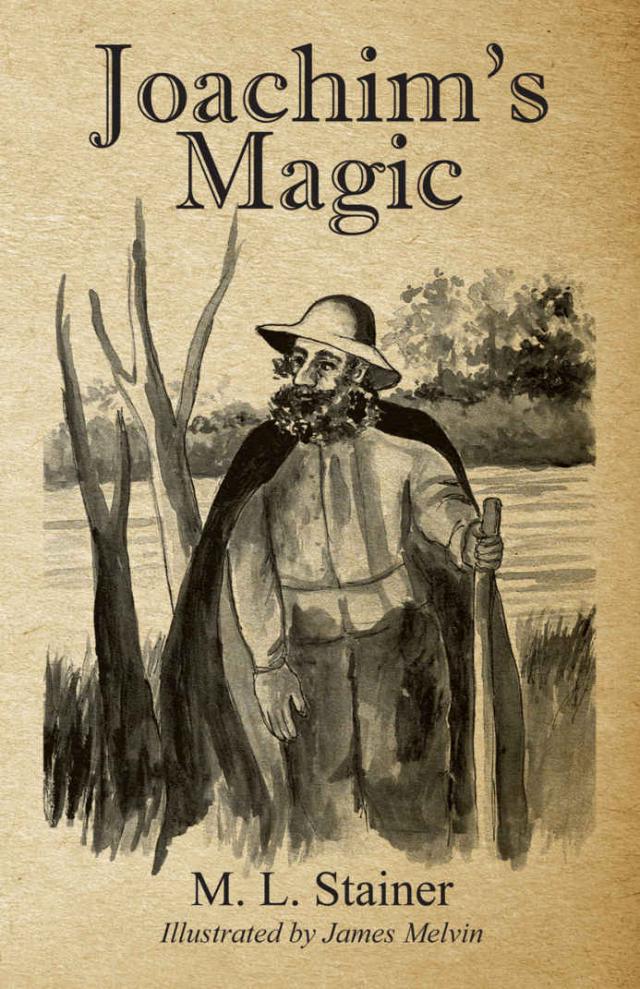
Joachim's Magic, page 1


“M. L. Stainer’s books are well done in the style of eastern North Carolina’s own Inglis Fletcher – a group of warm believable characters in a framework of the colonial history.”
– Harry L. Thompson, Curator,
Port o’ Plymouth / Roanoke River Museum
M. L. Stainer, author of The Lyon Saga books, has now undertaken an equally serious subject: the story of Joachim Gans, master metallurgist to Elizabeth I, and the first documented Jew in the New World. The story is told from the point of view of Joachim’s young apprentice, Reis Courtney, who has volunteered his services to the wild-looking foreigner.
The literary style successfully melds two seemingly incompatible elements: bold action, dramatic choices, blood and gore adventure with its opposite: philosophical meditations on the meaning of life and how to treat others in a hostile world. There is real character development in this 200-page novel as Reis learns the value of a human life. His growing admiration for his shunned master leads him to ponder the various ways of absorbing life’s often bitter lessons. Another serious theme concerns the suspicion and prejudice against Jews which the English and Germans brought straight to the New World. The 16th century was one of great superstition—encouraging people in many countries to dread the intrusion of evil entities into the real world. In JOACHIM’S MAGIC a 13 year old boy learns what real magic is and how to become a man in a changing world, where tomorrow is guaranteed to no one. For readers ages 12 and up.
– Gale Finlayson, Historian and College Teacher,
Jacksonville University, Community College of Vermont
This is a work of fiction. The events and characters described herein are imaginary and are not intended to refer to specific places or living persons. The opinions expressed in this manuscript are solely the opinions of the author and do not represent the opinions or thoughts of the publisher. The author has represented and warranted full ownership and/or legal right to publish all the materials in this book.
Joachim’s Magic
All Rights Reserved.
Copyright © 2015 M. L. Stainer
v3.0 r1.0
Illustrations by James Melvin
This book may not be reproduced, transmitted, or stored in whole or in part by any means, including graphic, electronic, or mechanical without the express written consent of the publisher except in the case of brief quotations embodied in critical articles and reviews.
Outskirts Press, Inc.
http://www.outskirtspress.com
Outskirts Press and the “OP” logo are trademarks belonging to Outskirts Press, Inc.
PRINTED IN THE UNITED STATES OF AMERICA
To my husband, Frank,
for his love and support
To Lance Culpepper,
whose brilliant portrayal of Joachim fired my imagination
and
To Gary C. Grassl,
whose knowledge of Joachim
helped so much
OTHER WORKS BY M. L. STAINER
The Lyon’s Roar (1997)
The Lyon’s Cub (1998)
The Lyon’s Pride (1998)
The Lyon’s Throne (1999)
The Lyon’s Crown (2004)
CONTENTS
Prologue
In Praise of Seafaring Men in Hopes of Good Fortune
1. Reis Courtney
2. The Diggings
3. Dreams
4. The Lesson
5. The Bear
6. Questions
7. The Copper Furnace
8. An Alarming Discovery
9. The Search Party
10. The Journey North
11. Trouble Brewing
12. Master Greutter
13. Jeremie
14. The Plans of Pemisapan
15. The Sponge, the Funnel, the Sifter, the Sieve
16. Captured
17. Power Play
18. A Bargain Struck
19. Can We Escape?
20. Joachim’s Magic
21. Flight
22. Ralph Lane’s Camp
23. The Attack
24. “Tell Your Master….”
25. The Measure of a Man
Sonnet by Reis Courtney
Epilogue
Letters Patents
Joachim’s Talmud
North Carolina’s Coastal Indians
Personnel Associated with the 1585-86 Venture
Further Reading
About the Author and Illustrator
PROLOGUE
The Company of Mines Royal, first established in 1568 by Elizabeth I, was created to seek copper and other metal ores in England. Several mines were opened in the Lake District of Cumberland, searching for copper and, hopefully, veins of silver and gold. Recognizing that the English had no real skills in mining, the Queen employed experienced European copper miners, some of them from Germany. By the early 1580’s, war with Spain was a serious threat and the sense of urgency was very real to build England’s navy in anticipation of future problems. It was of the utmost concern that England replenish her inadequate supply of metal ores without dependence on foreign sources. She needed heavy weapons and good artillery if she were to vanquish Spain. In 1581 at Keswick, a Jewish metallurgist from Prague found himself working under the auspices of the English crown to develop a faster and more economical way to smelt copper. The copper could then be mixed with tin to make bronze, used in canons and other weaponry.
Hearing stories from the New World about the natives who wore jewelry and decorations fashioned of pure copper, a group of men sponsored by Sir Walter Raleigh and with the Queen’s authorization, left England on April 9, 1585 to seek more information about the source of this copper. They hoped to find silver and gold deposits as well. The military leaders were Sir Richard Grenville and Ralph Lane, newly brought back from the fighting in Ireland. After several preliminary explorations, Sir Richard Grenville sailed back to England on August 25 for more supplies, leaving Ralph Lane in charge. Prior to his departure, there had been serious trouble between him and Lane over management of the whole expedition, including an accusation of reckless endangerment made by Lane concerning the raid of the Rojo Bay salt pans. Lane even went so far as to write several letters to his friend and sponsor, Sir Francis Walsingham, Elizabeth’s Secretary of State, complaining about Grenville’s high-handed treatment.
The head scientist of the group was Thomas Hariot, renowned mathematician and intellectual of his day, and the chief surveyor of the Virginia lands. The vast majority of the 107 members were English and included John White, famed artist and future governor of the Roanoke Colony of 1587. The pilot of their ship, The Tyger, was Simon Fernandes, a Portuguese who later feuded with Governor White on the ill-fated 1587 voyage. When The Tyger ran aground at the inlet of Wococoon, the majority of their supplies and heavy equipment, including a furnace carried all the way from England, were jettisoned to help lighten the load.
Others on the expedition were from the military, called harquebusiers, or musket men. There were also carpenters and those of similar trade skills, some of whom brought their young apprentices with them. In addition, there were a few Irishmen, German miners and the metallurgist from Prague, listed on the records as Dougham Gaunse or Gannes, whose real name was Joachim Gans. He was the first reported Jew in the New World. In his “Briefe and True Report,” Thomas Hariot wrote about the expedition, their discoveries and disappointments.
There are those who believe that Hariot knowingly omitted much of the strife and troubles which had occurred.
IN PRAISE OF SEAFARING MEN
IN HOPES OF GOOD FORTUNE
Sir Richard Grenville (The Senior)
Who seeks the way to win renown
Or flies with wings of high desire;
Who seeks to wear the laurel crown,
Or hath the mind that would aspire;
Tell him his native soil eschew,
Tell him go range and seek anew.
To pass the seas some think a toil,
Some think it strange abroad to roam,
Some think it grief to leave their soil,
Their parents, kinsfolk and their home;
Think so who list, I like it not,
I must abroad to try my lot.
CHAPTER 1
REIS COURTNEY
“ME MASTER BEAT me yesterday.”
The blond-haired boy moved closer to Reis, his head bent as if tying his bootstrap.
“Now why would he do that?”
The boy cupped a hand over his mouth to hide his words.
“Said I didn’t clean his boots well enough.”
Reis nodded. He knew Master Snelling, a surly man with a heavy hand which he freely used on his young apprentice. He was always kicking him or raising a fist in his direction. Already he’d yelled at him twice since Hugh stirred out of bed.
“But I HAD cleaned them,” Hugh said fervently. “They was a-shining like the sun itself.”
He got up quickly, hearing his master’s voice bellowing from the camp.
“You’d best be hurrying,” Reis warned and watched Hugh run off. Reis sighed, feeling sorry for him. The boy was only nine, after all, torn from his family and still with a lot to learn about keeping on good terms with his master. Many a time since they’d set up camp in this New World, he’d seen him slacking off, leaning against the trunk of a tree with the half-cleaned boots on the ground before him. Now he’d been caught dreaming and whipped for his laziness. Reis wondered how many times he’d be disciplined before he learned. He shrugged. Did no
‘I be lucky,’ he thought, ‘for as Master Snelling’s apprentice, t’would be hellfire and brimstone for sure.’
Reis could hear the surly man yelling at poor Hugh and he, in return, whimpering and sniveling.
“Crying for your mother?” Master Snelling’s voice boomed across the camp.
“Ye be looking for a teat to suck on, Hugh Salter. Never you mind the snot from your nose, pick up them boots and do a thorough job this time. What good be you apprenticed to me? Should I get a stick now and knock your head about?”
Reis watched Hugh walk dejectedly over near the fire, there to keep some warmth in his bones on this cold morn and to get away from his master’s wrath. He caught Hugh’s eye and gave a sympathetic nod. Wouldn’t hurt the boy to know his friend was cheering him on. Hugh nodded back and gave a small smile. Then he turned and began to finish what his dreaming had made him forget, the careful shining of Master Snelling’s boots. Reis saw him spit on the boot to give it shine, knowing in his heart that Hugh was probably wishing it was his master he was spitting on. Reis turned and bumped right into Dougham Gaunse.
“Well,” said Master Gaunse with his strange accent, “and what is my apprentice doing, staring at our fire with nothing in his hands?”
He glanced over and saw Hugh vigorously rubbing the boots.
“Aah,” he commented, “so it is young Hugh that Snelling was raising his voice to. For what is he being punished?”
“‘Twas not what he did but what he didn’t do. The boots…,” and Reis pointed where Hugh was working close to the fire. Dougham Gaunse nodded.
“A man needs his boots strong and polished in this wild country or the mold will eat the leather and then, they are fit for nothing!”
Reis glanced down at Dougham’s boots. They gleamed back at him, the result of his getting up before the sun to shine and spit-clean them so his master would be pleased.
“A good job,” said Dougham Gaunse, slowly and thoughtfully pulling on his beard. He nodded his head.
“You are a good apprentice. You serve me well as you learn the trade. No labor, however humble, is dishonoring.”
Reis felt a glow in his heart. Praise from Dougham was rare but when it came, it fell like silver rain upon a thirsty land.
“We go digging again, boy. You are game then, to follow and keep the samples?”
“Indeed, sir.”
“Then gather the instruments and meet me by the river in five minutes. Forget nothing.”
Reis turned and ran back to the tent, there to gather the glass bottles, the measures and weights, the digging implements which were the tools of Dougham’s skill in metal, thrusting all carefully into the knapsacks which were strung together. When they were full, he glanced around to make sure he’d forgotten nothing. Then he slipped the harness to which the sacks were attached over his shoulders, buckling the thongs and straps until he felt like a cart horse with his heavy load. He staggered under the weight, righted his shoulders and strode out into the early morning light.
From the distance he saw Hugh watching him enviously. Because of the boots and a long list of grievances on Master Snelling’s part, Hugh would be required to remain at camp all day, scrubbing, polishing, sweeping dirt floors, hauling wood from the forest and water from the river. He gave Hugh a cheery goodbye but the youngster merely turned his head away. Reis thought he saw his shoulders heaving.
Then he forgot Hugh in the excitement of another journey. This time they were heading up river about five miles, there to dig the soil and search once again for signs of rock in which might be hidden the iron ores and metals that were Dougham’s dream, his life-long vocation. Sir Walter Ralegh had paid Dougham Gaunse’s passage across the Western Ocean for just such purpose, to locate copper and other ores for the greater glory of England and her navy. And though Master Hariot, astronomer, mathematician and surveyor was one of the leaders of this expedition, it was clearly Dougham, with his dark eyes and intensity, his thick accent and strange ways, who was favored for his skills as the Queen’s own mineral man. The others of the group, some of them Cornwall tin workers and German miners, kept to themselves in the camp and on occasion, had shown discontent at the thought of subservience to such an argumentative and headstrong person as Dougham. Troubles had risen already, but Reis thrust them from his mind as he ran to meet up with his master.
He struggled with his load of sacks which seemed to get heavier with each step. The group of men striding ahead barely glanced back to see how he was faring, nor did he expect them to. They were too busy discussing the possibility of what they might find once they began digging. Already some of the men were arguing, giving vent to loud cries of disagreement. Only Dougham remained calm, walking slowly and pulling always at his black beard. Reis glanced around but there were no other apprentices save for one, a thin, narrow-shouldered boy named Jeremie Whitton, who walked even further behind than Reis, his back stooped under the weight of his master’s tools. Jeremie, like Hugh Salter, was about nine or ten. Reis felt so much older at twelve, almost thirteen. He wished there were others his own age, boys he could talk to with some semblance of intelligence. Both Hugh and Jeremie still cried at night for their mothers; he could hear them sometimes when he couldn’t sleep for the ache in his own joints.
He often wondered why their mothers had let them go. He had no such concern for he had no mother nor father to care where he was or how he fared. But Jeremie and Hugh had been thrust into apprenticeship back in England by parents too poor to put food on the table. Six silver shillings for the one, seven for the other, a veritable fortune in a shanty landscape so sparse and barren it could barely support its hungry inhabitants. Mothers wept and wrung their hands, fathers cursed and took to their drinks again, but what else was to be done? Masters bound for the New World didn’t want females and the girls, bent over sewing or cooking or tending the babes, watched out of the corners of their eyes to see their cousins and brothers sold like cattle to the highest bidder. Hungry eyes the girls had, black as coal dust or else, green like jade only duller, with no light shining in them.
Some of the young boys didn’t want to go, kicking and ducking out of the new master’s arms which reached for them. Then a swift kick, a curse and a clout on the ear. Back they were dragged, protesting and crying, while the sisters clung to the mothers’ skirts, weeping along with them. But silver shillings meant food on the table and the rent paid so they could keep the roof over their heads and not have to sell the last cow. Even the Peter’s Pence per annum was too much to give, though out of fear they did so, not wishing to incur the wrath of Holy Mother Church.
Reis was different. Unlike the rest, he had stepped forward and volunteered himself, glad he was older and not so puny-looking. His aunt didn’t seem to weep much, he remembered later; his uncle just nodded and gave him a small push.
“See you mind,” was all he said.
The aunt, herself surrounded by six or seven youngsters, seemed relieved in a strange, sad way. One less mouth to feed. Reis, who had long ago forgotten how to cry, squared his shoulders and saw his opportunity. He marched right up to the dark-haired, bearded man and said,
“I be Reis Courtney, your new apprentice.”
The man laughed a slow, dark laugh, not at all like the Englishmen nearby, but thick with foreign tones. The children stopped weeping, the fathers stopped cursing and they all stared at the stranger who, along with several others, had come into this realm of poverty to seek their helpers.
“Why not in London?” was the question asked. “Why do they come all this way to Surrey when they could have others?”
“Country lads are strong,” was the answer, “and all are hungry. Parents will sell their children to keep the landlord from breathing down their necks.”


