

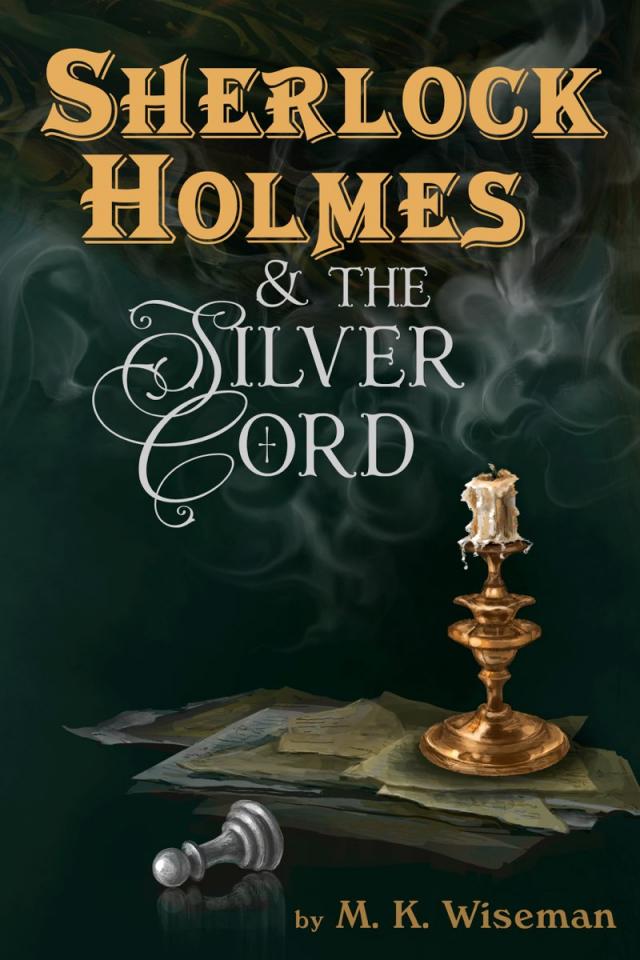
Sherlock Holmes & the Silver Cord, page 1


ALSO BY M. K. WISEMAN
Sherlock Holmes & the Ripper of Whitechapel
Sherlock Holmes & the Singular Affair
Bookminder trilogy:
The Bookminder
The Kithseeker
The Fatewreaker
Magical Intelligence
Forthcoming:
The Poison Game
SHERLOCK HOLMES & THE SILVER CORD
M. K. WISEMAN
Copyright © 2023 by M. K. Wiseman
All rights reserved.
No part of this book may be reproduced in any form or by any electronic or mechanical means, including information storage and retrieval systems, without written permission from the author.
ISBN: 978-1-7344641-6-0 (hardcover)
ISBN: 978-1-7344641-7-7 (paperback)
ISBN: 978-1-7344641-8-4 (ebook)
This is a work of fiction. Any references to real people, places, or historical events are used fictitiously. Other names, characters, places, descriptions, and events are products of the author's imagination or creations of Sir Arthur Conan Doyle and any resemblances to actual places or events or persons, living or dead, is entirely coincidental.
Edited by MeriLyn Oblad
Cover Illustration by Egle Zioma
Interior design created with Vellum
Published in the United States of America
1st edition: August 1, 2023
mkwisemanauthor.com
CONTENTS
Foreword
1. Dear Diary
2. “He Is Evil”
3. Good Old-Fashioned Charlatanism
4. A House Call
5. Locked Doors
6. Placed in a Difficulty
7. How vs Why
8. Soul-Searching
9. Doubles and Pairs
10. My Colleague, Mr. Holmes
11. Different Time, Different Person
12. There Can Be No Going Half-Way
13. Games and Tricks
14. Beliefs, Convictions, and Questions
15. Jump
16. Warrants and Apologies
17. Answers
18. Setting Aside the Cloak of Justice
19. “It Was Poison”
20. No Apologies Necessary
21. Mountains and Cliffs
Epilogue
Author note
Acknowledgments
About the Author
FOREWORD
OR, THE TRUE REICHENBACH:
I watched Watson’s receding figure grow small as he picked his way back down the steep path to Meiringen, a doctor’s urgency speeding his steps. He looked back twice. When I believed his eyesight unlikely to pick out my form from amongst the jagged boulders at my back, I dismissed the youth who had delivered the message. I needed no guide to Rosenlaui. I was under no illusion I should be allowed to make it there. Of Moriarty’s having sent the lad to draw Watson away, I had little doubt. A cold courtesy, but a courtesy nonetheless. Inwardly, I thanked the professor for his foresight and finished the short ascent, keen but not altogether eager for the ending which drew ever nearer.
A note about Reichenbach itself:
The ground around the falls is, in turns, steep and rocky, all of it soaked and slick. The tumbling waters are deafening and relentless. A person sinks into the sound and is drowned even if they do not fall within the water’s unforgiving grasp. The mist reaches out further than any man has a right to expect. The spray flies upwards and sideways into the air, a perpetual rain shower—all backed by the noise, noise, noise of the rushing waters. The trees, the grass, bathed in this never-ending mist, grow green and lush all around. Save for what flora has dared reached too close. Such branches hang limp, blackened and bare, flayed alive by the tumbling waters. All cling to those unyielding rocks, their knotted roots holding tight to every crevice and adding to the perilous footing of the place.
The views from the summit, or rather, near the path’s ending: exquisite. Rainbows arc in the foaming spray, the shining leaves dance and shimmer, and a person is keenly conscious of their extant indomitab— Nay, of their own fragility. There is, I believe, scarce a more perfect, efficient, and heartless killer than those falls.
Alone, with the mist of the rushing waters gathering great beads on my coat and hat, I waited. It is a strange thing to be balanced between Heaven and Hell, to sit on the lip of a roaring precipice and see grand distant peaks glowing in the afternoon sun, to look down upon pastoral valleys and feel that same stirring in the breast as London gives with its press of buildings and frenetic industry. The world, it holds the same secret yearnings and passions wherever a person may be. Untruths, humbuggery, and blackmail; peace, love, and honour. Nothing is small, and few things are ever at rest or unchanging. We pick our path, we choose our side, and then everyone else’s choices and sides come at us, the good and ill-meaning grappling and altering our lives through their never-ending conflict.
My own conflict would find closure before the day was out. I congratulate myself even now that my guts did not twist at the thought. In imagining the potential outcomes, I had not writhed about, seeking escape, some miracle solution that would condemn my enemy but save myself. I was at peace. The world would be rid of Moriarty. The head would be cut from the snake, and the rest of his terrible organization would fall. The contents of one blue envelope would ensure as much. And Watson—
Here my resolve weakened. I drew forth pen and paper from my pocket. The resulting note has been chronicled elsewhere by its recipient. Heart eased, I rose and flicked my spent cigarette into the alluring, watery void.
But my peace, now scattered, would not easily return to me. I turned, as ever I had, to logic. My actions here and now—my sacrifice—would have meaning. Moriarty, that tricky devil of a man, could not be defeated any other way.
From the corner of my eye, I saw I was no longer alone.
“Mr. Sherlock Holmes,” Moriarty said, quickly moving forward along the path so as to position himself between me and any possible escape. Certainly, he knew as well as I that our contest would produce some definite conclusion here and now; the motion, thus, was unnecessary yet not out of character for a man so singularly pledged to malevolence.
“Mr. Moriarty,” I answered back, smoothly gesturing with my cigarette case my intention that our interview was not to be rushed. “I presume your use of an ill-disguised messenger means that my having sent Dr. Watson back to Meiringen none the wiser ensures his safety?”
He sneered, and I had my answer. A gentleman’s courtesy be damned. Icy water flooded my veins. I had been right from the first. Only one thing would ensure Watson’s, Mrs. Hudson’s, my brother’s safety.
Moriarty rushed at me, and there, on the edge of the falls with its rocky, slick terrain, we grappled. For all that our rivalry had, until today, manifested in words and in the intellectual chess match which had set him so resolutely against me and me against him, our final confrontation remained silent and almost completely physical. He was—as he had ever been—an opponent completely devoid of decency. I found myself pushed to the brink as the professor’s desperation found voice in the thrashing of his fists, his fingers becoming wicked talons which I was hard-pressed to avoid. All this I had anticipated, however, and I refused to let go. He had passion and fear and hatred and I . . . I was a blank unfeeling bulwark against which Moriarty could dash himself to pieces! He could claw out my eyes for all I cared. I remained as impassive and unflinching as fact, manoeuvring our conflict to the very edge of the path.
Thus, locked as we were in one another’s grasp, I allowed my choice for justice and Moriarty’s commitment to evil to propel us both backwards and into empty space. Again, I had anticipated every possibility and prepared myself for this end. He had not. Eyes widening and with a feral growl, he tried to save himself. But it was too late. Moriarty’s final words were nothing more than an interminable scream.
I should have died there. There was no scenario wherein I expected life as payment for Moriarty’s destruction. And yet rough rock cut into my palms, slippery wet stone which threatened to drop me still uncaringly into the abyss. I now clung to the cliff opposite the lookout whereupon I had awaited Moriarty’s pleasure. Somehow, in falling, my hands had found purchase, and be it by length of limb, strength of balance, fate, luck, or a combination of all, I had cheated death.
Or merely delayed its embrace. A glance downward informed me that, yes, Moriarty had succeeded in plunging to his demise and that I should not look down a second time lest it prompt my swift following in his wake. My left foot might find purchase if I stretched. It might—
In reaching out, I glanced up and saw the outline of a man’s head and shoulders high above. My hands slipped, and I fell some five feet more. In that same instant, something struck the boulder above me. A loosed shard of stone cut my cheek, and I knew the “something” for what it was: a bullet.
I had sent my second to safety. Moriarty had not.
Without hardly thinking, I threw myself sideways towards a small outcropping which lay out of my pursuer’s line of sight and stood as my best chance for giving me time to calculate my route back onto the path above—were there such an option left for me. My coat I bequeathed to the roaring waters. With luck, Moriarty’s man would have a glimpse of the item and little more. The afternoon was fading to twilight; my imperfect ruse might buy me reprieve.
I gave myself four minutes to gather my strength. Fifteen minutes later saw
me lying exhausted and bloody-handed on another shadowy ledge high above and opposite the path which led back down into Meiringen. Of Moriarty’s gunman there was no sign. Uncertainty shook me. For all my careful gathering of evidence, Scotland Yard would have but partial success in dismantling the professor’s organization. Life after Moriarty? There truly was no such thing as life after Moriarty.
And yet here I had it.
Motion on the path to the falls. A handful of men. I shrank further back within the shadows of my hiding spot.
Watson. Watson and several others from the town below. I watched as erroneous yet logical conclusions were made. I saw my dearest companion in all the world read and then reread the note which I had left pinned beneath my cigarette case. I quailed as John’s legs seemed to give way under the weight of my words, and he sank down onto a rock, his eyes staring unseeing at the tumble of water that separated us.
At length Watson was drawn off from the fruitless vigil by his companions, and I made ready to emerge from my hiding spot. It was then that my caution rewarded me once more. Moriarty’s man, Colonel Moran—my brain helpfully dug the name from my files—stepped from his place of concealment and made to follow the small, sombre contingent back into Meiringen.
Hardened resolve and renewed purpose fuelled my limbs, and I half-climbed, half-scrambled up the cliff face. My motions more than the sound of my ascent drew Moran’s attention. It was exactly as I had hoped. The growing gloom of evening was no friend to his marksmanship, and I made it safely back up onto solid ground, whereupon I took off at a run. With my head start and the urgency for survival guiding my steps, I led him on a merry chase through the darkened forest. Eventually it became apparent I had lost my pursuer. Providence wanted me to live, it would seem, though a day and a half later she dropped me penniless, friendless, and half-dead at a little hamlet some ten miles distant of where Moriarty had met his death at my hands.
Eight days and nearly five hundred miles later: Florence. And the semi-reliable safety of my brother’s long-reaching connections.
Did I ever look back over my shoulder? Did I ever again hear Moriarty’s wild and soul-rending scream? Yes. At every moment, yes. Torn flesh heals. But the mind, the heart? I have yet to find that out.
Take, if you must,
this little bag of dreams;
Unloose the cord,
and they will wrap you round.
W. B. YEATS
DEAR DIARY
CHAPTER 1
Early morning London is second only to late-night London. In a city never quiet and rarely at rest, there is, daily, a short space of time wherein stillness is grasped at and very nearly realized. In the small hours of the day, the nightmen have come and gone. The labourer rises, refreshed—either from a well-earned slumber or an equally restorative visit to his local public house. The sky, steady and dark, contemplates what hue she will wear today, while the criminal nerve, exposed by this relative peace, falls prey to men such as myself who are so bold or so foolish as to borrow a horse and hansom cab with the plan to spring a trap in the service of justice and the law.
In short, I, Sherlock Holmes, could at present breathe deeply of the pre-dawn air, feeling it all the sweeter, all the clearer, for having now removed one more of the late Professor Moriarty’s agents from the freedom of the wider world.
With a wince, I allowed my fingers to dance themselves along the edge of the long scrape which graced the left side of my face and jaw. The grimace was twofold. For one, said injury really hurt. More importantly, I was imagining the consternation with which I would be met upon my arrival at Baker Street. Mrs. Hudson I could dodge until such time as I had managed my medical needs. I had done so on a semi-regular basis in the ten-odd years I had been in residence at 221B. Dr. Watson, however . . . his scolding stood a better chance of hitting home. As well it ought, considering how close to my eye my assailant’s attack had landed.
“Watson knows the risks,” I groused, reining in the fractious horse. Returning to the yard, I surrendered my cab, tendered my thanks, and offered compliments to the borrowed mare whose steady temper had saved me from a worse beating by my opponent.
From there I walked home through a waking London.
Self-preservation saps curiosity. My dishevelled state painted me the ruffian, and the glances cast my way quickly settled elsewhere lest they draw my attentions. I made it home without incident. An irksome throbbing sprang up in my cheek by the time I let myself into our rented rooms.
Standing before our darkened hearth, I eyed my desk, contemplating its contents and the delicious insensibility that my needle and morphine bottle could provide. What I craved, however, was a different kind of numbness, the type which provides clarity of mind rather than the suppression of all thought and feeling, though this, too, had its attractions. In the end, an imperfect solution was not a solution, however, and by falling back on practical perseverance, I resisted temptation and found that I was tired. Profoundly bone– and soul-tired. Between couch, chair, and bed, the quickest solution proved the most tempting. I claimed the nearest of the three and, taking care that I stretched myself out on my uninjured side, fell into a dreamless sleep upon 221B’s sitting room couch until dawn.
“Good heavens, Holmes.”
I awoke to Watson’s muttered complaint, and I considered how I must appear to him. The evidence of the prior night’s activities clung to my wrinkled clothes, and various bruises on my face and arms had gained new colour during my slumber. More than ever, I was glad that my syringe had remained in its case, though the cut on my cheek screamed at me for having been neglected. It was a wonder I had slept through its anger.
This contrasted with Watson’s own tidy-in-dressing-gown-and-slippers domestic self. Without another word, he left my field of vision, returning a moment later with his black bag and a gruff, “May I?”
I sat up. “It’s not as bad as it appears—”
“It appears very bad, Holmes.” He pulled up a chair opposite me and, frowning, laid out his instruments on the couch. “Goodness! Did you fall from the cab itself?”
“Very nearly,” I said simply.
“One of the late Professor’s agents?”
“But of course.”
He grunted again and allowed silence to grow between us as he dressed the wound on my face. He then seized my right hand, gently turning my wrist so that he might clean and apply a bandage over two split knuckles. I stared, utterly surprised at the colourful collection of bruises and dried blood. An instant later, my brain supplied the answer. I hadn’t seen it, because I hadn’t wanted to see it. And yet, seeing it now, I could recall the moment and its resulting pain with perfect clarity.
Watson’s troubled eyes met mine twice during his brief ministrations. Each time forced a hasty retreat on both our parts. His doctoring was swift and sure. The black bag was taken away and I was bid—again through silence—to arise at my leisure.
I took myself over to the hearth-side cane chair, collecting the previous day’s dottles along the way for my morning smoke. A careful pull at my black clay pipe informed me that my wounds would not much trouble me in the coming days. Fine, all fine. I had disturbances enough in the form of a bandaged hand whose damaging I had completely managed to avoid acknowledging.
It appeared I had numbness aplenty after all.
“That’s four men now gone from an initial collection of but two,” Watson announced from across the room. He rang for coffee and then came to sit opposite me. “Moriarty’s enterprise. Legion is thy name.”


