

Prophecy: Clash of Kings: Book One, page 1


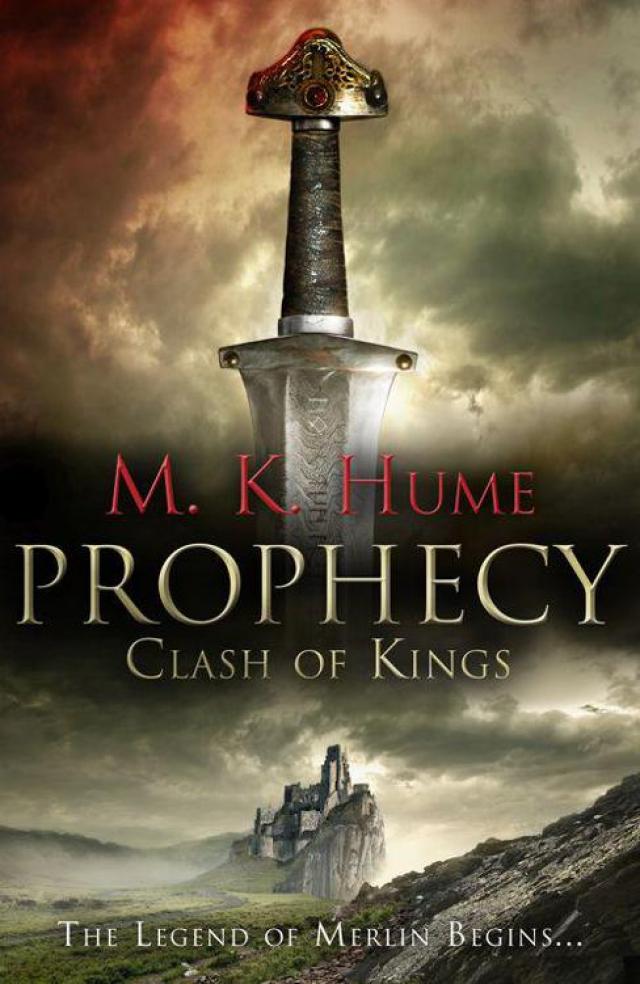
Prophecy: Clash of Kings
M. K. HUME
headline
www.headline.co.uk
Copyright © 2011 M. K. Hume
The right of M. K. Hume to be identified as the Author of the Work has been asserted by her in accordance with the Copyright, Designs and Patents Act 1988.
Apart from any use permitted under UK copyright law, this publication may only be reproduced, stored, or transmitted, in any form, or by any means, with prior permission in writing of the publishers or, in the case of reprographic production, in accordance with the terms of licences issued by the Copyright Licensing Agency.
First published as an Ebook by Headline Publishing Group in 2011
All characters – other than the obvious historical figures – in this publication are fictitious and any resemblance to real persons, living or dead, is purely coincidental.
Cataloguing in Publication Data is available from the British Library
eISBN : 978 0 7553 7145 7
This Ebook produced by Jouve Digitalisation des Informations
HEADLINE PUBLISHING GROUP
An Hachette UK Company
338 Euston Road
London NW1 3BH
www.headline.co.uk
www.hachette.co.uk
Table of Contents
Title Page
Copyright Page
Dedication
Acknowledgements
CHAPTER I - FROM MONA
CHAPTER II - UPON THE TIDE
CHAPTER III - A TRICK OF FATE
CHAPTER IV - AN INAUSPICIOUS BIRTH
CHAPTER V - A CHILD DENIED
CHAPTER VI - THE APPRENTICE
CHAPTER VII - THE BROKEN TOWER
CHAPTER VIII - THE SONG OF THE SUN
CHAPTER IX - TAKEN
CHAPTER X - DINAS EMRYS
CHAPTER XI - WALKING WITH KINGS
CHAPTER XII - WHEN EAGLES FLY WITH NIGHTINGALES
CHAPTER XIII - THE RETRIBUTION OF TIME
CHAPTER XIV - HEALER
CHAPTER XV - IN THE VALE OF PAIN
CHAPTER XVI - A GOOD DAY TO DIE
CHAPTER XVII - THE NIGHT OF THE LONG KNIVES
CHAPTER XVIII - FATHERS AND SONS
CHAPTER XIX - CIVIL WAR
CHAPTER XX - AN UNTIMELY END
CHAPTER XXI - ENDINGS AND BEGINNINGS
CHAPTER XXII - THE BURNING MAN
EPILOGUE
AUTHOR’S NOTES
GLOSSERY OF PLACE NAMES
This book is dedicated to David Hill, a kind and gentle man, who departed this life on 30 September 2009, after a long and courageous battle with cancer. David was a family man to his bootlaces, and was dedicated to his caring wife, their five sons and their partners. Through David’s guidance and influence, his sons display admirable qualities of their own because, like all good men, they are reflections of their father. No higher praise can be conferred on any man.
Ave, David.
Marilyn Hume
ACKNOWLEDGEMENTS
I am aware that few readers bother with acknowledgements, which is rather sad as authors have few opportunities to thank the many people who make our creations possible. Family members sacrifice their routines so that authors can have the luxury of time in which to write. For the garden untended, the maintenance undone, the carpets unbeaten and the tidying that is ignored, I thank you!
Thank you to Michael who keeps saying ‘What’s next?’ or, more often, ‘What does this crap mean?’ Every writer needs an honest, fiercely partisan critic who expresses their views constructively, so I am fortunate that Mike has always guarded my back and challenged my preconceived ideas.
My thanks to Damian who struggles on through illness and debilitation with his passion for history and his curious lateral thinking. Sometimes, with a simple observation, he sharpens my viewpoint or sets me off on a new path. We both love the darkness, the bizarre, the uncomfortable and the uncompromising nature of truth, all of which have a place in this work.
To Pamela Guy, a distant relative and very true friend, thank you for your big heart, your unquestioning support and your almond flour cake during long conversations over what to do next. As a ‘chalkie’, which is teacher-talk for a fellow professional, she has seen at first hand my passion for history, literature and the sheer beauty of knowing and searching. Love you, Pam!
Then there’s the publishing crew in London. My agent, Dorie Simmonds, asked for the first ten chapters of this novel, and then bullied me into a plan of where I was going with the trilogy. Bless her! Like Michael, she is a charming and elfin spur who always says exactly the right thing. I depend on her sound professionalism, and I appreciate her great talents.
Jane Morpeth, Headline’s CEO, is a genius, pure and simple. A few casual questions, and she sends my imagination into overdrive. Stylish and so erudite, she dominates my thinking when I am kicking my manuscripts into their final shape. Will Jane like this, I wonder? I probably should be embarrassed to admit such open admiration, but people do not rise as high in the publishing trade as Jane without being highly gifted. I trust this book meets her expectations and my promises.
And now there is my new editor at Headline, Clare Foss, who lifts my flagging spirits with her enthusiasm and support. With a few deft sentences, she guides me into considering all the ramifications of what I am doing. I thank you, Clare.
Then there are those at Headline who make things tick – Nancy, Kate, Emily, Angie and others. All are brilliant, professional Headliners who turn my manuscripts into something more substantial than my initial dreams. You are the ones who put real, adorned flesh onto the bones of my imagination. You clean the skin, tighten the pores, show the face of the novel to the world and shout about its value. I only write it and, without you, I would struggle for success. There are many others at Headline who have helped me, I know, so please forgive me if I have not named you. In truth, no one would ever read a word I write without you all.
I try to remind myself every day how lucky I am – in love, in my ability to write and in the recognition that I have received. Gratitude and humility are the only cures for hubris, which is as dangerous a vice now as it was in Myrddion’s day. Vortigern, Ambrosius and Uther Pendragon suffered from hubris and paid a very high price for their sins. Lord of Light, save me from its easy temptations as you evaded its blandishments yourself.
Marilyn Hume, April 2010
DRAMATIS PERSONAE
PROLOGUE
On the brow of the storm-torn headland, where the steel tines of the ocean wind combed the long grasses into smooth ringlets, the girl-child looked down upon her new home and sighed.
Grey stone rose coarsely out of the green flanks of Tintagel, where the leaf-shaped spearhead of land jutted into the Hibernian Sea and the wild waves smashed themselves to foam on the eroded cliffs below Gorlois’s protective wall. The girl shuddered at the cheerlessness of the small, conical cottages which clung to the cliffs below the fortress, linked by steep, winding paths that tethered them to the paved courts above. Beyond the narrow steps, one hundred feet below, the sea crushed the cliffs into pebbles and gnawed its way into the peninsula in a long, narrow inlet.
The girl turned slowly in a circle, holding her waist-length hair out of her eyes as the wind tore her luxuriant locks into rags of russet and mahogany. No trees grew at Tintagel, nor on the land around the fortress, so the long grass was the only hiding place for small hunted creatures. Although the wheeling, circling gulls preyed off the small fish and living shells of the shallows, other predators waited above, wings riding the invisible currents of the air and hungry eyes watching for the slightest movement in the long tangles of green grass below.
The girl bit her lip as a merlin dropped from the sky like a stone, its wings folded and its talons outstretched. Its scream of triumph drowned out the small cry of a young rabbit that found itself snatched up in the raptor’s cruel claws. Tears appeared in the girl’s clear eyes as she followed the flight of the huntress.
‘My lady.’ A deep rumbling voice disturbed the girl’s moody thoughts. She turned too swiftly and, for a moment, the sky wheeled around her in a dizzying parabola. As her startled eyes rose to meet a pair of warm black irises in a broad, sunburned face, she felt a sudden chill of premonition that froze her tongue.
‘Are you well, child? Perhaps you’ve been too long in the sun?’
The girl’s vision narrowed until all she could see was the greatly magnified face of the warrior who stood over her. A dull roaring sound filled her ears as she watched the smiling mouth, so close to her own, open slowly to release a viscous flow of dark blood. The sun had dazzled her frightened eyes, but she was sure she could see a terrible, sucking wound that opened across the warrior’s strong, thick neck.
‘You are unwell, Lady Ygerne. Please allow me to help you back to your maid.’
Her legs folded, and as she slid into a dead faint Gorlois swept up the frail body of his betrothed who had been so newly delivered to Tintagel by her father. Concerned, the tribal king assessed the violet shadows below her eyes and the childish shape of her long lashes as they rested upon her pale cheeks.
‘She’s so small – and so young,’ he whispered to himself as he hefted her slight form in his arms, taking care not to drop the reins of his horse in the process. I hope she’s not sickly, he thought guiltily, even as he ordered his servants to ride ahead and prepare a hot, sweetened drink for her. He’d already lost one young wife to childbirth
and, although his heart had not been given to the delicate little princess who had carried his stillborn son, he remembered the shrill desperation of her childbed cries with a sick dread. But his position demanded a wife and, more urgently, an heir, so he longed for a woman who could survive in his harsh and wildly beautiful domain.
‘She’s but ten years old, you fool!’ Gorlois told the wind as he climbed back onto his horse, still pressing her insubstantial length against his barrel chest. ‘She’s frightened, she’s lost and she’s far from her home.’ He was still searching her face with an expression of kind concern when her eyelids fluttered open.
‘There you are, my lady. I’ll soon have you back in a cosy room with a warm rug to cover your knees. You’ll feel better for a cup of hot milk from my kitchens. Tintagel is a wild place, and very isolated, but I have fairer houses in Isca Dumnoniorum that you will find comfortable and beautiful. The winds are warm and mild there. Tintagel is my country’s heart, so my wife must understand what makes it beat, but she need not love it, as I do.’ He smiled in a fatherly fashion as he observed her obvious confusion. ‘Never mind, pretty sweetling! When you have rested, perhaps my home will not seem so grim.’
Above his head, the birds continued to wheel as they squabbled in the wind-torn sky. Ygerne’s pale lips smiled tremulously, and she watched another falcon as it rode the thermals in the bright sky. She could imagine its golden eyes, seeking and seeking, and wondered if the bird could see her or would acknowledge her presence.
Without understanding her vision, the threat of the bird or the childish invitation in her actions, Ygerne turned her face and snuggled into the broad chest of Gorlois. She felt safe and loved for the first time in that long, strange and painful day. And as Gorlois felt her hair and her warm flesh pressed against his body, the fragility of her lovely face wound itself around his heart.
CHAPTER I
FROM MONA
Why should the worm intrude the maiden bud?
Or hateful cuckoos hatch in sparrows’ nests?
Or toads infect fair founts with venom mud?
Or tyrant folly lurk in gentle breasts?
Or kings be breakers of their own behests?
But no perfection is so absolute
That some impurity doth not pollute.
Shakespeare, ‘The Rape of Lucrece’
‘Daughter?’ An angry, masculine voice bellowed from the forecourt of the old villa at Segontium. Disturbed farm birds squawked and squabbled as they scrambled away from the huge horses. ‘Olwyn! Come out at once! Explain yourself!’
The sounds of nervous horses and a series of shouted orders, all delivered in a stentorian, impatient voice, forced Olwyn to put down her spindle, smooth her hair and woollen robe, and hurry out of the women’s quarters towards the atrium of the ancient house, where a tall, grizzled man was stripping off his fine leather gloves and woollen cloak, dropping them negligently over the nearest oaken bench.
His garb was careless, but his leathers, the well-tended furs and the embossed designs of hawks on his fine hide tunic indicated wealth and power. The heavy golden torc that proclaimed his status and a collection of brass, gold and silver arm rings, wrist bands and cloak pins were worn with such negligent grace that Melvig radiated the authority of a king. Even more telling were the disdainful eyebrows, the heavy lines of self-indulgence that drew down his narrow lips and a certain blunt directness in his stare that spoke of a nature accustomed to giving orders. On this particular afternoon, above a greying beard, his eyes were stormy and promised that squalls would soon come to her door.
‘Father! How nice to see you. Please, sit and be welcome. May I order the wine you like so much?’
Melvig ap Melwy made a grumpy gesture of assent and threw himself into a casual slouch, his long, still-muscular legs outstretched and his fingers tapping the armrest of his chair with ill-concealed irritation. Olwyn turned to her steward, who was hovering nervously behind his mistress. ‘Fetch the last of the Falernian wine that came from Rome. And some sweetmeats. I believe my father’s hungry.’
‘Hungry be damned, woman! I’m cross. And it’s your infernal brat who’s the cause of my upset. A man ought to be able to ride with his guard to see his daughter without risking assassination.’
Olwyn’s brow furrowed. Her father had always been a tyrant and a blusterer, but she loved him despite his faults. As the king of the Deceangli tribe, he often risked death from impatient claimants to his throne and ambitious invaders. But, so far, he had proved to be an elusive target and a vengeful survivor.
‘Idiot woman! It’s that daughter of yours. More hair than brain, I say, and thoughtless to a fault. She ran across the path right under the hooves of my horse. Only good luck prevented me from being thrown . . . and I’m too old to risk my bones.’
Olwyn smiled with relief, noting that her father showed no concern for the health of his granddaughter. Melvig was utterly egocentric.
‘You’re not very old, Father. You’re only fifty-two years by my reckoning, and you’re far too vigorous to be harmed by a twelve-year-old girl.’
‘Humpf!’ Melvig snorted. But he was pleased, none the less, and accepted the fine goblet of wine and ate every sweetmeat on the plate that was offered to him by Olwyn’s fumbling, nervous steward. When he had licked the last drops of honey from his huge moustache and drained the last of the wine in his cup, he fixed his daughter with his protuberant green eyes.
‘Olwyn, my granddaughter is near as tall as your steward, but she still runs wild through the dunes with her legs bare where she can be seen by any peasant who cares to look. When did she last have her hair brushed? And when did she last bathe? She’s little more than a savage!’
‘You exaggerate, Father. She’s high-spirited, and too young to be cooped up indoors. Would you take her from me? She’s all I have.’
‘And whose fault is that?’
But Melvig’s eyes softened a trifle, as much as that dour man was able to express feelings of sympathy. He remembered that Olwyn had lost her husband to a roving band of outlanders in her second year of marriage. Since Godric’s death, she had steadfastly refused to remarry, and preferred to live with her servants and her daughter on the wild stretch of coast below Segontium. In Melvig’s opinion, his daughter was too young at twenty-five summers to have turned her face away from life. She still had all her teeth, her skin was unlined and she had proved that she was fertile. If she had any loyalty to her clan, he thought with another spurt of temper, she would have given him another grandson years ago.
But Olwyn’s hazel eyes were slick with unshed tears, so Melvig was moved to pat her arm awkwardly to show his understanding of her fears. Although he was an impatient father, this particular daughter had always been a favoured child, for in all the details that mattered Olwyn had been obedient and circumspect.
‘I’ll not take her from you, daughter, so have done with all this fussing. But you must be aware that she’s as wild as a young filly and as heedless as a foolish coney that dares the hawks to strike. Would you have her stolen and raped? No? Then you must see to her education, Olwyn, because I’ll be searching for a husband for her at the end of winter.’
Olwyn’s heart sank and a single tear spilled from her thick, overlong lashes to roll down her pale cheek. Melvig used his large, calloused thumb to wipe away the salty trail with affectionate impatience.
‘May the gods take thee, woman,’ he whispered softly. ‘Don’t look at me as if I steal your last crust of bread. I’ll not take her yet, but the day will come soon, Olwyn, so you’d best be considering how you are to spend the rest of your days. Now, where are my travelling bags?’
Too wise to waste time in fruitless argument, Olwyn saw to the comfort of her father first, and then sent her maid to find her moon-mad daughter.


