

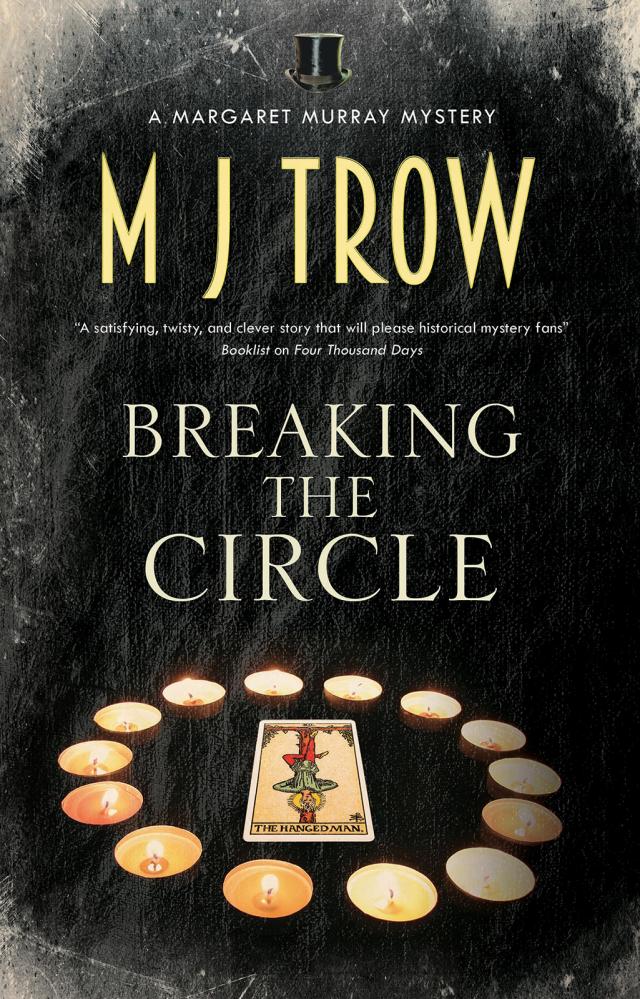
Breaking the Circle, page 26


Working quickly and definitely not using William Flinders Petrie’s dressing gown cord, she tied the artist up. Jack Brooks, on a very hot day the previous week, had conveniently left his old school tie looped over the arm of a possible priest of Amenhotep and she used that for the ankles. A belt she had bought on a whim and decided made her look like a cushion with a ribbon round it was rescued from the back of a drawer and that sorted the wrists. She toyed with a gag, but that didn’t seem necessary. If Kirk Merrington decided to shout for help, it could only be to the good. Once she was sure he was well trussed, she went to the top of the stairs and called for the nightwatchman, who she eventually heard slouching across the hall.
‘Ooizit?’
‘It’s me, Dr Murray. I wonder if you could do me a favour?’
‘I carn leave me box.’
‘I do understand. Do you have a police whistle in said box?’ She wished she didn’t get arch when she had just knocked out a murderer, but it was just a little character flaw she would have to live with.
‘Yers.’
‘Well, can you pop your head outside and blow it, quite hard. And when the policeman comes, send him up to my room. Can you do that now, there’s a good chap?’
Going back into her room, she was aware of a strong smell of almonds. She wasn’t a scientist and had no idea how dangerous or not that could be. It was a problem. Merrington was tall and was half-trapped under her desk. She wasn’t sure whether she could drag him out. On the other hand, she needed him to stay alive. She quite wanted to stay alive herself. So she settled for opening the door, the window in her room and the window at the end of the landing. Then she sat in the doorway and waited for the artist to come round.
She hadn’t long to wait. He came to slowly, turning his head from side to side, trying to work out how he was suddenly looking at the ceiling, when moments ago he was on his way to deliver a fatal dose of cyanide to the annoying little woman now sitting on the floor a few feet away.
‘I hope you’re all right, Mr Merrington,’ she said, kindly. ‘But I’m sure you can see that I had to do something. Cyanide is not a favourite tipple of mine.’
‘How … how did you know?’ He licked his lips and turned his head, wincing. ‘How did you know it was me?’
‘I didn’t, not for a long time. Your compulsive neatness, of course, explained why the scenes of crime were so tidy. And I had noticed, subliminally, if you like, that you and your receptionist were of similar builds. In fact, I wondered if you were perhaps siblings, because there was even a superficial facial resemblance. You reminded me of someone else as well, but I couldn’t remember who. This whole sad business has been fraught with resemblances, one way and another, hasn’t it? Then, as you talked, telling me of your uncle and his missing money, his reliance on mediums for his victims, it reminded me of the story you had told me about going to a séance as a child. And that in turn reminded me that Robert Grimes had told a similar tale. His uncle was Gregory Grimes, the conman, who was hanged for murder a few years ago. And that’s when I realized that it was Robert you reminded me of. He’s much better looking, of course, possibly by dint of not being an habitual homicide of unusual cruelty, but the look is there.’ She waved her hand across the top half of her face. ‘It’s the eyes, I think.’
‘Him! He would have been next.’ Merrington said, bitterly.
‘I would imagine so. Poor Robert, such a nice man and not really deserving of the kind of relations he was dealt.’
Merrington wriggled, but his ankles and wrists were tied too tightly for him to get out of their toils. ‘I thought of everything, though,’ he whined. ‘I even engaged Courtney purposely because I knew I could pass for her in anything but a bright light. If I had had to, I would have sacrificed her, you know I would. I made sure she was doing filing or cleaning alone in the studio when I was killing those worthless women, so she had no alibi.’
Margaret had heard enough. The man had not got the conscience of a sea urchin. She turned her back – even the sight of him, squirming in his bonds, sickened her. A tear, for all dead things, crept down her cheek. She struggled to her feet. She wasn’t really built for sitting comfortably on the floor and certainly not for getting up with any grace.
Just as she managed to become upright and was tucking in her blouse and tidying stray wisps of hair, there was a sound of feet like the trump of doom echoing up from the hallway below.
‘The police are here,’ she said, over her shoulder. ‘Please stop struggling. It only makes an appalling situation that much worse.’ She turned to explain to London’s finest as the landing was suddenly full of large men, mostly wearing blue coats and enormous boots.
All but one …
Later that evening, sitting in Flinders Petrie’s study on the second floor, an untainted sherry in her hand, her feet on a footstool and her head on his shoulder, Margaret Murray sighed with contentment.
‘So, it was my dressing gown cord that saved the day?’ The deep voice above her head was all she wanted to hear at that moment, so she forgave the egotistical subject of the speech.
‘More or less, William,’ she said. ‘It would certainly have been a different story if you had had a sensible cotton one, as I have suggested many times.’
The arm encircling her squeezed a little tighter. ‘You do give us frights, Margaret,’ the professor murmured, kissing the top of her head.
‘Frights, William? Call these frights? I’ve got many more where these came from. Just wait and see.’
The real Margaret Murray
Margaret Murray was born in India in 1863, in what was then the Bengal Presidency. Her father ran a paper mill and her mother was a missionary. Her education was sporadic, largely because women of her social class were not expected to work for a living. She did train as a nurse, however, during India’s cholera epidemic and carried out social work in England.
From 1894, despite having no qualifications, she enrolled in the newly opened Egyptology department at University College, London. Here she stayed for many years, lecturing and encouraging the students of her ‘gang’ and working with William Flinders Petrie, one of the foremost archaeologists of his generation. The work took her to Egypt and led to her publishing a number of works.
On the outbreak of the First World War, Margaret volunteered as a nurse in France. Exhausted by this, she went to Glastonbury in Somerset and became immersed in the Arthurian/Holy Grail legends and her archaeology morphed into folklore and anthropology. She was given an honorary doctorate in 1927 and she travelled extensively before retiring seven years later.
As president of the Folklore Society, she fascinated thousands and shocked several with her publications on witchcraft and demonology, on which she had controversial views. She remained alert, adept and still writing into extreme old age, publishing her autobiography My First Hundred Years in 1963, the year of her death in Welwyn, Hertfordshire.
Her legacy lives on today in the writings of H.P. Lovecraft and the whole modern Wicca movement. She was a determined feminist, striking a blow for emancipation in a world dominated by male privilege.
M.J. Trow, Breaking the Circle


