

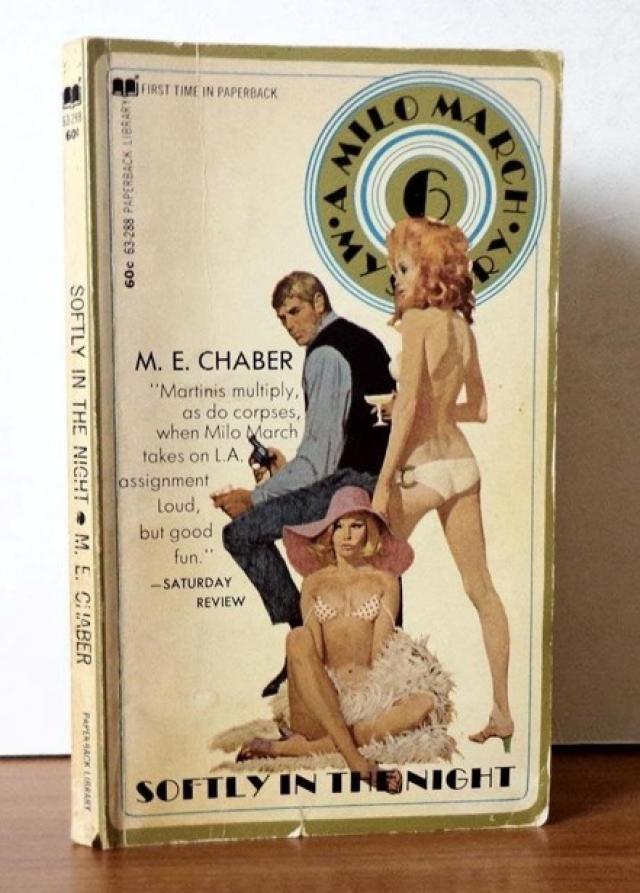
Softly in the Night, page 4


“What did you do in the company before, Mr. Patman?"
“I was the accountant. Of course, Mr. Cantwell worked very closely with me, so you might say I knew quite a bit about the business. . . . Yes, I think you could say that.”
“How long did you work for Cantwell?” I asked. “Twenty-five years next month.”
“Then you must have known Cantwell and his company very well.”
“Yes. Yes, I believe you could say that.”
“And did you know Mrs. Cantwell?”
“Yes, of course, but not so well. She seldom came down here and I was never invited to the house—except when I might have to take some papers to Mr. Cantwell there.”
“You know why I'm here?” I asked.
“The girl said you were from the insurance company, so I presume you are here in connection with the two policies concerned. Isn’t that so?”
I nodded. “You are familiar with Cantwell’s insurance policies?”
“Oh, yes, I know all the policies very well. I might say that I gave a certain amount of advice on them. When I was asked, of course.”
“Good,” I said. “You’re just the man I want to talk to. What did you think of Mr. Cantwell?”
He looked startled. “Well, he—he was a very astute businessman. He started this business and built it up.” “I’m sure he did,” I said pleasantly. “But what did you think of him personally? Did you enjoy working for him? Did others? What kind of a boss was he?”
“Personally,” he repeated, as though he wasn’t sure what the word meant. He took a pair of glasses from his pocket and began cleaning them. “I’m not sure that I ever thought of Mr. Cantwell in the personal sense. ...”
“You must have. Did anyone in the office like him?” “I do not believe in speaking ill of the dead,” he said primly.
“Nonsense, man,” I said roughly. “We’re not just talking about a man who is merely dead. We’re talking about Richard Cantwell, a man who couldn’t get along with anybody, including his wife, a man who collected mistresses the way some men collect stamps, and a man who was either murdered or murdered someone else in an attempt to defraud the insurance company.” Patman put on the glasses, stared through them for a minute, then put them back in his pocket. His face worked nervously. “Well,” he said finally, “Mr. Cantwell was sometimes rather difficult.”
“I’ll bet. How did the other employees feel about him?”
“I’m afraid Mr. Cantwell was not popular with them— except for an occasional temporary popularity with one person.”
“You mean a girl with whom he would be having an affair?”
“Yes.”
“Any of them working here now?”
“No. It was customary to discharge them—afterward.” “A nice fellow,” I said. “How did he treat you?”
“He paid me well, although good salaries were not a habit with him.” „
“I didn’t ask you that. I asked how he treated you.” “Like a servant.” He bit the words off as if each one were a slice of lemon peel.
“You were with him twenty-five years. Anyone else here who was with him that long?”
“No. When the company was first started there were only three of us: Mr. Cantwell, Hal Kray, and myself. It was Kray who had certain contacts which brought in the first business we got. He was given some small percentage of the company, so you might say that I was the only employee.”
“Is this Kray still a partner?”
“No. About five years ago the business was reorganized and he no longer retained an interest. A few weeks later he was fired. I do not know what reason was given.”
"Where is he now?”
“I do not know. I haven’t seen him since then.” “Any other employees been here long?”
“The longest is a little less than two years. As I said, Mr. Cantwell did not pay good salaries and we have a rapid turnover.”
“All right,” I said, “let’s go on to something else. Do you know anything about this foundation that is the second beneficiary in the insurance policies?”
“The Japanese-American Cultural Corporation? Of course I do. I helped to set it up.”
“Tell me about it,” I said.
He put the tips of his fingers together and stared off over my head. “The Japanese-American Cultural Corporation was founded about ttiree years ago. It is a nonprofit corporation. Its purpose is to improve the relations between this country and Japan.”
“What does it do?” I interrupted.
“Arranges for cultural exchanges,” he said. “It sponsors, and sometimes pays part of the cost for, the translations from one language to the other. It arranges for the exhibition and sale of American art objects in Japan and for Japanese art here. It has been instrumental in the exchange of theater and sports groups. It publishes pamphlets in English on Japan and in Japanese on America. It does almost everything possible to help the two countries understand each other.”
“Very commendable. But why? What was Cantwell’s relationship to this?”
“He was the original donor and has in the past three years given about three-fourths of the money spent by the foundation.”
“Why? He doesn’t strike me as having been the sort of man who was interested in doing anything for art. Was the broad one of his mistresses?”
“The broad? Oh, I presume you mean Miss Asakusa.” He looked thoughtful for a minute. “She’s a very attractive young lady, so I suppose it’s possible, but I never had any clear indication that she was.”
“Then why?”
“I’ve thought about that myself,” he confessed. “I think, perhaps, there were several reasons. Miss Asakusa is related to the owner of a company in Japan with which we do considerable business. That business did increase shortly thereafter. I believe that Mr. Cantwells participation in the foundation—which was well-publicized in Japan—brought in much more business. I’m sure that Mr. Cantwell anticipated these things. And they were probably his chief reasons for supporting the foundation. Making the foundation the second beneficiary in the insurance policies was probably something else. Mr. Cantwell had no family and no friends. He had no old employees except me. I believe it amused him to think that if anything happened to him all the money would go to another country, one with which we had been at war not too long ago. That is, the money would go to benefit it.”
“Is the business successful?” I asked.
“Yes, indeed. It has become more successful with each year.”
“So its in good shape?”
“What do you mean?”
“Has someone been dipping into the till?” I asked bluntly. “If so, then it may not be in such good shape no matter how successful it's been.”
He had turned pale while I was talking. He took the glasses from his pocket again, looked at them, then replaced them. His hands were trembling. “Whatever gave you that idea?” he asked.
“The insurance company received an anonymous letter not long ago suggesting that such was the case. I probably would have gotten around to asking the same question even if they hadn't.”
He took a deep breath. “I wouldn't want any rumors like that to get out just now, Mr. March. It might hurt the business for Mrs. Cantwell. I am not sure, you understand, but I believe that there may have been certain defalcations.”
“How much?”
“I'm not sure,” he faltered. “I just today discovered something that makes me think this is true. But I have had no opportunity to look into it further, and it may very well take several days to trace.”
“Make a guess,” I said.
He wasn’t happy about it, but he’d gone too far to back down. “I would guess that it was somewhere in the neighborhood of five hundred thousand dollars.” “That’s a lovely neighborhood,” I said. “Who could have done it?”
“Only one person could have taken a dollar from this company,” he said. “That was Mr. Cantwell. No one else had access to any of the funds.”
“How could he have done it without you knowing it? You were the accountant.”
“I operated entirely on memoranda given to me by Mr. Cantwell. That was the way we always worked.” “All right,” I said. “Any idea why he might do it? Was he heavily in debt?”
“I wouldn’t think so. Mr. Cantwell did spend a lot of money, but then he also had a good income. Even if that were so, Mr. March, it doesn’t make any sense. This was Mr. Cantwell’s company. He was the company. He didn’t have to steal the money and have the books falsified. He could have just drawn the money out in a normal manner. He didn’t have to account to anyone.” “But somebody would have had to know he was taking the money if he did it that way. At least you would have known. Maybe he wanted to get the money without anyone knowing he had it.”
He looked bewildered. “But why?”
“I can think of a few reasons,” I said. “Tell me something else, Mr. Patman. Did you know much about his mistresses?” .
He shook his head. “I knew he had them, that was about all. Sometimes it would be a girl here and we’d all know about it. But that wasn’t often. Other times I could guess he was starting up with a new one. Whenever that happened, he’d be absent from the office more for the first couple of weeks. But I never knew any of them.”
“Any idea of who his latest mistress was?”
“No.”
“There was a woman’s body found with the one identified as Cantwell's,” I said. “Who do you think that might have been?”
“I don't know.”
I wasn’t getting anywhere with that so I switched back to the money. “WTien would you say that he began to help himself to the company funds?”
“I can t say for sure until I’ve had a chance to go over his papers and checkbook more carefully, but I believe it might have been during the last three months.”
“What about Cantwell’s behavior during that period? Would you say that it was normal?”
He was thoughtful for a minute. “Pretty much so, I believe.”
“Did he acquire a new mistress during that period?” “I think so,” he said uncertainly. “I can’t really be sure. I never paid close attention to the exact times. Not after all these years.”
“Did he do anything unusual during this time?”
“No. Nothing important.”
“What do you mean by that? If he did anything unusual tell me about it, even if you think it unimportant.”
“Well,” he said, “when Mr. Cantwell was at the office he always went to a hotel over near Pershing Square for his lunch. But there were several days about two months ago when I saw him going into bars near here. You know the sort of places I mean, certainly not the sort of bars that a man like Mr. Cantwell would normally enter.” -
“You mean Skid Row bars?”
“Yes.”
“Was it always the same bar?”
“No, each time a different one. Although I believe that the last time I saw him he was entering one that I’d seen him go into before.”
“Remember what bar it was?”
“I’m sorry, I don’t.”
“When he returned on those days was there any evidence that he’d been drinking heavily?”
“No.”
“Did he drink much?”
“Not to excess, so far as I know. I believe he usually had one or two drinks before lunch and perhaps a few drinks at night, but so far as I know that was all.” “Any idea why he went to those bars?”
He shook his head.
“That period was the only time you ever saw him do such a thing?”
“Yes.”
“All right, Mr. Patman,” I said, standing up. “I won't take up any more of your time now. I’ll check back with you in a few days about the auditing of the books.” “Mr. March,” he said nervously, “I do hope that you wont say anything about the—er—shortage?”
“Only to my insurance company,” I said. I started to leave then turned back. “Tell me one more thing, Mr. Patman. Considering the sort of man Cantwell was and the way he treated you, why did you stay with him so long?”
“I believe I said that he did pay me well.” He looked up at me and there was a sort of nakedness in his eyes. “I guess I stayed for another reason. I thought that someday he would get what was coming to him and I wanted to be around to see it happen.”
He took the glasses from his pocket and was busy cleaning them again as I left.
FOUR
There was a street not far from the import offices that was filled with cheap bars. Human derelicts, in various stages of stupor, wandered in and out of them or collapsed on the sidewalk. The street was full of the smell of stale whiskey and wine and stale clothing. A police wagon pulled up and a half-dozen comatose men were loaded into it as I turned the comer.
I had to start somewhere. The first bar I came to was called the Shamrock. I turned aijd went inside. It was like a million bars all over the country. It smelled of beer and whiskey and smoke. Down at one end of the bar there were four men. All of them needed shaves and baths and fresh clothes and none of them needed, from the looks of them, the glasses of wine over which they nodded. The bartender didn’t look much better, but at least he was sober. Sober and bored. He looked up from a racing form and showed some surprise at the sight of me. He put down the form and came over.
I looked around at the bar. The mirror back of it was plastered with prices. Almost any shot of American whiskey was thirty or thirty-five cents. A few brands were forty cents. And you could get any imported whiskey for a mere fifty cents. I settled for V.O. and water. The bartender poured the drink into a shot glass that seemed to be made out of magnifying glass. It was probably slightly less than an ounce. He waited carefully for the money, rang it up, and went back to his racing form.
I sipped my drink and looked around. The four men at the end of the bar wouldn't do me much good. They were about ready for the sidewalk and the police wagon.
I felt rather than heard someone else come in. I looked around. It was another bum. But this one seemed reasonably sober. Also a little cleaner. He needed a shave and his clothes were pretty battered, but he didn’t look as if he’d just rolled in the gutter. He paid no attention to me or the other four men as he walked up to the bar.
“Good afternoon, William,” he said. The tones were those of an educated man.
The bartender looked up and frowned. “Hello, Hank,” he said “What do you want?”
The newcomer considered the question as carefully as if it involved the fate of the world. “I believe,” he said finally, “I will have a glass of ‘the grape that can with logic absolute the two-and-seventy jarring sects confute/ ”
“Words,” the bartender said scornfully. “All you ever have Hank, is words. You got the two-bits for the glass of wine?”
The man made a pretense of feeling through his pockets. “I believe,” he said, “that I am temporarily without funds, but if you could ‘fetch me somewhat to delight my mind I might be able to manage a restitution on the morrow/ ”
“Words,” the bartender said again. “No money, no booze. Is that clear?”
“Painfully so,” the man said.
“Just a minute,” I said. “I'll buy him a drink, bartender. Give him anything he wants.”
The man turned and looked at me. His eyes were still bright and clear, not yet clouded by cheap liquor. His gaze was inquisitive. “By my faith,” he said, “a good Samaritan. I thought they had gone out of fashion. Did you say anything, sir?”
“I did,” I told him.
“Then, innkeeper, I will have whiskey. The best you have in the house.”
“Give him the same as I have,” I said, “some V.O.” The bartender looked his disapproval, but he took the bottle and poured a drink. He came down and took the money from me.
“Why don't you come down and join me,” I said to the man.
“Delighted,” he said. He carried his drink down to sit next to me. He took a sip from the glass. “An excellent whiskey, sir,” he said. “I had almost forgotten there were such delights in the world.”
“Enjoy it,” I said. “Any man who can quote from both Omar and Marlowe almost in the same breath deserves it.”
“Ah,” he said, “you recognized both quotations?” He gave me a searching look. “I do not recall seeing you before, sir. You do not have the appearance of a regular denizen of this fieshpot. Nor do we often have visitors who recognize Omar or Christopher—if I may be familiar.”
“I don’t imagine that either of them would object to being discussed in a tavern.” I said. “My name is Milo March. I’m just passing through.”
“An excellent thing to be doing anywhere in the world,” he said. He lifted his glass. “Your most excellent health, sir.” He finished the drink.
I finished my own and motioned for the bartender to fill both glasses. He did, but his expression indicated that he didn’t think it was a good idea. I paid him and let him drift back to his racing form.
“I’m not sure that I caught your name,” I said to the man.
He smiled without mirth. “Perhaps because I did not mention it, sir. Here I am known simply as Hank. It is not an area which specializes in elaborate identification.” “All right, Hank,” I said. I lifted my glass. “To your good fortune.”
We both drank. There was a vague muttering from the four drunks at the end of the bar. Hank looked at them.
“ ‘These lords, perhaps ” he said, “ ‘do scorn our estimates, and think we prattle with distempered spirits.” “I always say that distempered spirits are the best kind,” I said gravely. “And I think Marlowe might have agreed. Tell me, Hank, what is this preoccupation with our friend of bygone years, Christopher Marlowe?”
“A fine writer,” he said. “In fact, sir, I believe he was the finest writer in the English language, perhaps in any language.”
“There was a fellow named Shakespeare,” I said casually.
He looked at me with interest. “A man of obvious financial worth who knows Marlowe and Shakespeare, and also frequents low taverns. You try my credulity, sir. I would think that you would be more at home in the Brown Derby with a martini in your hand.”


