The Warriors of Dawn, page 1
part #1 of The Book of the Ler Series


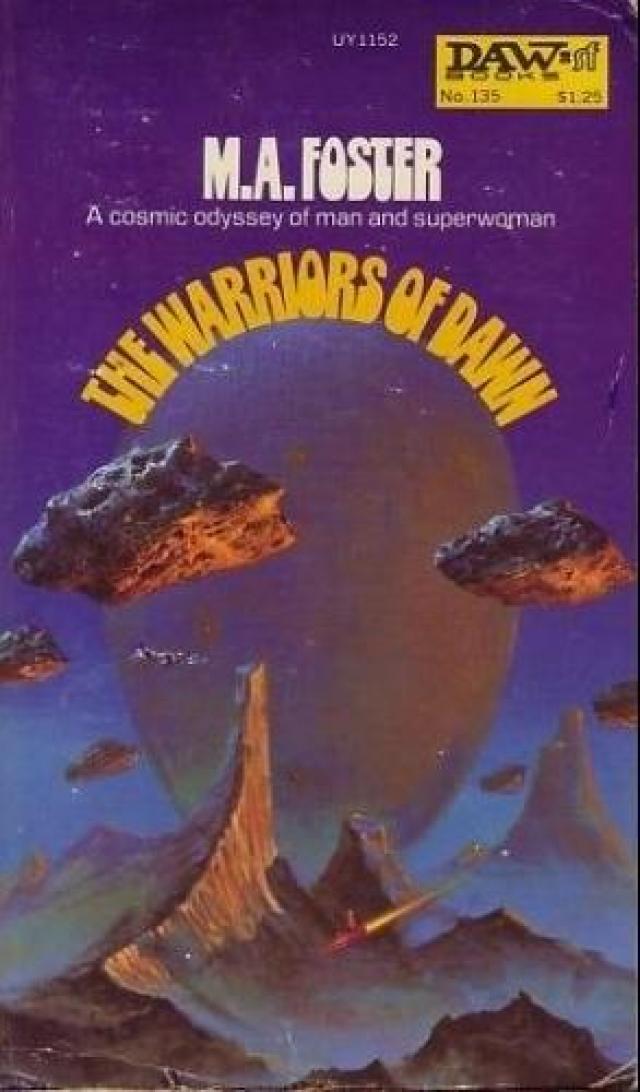
The Warrior of Dawn
Book 1 of the Ler Trilogy
Copyright ©, 1975, by M. A. Foster
Part 1
CHALCEDON
I
“A ler called Maidenjir, of the period when they were still on Earth, is reputed to have said, ‘Fools think that everything must have a name and so apply themselves, forgetting that at the completion of their activity, the Universe will end. Now shall we speak of last words?’ This has its roots in the curious ler doctrine of ignorance (facts are finite, but ignorance is as boundless as the Universe) and in their concepts of person and number theory. But more than one human scholar has seen in this an interesting parallel to the ancient Hindu belief that if one repeated the name of Shiva, Lord of Destruction, often enough, He would open His eye and destroy the world.”
—Roderigo’s Apocrypha
In the early history of one particular planet, Seabright, human colonists came and broke the ground for a new world’s development, and built a port town of tarpaper shacks, warehouses, dumps and shabby repair depots. Likewise, they thoughtfully installed brothels, gambling dens, beer halls, and filled the city up with a raw new world’s drunks, entrepreneurs, derelicts and whores. It was a vast running sore, and they named it “Boomtown,” taking precedent
from many hasty towns which had sprung up before on other worlds.
But Boomtown, of course, like all things, changed with time; itwas renewed, urban and otherwise, rebuilt, scraped over, moved several miles down the coast, moved back, burned, and built again after being shaken into ruins by earthquakes. Now, Han reflected, enjoying the bright morning light playing among the apartment balconies, it was perhaps more resort than anything else, with “minor government center” trailing in second place. Tourists swam in the clear water of the bay, around which the city curved in a sophisticated embrace, hoping to find artifacts and old coins. The Boomtowners made it beautiful and they moved part of the government to it, but they retained the awful name out of a bizarre sense of humor and a sense of the power of habit: the name was several thousand years old and every attempt to change it had ended in failure.
As with every city worth the name, yokels arrived daily out of the hinterlands seeking adventure and fame. They found neither. Boomtown was now lazy, bright, lovely, seductive … and people woke late of mornings, as Han Keeling ruefully thought in reference to himself as well. He finished his bun and coffee, paid the waiter, and departed the half-empty sidewalk cafe, knowing well enough that he was already late.
As he walked towards the top of Middlehill, in the direction of an unpretentious residence and office building, he reviewed what heknew about his appointment, which was little enough.
He was an apprentice Trader, almost finished with the trade guild’s finishing school. He was in his mid-twenties, sound of mind and body, and a moderate success with the lazy, teasing secretaries of Boomtown. And he had been told by the Master Trader that if he wanted an interesting and undescribed assignment, he could report to a certain building on Middlehill and once there, go to room 900 at a certain time, and press on from there. Press on! That was the guild’s overworked motto. Press on; in the face of dire calamities, fires, cannibals, slavers, economic “readjustments” and accidents. Indeed. But in this case, if he took the job and completed it successfully, he would get his Trader’s papers, and his license.
And of course, he was late. Han quickened his step, and sodoing, caught a glance from a passing, brightly dressed girl,
apparently on her way to work. She wore a flowerprint gauzy dress that floated around her, suggesting curves as it swirled from her motions in the clear morning air. He surreptitiously checked his reflection in a shop window: slim, elegant, knowledgeable, competent, relaxed. So he thought. The figure that covertly glanced back at him in the reflection was dark of hair, smooth of face, with features which a more critical observer might have described as being slightly too sharp, too well defined. But he was not a critical observer; he saw the reflection as being somewhat taller than average, and dressed fashionably enough after the tastes of the times.
He arrived at the building and went in, without passing anycheckpoints or observers he could see. At the door of room 900, he paused before entering and reviewed his excuses for being late. He was sure, however, that little would be made of it, if anything, for everyone in Boomtown was always late; to be early or precisely on time was considered slightly vulgar, in bad taste. He knocked, andentered, through an old-fashioned door which swung open rather than sliding.
The room inside was brightly lit by the morning light streaming in over the terrace; there was no other illumination. Beyond, the blue sea. Steelsheen Ocean, rolled and played, throwing quick flashes of sparkling light and sudden glimpses of whitecaps. The room itself was a large one, floored with natural stone. Instead of the expected furniture, there were planters scattered about, some containing miniature trees which, by their gnarled appearance, were very old and carefully tended. But the decor of the room went far beyond mere mannerism; there was something delicate and natural about it, a difference one could sense below the level of direct perception. It was a ler room.
There were nine people in the room, obviously waiting for him, because as he entered, they began settling themselves at a low tableon the terrace proper. Four were humans, which Han could distinguish by their colorful Boomtown clothes and gestures of impatience. The remaining five were ler, which he could distinguish by their slightly smaller stature and homespun robes. There was an almost total absence of decoration on any of the robes, which Han recognized as an indication of high status.
A florid, heavy-set human approached Han and introduced himself as one Yekeb Hetrus, regional coordinator. The other humans introduced themselves in turn; Darius Villacampo,
Nuri Ormancioglu, and Thaddeusz Marebus. No other titles or positions were referenced; this caused Han to become more attentive. That they would not mention titles indicated that they were either very high or very low. He decided that they were high. Most likely Union Security people, who were reputed to be a closemouthed lot in any circumstances.
The ler were more interesting, if for no other reason than that they were rare and strange in this part of space. And as he had oftenheard, he could not distinguish at first sight whether they were male or female. In a certain way, they looked like, disturbingly like, slender, graceful children with slight signs of age and maturity beginning to show on some of their faces. They were all rather uniform in height; Han guessed they would all be around just over five feet.
Han knew very well that ler were human-derived, the result of an early atomic-era program to accelerate human evolution. The theory had entailed DNA manipulation and a reliance on a magic-number hypothesis analogous to the early approaches to quantum mechanics; to continue the analogy, they had been reaching for the next stable junction on the “magic number” grid. The project had no sooner reached its goal than it was attacked from without, by humans who felt genetics was oriented to the environment, and by the specimens themselves, who had stabilized and formed a culture of their own. After several hundred years of uneasy relations betweenten billion humans and several thousand ler, the ler had discovered a faster-than-light drive, built a spaceship in secret, and departed. Before they left, however, the world government of the day hadbecome dependent on them to supply the necessary technological input to keep an overconsumptive culture afloat far beyond its years. Naturally, when the ler left Earth, there was a “readjustment.” Humans had called them ungrateful, and were terrified of the implications of an advanced human type in their midst. The ler were not competitive, were terrified of human numbers, and wanted to be left alone. That was ancient history. Since that period, they hadmutually colonized a large volume of space, the humans expandingspinwards al
Still, Han experienced something akin to awe, as they introduced themselves. Neither race had ever found any other intelligent life in the worlds they had discovered, by now, some forty worlds. Therewere traces here and there, an occasional undecipherable artifact, but no aliens. So, in
the popular mind, they had become, to each other, the alien race.
The first introduced itself as Defterdhar Srith. Han knew enough basics from school days to recognize the last “name” as not a surname, but an honorific that indicated that the individual concerned was a female past the age of fertility. She was as quiet and self-possessed as one of the large stones that stood here and there about the terrace. The second and third were, respectivelyYalvarkoy and Lenkurian Haoren, insiblings to each other. Hanlooked closer. Male and female. The fourth was dark, rather saturnine and quiet, but with bright, animated eyes. He did notspeak, but instead stood quietly with his hands in his sleeves.
The fifth, and closest to Han of the group around the table, was at second glance a female, and a young one at that. In fact, she was, as he looked and listened more closely, much younger than the other ler present. She gave her name as Liszendir Srith-Karen. Han’s suspicions were confirmed: the ler girl was young, in their terms still an adolescent, although he could not guess her age at all.She might have been sixteen standard or twenty-eight. Their adolescence went up to thirty standard. Somehow, subtly, he became aware of her not as a member of a race near man and derived from him, but as a young girl. She had plain, clear featuresof no particular distinction; her hair was short and pale brown, almost uncolored in its neutral tone, cropped off artlessly neat about ear level. It was straight and extremely fine in texture.
Her manner suggested something unfathomable and contradictory: an apprentice sage; a tomboy. She had a small, delicatenose and a broad, generous mouth. She was not a beauty in human terms of reference, but at the same time, she was attractive in a clean and direct way. Her eyes, however, were the most noticable feature of her face; they were large and gray, and the pupil almost filled up the whole eye, except for corners of white. A faint yellowring exactly divided the inner and outer iris. Han looked away from them. They were intense, knowing eyes. He looked at Lenkurian,the other young ler female present. Yes. There was some difference. Han could catch a hint of it; Liszendir was much better-looking than the other.
At this point, Hetrus made some introductory remarks, and then indicated that they were to listen to a recording, which he initiatedby pressing a concealed switch. The recording
started, identifying itself as a Union Security tape, subject, an interrogation, and circumstance, the statement of one Trader EdoEfrem, Master Trader. Han did not recognize the name at all, and assumed that Efrem was probably not of the Seabright system, but from some planet further out.
The interrogation recorded by the tape went as follows:
—Proceed, Trader Efrem.
—Very well. As I said before, I had headed outwards towards Chalcedon to do a little trading and see how things were. None of us get out that far on the edge very often, so I was sure I could sell a load of primitive toolstuff I had picked up deep inside as a … a h … a speculation, so to speak. I arrived at night, so of courseone couldn’t see very much. We set the bazaar up and waited for morning. But nobody came. I sent my Crew Chief into the local areato see if he could stir anyone up. Much later, he returned with a handful of people. To my surprise, of both kinds. In fact, I hadn’t made a voyage to Chalcedon before, and I didn’t know …
—Yes. We know about that aspect of Chalcedon. Go on.
—Well, to make a longer story shorter, they had been raided. Now, we all hear tales, of course, but we rarely ever see any hard and fast evidence. But they had gotten it there, all right. Later, I flewaround the planet, and it was all over. Destruction everywhere. Some of the craters were still hot. Apparently, they came in, shot the place up, looted and took captives. They stayed about a month, and thenabruptly left. Incredible damage. I unloaded as much as I could afford and beat it back here as fast as possible.
—Did you hear a description of the raiders?
—Yes, and that was what bothered me. It didn’t make good sense. Both kinds of people on the planet described them as ‘ler barbarians.’ They all had their hair either shaven off, or done up in plumes and crests. They wore loincloths and many had tattoos. And they weredefinitely ler.
—They were sure?
—Absolutely. Both kinds said so.
—What about captives?
—From what we could make out, only a few ler were taken, but quite a few humans. At first, the locals thought that the purpose inmind was ransom, but when more time passed and nothing was heard, slave-taking seemed the more probable. It was pretty strange, though; the raiders only appeared to take certain types of people. Perhaps “types” isn’t the right word. They used a ler word which means something like “subrace” or “one who has a tribal characteristic.” They did not seem to pick according to any known standard of beauty or utility. Now that’s what bothered me. You hear tales, of course, but slavers and raiders? Besides, as far as I know, nobody has ever known ler to do anything even remotely like that. They fight well enough when the occasion demands, but they aren’t aggressive.
—Did anyone know what kind of weapons the raiders used? Or what their ship looked like?
—No, to both. Nobody saw what caused the craters. And nobody saw the ship close. Some saw it above, at night, but all they could see were some lights. It was a terror raid, simple. There isn’t anything on Chalcedon except a few mines and farms. There are no defended places or anything like that. No concentration of wealth.
—Any indications of where they came from?
—The survivors said that the raiders called themselves “The Warriors of Dawn.” But that could mean anything. Every planet has dawns; plenty of them, too. No. Nobody knew. But I would guess, as did everyone else on the planet, that they came from somewhere further out.
—What language did they speak?
—The ler on Chalcedon said that it was a very distorted form of their “Singlespeech,” barely understandable. There were words mixed in that no one could identify.
Hetrus turned the reproducer oil. After a moment, he spoke, slowly and at length.
“This tape has been primarily for the benefit of you two young people, Han and Liszendir. The rest of us have already heard it. Likewise, the history you are about to hear. It is well known to some of us, but probably not to you.
“You already know that the ler originated as an experiment in forced human evolution on Earth. After they fled Earth, many years later, they founded a world they called Kenten—‘firsthome.’ No contact was made for many more years, partly out of inability and partly out of mistrust. When contact was made, it began an unpleasant period, which was a shame to both our peoples. The Great Compromise ended all that, with humans expanding spinwards and ler antispinwards. New worlds would be, as discovered, for one or
the other. Disagreements would be kept local. This worked for more years.
“No provision was made in the cases of inwards and outwards.Inwards, there has been some rare skirmishing, but nothing of any great importance. Outwards, however, it has been completely peaceful. Towards the edge, at the farthest known habitable world, the guiding councils of both decided to dual-colonize one world; tosee if perhaps the rent in our fabric could be mended. To date, we have been successful—on Chalcedon.”
As Hetrus paused, Lenkurian broke in. She seemed impatient, and spoke in a whispering, breathless voice which seemed so quiet it hardly sounded at all; yet curiously, it carried effortlessly to all parts of the terrace.
“When we heard this report, naturally we were interested. Note that the raiders were apparently ler, but of no origin anyone could determine, and of decidedly abnormal behavior. This caused some strain among our senior governing bodies. So we urgently wish to look further into this matter.”
Hetrus continued, “Naturally, we wish it to appear innocent. Weknow in fact almost nothing, and we do not know if the area is under observation. That is why you two were suggested. Han is waiting for an assignment; Liszendir is likewise unoccupied at this time, and can be considered to be making her journeying for her skill, her ‘tranzhidh.’ ”
The girl nodded approval at the alien use of a ler word.
Hetrus said, “You need not feel particularly gifted. Others would have perhaps been better; but you two were readily available. Neither of you has family responsibilities at this time, and you are not likely to develop any attachment to each other beyond the business at hand. We have provided a ship, an armed cutter, and some goods to suggest traders. You will voyage to Chalcedon and pursue the matter further. Efrem was in a hurry to leave; you need not, and may follow it as far as it leads. Your skills complement one another’s admirably.”
Han and Liszendir looked at each other. As if she anticipated the question in his mind, she said quietly, with a subtle undertone of belligerence, “I am Liszendir, an adolescent of Karen Braid, infertile, Nerh or elder outsibling, unwoven. You would sayunpromised and unattached, I believe. My age in standard is twenty-six.”
Han felt immediately put on guard by the frankness, which, hereminded himself, was not so much a personality
trait of the girl herself, but a cultural trait they all shared in in various degree. Still, it seemed that as she spoke, she had deliberately dropped the little femininity he could perceive, and become something different. Something fey, wild, tomboy. Aggressive. He wondered just what her skill was. And if she could turn on her femininity as easily as she turned it off.
Han asked her, “I am Han Keeling, male, unattached, Srith-Karen Liszendir. May I ask what your skill is?”