The Man from Outback: An Australian Outback Romance, page 1


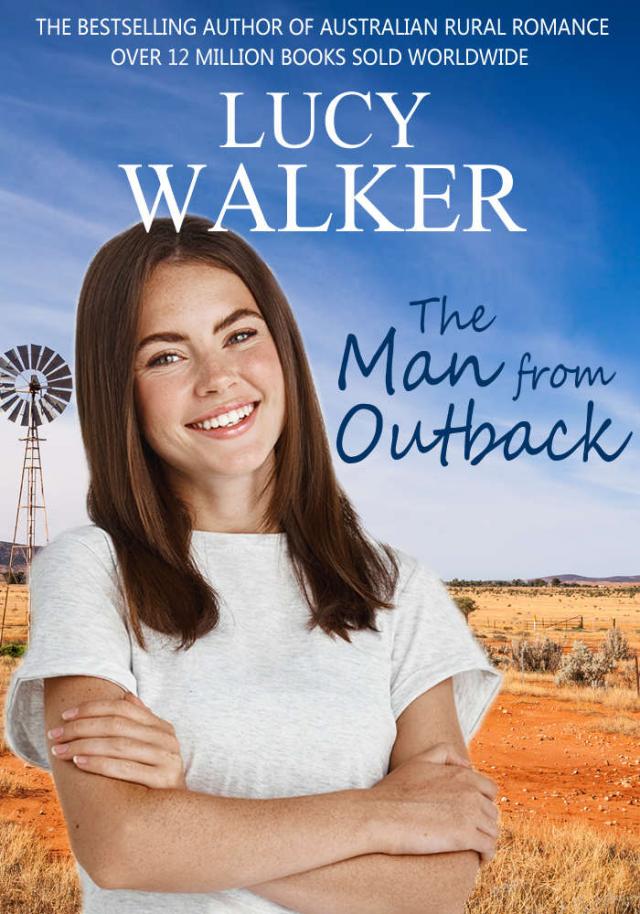
The Man from Outback
Lucy Walker
Copyright © The Estate of Lucy Walker 2022
This edition first published 2022 by Wyndham Books
(Wyndham Media Ltd)
27, Old Gloucester Street, London WC1N 3AX
First published 1964
www.wyndhambooks.com/lucy-walker
The author has asserted her right to be identified as the author of this work in accordance with the Copyright, Designs and Patents Act 1988.
This book is a work of fiction. The names, characters, organisations and events are a product of the author’s imagination and any resemblance to actual persons, living or dead, organisations and events is purely coincidental.
All rights reserved. No part of this publication may be reproduced or transmitted in any form or by any means, electronic, mechanical, or otherwise, without the prior permission of the publisher.
Cover artwork images © Cookie Studio / bmphotographer (Shutterstock)
Cover artwork design © Wyndham Media Ltd
Wyndham Books: Timeless bestsellers for today’s readers
Wyndham Books publishes the first ebook editions of bestselling works by some of the most popular authors of the twentieth century, such as Lucilla Andrews, Ursula Bloom, Catherine Gaskin, Naomi Jacob, Mary E. Pearce and Lucy Walker. Enjoy our Historical, Family Saga, Regency, Romance and Medical fiction and non-fiction.
Join our free mailing list for news, exclusives and special deals:
www.wyndhambooks.com
Books by Lucy Walker
from Wyndham Books
The Call of the Pines
Reaching for the Stars
The River is Down
Girl Alone
The One Who Kisses
The Ranger in the Hills
Come Home, Dear
Love in a Cloud
Home at Sundown
The Stranger in the North
Wife to Order
A Man Called Masters
Follow Your Star
Down in the Forest
The Runaway Girl
Kingdom of the Heart
The Other Girl
The Loving Heart
This Distant Hills
The Gone-Away Man
Sweet and Faraway
Heaven is Here
Gamma’s Girl
Joyday for Jodi
The Mountain That Went to the Sea
The Moonshiner
The Man from Outback
More Lucy Walker ebooks coming very soon
Wyndham Books is reissuing
Lucy Walker’s novels in new ebook editions.
Be the first to know about the next reissue
by signing up to our free newsletter.
www.wyndhambooks.com/lucy-walker
Contents
Chapter One
Chapter Two
Chapter Three
Chapter Four
Chapter Five
Chapter Six
Chapter Seven
Chapter Eight
Chapter Nine
Chapter Ten
Chapter Eleven
Chapter Twelve
Chapter Thirteen
Chapter Fourteen
Chapter Fifteen
Chapter Sixteen
Chapter One
Mari Curtis sat in the back of the dust-covered car while her Uncle Ralph sat in the front seat by the driver. They bowled at a terrific pace over bumpy trackless ground, the steering-wheel sometimes spinning free in Bob’s hands.
Already Mari thought of the little wizened brown-faced driver as ‘Bob’. That was all Uncle Ralph had called him when they had arrived at the landing strip.
‘This is Bob, Mari,’ Uncle Ralph had said, then looking at the quaint little man he had added laconically: ‘My niece, Mariana Curtis, from England, Bob. Come for a holiday.’
Bob’s expression said he was seeing a mirage. For one moment his eyes had widened, looked affrighted, then quickly hooded had recaptured that former dead-pan expression. It struck Mari as a cross between the comical and the odd.
‘G’ day,’ Bob said, then not waiting to hear what kind of reply the pretty dark-haired girl in the ice-blue dress might make, he picked up two cases and began to stow them away in the boot of the car.
‘Not used to girls!’ Uncle Ralph explained to Mari. He did not add that nobody on Ninna-Warra Station was used to girls, or to any white women at all, in fact. There was every good reason for Bob’s staggered reaction to the sight of Mari. Uncle Ralph, back from his holiday in England, had not bothered to tell anyone on the station he had brought Mari with him.
If the driver didn’t know about her ‒ hadn’t prepared to meet her ‒ then what about Kane Manners, Mari wondered.
For the first time in all that long trip ‒ three days by jet airliner to Darwin, then one day by a vintage DC3 out to Ninna-Warra Station ‒ Mari began to think about Kane Manners.
Uncle Ralph had told her the bare facts, but they were very bare indeed. Kane Manners was his partner and, now that Uncle Ralph was nearing retiring age, was also his station manager. In addition to this job, Kane Manners owned another station called Half Moon which he had leased out to other people.
‘Uncle Ralph,’ Mari said, veiling her sea-blue eyes against the glare of the light. The clear pale colour of the sky was so pure, yet it hurt her eyes. ‘Uncle Ralph, what does Kane Manners look like?’
Bob, in the driver’s seat, moved his hat forward over his brow. Uncle Ralph took his pipe out of his mouth and coughed.
I wonder if he’s bossy and they’re scared of him, she wondered to herself. Something about her question had put both Uncle Ralph and Bob off their beat.
‘Well …’ Uncle Ralph drawled. He was once again the outback man, now that he was on home territory. ‘He’s a big fellow. Well, tall, anyway. He’s quiet. Likes to do things his own way.’ He turned and looked over his shoulder at Mari. ‘You don’t have to worry about Kane, Mari,’ he said. ‘He’s quite a nice fellow ‒ when you get to know him. Just carry on out here at the homestead the same as you did at home in England. That’s all there is to it …’
What prophetic words, had Mari only known!
At home she had housekept for her father, and even now, driving fast over a dusty and pitiless landscape, Uncle Ralph’s words tinkled like a little bell of warning. At that moment she didn’t heed it.
Instead, she thought of Robert Alton, her erstwhile dear ‘steady’ from next door, back there in England. How scornful Robert would have been of this dead-pan driver; this noncommittal uncle. He loved to probe, draw people out and look at them through a microscope. That was because he was studying to be a scientist.
Mari was seventeen, rising eighteen, and Robert Alton was twenty-one. One day, during Uncle Ralph’s visit to England, Mari and Robert had had the wonderful idea they would marry. Straight away! All they had had to have, they thought, was the idea. It was as simple as that. Two could live as cheaply as one; they knew, because Robert had worked it all out on paper. If the worst came to the worst Mari could get a job ‒ in addition to looking after Robert and her father, of course.
Mari had been thrilled. She would be engaged, then married. It was a wonderful idea and all quite easy. Everyone was doing it.
‘On a starvation ration?’ her father had snorted.
That had been the end of Robert Alton for the time being. His parents had whisked their son away to an uncle in Edinburgh for the vacation, and Uncle Ralph had decided to give Mari a ‘holiday’ in Australia.
Robert whisked off to Edinburgh, and not even writing to Mari, had broken her heart. At nearly eighteen Mari knew that a broken heart is a very sore thing indeed. In fact, all the way to Australia, through all the exotic countries en route, she had looked out of the windows of the jet liner with sadly clouded eyes ‒ until she landed in Darwin.
There in the palatial, tropical hotel, she met Allen Webster.
They had been waiting in the cool palm-decorated lounge for the trans-country plane, and he came in. He was tall, extra good-looking in a slightly fun-making wicked way, and he had come across the lounge and smiled at Mari. He knew Uncle Ralph and somehow wangled an invitation to sit down with them.
‘If you don’t like it out there at Ninna-Warra, Mari,’ Allen Webster had said, half an hour later and smiling in a you-know-how way right into Mari’s eyes and using her Christian name, just as easily as that, ‘we’d like to have you here.’ Then grinning wickedly he had added, ‘That is ‒ I would.’
‘Why shouldn’t she like Ninna-Warra?’ Uncle Ralph had growled ferociously over his long drink of ice-cold lager. He had disapproved of Allen Webster buying Mari a gin and tonic, and had looked it. ‘There’s everything a girl wants out there at Ninna-Warra.’
Allen Webster had flicked up one eyebrow in an engaging way.
‘Including that ogre Kane Manners?’ he asked. ‘By the way, does he know this charming young girl is about to be landed on his plate for dinner to-night?’
Now, hours later, driving in the car from the airstrip to Ninna-Warra Station, Mari thought of Kane Manners. A flock of emus raced past the car as they neared the scrub banks of a creek bed. The car swerved round the first big clump of trees Mari had seen since they left the landing strip.
Why had Allen Webster in Darwin called Kane Manners an ‘ogre’?
Ma
Once in Australia, he had thought, this little heartache about the boy next door would soon pass. He had seen the first signs when Mari had lifted her delicate pointed chin and widened her eyes when Allen Webster in Darwin had put on his Lothario act. Uncle Ralph did not know that anything or anyone that was kind would have lifted Mari’s heart at that moment. She needed a little gaiety very badly, for she had been sad for quite a long time. Several weeks, in fact. Uncle Ralph, who thought Allen Webster had had more success than was necessary, wasn’t very pleased with him.
The landscape was changing, growing more interesting, yet Mari sitting back in her corner seat was thinking more of Darwin than of England or the creek bed outside the window; more of Allen Webster than of Robert Alton.
‘If you don’t like it at Ninna-Warra,’ Allen Webster had said, ‘we’d like to have you here.’
‘There you are, lass,’ Uncle Ralph said from the front seat. ‘Home at last!’
Mari opened her eyes.
They had mounted a rise. Stretching away below them the track fell into a rocky decline like a gash in the hillside. At the bottom of the gash, trees grew thick and high, some of them reaching right up as if to find the sky with their long slim leafy arms. The car passed through a gorge and the walls on the far side were red and blue and green, shining as if wet with water. There were ferns, thick bushes, and more of the tall slim trees whose arms sought the sky.
‘But where is home?’ she asked, without noticing she had called it home.
The car slid past the straining posts of the cross-fences, and there was the homestead. It was a low rambling house, surrounded by a veranda and standing in a nest of trees. There was a wire fence around the house but no garden to speak of. The car stopped at the wire fence. Mari read the words ‘Ninna-Warra’ on a rectangle of board attached to the gate.
‘Right here,’ Uncle Ralph said, answering the question Mari had asked quite five minutes before. He seemed pleased with this homestead, even proud of it.
‘It has a nice name,’ Mari said, a little wistfully.
Bob and Uncle Ralph got out of either side of the driving seat.
‘Well, this is it, lass,’ Uncle Ralph said. He beamed at Mari as she extricated herself from the back seat. ‘First duty you’ve got, my girl, is to go right in and make the tea. I’ll help Bob bring in the cases. You see if you can live up to your home standards. Wonderful cup of tea you could make there, Mari.’
Mari was dazed.
‘You mean … you mean I’m to go right into the kitchen? Won’t somebody mind?’
Ralph Curtis hooted.
‘There’s men hereabouts and we need a woman to look after us, Mariana. Go right ahead. No one will stop you, and the three of us will just love it.’
The three of us! Bob and Kane Manners and Uncle Ralph!
Mari’s heart dropped. Was there no one else?
Uncle Ralph gently patted her shoulder as he propelled her in the direction of the veranda steps and the wire-screen door that protected the open doorway beyond.
Bob, straightening himself after depositing a case on the ground, could now stare his fill. Uncle Ralph and the girl had their backs to him. His burned, weathered face wore no expression, but the very stillness of his stance betrayed the fact that he was seeing something the like of which he had never seen before. A white woman come to live on Ninna-Warra Station.
Mari mounted the steps ‒ her instinct told her dry rot was in the boards, but she did not think about it then. A dog had his brown and black nose around the corner, but he did not stir. Uncle Ralph let go her arm and returned to the car. Mari looked back, but neither he nor Bob was taking any notice of what she did now.
Delicately she put out her hand and opened the screen. She looked down a long, narrow, linoleum-covered passage, scrupulously clean but, except for the floor cover, bare.
She went inside and took one step, then stood still and listened. There was only silence.
She walked, carrying her hat in her hand, a little way down the passage. The doors to the left and right were open, and on the far side of them, on the outside walls, the windows were wide open too.
There was a sitting-room, with leather-upholstered chairs and a gun-rack in the corner. There was a heap of harness on a small table, and a case of books in that room. Other rooms were bedrooms, and one that looked like an office, another a dining-room. It was all clean, bare and masculine as a hospital ward, for there was no carpeting, only linoleum on the floors.
She went eerily, because of her tiptoeing, down the passage, looking in one door after another. There was a small room near the end of the passage, opposite the dining-room, that was clearly unused. The mattress stood on its side on the bed as if it had been there many a long day.
Where, Mari thought, is the kitchen?
She went out on to the wire-screen veranda at the end of the passage and saw the open door leading into the kitchen. In its dim recesses she could see the gleam of something white where the light from a window fell on it.
She took a step into the kitchen.
There across the wide linoleum-covered floor was a huge refrigerator against the far wall and beside it a ‘deep freeze’. Mari’s eyes widened and her heart leaped. Even at home in England she hadn’t had those.
Under the window was a stainless steel sink, and farther along a shining-topped table with matching chairs around it. There was an electric stove, and on another bench, beside the stove, there was a kettle, a coffee percolator and a frying-pan ‒ all gleaming silver-steel, and all electric.
In this strange land, in this empty homestead ‒ was Mari’s dream of a kitchen! It was like magic.
She put her hat down on the table and walked softly over to the bench and let her fingers stroke the lovely blue and silver gleam of the electric kettle.
This great barn of a homestead, her fingers seemed to say. And this lovely kitchen. Oh, I would like very much to cook in this kitchen.
There were heavy footsteps coming down the inside passage, out on the back veranda and then to the kitchen door. Mari had turned her head, and saw with relief that it was Uncle Ralph.
‘Leave the tea half an hour, lass,’ he said. ‘Seems Kane’s not in from the muster yards yet and I’ve got to turn the engine on. No engine ‒ no electricity. That’s the way it works!’
He beamed at her as if he too knew this was magic and expected Mari to appreciate it as he did.
Uncle Ralph had exchanged his nice London felt hat for a fearful brown one that had a brim like a dusty veranda. He stumped off ‒ through the back-veranda screen door, on to the gravel path and then away around the corner of the house.
If Kane wasn’t in yet, it meant he would be in soon.
Mari wished, unexpectedly, that she was back in London.
Then that spirit which Uncle Ralph had admired so much came to her aid.
So Uncle Ralph and Kane Manners would come in presently to find their tea nicely prepared and served up to them by the latest thing in housekeepers, would they?
Well, it would be the latest thing in housekeepers too. Uncle Ralph at least was going to have a shock.
Mari picked up her hat and went out of the kitchen, through the house to the front where her case sat waiting for someone to lift it in. Clearly that someone had to be Mari herself.
She carried it to the room where she had seen the mattress up-ended on the bedstead. She put her hat on top of the wardrobe, then, finding the bathroom, had a quick wash.
Back in her room she opened her case. Out came her ‘trews’, her flattest flatties, her cotton print over-blouse.
Down came the swathe of hair, and with two strokes it hung, shining, to her shoulders.
The make-up box came next, and on went the dash of eyebrow pencil, and the dash of mascara ‒ things Mari hadn’t dared to use in her father’s presence. She managed to put the lipstick on with the kind of quick flick that made her mouth look like a rich peony.
‘The very latest edition of housekeepers! That’s me,’ she told her image in the shabby dressing-table mirror. ‘That’s me!’