

Scalp Dance: A Sam Chitto Mystery, page 1
part #1 of A Sam Chitto Mystery Series


Acclaim for Lu Clifton’s Scalp Dance
“Clifton crafts a compelling adult debut, vividly rendering southeastern Oklahoma settings . . . this book will thrill readers of Jean Hager’s ‘Mitch Bushyhead’ and ‘Molly Bearpaw’ mys-teries or anyone interested in Native American lore.”
- Library Journal, Starred Review
“A tribal police officer fights inner demons as he investigates a series of killings. Lt. Sam Chitto of the Choctaw Nation Tribal Police is nearly at his breaking point after the death of his young wife and his continued failure to solve the 10-year-old murder of his police-officer father. Chitto, who’s being fol-lowed as he investigates, wonders if someone in law enforce-ment is leaking information. When he does discover the truth, he has a tough decision to make . . . this fine procedural debut by Clifton . . . is made even more interesting by its detailed information on Native American ceremonies.”
- Kirkus Reviews
“An intriguing page-turner! Lu Clifton has written a hard-to-put down mystery rich in the lore and culture of the Choctaw Na-tion. And Tribal Police Lieutenant Sam Chitto is as smart and savvy as he is likable, the kind of character who gets under your skin. I look forward to his next outings.”
- Margaret Coel, New York Times bestselling
author of The Man Who Fell From the Sky
Scalp Dance
A Sam Chitto Mystery
Lu Clifton
Scalp Dance© 2016 Lutricia L. Clifton.
All rights reserved. No part of this book may be used or reproduced in any manner whatsoever without written permission, except in the case of brief quotations embodied in critical articles and reviews. For information, write to the publisher at the address below.
First published in hardback by Five Star Mysteries in 2016.
SECOND EDITION, October, 2020
ISBN 978-0-9985284-9-6 (Paperback)
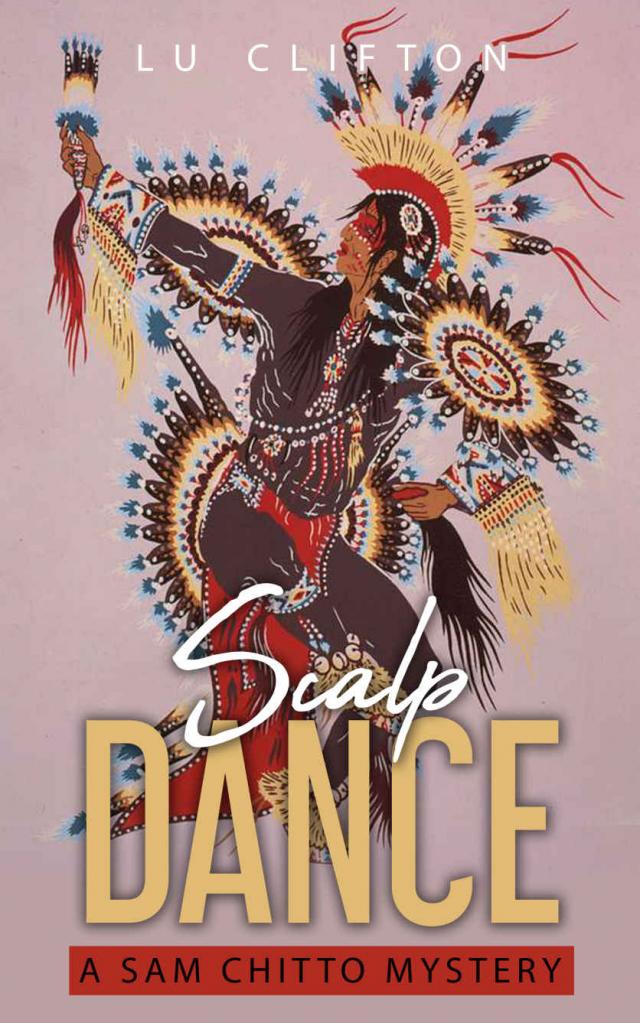
Cover illustration courtesy of PICRYL, The World’s Largest Public Domain Source: Scalp Dancer, GU 20275, U.S. Copyright Office, #721. Library of Congress: No known restrictions on publication. No renewal in the U.S. Copyright Office.
Printed in USA.
1. Indian reservation police—Fiction. 2 Murder-investigation—Fiction. 3. Choctaw Indians—Fiction. 4. Oklahoma-Fiction. 5. Police Procedural--Fiction
Two Shadows Books
P.O. Box 154
Davis, IL 61019
Books by Lu Clifton
Sam Chitto Mysteries
Scalp Dance
The Bone Picker
The Horned Owl
Five-Dollar Indian
Standalone Novels
Seeking Grace in Beulah Land
Liquid Grace
Children’s/YA Novels
Freaky Fast Frankie Joe
Immortal Max
Seeking Cassandra
Contents
ACCLAIM FOR LU CLIFTON’S SCALP DANCE
CONTENTS
FOREWORD
DEDICATION
PROLOGUE
CHAPTER ONE
CHAPTER TWO
CHAPTER THREE
CHAPTER FOUR
CHAPTER FIVE
CHAPTER SIX
CHAPTER SEVEN
CHAPTER EIGHT
CHAPTER NINE
CHAPTER TEN
CHAPTER ELEVEN
CHAPTER TWELVE
CHAPTER THIRTEEN
CHAPTER FOURTEEN
CHAPTER FIFTEEN
CHAPTER SIXTEEN
CHAPTER SEVENTEEN
CHAPTER EIGHTEEN
CHAPTER NINETEEN
CHAPTER TWENTY
CHAPTER TWENTY-ONE
CHAPTER TWENTY-TWO
CHAPTER TWENTY-THREE
CHAPTER TWENTY-FOUR
CHAPTER TWENTY-FIVE
CHAPTER TWENTY-SIX
ABOUT THE AUTHOR
TOPICS AND QUESTIONS FOR DISCUSSION
Foreword
In August 1994, the 103rd Congress signed into law the Violence Against Women Act. This law created penalties for gender-related violence and grant programs encouraging states and tribes to address violence against women. Congress reauthorized the act in 2000 and 2005, with President George W. Bush signing the latest act into law on January 5, 2006. Because of these acts, many tribes received grants to create programs to educate women and girls on how to avoid domestic violence and rape. As I write this book, violence against Native American women persists in significantly higher percentages than with their Caucasian, Hispanic and African American sisters.
The setting in this book is genuine; the towns and byways depicted are based on first-hand knowledge of southeastern Oklahoma, my birthplace. The characters and events are purely fictional. The view the reader receives of the old Choctaw religion is that of someone with an interest in long-lost mythology and cultural beliefs. Regarding references to the geology of Oklahoma, the reader receives this author’s interpretation of it after much research.
In understanding the Choctaw Tribal Police organization, I am indebted to R. D. Hendrix, Director of Law Enforcement for the Choctaw Nation. Director Hendrix also demonstrated incredible patience as I endeavored to fathom the inner workings of the Checkerboard jurisdictional system. As fiction writers are prone to do, I exercised artistic license in developing characters and plot in Scalp Dance; if I have portrayed anything incorrectly in so doing, it is through no fault of Director Hendrix.
I am also indebted to the Choctaw School of Language for help with Choctaw phrases and terms. Yakoke!
Dedication
For my sons, Jeffrey and Christopher
Prologue
The four men forming the circle shuffled uneasily, dark faces beaded with sweat, eyes turned away from the man on the ground. The hollow call of an owl caused an involuntary shiver. It was the darkest part of the day, a phenomenon involving radiational cooling of the atmosphere. The men in the circle knew nothing about the scientific reason for the phenomenon. Or cared. To them, it was that time when darkness and light exchanged roles. A time when even August heat could be chill.
Periodically, three of the men glanced toward the head man, who stared eastward. As the sky took on a scarlet hue, he cleared his throat and began reciting the words he had been given. Hesitant at first, then resolute.
“The Master of Breath will judge you, determine your punishment and how long it will last. Your ghost will wander in this world for that time. Perhaps hundreds of years. Maybe less . . . maybe more. The Master of Breath will decide this, but it will be equal to the pain you have caused. This we do know. No one will mourn your passing, and when your time of punishment is over, you will not be reborn.”
The man on the ground stared wide-eyed, his eyes darting around the group. He attempted to spit out the gag in his mouth, but it was useless. The men in the circle knew how to tie knots. His bound hands and feet were proof of that. He struggled to gain purchase on the hard ground beneath him, but he could not. His hands and feet were being held in place with more knots tied to stakes. He could feel a hard object under his neck, which was elevated from his shoulders and head so that his throat stretched in an arc. Even if he were not gagged, he would have difficulty speaking, the pressure on his vocal cords was so great.
“It is time,” the spokesman said, looking toward another in the circle.
Nodding, the man removed a knife from a sheath at his waist. Quickly he knelt and knotted a lock of hair between his fingers. With his other hand, he incised a square around the knot. Then he pulled, fast and hard. The knot of hair came free, and with it, a whimper.
As he completed his task, the man across from him removed a sword-like instrument from a leather case. Dropping the case to the ground, he swung the instrument overhead, putting muscled shoulders and back into the downward swing. The sound of splintering bone echoed through the stillness.
Their task done, the men broke the circle. Wasting no time, they took what they needed and left. The sound of their vehicle’s motor was accompanied by early-morning birdcalls, the flutter of wings taking flight. Nothing more.
None in the vehicle spoke. Not because they felt remorse for their actions that day, but because a man’s spirit had been dispersed, never to be born again. Though no sounds were made, their communal thoughts melded into a prayer that none there would ever know such punishment. There was no worse fate imaginable than for one’s spirit to be destroyed forever.
CHAPTER ONE
One, two, three . . . four.
Sam Chitto eyed the men standing in the trailer’s shadow. The singlewide sat on U.S. 70, accounting for the state patrol officer’s presence. A Hugo Oklahoma city-limit sign across the road explained why the town cop was there. The man in the tan uniform had a sheriff’s department insignia on his sleeve, accounting for his interest. A fourth man, wearing the black-and-gray uniform of the Choctaw Nation Tribal Police, waved him into the driveway. Pulling his white Tahoe alongside another one just like it, he killed the engine and waited.
Tommy Rideout climbed into Chitto’s SUV, fanning his face with a campaign hat. “What took you so long to get here?”
Rideout was young, fresh out of training, and did his uniform proud. Biceps stretched sleeves taut, damp cloth outlined tight abs. Chitto wondered if he’d ever been as fit.
“Got here soon as I could, Eight.”
Chitto had trouble with names. He had field responsibility for District 9 but handled multiple-district responsibilities when needed. Like today. While still a rookie, he
“This what it looks like?” he asked, eyeing the three officers in the distance.
“Yep, Mexican standoff. Girl’s been raped and it’s not clear whose land this trailer’s settin’ on. You bring a checkerboard?”
“Raped,” Chitto hissed. “When you called, you said I needed to mediate an incident.”
“Well, see . . .” Eight dipped his chin, staring at the floorboard. “The, uh, the girl was right next to me—listening—and, uh . . .”
Chitto listened to Eight’s words fade. Though new, the young officer had what it took to be a good, solid tribal officer. He believed in protecting the Choctaw and their land and didn’t go looking for trouble.
“Okay, then,” Chitto sighed. “Let’s see if it’s in our jurisdiction or outside of it.” He pulled a map from the glove compartment and unfolded it. The patchwork of colored blocks—the checkerboard—represented the homeland of the Choctaw since the Removal, the forced march of the Choctaws from Mississippi to Oklahoma in the 1830s. Subsequent chopping and changing of tribal boundaries by successive governments had created a nightmare of jurisdictional problems for modern peacemakers.
The problem drove Chitto and every other lawman to distraction, not least because of the amount of wasted time it caused. Just like this day, where four officers—most of them standing around twiddling their thumbs—were forced to wait for a consultation involving a map to determine whose jurisdiction this particular crime fit in.
But that wasn’t the worst of it. Frustration among investigating officers occasionally escalated into arguments and disputes worse than the crimes being investigated. More than once, an officer’s performance bordered on idiotic. More than once, the suspect slipped out the back way and was never brought to justice. Those with a perverse sense of humor found the situation laughable. But they weren’t the ones dealing with the fallout.
To Chitto’s thinking, the whole thing could be brought back to politics—and politicians. The good old boys, back slappers with hidden agendas. Chitto had little use for politicians. Truth be told, he hated them with a vengeance.
“It’s in,” he said a minute later. “Belongs to us.” Noticing Eight’s hesitation, he waited for him to voice the cause.
“The guy’s still inside. I’ll send these other boys packing if you’ll handle him. Call just came in on my cell ’bout a domestic dispute. I could follow up on it while you’re finishing up here.”
Chitto stared at him. “You telling me the perp’s inside with the girl?”
“Yeah.” Eight glanced toward the trailer. “But she’s okay. She bashed him after . . . When he was done with her. Dragged him into a closet, wedged a chair under the doorknob, called us. She cold-cocked him a good one. Think he’s sleeping one off, too. Smells like a bottle of Jack.”
Chitto’s chest felt like a hollowed-out gourd. The People called the tribal police ahead of other agencies—those that bothered anymore. Women rarely reported assaults. A few years before, the Nation had been granted government money to fund abuse-prevention programs. All ten and a half counties that fell within the Choctaw Nation boundaries had received train-the-trainer instruction with the money. How to teach young women and battered wives ways to avoid rape and domestic abuse. Still, the numbers were staggering, and most times, the assailant walked free.
“He, uh, he doesn’t look Indian.” Eight ran a hand over dark, burr-cut hair. “So you know what that means.”
Chitto knew only too well what that meant. Making an arrest in the checkerboard was quite literally a game of checkers, the ability to make a move dependent on whether the victim and suspect were native or non-native, whether the incident occurred on native or non-native land, whether the Nation had a cross-deputization agreement in place if on non-native land. A crime committed against a native by a native on Indian land was handled in the state court. A crime committed against an Indian by a non-native on Indian-held property was filed in federal court, and sometimes required the tribal police to contact the U.S. attorney’s office to see whether an arrest should be made or paperwork filed for a later indictment. Because an arrest started the clock—putting the attorneys under the gun to build a solid case—tribal police typically filed paperwork in lieu of an arrest. Chitto didn’t have to make a phone call today. He knew what the answer would be.
“Well, hell.” Chitto sighed again. “Okay, take care of that other incident.”
“Will do. Oh, I called for a victim’s advocate from the county. Be here any minute.”
“That’s good, real good.”
Eight paused as he opened the door, the hint of a grin showing. “It, uh, it smell like cigarettes in here to you?”
Shaking his head, Chitto laughed quietly. “That’s just nostalgia you smell. Now get the hell out of my car.”
Eight was still grinning as he made his way toward the three officers next to the trailer. It was common knowledge that Chitto kept a pack of Marlboro Reds in his glove compartment. No one knew the reason it was there or why Chitto replaced it from time to time with a fresh pack. All they knew for certain was that he had given up smoking four years before—cold turkey. Trading chewing gum for smokes, he bought a pack of Doublemint weekly and stored it next to the Marlboros. His habits had made Chitto the butt end of jokes, not to mention earning him a reputation for being somewhat eccentric, all of which sloughed off like water on a duck’s back.
Chitto pulled out a stick and folded it into his mouth. Not a day went by when he didn’t want to pull out a cigarette instead. But he didn’t. He kept the Marlboros there as a reminder of a promise he’d made and intended to keep. The aroma of tobacco served to remind him that, whatever else his shortcomings, he was a man of his word.
Opening the car door, he paused, easing scorched air into his lungs. The burnt-out yard provided no relief from record-breaking heat. Summer temperatures typically ran in the nineties, but this year, the norm had been a hundred or better and the skies had granted little rain. On the fifty-mile drive from his office in Durant, he’d noticed trees and bushes turning yellow, dropping leaves early. Still, animals in the field sought out their measly shade.
Retrieving his camera from the backseat, he heard tires crunch on the caliche driveway and watched Rona Guthrie pull up in a sedan with a Choctaw County insignia on the side panel. The victim’s advocate. This dark-haired, dark-eyed woman was a crusader when it came to women’s rights and outspoken about the need for more convictions. Despite the oppressive heat, her white blouse and beige pantsuit were crisp.
“You boys finally sort out which square this checker’s on?” Not waiting for a reply, she headed for the front steps, the wooden kind that spoke to the impermanence of a home on wheels.
Chitto hustled ahead of her, planning to brief her on the situation.
“Know the drill, Sam.” She pushed past him. “How’s she doing? Take her statement yet?”
“Just got here myself.”
Following her inside, Chitto spotted a girl sitting on a worn sofa, a nervous-eyed dog at her feet. Australian shepherd, a herding dog with a protective nature. Bared teeth brought Rona to a quick stop. Chitto stepped in front of her, watching the girl calm the dog.
“Lieutenant Chitto,” he said, pulling a business card from his shirt pocket. “This is Mrs. Guthrie from the county. We’re here to help you.”
“Name’s Domino,” the girl said, taking the card. “His chain’s at the back door.”
As Rona sat down next to the girl, Chitto hooked a finger in the dog’s collar and led it to the back stoop. Pausing, he noted the lock on the door hadn’t been jimmied. Beyond that, he saw a patch of yellow grass, no fence. A battered red Bronco was parked in the alley, front end jutting into the yard. Driver’s door half open. Liquor bottle in the grass next to it.
Returning to the front room, he eyed the girl. Faded jeans, loose cotton shirt, and tennis shoes did not detract from her natural beauty. What did was a split bottom lip and eyes all but swollen shut. A cast-iron skillet lay on the floor at her feet. In legal parlance, a weapon of opportunity.


