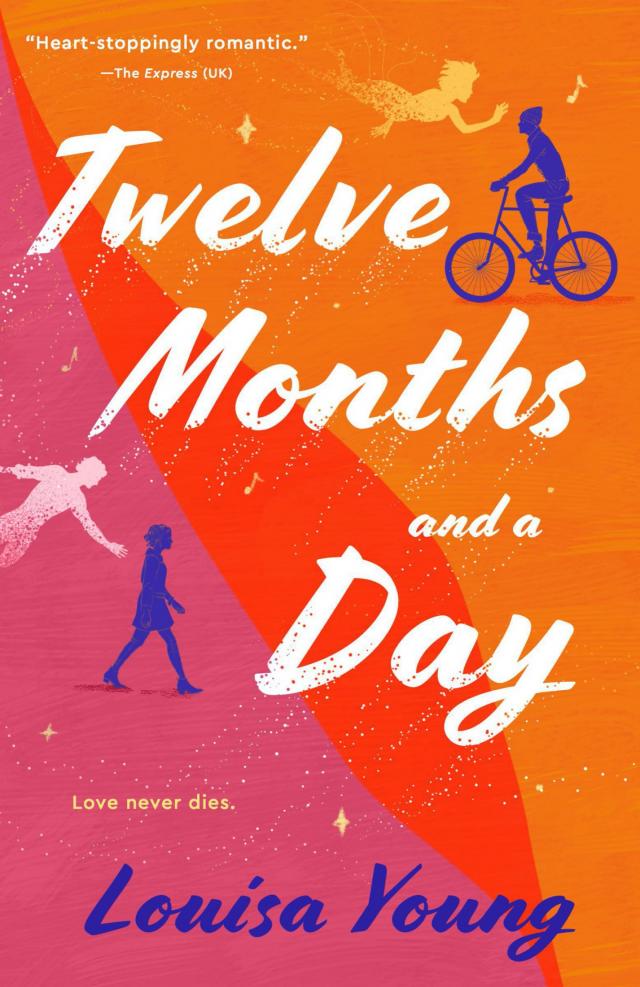
Twelve Months and a Day, page 1


Praise for Twelve Months and a Day
“A wonderful and inventive novel, sorrowful and hopeful in equal measure. It was a true pleasure to read.”
—Miranda Cowley Heller, author of The Paper Palace
“Not many people can pull off a story where two ghosts try to bring the partners they left behind together, but Louisa Young apparently can and did. More than a novel, this is a treatise on love, death, and grief that utterly blew me away. One of the freshest love stories I’ve read in years.”
—Colleen Oakley, author of The Invisible Husband of Frick Island
“Equal parts tender, sparkling, and authentic, Louisa Young’s prose is like watching a flower open, each moment beautiful, mesmerizing, and better than the last. Twelve Months and a Day will have readers captivated from beginning to end.”
—Amy E. Reichert, author of Once Upon a December
“A tale of two love stories with a supernatural twist, Twelve Months and a Day is poignant and sad as well as funny and beautifully written and imagined. What if our beloveds lived on as ghosts and watched us grieve, what if they never really leave us, and what if some of these ghosts even meet? You will fall in love again as you read this clever book by a writer who understands grief. Hugely engaging and readable. A bittersweet pang in my heart as it ended. A page-turner.”
—Monique Roffey, author of The Mermaid of Black Conch
“What a writer. A raw and beautiful exposition on grief and loss but so beautifully earthed in the everyday. Terrific.”
—Elizabeth Buchan, author of Revenge of the Middle-Aged Woman
“The words ‘emotional roller coaster’ seem coined for Louisa Young’s beautiful, bittersweet novel, as heart-stoppingly romantic as it’s heartbreakingly sad. . . . Young has a playfully light touch, delighting in the absurdity of the supernatural situation and the unusual romantic complications, even as she explores the heavy emotional burden that death brings. A lovely, moving, ultimately hopeful read.”
—The Express (UK)
“A modern-day Truly Madly Deeply . . . Rasmus and Roisin both lose their partners, but the ghosts of Nico and Jay stay, unable to leave their loved ones alone as the brokenhearted pair find comfort in each other. Beautifully written, this is a haunting love story—literally.”
—Best magazine (UK)
“Delicately balanced between wry and tender, Twelve Months and a Day is both an exorcism of the most brutal pain of final separation and a way of managing the stubborn refusal of the mind to accept absolute absence. Thoughtful, philosophical, and clever, it is also funny, and full of poetry, and powered by an unflagging and irresistible belief in the redemptive power of love.”
—Perspective magazine (UK)
“Louisa Young is the great chronicler of romantic love and the pain of its loss.”
—Linda Grant, author of The Clothes on Their Backs
“Left me happily in bits. A skillfully calibrated love-after-death tale, it’s a four-course feast of hearts broken, hearts mended, of songs, laughter, old regrets, and fresh desire that demands a major film deal.”
—Patrick Gale, author of A Place Called Winter
“A beautiful book. Insanely romantic and utterly convincing.”
—Julie Myerson, author of The Stopped Heart
Praise for My Dear I Wanted to Tell You
“Inspires the kind of devotion among its readers not seen since David Nicholls’s One Day.”
—The Times (UK)
“This masterly storyteller fervently believes that the healing process begins with a decision to share your stories . . . with those you love.”
—The Washington Post
“An epic love story.”
—Kirkus Reviews
“Powerful.”
—The Sunday Times (UK)
“Singular in quality . . . an unsensationalized and thoughtful story of . . . that universal constant—love.”
—Publishers Weekly
“One of those books that doesn’t leave you, and probably never will.”
—Jacqueline Winspear, author of Maisie Dobbs
“Uplifting and emotional.”
—Tatler
“Compelling and deeply moving.”
—The Observer
“The lives of loved ones left behind are masterfully conveyed.”
—Woman & Home
Also by Louisa Young
FICTION
Baby Love
Desiring Cairo
Tree of Pearls
My Dear I Wanted to Tell You
The Heroes’ Welcome
Devotion
NONFICTION
A Great Task of Happiness
The Book of the Heart
You Left Early: A True Story of Love and Alcohol
CHILDREN’S
(with Isabel Adomakoh Young as Zizou Corder)
The Lionboy Trilogy
Lee Raven, Boy Thief
Halo
G. P. PUTNAM’S SONS
Publishers Since 1838
An imprint of Penguin Random House LLC
penguinrandomhouse.com
First published in the United Kingdom in 2022 by The Borough Press, an imprint of HarperCollins Publishers Ltd.
Copyright © 2022 by Louisa Young
Penguin Random House supports copyright. Copyright fuels creativity, encourages diverse voices, promotes free speech, and creates a vibrant culture. Thank you for buying an authorized edition of this book and for complying with copyright laws by not reproducing, scanning, or distributing any part of it in any form without permission. You are supporting writers and allowing Penguin Random House to continue to publish books for every reader.
Library of Congress Cataloging-in-Publication Data
Names: Young, Louisa, author.
Title: Twelve months and a day / Louisa Young.
Description: New York : G. P. Putnam’s Sons, 2023.
Identifiers: LCCN 2022047433 (print) | LCCN 2022047434 (ebook) | ISBN 9780593542651 (trade paperback) | ISBN 9780593542644 (ebook)
Classification: LCC PR6125.O9415 T94 2023 (print) | LCC PR6125.O9415 (ebook) | DDC 823/.92—dc23
LC record available at https://lccn.loc.gov/2022047433
LC ebook record available at https://lccn.loc.gov/2022047434
p. cm.
Cover design: Tal Goretsky and Sandra Chiu
Title page art: Cloud background © Ratchat / Shutterstock
Book design by Alison Cnockaert, adapted for ebook by Maggie Hunt
This is a work of fiction. Names, characters, places, and incidents either are the product of the author’s imagination or are used fictitiously, and any resemblance to actual persons, living or dead, businesses, companies, events, or locales is entirely coincidental.
pid_prh_6.0_142389075_c0_r0
Contents
Cover
Praise for Louisa Young
Also by Louisa Young
Title Page
Copyright
Dedication
Epigraph
1. Bloody Boats
2. This Is Natural
3. Are Ghosts Allowed?
4. Floating Witchery
5. I’m Okay
6. Opening Chords
7. Delusion
8. Boiled Egg
9. Strong
10. Monstera
11. Into the Sea
12. A Really Crap Quality
13. Cuban Heels Under a Disco Ball
14. Machinations
15. Have You Exploded?
16. More Honestly
17. It’s a Leap
18. I Don’t Know How
19. Sandbags
20. Alchemy
21. Don’t Remind Me
22. Tá Mo Chroíse Briste Brúite
23. Not Absolutely Biblical
24. Earthlings
25. Don’t Hurry the Journey
26. Location
27. Tangerine
28. Change Everything
29. For the Boatman
30. A Red, Red Rose
31. What About Breathing?
32. It’s Sweet to See
33. A Big Beautiful
34. Love and Love
35. He Hadn’t Meant To
36. You in Your Condition
37. And Where Does That Lead?
38. Enthralled
39. A Bench or a Grave
40. Cheeky Sod
41. Feathered Hat
42. Melty Like a Whale
43. Yellow Roses
44. The Songs
45. Baby Baby Baby
46. A Glass of Champagne
47. Big Ragged Moon
48. What IS Your Name?
49. Symbolic
50. Not So Far Away
51. Toward Home
52. Let No One Say That Romance Is Dead
A Note on the Songs
Acknowledgments
Book Ends
A Conversation with Louisa Young
Discussion Guide
About the Author
_142389075_
To Michel Fa
Of old age, in our sleep
It seems ridiculous to suppose the dead miss anything.
—Marilynne Robinson, Gilead
1
Bloody Boats
FEBRUARY
London
Róisín Kennedy—thirty-three, observant, clever, a slight rockabilly look to her (blue-tipped hair, at the moment, and a little fringe)—was feeling good in the pale sunshine of the gastropub garden. She and her fiancé, Nico Triandafilides—thirty-six, nicely shaved, clean white shirt, quite the lad even on a Saturday lunchtime—hadn’t seen much of each other that week. He’d been working nights and she’d had a deadline in the editing suite. They hadn’t been getting on that well: for three months they’d been on a promise to discuss whether or not they wanted to have a child, though it was something neither of them actually wanted to talk about. They each thought that the other felt differently about it to them and was secretly upset. They were both wrong, and therefore they were both, secretly, upset. So this long-weekend morning of unexpectedly hot sex and breakfast out was bloody lovely.
It was the first sunny morning of springtime: too early for the crocuses, but the unmistakable secret sign had gone out. The light was a breath lighter; even London’s sooty black walls and spit-raddled gray curbstones had an air of imminence. When the breeze lifted your hair, the sun was almost warm on your skin. The swans in the park had started with the neck-coiling; there was mimosa on the flower stalls. She was having avocados and stuff; he was going the full English, with triple espressos and extra black pudding.
“Funniest thing this week?” she cued him, their old habit, a guaranteed mood-enhancer—mood-changer if need be—and that started up the run of stupid jokes. One of her many sisters, Nell, had pointed out that the term “Leider-hosen”—like Lederhosen, the well-known and arguably regrettable dungaree-style Alpine leather shorts, only with an extra i—meant, in German, literally, “regrettable trousers.” This alone provoked some hilarity. “Yeah, I’ve had a few pairs of them in my time,” Nico said, and they remembered one brown tweed suit that had made him look like a confused sheep farmer.
“Or an Irish intellectual,” Róisín had said kindly.
“Irish!” Nico squawked, which was fair enough as he really couldn’t have looked more Greek, from his brown eyes and hairy chest to his quizzical mouth and not-very-secret desire to have a mustache like his granddad’s.
“So does that make Lieder-hosen trousers for singing classic German folk songs in?” Nico said, and it went downhill.
Lido-hosen, she suggested, for urban swimming.
“You could wear them when you go to Crouch End,” he said. “With Lilo-hosen to change into, for wearing on your lilo. Inflatable, maybe.”
Lipo-hosen, she suggested, which make you thinner.
“We don’t need them,” he said. “Lager-hosen, for drinking beer in! Indistinguishable from the original Lederhosen.”
“Luger-hosen,” she said, “with a built-in holster.”
Wader-hosen, with long wellies attached for fishing. Yoda-hosen, Data-hosen, Gator-hosen, and make it snappy. Hater-hosen, for Twitter trolls; Mater- and Pater-hosen for Latin teenagers to address their parents; Straighter-hosen, if you’re going for the skinny-leg look. They were in such hysterics by then that people turned to look. All those couples with nothing to say to each other after fifteen years, glancing across at the couple in fits of giggles. It wasn’t because the jokes were that funny, because obviously they weren’t. It was just that they were having such a lovely time. He’d even rolled up his sleeves, pretending they were by some sunlit blue bay in Ithaca, at Frikes in the morning sun, with bitter coffee and baklava—God, summer, so far away—and then something in the sound of his laughter changed and she was calling out.
Twenty-one minutes while she and the barmaid took turns giving him CPR, till the ambulance came. Paramedics who didn’t know that he was one of them. But everybody knew that it was too long. Her eyes were still full of the tears of laughter he’d reduced her to. She didn’t feel it was right for him to die while her hair was this stupid blue. She wanted to kiss him but once the pros arrived, she couldn’t get near him for equipment. CPR, our last kiss.
After a while, alone and almost furtive by the trolley in A&E, she took her father’s wedding ring from her forefinger and put it on his finger, third finger, left hand. And she took his stupid rock ’n’ roll silver skull ring and put it on her own.
“I do,” she tried to say. “You do too.”
They’d been going to. He’d actually proposed the day they met: in the mudbath of a Glastonbury crowd bouncing around to the Fratellis. Nico had intervened when a drunk stranger was being difficult during “Chelsea Dagger” (“Listen,” he’d said. “Go away.”), and the resultant joshing ended up with him proposing to her. A year later he’d given her a diamond. No mud. But they’d never got round to the actual wedding. It seemed absurd, actually getting married. But a romantic revelation had crept up on them. This was love. This every day. This supporting each other. Me supporting him, mostly, she often thought, but you know. The diamond fitted snugly now with the skull, like a tiny flower behind its ear. Holding it on.
* * *
◆ ◆ ◆
She stood on the deck of the launch in the black-and-white Dalmatian-print fake-fur coat she had decided was just the thing for the occasion. Well, what the hell do you wear? she thought. To denote courage, devil-may-care desperation, determination, I’m going to make it through today, I am, it’s required.
She’d cut her hair, because she didn’t know what to do: slaughtered the peroxide strands with the blue tips and the little tumbling fringe; sent it to the cancer charity for children. Her head now wore a soft fuzz of its natural dark brown and she’d a feeling she looked like Sinéad O’Connor back in the day. Sinéad was a lovely-looking woman, but it wasn’t what she wanted people to be thinking about when they were shouldering his coffin to the boat. Still, she’d done it now, so.
To the northeast she saw the red-and-white lighthouse of the Needles standing proud against blue sky. Southwest was the wide horizon down to the Atlantic. Behind her, a hundred people on a bright, terrible, unseasonably sunny morning out on the Solent in boats, all saying “I had no idea he wanted to be buried at sea!” But that’s the good thing about dying young. Lots of friends still around to come to your funeral. Look, darling, they all came! And they’re all in bloody boats!
Who knew!
She’d let his mum arrange it all. She was hardly going to make a fuss when Marina was ringing her wanting to know if she thought it would be all right, as there was no grave in the earth, to ask the sea-burial people if they could throw the grains of wheat into the sea, or should they just do it without saying anything? Róisín had no opinion about that.
Nobody knew where his will was.
Lots of his family were there, lighting candles in loaves of bread, and keening. Twenty-three of hers. Declan with the good voice sang “The Parting Glass”; Dmitri with the even better voice sang the one about how he gave her rosewater and she gave him poison . . . The works. He died. Damn you, you utter bastard, darling—Cavafy was recited, of course: “Ithaka.” Kind of compulsory. Don’t hurry the journey at all, better if it lasts for years . . . She hardly heard it; there was nothing in her to consider how inappropriate that was. And Tennyson: Sunset and evening star, And one clear call for me! And may there be no moaning of the bar, When I put out to sea . . . The kind men in uniform put the lilies aside and flicked the flag away. Nico’s coffin—plain new wood, heavily weighted—had been drilled through with more holes than she had expected. It was so quick! The men tipped it into the sea, green and choppy here, mercury-silver in the distance, bloody sea, you can’t trust it, and it sank. She wasn’t crying, because she didn’t want to set people off, to raise the water level. She watched the bubbles swaying as they rose. Goodbye. Aντίο φίλε μου. Slán.
Everyone else cried anyway, friends and relations, throwing flowers on the water. Gulls appeared from nowhere and wheeled beautifully among them. The boat circled, and for a moment she thought she felt a hand on the back of her neck. She jumped—but there was nobody.