

Alchemy and Artifacts, page 1


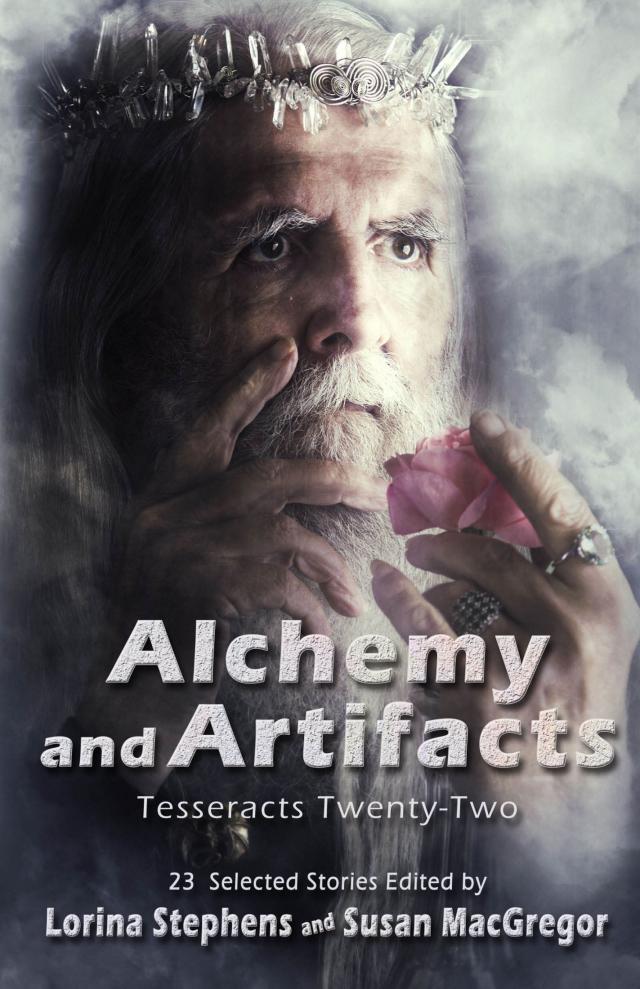
Alchemy and Artifacts
Tesseracts Twenty-Two
edited by Lorina Stephens
and Susan MacGregor
Copyright © 2019 All individual contributions
copyright by their respective authors
e-Book Edition
Published by
EDGE-Lite
An Imprint of
HADES PUBLICATIONS, INC.
CALGARY
Notice
This eBook is licensed for your personal enjoyment only. It may not be re-sold or given away to other people. If you would like to share this book with another person, please purchase an additional copy for each reader. If you’re reading this book and did not purchase it, or it was not purchased for your use only, then please purchase your own copy. Thank you for respecting the hard work of the author.
* * * * *
~ The Tesseracts Series ~
Tesseracts 1
edited by Judith Merril
Tesseracts 2
edited by Phyllis Gotlieb & Douglas Barbour
Tesseracts 3
edited by Candas Jane Dorsey & Gerry Truscott
Tesseracts 4
edited by Lorna Toolis & Michael Skeet
Tesseracts 5
edited by Robert Runté & Yves Maynard
Tesseracts 6
edited by Robert J. Sawyer & Carolyn Clink
Tesseracts 7
edited by Paula Johanson & Jean-Louis Trudel
Tesseracts 8
edited by John Clute & Candas Jane Dorsey
Tesseracts Nine
edited by Nalo Hopkinson and Geoff Ryman
Tesseracts Ten: A Celebration of New Canadian Speculative Fiction
edited by Robert Charles Wilson and Edo van Belkom
Tesseracts Eleven: Amazing Canadian Speculative Fiction
edited by Cory Doctorow and Holly Phillips
Tesseracts Twelve: New Novellas of Canadian Fantastic Fiction
edited by Claude Lalumière
Tesseracts Thirteen: Chilling Tales from the Great White North
edited by Nancy Kilpatrick and David Morrell
Tesseracts Fourteen: Strange Canadian Stories
edited by John Robert Colombo and Brett Alexander Savory
Tesseracts Fifteen: A Case of Quite Curious Tales
edited by Julie Czerneda and Susan MacGregor
Tesseracts Sixteen: Parnassus Unbound
edited by Mark Leslie
Tesseracts Seventeen: Speculating Canada from Coast to Coast to Coast
edited by Colleen Anderson and Steve Vernon
Tesseracts Eighteen: Wrestling With Gods
edited by Liana Kerzner and Jerome Stueart
Tesseracts Nineteen: Superhero Universe
edited by Claude Lalumière and Mark Shainblum
Tesseracts Twenty: Compostela
edited by Spider Robinson and James Alan Gardner
Tesseracts Twenty-One: Nevertheless
edited by Rhonda Parrish and Greg Bechtel
Tesseracts Twenty-Two: Alchemy and Artifacts
edited by Lorina Stephens and Susan MacGregor
Tesseracts Q
edited by Élisabeth Vonarburg and Jane Brierley
Publisher’s Note:
Thank you for purchasing this book. It began as an idea, was shaped by the creativity of its talented author, and was subsequently molded into the book you have before you by a team of editors and designers.
Like all EDGE books, this book is the result of the creative talents of a dedicated team of individuals who all believe that books (whether in print or pixels) have the magical ability to take you on an adventure to new and wondrous places powered by the author’s imagination.
As EDGE’s publisher, I hope that you enjoy this book. It is a part of our ongoing quest to discover talented authors and to make their creative writing available to you.
We also hope that you will share your discovery and enjoyment of this anthology on social media through Facebook, Twitter, Goodreads, Pinterest, etc., and by posting your opinions and/or reviews on Amazon and other review sites and blogs. By doing so, others will be able to share your discovery and passion for this book.
Brian Hades, publisher
Contents
Alchemy and Artifacts
~ The Tesseracts Series ~
Publisher’s Note:
Contents
Foreword
Lorina Stephens
Foreword
Susan MacGregor
Cleaning House in Ithaca
Leslie Brown
Caligula’s Eagle
Tony Pi
Blood, Lead, and Torchlight
Cat McDonald
The Guardian of Wisdom
Mary-Jean Harris
By A Thread
Geoff Gander and Fiona Plunkett
Mirror of Alchemy
Katherine Cameron
The Inland Beacon
Kate Heartfield
The Witch of Glencoe
Bev Geddes
Winged
Michal Wojcik
Saddle and Snake
R. W. Hodgson
Joint-Eaters
Halli Lilburn
Lady Jordan
Bianca Sayan
Things Better Left Buried
Chris Patrick Carolan
Phlogiston’s Rainbow
Erik Jon Spigel
The Horn of Winter
Jason Lane
Uki Dreams
Colleen Anderson
Intentions
Lara Apps
Darkness Peering
Kurt Kirchmeier
The First Pillar of Wisdom
Mike Rimar
The Berlin Golem
Geoffrey Hart
Khrushchev’s Shoes
Liz Westbrook-Trenholm
If There’s A Goal
Michael Skeet
Holding Our Own
Holly Schofield
If you enjoyed this read
About the Editors
Need something new to read?
The Black Chalice
By the Light of Camelot
Druids
Details
Foreword
Lorina Stephens
When Susan MacGregor approached me to co-edit an anthology of historical fantasy for the next Tesseracts series it didn’t take a lot of reflection for me to agree. I work well with Susan. While we don’t agree on everything — what partnerships ever does, or should — I knew we shared a deep love of historical fantasy and fiction, that we both felt the genre tended to get shunted off into the realms of literature of little import, fluff, pulp for the brainless masses. And we are both uncompromising in our search for excellence.
We both feel historical fantasy very much matters, especially historical fantasy that pushes a reader to think, fiction that takes a concept, a culture, an incident, or an artifact, and launches into rich speculation — what if?
For me, the cultural surround of history has always been profound, because it is through cultural artifacts we glimpse the possibility of what occurred in the past. The artifacts carry voices, warnings, celebrations. They are touchstones and resonate if we only will observe, listen, be willing to learn. Once the creators are dead, the wars ended, the political machines decayed and dissolved, there are the artifacts, the art. Manna.
Ah yes, manna. It is a concept I have long embraced, first coined to me outside of its Biblical reference by an old acquaintance, Darrell Markewitz, who is an artisan blacksmith of some considerable repute, having forged — forgive the pun — a reputation as an expert in ancient Norse metallurgy. Darrell said to me an artisan should strive to imbue manna in the work they create, that by doing so they created something which transcends themselves and their skill, that they created something which would inspire and nourish generations to come.
That concept, that imperative to imbue manna into a work has stayed with me ever since. And so, when it came to selecting stories for an anthology about the alchemy of artifacts, it of course followed those stories must needs be imbued with manna. These stories had to not only use as a touchstone an artifact from history, but then create a story which would nourish those of us wandering in a wilderness. Especially the wilderness of today, in a world which seems determined to plunge blindly and eagerly along a path of hate, destroying all that has been, everything that is true and beautiful and that nourishes our global community, everything that has manna.
So, Susan and I waded through an embarrassment of riches, and finally, after weeks and weeks of reading, discussion, debate, came up with twenty-three stunning stories, all of them with manna.
I am very proud of this anthology, proud to have been one of its curators. I believe, in time, it will be remembered as an anthology of manna, this anthology — Tesseracts 22: Alchemy and Artifacts.
Lorina Stephens
Foreword
Susan MacGregor
I’m one of those people who likes to ask herself why she’s drawn to certain things. It’s never been enough for me to answer, ‘because I am.’ I have to delve into my o
I’ve always found history fascinating — although not so much its dryer aspects. What captivates me instead, are the motivations behind those dates and events, the quest for power, the fight against repression, the sacrifices to a greater cause — in other words, the human drama that reflects the worst and best of who we are. Greed and conquest drive us as much as our need for order, justice, and peace. Our past shows us where we’ve been and how we are evolving — if, in fact, we are. Above all, our history reflects our human need for more. As humans, we are a grasping, driven, hungry, and magnificent species. Which means we live and create wonderful stories, just by virtue of who we are.
When we add a fantastic element to such tales, we stimulate two other very human experiences — the satisfaction that comes from sudden insight, and occasionally, awe. When I asked contributors to send us stories that featured the ‘hidden’ side of history, tales that reflected the magic behind the events, I was hoping to come across such alchemies. There is much that happens in our world that we don’t see. The past is no exception. I wanted to get a sense of ‘the man’ (or woman) who was behind the curtain, the one pulling the world’s strings. Or to get a hint of those forces we only suspect are there, but that disturb us with their possibility.
I’ve often felt that historical fantasy tends to be dismissed by those who favor the purer flavors of the genre, as well as by those lovers of science fiction who look to the future with hope or cynicism. Why bother with the past, when the future is so much more exciting or depressing? Writing historical fantasy demands a whole new level of expertise. All writers world-build, but with historical work, research is critical. You have to know your stuff and work within the past’s restrictions and constructs. And then — you weave what you hope is an intriguing story.
Before you are twenty-three amazing artifacts of fantastic historical fiction, filled with the alchemy I had hoped to discover. It’s been a pleasure to put this collection together with my dear friend and co-editor, Lorina. May these tales entertain and enthrall you, as they have us.
Susan MacGregor
Cleaning House in Ithaca
Leslie Brown
“Papákis, I’ve been looking everywhere for you!” The dark-haired boy landed beside him accompanied by a tiny landslide of shale and dirt.
“I’m here where I always am,” Odysseus said and flipped his bait a little farther out into the aquamarine waters of the Ionian Sea.
“Mitéra says you are supposed to be cleaning out the back room of the house. Your useless junk has to go so Giagia can sleep there.” The boy started rooting through the crock of worms, pulling one out and then another.
“Leave my bait alone, Poli. You’ll put the taste of boy on them and the fish won’t want them anymore.” Odysseus squinted up at the sun. Penelope had a point. The room containing the souvenirs of his travels was in the gynaecium or women’s quarters. There had been space there when he had returned from the war but ever since Telemachus had married, there were more women in the house. And now Penelope’s mother was to live with them. Odysseus was expected to dispose of the mementos of his past, as if his achievements meant nothing.
He left early to go fishing in an effort to avoid Penelope, so she sent the boy to do her nagging for her. That wasn’t the only thing she’d been pestering him about. She wanted him to speak to Telemachus about how he treated his younger brother Poliporthes, the same who was now rooting through the worms. Odysseus had left when Telemachus was an infant and returned when he was a man. His older son was jealous of his younger brother for having the attention of a father as he grew up. Odysseus felt bad about that, of course he did, but what could he do about it? Ignore the boy to make his brother feel better? It was ridiculous and annoying, and it gave rise to his retort to Penelope, words that could not be taken back: if he is even my son.
Odysseus had been a red head in his younger days and Telemachus a reddish blonde. Poliporthes was dark-haired like his mother but his skin was more olive toned than hers. And where did that nose come from? Odysseus had never asked after he had disposed of his wife’s suitors, and Poliporthes had been born close enough to the proper time after they had returned to their marriage bed. In all truth, he never would have said anything but for the nagging. You don’t pay enough attention to your oldest son. You pay too much attention to your youngest son. You don’t want my mother to live with us. Your useless junk is taking up valuable space. Get rid of it or sell it so we can feed all these mouths.
Odysseus sighed. He couldn’t avoid it forever. “You’ll help me clean the room, boy?”
The boy, who might or might not be his, glanced up at him, love and trust shining in his eyes. “Of course, Papákis. I’m strong. I can carry things down to the courtyard.”
The heat of midday was upon them and the house was quiet. Odysseus led Poliporthes upstairs to the storage room, glancing ahead to make sure all the women’s rooms were decently curtained. He paused briefly beside Penelope’s dayroom and then resolutely pushed on. She’d be sweeter once she knew he was tackling the storage room.
He had put a wooden door on this room and had woven an intricately knotted piece of rope looped between two brackets to hold it shut. No one, including himself, had gone in there for five years or more. He cut the rope off with his knife rather than trying to untie the knot. Dust swirled in the air when he pulled open the door. Ah, he had forgotten how much was in there. The stories of shipwrecks and lost valuables were exaggerations. He had loaded up his ship with the treasures of Troy and hadn’t exactly come straight home. He had dallied, there was no denying, in most cases to earn him and his men shelter and food. Who was he to say anything if his wife had also done what she needed to do to survive? Ah but Gods, the look she had given him when he had said those unforgivable words. You’d think he had struck her across the face.
The chests were going to be the biggest job. They were stacked from floor to ceiling for half of the room. There was ornate furniture too fussy for any of them, even his wife’s mother. That could go, either to be remade into something more palatable or sold to a rich merchant with no taste.
“Poli, let’s take these chairs down to the courtyard.” Penelope would chide them for doing servants’ work, but Odysseus didn’t want uncaring hands touching his mementos. By starting with furniture, they could postpone the chests for a bit. There was no gold or jewels in them. He had taken those out before the chests had gone into storage. The money had been put into the house which had desperately needed repair.
They made quick work of the furniture and stacked up three piles in the courtyard: one to sell, one to give away to the villagers and one to have the carpenter simplify.
“Right,” Odysseus said, dusting off his hands and glancing upwards. Heads were appearing at the second floor railing then disappearing. Many eager feet were now scurrying to tell Penelope that her husband was finally doing her bidding. “Let’s tackle some of the chests.”
He knew where everything was, even after all these years. Since he had found new resolve, he and Poli pulled down the most troublesome first. The resin had seeped out of the wood, sealing the lid shut. They pried it open with an old blade. Inside was a wrapped statue, approximately Poli’s height. They set it upright and Odysseus pulled off the wrappings.
“Athena,” Poli exclaimed with delight, touching his brow respectfully. He knew the stories of how the goddess had favored his father in his travels, and also aided his older brother. She was a favorite of his.
“Not just any statue,” Odysseus said, gazing at the lidded eyes and pursed mouth of his patron goddess. “This is the Palladium. Troy could not fall until I stole her from inside its walls. All I had to do was dress like a beggar and speak with a cowherd’s accent. They let me in, even with a foreign army camped on their doorstep, the idiots. I heard the city cry out, you know, when I took the Palladium through the gates in a dung cart. But only I heard it. The guards kept playing dice.”
“Hah,” said Poli in awe and appreciation.
“Such a fine piece as this should go to Menelaus and Helen. We’ll bring her down to the family shrine and make offerings until she goes to Sparta. She’s probably angry with me for shutting her in a trunk for so long.” He set the carved wooden statue aside. She could use a paint touch-up as well. He and the boy would make a mess of that. Best pay an artist.





