

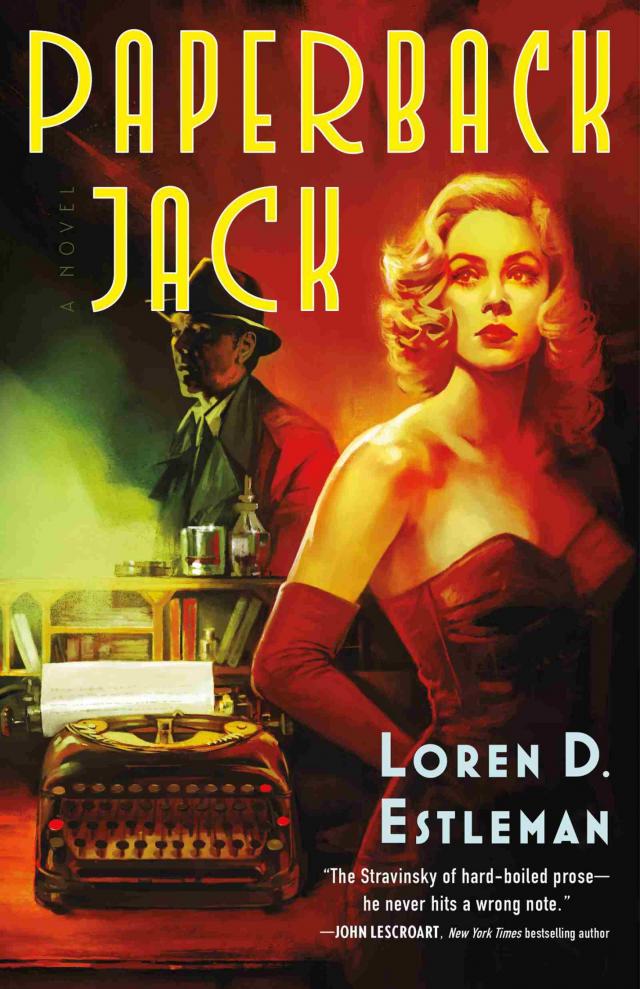
Paperback Jack, page 1


Begin Reading
Table of Contents
About the Author
Copyright Page
Thank you for buying this
Tom Doherty Associates ebook.
To receive special offers, bonus content,
and info on new releases and other great reads,
sign up for our newsletters.
Or visit us online at
us.macmillan.com/newslettersignup
For email updates on the author, click here.
The author and publisher have provided this e-book to you without Digital Rights Management software (DRM) applied so that you can enjoy reading it on your personal devices. This e-book is for your personal use only. You may not print or post this e-book, or make this e-book publicly available in any way. You may not copy, reproduce, or upload this e-book, other than to read it on one of your personal devices.
Copyright infringement is against the law. If you believe the copy of this e-book you are reading infringes on the author’s copyright, please notify the publisher at: us.macmillanusa.com/piracy.
This book is dedicated to the memory of Donald Hamilton, Gordon D. Shirreffs, Richard Matheson, and Harlan Ellison, whose books found their largest readership during the Golden Age of the paperback, and whom I was privileged to call my friends; also to their colleagues, who along with them helped to create that distinctly American tradition: art from junk.
If it is art, it will offend before it is revered. There are calls for its destruction and then the bidding begins.
—E. L. Doctorow, Homer & Langley
PART ONE
1946
PENNY A WORD
CHAPTER ONE
The Remington Streamliner portable was black, glossy, curved, with a sleek low profile like a Cadillac roadster. It had four rows of black-and-silver keys, but three keys were enameled in ruby red. One, the tabulator (largely useless except to accountants), was labeled SELF STARTER.
The typewriter—for that’s all it was, despite the trimmings—compared to his old gray Royal standard like a spaceship parked next to a hay wagon. In a pawnshop window it was absurdly out of place, surrounded by egg-beaters and pocket watches, bouquets of fountain pens, a Chock full o’Nuts coffee can filled with wire-rimmed spectacles tangled inextricably like paper clips, a full set of the World Book Encyclopedia (outdated emphatically by events in Munich and Yalta). It looked proud and disdainful, a prince in exile.
And it spoke to him.
“My keys will never tangle or stick,” it said. “I will never skip a space or type above or below the line. All I ask is a cleaning now and then, a little light oil, and I will serve you faithfully forever. Together we will change the face of literature.”
Jacob tugged on the handle to the door of the shop. It wouldn’t budge. A tin sign in the barred window told him to ring the bell. He pressed a brass button. There was a pause, then a buzz and a clunk, and he pulled the door open. That was something new in the world of retail. It belonged in a prison film.
The proprietor was an anachronism in green felt sleeve-protectors, black unbuttoned vest powdered with gray ash, and a green eyeshade that turned his long narrow face the color of a pickle. His red bow tie was so surrealistically crooked it might have been tied that way deliberately. He stood behind an old-fashioned wooden counter that reached to his sternum. The cardboard recruiting poster on a shelf behind him might have been merchandise, or it might have been stood up there by a previous owner and forgotten: The snarling German soldier wore a spiked helmet from two wars ago. The colors were faded and the corners curled inward.
“Yes-s?” A slight hissing at the end, as if the man had drawn in too much breath for just that one syllable and the rest had to escape.
“What are you asking for the typewriter in the window?”
The proprietor reached up to adjust a pair of glasses he wasn’t wearing, squinting past the visitor’s shoulder in the direction of an item he knew was there. “Fifty dollars.”
Jacob goggled. “I wouldn’t pay that for a brand-new machine!”
“Depression’s over, mister. Cost of living’s on the rise.”
“I’ll give you twenty-five.” He could get a used Underwood from the Business Exchange for less; but it must be the Remington.
The man behind the counter registered funny-papers astonishment. Jacob was half surprised his eyeshade didn’t fly off his head. “That’s less than I gave the dame who brought it in.”
“Do you know why she didn’t redeem it?” He had a sudden doubt about the mechanics of the machine.
“It was her father’s. Fergus Tunn, the poet? FBI tagged him for writing Nazi propaganda. They stuck him in a booby hatch upstate. She pawned it to keep him in straw to weave baskets. It was in all the papers.”
There it was again, that accusatory coda: It was in all the papers. The uninformed were the second-class citizens of the postwar world. “When did this happen?”
“Last year sometime.”
“Last year sometime I was in Brussels, waiting for my orders to ship home. If it made the papers there, it was in French. Or Flemish, which no one speaks a hundred yards outside the borders. Thirty.”
“Fifty’s the price. Comes with a case, pebbled-black fabric with chromium latches. It’s a quality item.”
Jacob wished he’d worn his uniform and medals. They had a wizard effect; or had, before the parades on Fifth Avenue lost their novelty. His suit was the one he’d worn to basic training, and it was out of fashion even then, but it had fit. Now it hung loose around the belly and cinched tight at the shoulders. “Can’t a veteran get a break?”
A tongue came off a tooth with a sharp snick. “Vets. Spoiled buggers.”
“Spoiled?”
“Sure. All them free ham steaks and gasoline to burn while us Home Fronters had to hoard stamps to buy baloney and drive clear out to Coney Island for a little sun, which I think was rationed too. Now you want a deal just ’cause you wasn’t smart enough to dodge the draft. I ask you.”
“Just for that, ten, you son of a bitch!” Jacob scooped out his Army .45 and slammed it on the counter.
The muscles in the proprietor’s face shut down. He groped under the counter and lifted a short-barreled revolver into line with Jacob’s chest.
“This’s New York, Joe. The milkman packs iron.”
He put away the pistol. He’d packed it for muggers; he hadn’t expected to need it indoors even in that neighborhood.
The revolver vanished. “Next time I call the cops. Four-flusher.”
The buzzer let him out, blowing a raspberry.
Jacob drank six jiggers of Four Roses in a joint down the street called Ted’s Last Chance. It was of a piece with its surroundings, plopped between a check-cashing place and a Salvation Army store that smelled like old gym socks: Dead fighters struck old-fashioned stances in flyblown frames behind the bar. The juke kept playing “I’ll Never Smile Again.” Sots blubbered in their Schlitz.
After Last Call, when the only lights burning in the pawnshop were the little Christmas bulbs at the back to discourage burglars, Jacob threw a brick through the window and ran away with the Remington under his arm. He almost tossed a sawbuck into the vacant spot, but he might as well have left a card. And the alarm was clanging at his heels.
He’d pulled a gun on a civilian and robbed a legitimate place of business. He was a fugitive.
His name was Jacob Heppleman. He was twenty-nine years old, unmarried but no virgin, and thanks to the war was in as good a physical condition as he’d ever been or was ever likely to be. He was a writer, or had been before Pearl. Although he’d written a good deal about the sort of person who threw bricks through windows and snatched what was on the other side, he’d always dismissed them as freaks of nature, career crooks or wretches driven by ignorance or bad company into a Life of Crime: Fellows with broken noses, who doubled all their negatives and ended their sentences with prepositions; plot devices. This was the first criminal act of his life. It left him mortified, as if he’d been caught masturbating by the rabbi.
But three blocks away, with no police whistles in pursuit, no sirens, no warning shots into the air—none of the tricks he employed on paper to goose up suspense—he slowed to a stroll, shifting the weight of the Remington under his other arm to rest its mate. He might have been taking home a legitimate purchase. No, thanks, don’t bother to wrap it. I don’t have far to go.
It was a fine fall evening, geese squawking in Central Park; no reason for them to map out the migration just yet. It made a man sanguine. Petty theft, what was that? It wasn’t as if anything he’d fought for still applied.
Halfway home, he realized he’d left the carrying case behind.
CHAPTER TWO
It was funny he’d thought of the Business Exchange back in the pawnshop. That was where his life had begun.
He’d been twenty-one, on his own and out of work. On the way home from his final confrontation with the foreman, he’d stopped in a drugstore for a cup of coffee and the want ads, but the bright colors on the cover of a magazine called Double-Barreled Detective caught his eye and he bought it and read it at the counter.
The stuff was tripe. He didn’t know much about gunshot wounds (not then), but he was sure that no man on earth could floor a mob of thugs in a dingy hotel room with just his fists and with a forty-five slug in his shoulder to boot. But he assumed someone had been paid for writing the scene. He didn’t bother to go back and read the byline.
On the back page, among
He’d gotten out his wallet and counted the bills inside. “How much, buddy?” he asked the man in the paper hat behind the counter.
“Dime for the cup of mud, dime for the magazine. Twenty cents, Rockefeller.”
He had two tens, a five, and two singles in the wallet. From his pants pocket he counted out two dimes and a penny. $27.21. He smacked down the dimes and a penny tip for the Rockefeller crack. That left him with five cents bus fare and just enough for the machine.
That’s how Jacob Heppleman became a writer.
His first story, “Before I Go into Shock,” ran in the December 1938 issue of Double-Barreled Detective, entitled “A Punk with a Rod.” He was paid twenty-five dollars for 2,500 words. It had taken him three months to write, two-finger fashion, on a stodgy Royal standard with a crooked d, and another month to hear back from the editor, but it returned almost a hundred percent on his investment—when the story appeared in print.
Not counting paper, ribbons, and postage. But the storefront accountant he consulted told him the expenses were tax deductible. He charged five bucks for the advice.
It was a joke; in school, had Jacob studied arithmetic more and English less, he’d be earning five bucks an hour instead of a penny a word. But it didn’t take a Euclid to know that if you wrote twice as fast you’d make twice as much, and if you winnowed three months down to three days …
Well, it was still chump change. But it beat duking it out with some ape of a foreman for six-eighty a shift and kicking back four bits to the shop steward.
Had Sir Walter Scott started out this way? Likely not; but Walter hadn’t anticipated the Great Depression.
By his twenty-third birthday, Jacob Heppleman had sold crime stories to Double-Barreled Detective, Goon Squad, Third Degree, and Silk Sheets (a racy-thriller magazine, with a woman on the cover falling out of her lingerie; he was afraid to be seen admiring it in the drugstore), and westerns to Six-Gun Sagas, Warbonnet, Tin Star, Rawhide Riders, and Badlands. When he got tired of powwows and saloons he shifted gears, but after “Amazon Maidens of the Moon” had made the rounds of Orbit, Constellation, Astounding Science Fiction, and Tales From Outer Space, and come back with dog ears and coffee rings, he chucked it.
“Custer’s Ghost” was his last oater; everyone was either a paleface or a sidewinder, and he kept losing track of where the hero left his horse. At that point his rent was paid up and he had pork chops in the icebox, so he cranked in a sheet of yellow paper and spent a month on Chinese Checkers, about skullduggery in Chinatown, a place he’d visited only once, and got sick on bad chow mein. It ran 60,000 words and was serialized in five issues of Double-Barreled Detective. He’d written his first novel.
It caught the attention of a literary agent, who spent twenty minutes on the phone explaining why he needed representation. Finally: “Look, you can be a pulp writer all your life or you can play with the big boys. I’m talking Steinbeck. Hemingway. That dame, she wrote about deer?”
“Marjorie Kinnan Rawlings. The Yearling.” He almost never read in his own field anymore. “You’re serious?”
“The Hindenburg, that was serious. I’m talking im-fucking-mortality.”
He was impressed: It was the first time he’d heard anyone split a word in order to insert an obscenity. He agreed to hire the agent for a ten percent commission.
After three rejections, the agent, Ira Winderspear, placed Chinese Checkers with The Thornberry Press, an old Boston concern, recently inherited by the great-grandson of the founder, and a fan of detective fiction. Many months of revisions and rewrites followed: There were too many blackjacks, the publisher said, too many riddled bodies falling through doorways. On the final stroke of the last draft, the Business Exchange machine broke, sending the crooked d zinging past his left ear.
The book appeared in November 1941, bound in cloth with yellow-and-black Deco on the dust jacket. Sales were modest, but it was favorably reviewed in Literary Digest.
Jacob never saw the review. He was in New Jersey when that issue came out, in basic training at Fort Dix. Pearl Harbor was burning and the Second World War was on.
CHAPTER THREE
The war was over: but the battle with his conscience had just begun.
The first time he sat at the Remington, a wave of guilt swept over him. He’d never so much as stolen gum from the five-and-dime. Then he thought of the pawnshop owner, what he’d said about the men who’d fought for his right to own anything, and he was serene for the moment.
But he promised himself to go back and square things. It would be galling; but then that was something else he’d fought for, the good and just laws that protected everyone.
Which was laying it on thick. It was interesting what committing a crime did for one’s self-righteousness.
The machine worked fine. He was clumsy at first; he hadn’t typed a line in almost five years, and the keystroke was longer than the Royal’s. When he’d warmed up enough to work at his old speed, the keys jammed and he had to separate them by hand. (The Streamliner had fibbed about that; but then it was just trying to make the sale.)
His fear of writer’s block, that maybe he’d left whatever talent he had in some bombed-out farmhouse in Belgium, vanished by the time the bell rang at the end of page one. They waded through wheat waist-high, each of them thinking of the same things: the misty rain soaking their wool uniforms, the way the drops beaded on the barrels of their BARs, the musty smell of wet grain, the hissing sound the spikes made against their pants legs as they walked, the misery of sodden socks: everything but what their drill sergeants had drummed into them in Basic: “Krauts, Krauts, Krauts, morning, noon, and night. You eat Krauts, you crap Krauts, you fuck Krauts in your dreams.”
And then they saw their first one.…
They’d been with him since Antwerp, those words, in that order. He’d thought of making notes, but it was his fate to forget a thing the moment he wrote it down. If he lost the notes—which was likely; sooner or later everything got lost on the march—he would never get the words back. And so he’d repeated them, in his head and aloud, in the shower, when he was shaving, when he laced up his boots, whenever he wasn’t actually walking into harm’s way. The other guys in the outfit called him Charlie McCarthy, Edgar Bergen’s dummy, “on account of Heppleheimer’s always talking, but he don’t know what he’s saying.”
Which was when he’d determined to keep his mouth shut. If he’d feared anything more than death or the loss of a limb, it was that one of his eavesdroppers would be invalided home and write the damn book before he could.
By the time he became accustomed to waking up on his own schedule, with some savings left in the bank, he had three solid chapters and the only outline he’d ever written. He found his old address book and called Winderspear, hoping the number was still in service.
“Hey, hey!” That same gusty greeting in the burring voice marinated in Brooklyn, as if they’d spoken yesterday, with no war in between. The man was a permanence, like the skyscraper where he worked. “Johnny came home. How’s the hero? Bring back any Jap souvenirs?”
“Wrong theater, Ira. When can I see you?”
“Anytime, kid. My door’s always open to clients and vets.”
The door was framed in oak, IBW LITERARY AGENCY painted on the frosted glass, fifteen floors up in the Chrysler Building. It opened directly into Winderspear’s office, oak also, the desk and chairs and file cabinets and three paneled walls, the fourth mostly window looking out on New York City as it appeared on postcards, golden under a cloudless blue sky. Even the man sitting at the desk behind stacks of manuscripts looked like an oak blasted by lightning, his face and bald head gnarled and brown.
“Hey, hey! Fit as a fiddle and ready for work. Looks like you grew six inches over there. In-fucking-credible.”


