The Man Who Loved Mars Anthology, page 26
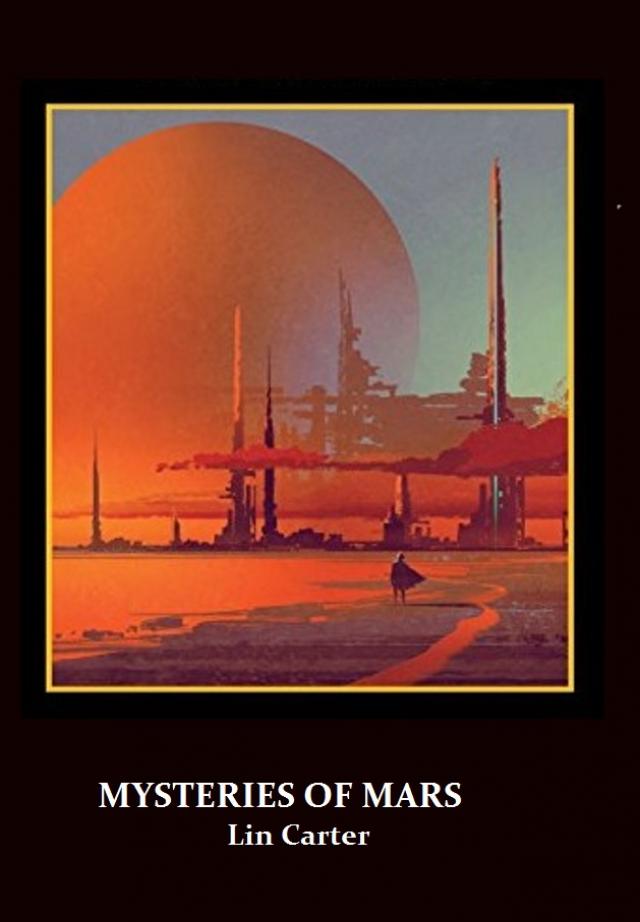


These things he only noticed in passing, as it were. It was the floor of the valley that held his attention, as it held that of Zerild and Phuun and Chastar and his brother. For it was nothing more than a broad and level rock-field littered with crumbled boulders and pocked with innumerable small craterlets.
It was dead, dry, sterile, lifeless rock—just like the surface of the plateau they had been crossing all these days!
It was nothing like what he had imagined it would be.
That made him stop and think. Exactly how had he pictured Ophar? Well, as a valley paradise, he supposed: a beautiful garden. But that was nonsense; there were no gardens on Mars, for the planet was old and dead and barren.
Why, then, had he pictured it so? Probably because of the parallel between Ophar and Eden; a garden is a garden, after all.
But he should have known better.
So should they all. For it was patently obvious that the others had shared much the same dream as M’Cord. Zerild stared down at the dead, rock-strewn valley with an expression of great surprise and disillusionment. Chastar was in a rage, his mouth working loosely, his body trembling with violent fury. Even Phuun was shocked from his customary torpor: the renegade priest was slack-jawed with a surprise so enormous as to be more properly termed horror.
“Tricked! I’ve been tricked!” yelped the outlaw. He turned on Zerild and struck her a vicious blow with his open hand, catching her off guard. The blow left vivid red splotches across her cheeks.
“You devil’s slut! You and your babble of maps and lost marvels! You did this to me—you!”
Thaklar cleared his throat. Chastar turned; the Hawk prince was pointing at the inner surface of the cliff. They looked—all of them, even Zerild, nursing her stinging face with murder burning in the depths of her green eyes.
A stairway had been cut into the stone cliff, leading down.
“That is the way down, Chastar,” Thaklar said calmly. Of them all, only the Hawk prince seemed undisturbed by the disillusionment of finding the Valley Where Life Was Bom to be a lifeless and empty place of barren, dead rock.
“Down! Why should I wish to go down?” snarled the outlaw. “There is dead rock and dust aplenty back the way we came; should I, then, descend into the crater for more of it?”
“If the Valley is truly a dead place, then why this stair?” Zerild asked wonderingly.
It struck them, then, the oddness of it.
With enormous industry and effort—someone—had cut the rocky surface of the sheer precipice into a zigzagging flight of stone steps. Stone steps that led down to—nothing?
It was not possible. Nor was it believable.
As if not trusting their eyesight, they turned simultaneously to peer down into the shallow valley once again. But it still looked the same, a sandy rock plain strewn with worn and crumbling boulders, irregularly pockmarked with craterlets of varying size. There was not the slightest trace of vegetation to be seen among the litter of stony fragments, or upon the slopes of the further wall.
No glint of moisture, no sign of ruins, no evidence that man had ever walked that shard-strewn plain. Only a dreary and desolate valley filled with emptiness.
Then why had the stair been cut in the wall?
Chastar spat a curse, but his fury left him. In its place was a hard, cold-eyed determination.
“Shoulder your gear, all of you,” he commanded. “We are going down!”
“Into … that?” Nordgren questioned feebly, the level afternoon light glinting off his eyeglasses. “But there is nothing there!”
“There must be something there, or they would not have cut the steps into the wall so men could reach it,” Chastar said grimly. “I have come too far and endured too much to turn back without seeing for myself exactly what Ophar truly is. Only when I have paced that plain from wall to wall and found nothing, only then will I give up the search and turn back. Shoulder your gear, F’yagh, and begin to climb down. You will lead us, yellow-hair; you and your kinswoman!”
Nervously, Nordgren peered down at the first step of the stair. It was only a few inches below the brink on which he stood. The stone of the cliff surface had been cut away, and each step projected about two feet from the side of the precipice. It was narrow enough, the stair, but by going slowly and watching your step it should be safe enough to descend. Shrugging, the Swede helped his sister down, cautioned her to be careful and not to look down into the abyss lest she become dizzy.
Then he stepped down onto the top step, tested it for security, found it strong enough to bear the burden of his weight, and strode down after his sister.
One by one, they followed him.
It was not as difficult as it might have been. There were no winds to shake them; no mosses or lichens underfoot to make their bootheels slip; and none of them was bothered by vertigo or a neurotic fear of heights. And the stair was beautifully smooth and straight-cut, with a shallow, easy decline where it could have been steep.
So they began to make their way down into the Valley.. .
The Valley Where Time Stood Still.
The Valley Where Life Was Born.
And they wondered why this empty and desolate place had ever been thought holy, and why it had been forbidden to men for all these ages….
XVI. The Descent
One by one, in single file, they climbed down the ancient stone stair that led to the floor of the crater.
The steps were cut into the side of the rock cliff in such a manner that they slanted to the south for a distance of about twenty-five yards, then terminated in a squarish stone platform where one might pause and rest a bit, catch one’s breath, before continuing the descent. From the first platform, the stone stair angled back in the opposite direction for another twenty-five yards, and again there was a platform where they could again pause before resuming the descent.
M’Cord’s leg was aching abominably, but he gritted his teeth and clamped his jaws shut and refused to whimper. Favoring his bum leg as best he could, he limped, in the rear, more slowly than his companions. There was nothing else to do; Chastar was in a frenzy of impatience to see the crater floor for himself, and would brook no delays.
At the first landing, M’Cord rested and sipped a mouthful of water, taking the opportunity to down a few painkillers. Thereafter he managed to drag himself along from step to step, although rather slowly. But they were all weary and none of them felt like sprinting down the stairway.
Nordgren was marveling over the ingenuity of the stonework.
“A magnificent achievement!” he panted, watery blue eyes peering about through his spectacles. He cleared his throat nervously. “What amazing engineers the ancient Martians must have been—think of the sheer cumulative man-hours of labor spent in hewing such a stair from the solid rock! It’s an extraordinary feat; yet one cannot help wondering for what purpose it was designed. Obviously, there is nothing within the crater that a man would wish to see…
Thaklar grunted impassively, but a hint of humor glinted in his hawklike eyes. “You trust too much to sight alone, dok-i-tar,” he commented. “There are things that cannot easily be seen, even by one whose eyes are strengthened by bits of glass.”
Nordgren blinked owlishly.
“Eh? Well, perhaps so; we shall see. But I cannot help wondering just how these steps were hewn. You will observe there are no marks of chiseling left in the stone: the surface and sides of the steps are smooth and regular as sanded wood. This can, of course, be accomplished even by primitive stonecutters, but only with enormous effort. It puzzles me that they should bother to smooth and polish the stone in such a manner.”
“Perhaps the stair was not hewn with chisels, but by another means,” Thaklar suggested.
Nordgren looked at him with bafflement. Then his thin lips quirked with amusement. “Well, actually one does get the impression the stone had been reduced to a fluid condition and cast, somehow, into the desired configuration! But such skill would, of course, have been beyond the powers of a primitive people.”
Thaklar made no reply. But it was Phuun who answered him; the little renegade priestling seldom spoke, and hardly ever exchanged a word with any of the three Hated Ones. Nevertheless, in this instance he spoke to Nordgren.
“The People were never primitives,” he whispered hoarsely, the glint of fanaticism in his snakish eyes. “The Timeless Ones, who raised them to manhood from among the squalid brutes, nurtured in their breasts the arts of a high civilization. Who is to say what powers were not possessed by our ancestors, who, in this very place, walked with eternal gods?”
Nordgren blinked and made a feeble protest, which Phuun ignored. There was no credible answer the scientist could make to the arguments of religious belief, so he wisely kept silent.
M’Cord had a hunch that they would find other marvels down here somewhere—marvels that would reduce the incredible craftsmanship and engineering of the stone stair to the level of child’s play. But he held his tongue and concentrated on the labor of keeping on his feet and moving down, one step at a time.
Inga paused to catch her breath, pressing back one errant blond curl with the back of her hand.
“I should have thought we would be at the bottom of the stair by now,” she said faintly. “It only looked to be five or six hundred feet down.”
“It’s a good thousand or more, if it’s a foot,” her brother said. “The cliff goes down and down—see?—the foot of the stair still looks as far away as it did from the crest of the crater wall!”
“But how can that be?” the girl asked bewilderedly.
Her brother seemed agitated. His eyes gleamed with mounting excitement as he glanced about intently.
“I don’t know! I don’t understand any of this. There’s some queer distortion of lightwaves here … some queer optical effect I don’t understand. Look at the valley floor— it looks different than it did from above!”
They followed his pointing hand, all of them. Indeed, a peculiar change had come over the bottom of the crater. By now they had climbed down the zigzagging stair some hundreds of feet. And from this perspective, the floor of the crater looked oddly… wrong.
M’Cord squinted down, trying to puzzle out what it was about the vista of barren sand and broken stone that had changed as they had descended. Then, with an uncanny thrill of premonition, he grasped what it was about the bottom of the crater that looked different now.
It was curiously blurred and artificial-looking. It was rather like a skillful painting by one of the extinct impressionist school; seen at a fair distance, the objects depicted by the painter are visible with great clarity of realistic detail. But when you come close to the canvas, the objects within it dissolve into mere meaningless blurs and splotches of raw color. It is the perspective of distance that resolves them into realistic detail.
It was rather like that with the Valley. The sweeping vista below looked oddly … unconvincing. Like a painted stage backdrop. The change in perspective, as they came closer to the floor of the Valley, exposed the flaws in what now appeared to be some manner of optical illusion.
They stared at one another in tense silence, a dawning wonder in their eyes.
Then they started down again, with Thaklar and the outlaw chieftain in the lead.
As they came to the bottom of the stair, or what appeared to be the bottom, at any rate, the optical illusion became blatantly obvious. There was no longer any question but that the stony floor of the crater was a false vision of some kind—a trick of light, designed to fool the eyes at a distance. Here, from the bottom landing, a dozen yards above the crater floor, the illusion was exposed as a hazy blur which twisted and distorted the lightwaves. It was like the level and motionless surface of a lake; but a lake of stationary mist.
“Hell!” M’Cord gasped. “It’s a mirage!”
Thaklar did not answer. He was testing the illusory floor of mist with one booted foot while Chastar lingered a bit above him, staring down with wide, incredulous eyes.
The moment Thaklar’s extended leg encountered the blurry surface of the illusion, it went completely opaque.
Then it became perfectly reflective, like an enormous mirror. The travelers stared down at their own inverted images, and at the crazily upside-down reflection of the stairs and the cliff. It looked as if they were dangling over the edge of a monstrous abyss at whose bottom there was only dim purple-black sky, with the first stars glittering beneath them.
The effect was horribly unsettling. Inga stifled a gasp of dread and clutched her brother’s arm for support. Zerild moaned deep in her throat and covered her eyes. Vertigo seized them all—it seemed that to move an inch off the stair would be to fall down into the weirdly inverted sky.
Thaklar withdrew his foot with an air of having answered a question he had been asking himself. And as he did so the illusion changed again, assuming its former aspect—that of the dim, blurred, strangely distorted image of a stony crater floor, barren and lifeless and littered with bits of crumbling stone. Only this time they knew that the image was not real.
“The magic of the Timeless Ones,” Phuun whispered in awed tones.
“Nonsense!” Nordgren snapped nervously. “Some curious effect of nature is at work here. Perhaps the meteorite is still imbedded in the floor of the crater—an aerolith of some unknown mineral whose mass is tremendous, causing a distortion of light. Or perhaps the meteor is radioactive, affecting our eyesight, interfering with the normal transmission of visual images … but, surely, it is nothing supernatural!”
Thaklar turned his gaze upon the outlaw chieftain, who stood as if transfixed with amazement and, perhaps, fear.
‘This is the moment of decision, red wolf,” the princeling said in quiet, measured tones. “You can turn back now and live. Go back to ruined Ygnarh in safety and resume your former manner of life, and all will be well. But to descend further is to go forward into the unknown. The Timeless Ones have placed all of the Valley under interdiction: this barrier of illusion which they left behind to mask the reality of Ophar forever from the knowledge of men tells us that the power of the Timeless Ones, to bless or to curse, to cure or to kill, still lives in this holy place, and is still strong. Turn back, Chastar, and forget your mad dreams—they are blasphemy! No one will call you coward if you turn back now.”
It was the wrong word to apply to Chastar.
He stiffened, glaring. One hand flew to the butt of his energy gun; with the other he gestured curtly to Thaklar to stand aside.
“Chastar fears neither man nor beast—god nor devil! Stand back—I have not come this far only to turn my back on the greatest treasure in the world!”
And with those words he stepped past the place where Thaklar stood, descended to the very bottom of the stair— and sank into the quivering veil of illusion—
And disappeared.
XVII. Beyond The Barrier
There was nothing else to do but follow him. One by one they filed down the narrow stone stair and passed the place where Thaklar stood silent and grim, his eyes somehow pitying—and entered the veil of quivering, mirror-like mist. And one by one they vanished utterly from sight.
M’Cord paused to Thaklar, who smiled briefly at him.
“Yes, go on, my brother! I think you and I have little to fear from what hides below. The powers that still guard this Valley will know that we were forced to come here against our will, and seek nothing of the treasure that the outlaws hope to find. You and I, my brother, may live … unchanged.”
M’Cord puzzled over the use of this cryptic word, but there was no time now to linger and ask questions. He was possessed with the same overmastering curiosity as to what lay below the barrier of illusion that had driven the others to dare its mystery.
He descended, step by step. When he touched the shaking mist-mirror a peculiar thrill ran along his nerves. It was like a faint electrical charge—numbing, a slight,
chilling shock. Nothing painful, but more than a bit startling.
The mist came up and drowned him. For a moment he felt himself completely blind; but the smooth stone steps were still there beneath his feet. He felt his way down, step by step, descending into complete darkness.
Out of the darkness, light blossomed.
A dim, dreamy haze of light, soft and faintly golden.
As he descended beneath the barrier, a vision of strange marvels appeared. It was like a bit of stage legerdemain, or one of the miraculous transitions the old-time moviemakers knew how to work. The scene was transformed, instantly and completely, as by some mighty magician.
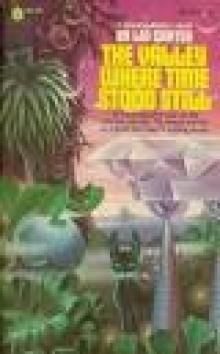
He stood on a steep slope of rock overgrown with a carpet of soft moss. Sapphire-blue was that moss, and it deepened to metallic indigo and brightened to lucent azure as the shifting light played across it.
A warm, humid gust of air met him, dampening his face and filling his lungs with the perfume of strange, unearthly flowers.
His bootheels slipped in the sapphire moss which carpeted the bottom steps of the stair. He slipped—slid— lost his balance and fell. The thick, rubbery cushion of moss broke his fall, but he slid down the inclined slope until at last he dizzily came to a halt amidst strange flowering bushes of azure foliage that bore long frond-like leaves resembling those of terrene ferns.
He lay there panting for a time while his lungs adjusted to the warm, moist air.
He looked up. Above him, about forty feet over his head, was the sky. But it was not the dull, purplish-black sky of desert Mars, studded with hard, diamond-bright stars. It was a hazy sky of limpid jade-green, shot through with glints and gleams of lucent gold. There were no stars in this strange, new sky, and no sun, either. And the ring-walls that surrounded the crater had also vanished.
He looked down, and for the first time saw the Valley as it really was. He stood at the lip of a vast cup of glimmering blue. Thick woods of gnarled and knotted trees grew near the sides of the cup, thinning out toward its center, some miles from his position. They were unlike any trees he had ever seen or heard described before, their boles built up of tangled, serpentine black lengths, like twisted roots grown thickly together into a column. The black wood glistened wetly with an oily sheen, and the foliage borne up by the writhing branches was like glimmering ribbons, with silver undersides and metallic blue outer surfaces. They wavered in gusts of humid breeze, the ribbony leaves, like the drooping fronds of an Earthly willow tree.