

BAF 35 - New Worlds for Old, page 1


30-07-2024
MAGICKS AND WONDERS
Being a compendium of various magicks and wonders, whereof one not having been encountered in these lands heretofore, and divers others being rare and unknown, it is earnestly hoped that this fourth arrangement of marvels will provide a merrie entertainment, and thereby prepossess the reader to the enjoyment of a fuller repast to be provided each himself by the magicians and wizards herein…
OR, TO PUT IT ANOTHER WAY
The fourth of Lin Carter’s anthologies of fantasy designed to bring to readers new names or little known works by famous writers. Included in this volume are unexpected delights from Oscar Wilde, George Sterling, Robert Howard and many others, together with a previously unpublished work of Mervyn Peake.
For Ballantine Books,
Lin Carter has written:
Tolkien: A Look Behind
“The Lord of the Rings”
And has edited these anthologies & collections:
At The Edge of the World I The Doom That Came To Samath I Dragons, Elves, and Heroes I The Dream-Quest of Unknown Kadath I Golden Cities, Far I Hyperborea I New Worlds For Old I The Spawn of Cthulhu I The Young Magicians
Zothique
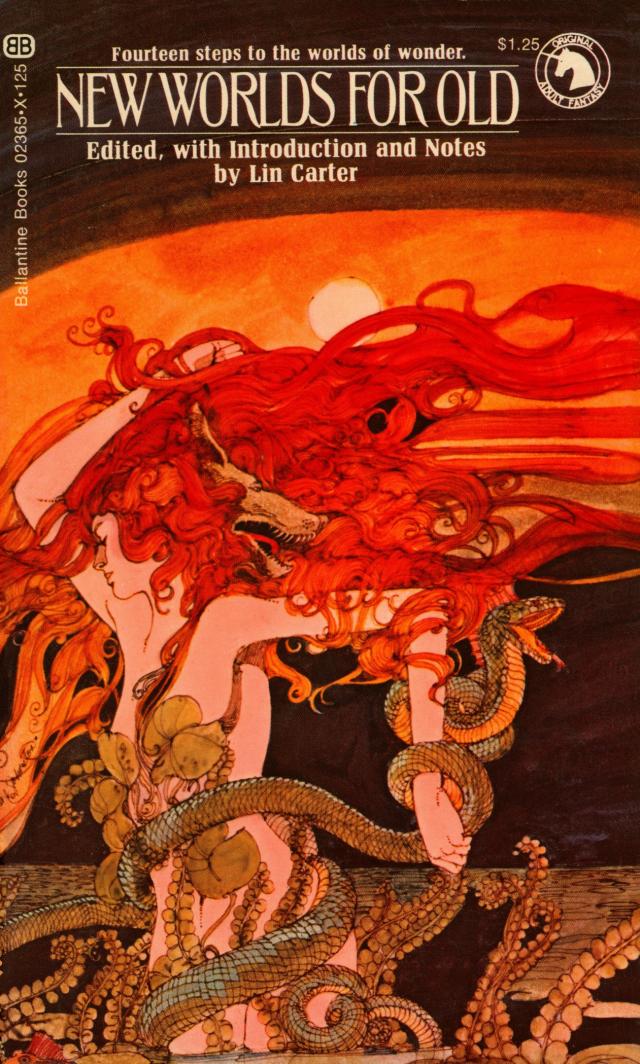
NEW WORLDS FOR OLD
Edited, With An Introduction
And Notes, By
Lin Carter
BALLATINE BOOKS • NEW YORK
An Intext Publisher
Copyright © 1971 by Lin Carter
SBN 345-02365-X-125
All rights reserved.
“Zulkais and Kalilah,” by William Beckford and Clark Ashton Smith (orig. “The Third Episode of Vathek”) first appeared in Leaves. It was included in the book THE ABOMINATIONS OF YONDO, by Clark Ashton Smith (Arkham House, 1960); copyright © 1960 by Clark Ashton Smith. Reprinted by permission of August Derleth and Arkham House.
“Silence: A Fable,” by Edgar Allan Poe, first written in 1839, was one of a cycle of sixteen tales known as “Tales of the Folio Club.” It is generally included today in most editions of his Tales of Mystery and Imagination.
“The Romance of Photogen and Nycteris,” by George MacDonald, sometimes reprinted as “Hie Day Boy and the Night Girl,” first appeared in a two-volume work, The Gifts of the Child Christ (London, 1882).
“The Sphinx,” by Oscar Wilde, was written in 1874.
“The Fall of Babbulkund,” by Lord Dunsany, is from The Sword of Welleran (1908); reprinted by permission of the Estate of Lord Dunsany.
“The Green Meadow,” by H. P. Lovecraft and Elizabeth Berkeley, is from THE HORROR IN THE MUSEUM AND OTHER REVISIONS, by H. P. Lovecraft (Arkham House, 1970); copyright © 1970 by August Derleth. Reprinted by permission of August Derleth and Arkham House.
“The Feast in the House of the Worm,” by Gary Myers (orig. “The House of the Worm,”) first appeared in The Arkham Collector #7, Summer, 1970; copyright © 1970 by August Derleth. Reprinted by permission of August Derleth and Arkham House.
“Zingazar,” by Lin Carter, appears here for the first time in print; copyright © 1971 by Lin Carter.
“A Wine of Wizardry,” by George Sterling, is from SELECTED POEMS by George Sterling (Henry Holt, 1923); copyright © 1923 by Henry Holt & Co. Reprinted by permission of Holt, Rinehart and Winston.
“The Garden of Fear,” by Robert E. Howard, appeared in the brochure THE GARDEN OF FEAR (Los Angeles, 1945); copyright © 1945 by the Crawford Publishing House. Reprinted by permission of Mr. Glenn Lord, agent for the Estate of Robert E. Howard.
“Jirel Meets Magic,” by C. L. Moore, first appeared in the July, 1935 issue of Weird Tales; copyright © 1935 by the Popular Fiction Publishing Company. It was included in the book SHAMBLEAU AND OTHERS, by C. L. Moore (New York, 1953); copyright © 1953 by C. L. Moore. Reprinted by permission of the Harold Matson Company, Inc.
“Duar the Accursed,” by Clifford Ball, appeared in the May, 1937 issue of Weird Tales; copyright © 1937 by the Popular Fiction Publishing Company.
“The Hashish-Eater,” by Clark Ashton Smith, appeared in EBONY AND CRYSTAL (1922); copyright © 1922 by Clark Ashton Smith. The poem was included in DARK OF THE MOON, edited by August Derleth (Arkham House, 1947); copyright © 1947 by August Derleth. Reprinted by permission of August Derleth and Arkham House.
“The Party at Lady Cusp-Canine’s,” by Mervyn Peake, first appeared in the British magazine New Worlds; copyright © 1969 by Maeve Peake. Reprinted by arrangement with Maeve Peake.
“The Sword of Power,” by Lin Carter, is excerpted from the unpublished manuscript of KHYMYRIUM, a work-in-progress, and appears here in print for the first time. Copyright © 1971 by Lin Carter.
First Printing: September, 1971
Cover art by David Johnston
Printed in Canada.
BALLANTENE BOOKS, INC.
101 Fifth Avenue, New York, N.Y. 10003
TO
AVRAM DAVIDSON
great editor, grand writer,
good friend.
Contents
INTRODUCTION ~ MAKERS OF WORLDS
THE STORY OF THE PRINCESS ZULKAÏS AND THE PRINCE KALILAH
William Beckford translated by Clark Ashton Smith
SILENCE: A FABLE
Edgar Allan Poe
THE ROMANCE OF PHOTOGEN AND NYCTERIS
George MacDonald
I WATHO
II AURORA
III VESPER
IV PHOTOGEN
V NYCTERIS
VI HOW PHOTOGEN GREW
VII HOW NYCTERIS GREW
VIII THE LAMP
IX OUT
X THE GREAT FAULT
XI THE SUNSET
XII THE GARDEN
XIII SOMETHING QUITE NEW
XIV THE SUN
XV THE COWARD HERO
XVI AN EVIL NURSE
XVII WATHO’S WOLF
XVIII REFUGE
XIX THE WEREWOLF
XX ALL IS WELL
THE SPHINX
Oscar Wilde
THE FALL OF BABBULKUND
Lord Dunsany
THE GREEN MEADOW
H. P. Lovecraft
THE FEAST IN THE HOUSE OF THE WORM
Gary Myers
ZINGAZAR
Lin Carter
A WINE OF WIZARDRY
George Sterling
THE GARDEN OF FEAR
Robert E. Howard
JIREL MEETS MAGIC
C. L. Moore
DUAR THE ACCURSED
Clifford Ball
THE HASHISH-EATER
Clark Ashton Smith
THE PARTY AT LADY CUSP-CANINE’S
Mervyn Peake
THE SWORD OF TOWER
from Khymyrium Lin Carter
8. He Showeth Them Azlon
9. He turneth aside the wrath of Lynxias with Gentle Words
10. They Speak of the Great Games of Sarthay
11. He First Looketh on the Lady Asmer
ABOUT LIN CARTER
MAKERS OF WORLDS
When the world was young and people knew hardly anything about it, story-tellers invented implausibly splendid cities and realms that lay just beyond the local horizons.
Somewhere in the trackless jungles of South America rose the dazzling spires of El Dorado, the golden city. Far to the north, beyond the Frozen Sea, lay the happy land of the Hyperboreans. Amidst the unexplored wastes of mysterious Asia could be found the River of Jewels, the Valley of Diamonds, the country of the Amazons and the Land of Darkness. Far in the deeps of the Atlantic were the Islands of the Blessed, the splendors of Hy-Brasil, the glorious isles of magical Antiilia. And somewhere in the unknown reaches of the Dark Continent dwelt that mightiest and most wealthy of all Christian Emperors, the great Prester John, whose jewelled palace rose near the fountains of the Nile, and upon whose dewy lawns herds of milk-white Unicorns roamed.
But Pizarro and Cortez came not to the shining gates of El Dorado, and Peary found no happy, naked Hyperboreans near the frozen Pole; Marco Polo combed Asia in vain for wonders of imagination and Columbus found fabulous lands—but not of enchantment; while Sir Richard Francis Burton discovered the sources of the Nile, but, alas, no Prester John.
Of course, this did not in the least deter the tellers of tales; it only forced them to move their realms of magic and sorcery a bit further off, either in time or in space. New generations of story-tellers arose to assume the place of those whose marvels had been discredited in the cold light of scientific discovery, and the old worlds of epic and saga, myth and legend and romance were replaced by glittering new worlds of fiction.
In Golden Cities, Far, published by Ballantine Books in 1970, we voyaged through these elder lands of legend; now, in New Worlds For Old, let us explore some of the more recent wonder-worlds of modern fantasy.
As a fantasy writer, I am sometimes asked why I persist in limiting my talents to what has been charitably described as “fairy tales for grown-ups.” Since I earn my living and support my family through the produce of my typewriter, such helpful persons argue, why do I not write for a larger audience, and reap some of the millions of dollars publishers lavish on whomever can or cares to write a Valley of the Dolls or a Love Story? Surely I have nothing against the idea of making a million dollars? Those who argue thus have no real conception of just how difficult writing a novel can be, and what grisly drudgery it is to write something for which one has no real enthusiasm or interest.
I was once a wide-eyed kid drinking in the marvels of such splendid films as Snow White and the Seven Dwarfs and The Thief of Baghdad or lost in the fascinating pages of Doctor Dolittle, Mary Poppins and the “Oz” books. A little later, a gawky teenager, I gloried in the pages of such magazines as Planet Stories, Weird Tales, Doc Savage, Unknown and Captain Future. That little boy, and that fascinated teenager, live somewhere within me to this hour—nor would I have it otherwise.
This being so, it naturally follows that I am most interested in writing the sort of fiction that first stirred and excited and enthralled me as a youngster, and which still entertains me and stretches my imagination to this day. It is not so much that I would not like to write a bestseller and make a million dollars and sell a book to the movies and appear on the Tonight Show. It is just that, by great good luck, I am able to earn a good living writing exactly the sort of thing I most want to write.
The problems—and the pleasures—of writing the imaginary world romance fascinate me. I have assiduously sought out the work of those writers who made this curious art their particular province. The list is not long, but it is a pantheon of brilliant creative talents. I reproduce it here for your amusement.
Morris (1834-1896)
Edgar Rice Burroughs (1875-1950)
Lord Dunsany (1878-1957)
James Branch Cabell (1879-1958)
E. R. Eddison (1882-1945)
A. Merritt (1884-1943)
H. P. Lovecraft (1890-1937)
J. R. R. Tolkien (1892- )
Clark Ashton Smith (1893-1961)
Fletcher Pratt (1897-1956)
C. S. Lewis (1898-1963)
Robert E. Howard (1906-1936)
L. Sprague de Camp (1907- )
Fritz Leiber (1910- )
C. L. Moore (1911- )
Mervyn Peake (1911-1968)
Henry Kuttner (1914-1958)
Hannes Bok (1914-1964)
Of course, this is a list of personal favorites. It might well be argued that since we are talking about people who consciously wrote fiction, such earlier writers as Voltaire or William Beckford or George Meredith or George MacDonald should be included—to say nothing of such contemporary fantasists as Jane Gaskell, T. H. White,
Jack Vance, Poul Anderson, Michael Moorcock, Andre Norton, or John Jakes. Each connoisseur will, I imagine, have his own list of personal favorites. But the eighteen writers above seem to me to have devoted a major portion of their careers to the delicate art of world-making, to have done their best work in this genre, to have “specialized” therein, and thus to have excelled.
Moreover, I could argue that each of the eighteen writers on my own master-list did something for the very first time—something that earlier masters had not thought of.
While Voltaire and Meredith and Beckford wrote fantasy novels about more-or-less imaginary, or anyway, legendary, countries, it was William Morris who first bothered to invent out of whole cloth* the medieval worldscape wherein his great pioneering romances were set. Only George MacDonald seems to have anticipated him in this, and the faerie romances of MacDonald are clearly described as dreams: we are not supposed to consider them as real places.
*Voltaire’s Candide journeys to that same El Dorado the conquistadores sought for in vain, and Meredith set the scenes of his Shaving of Shagpat in the world of the Arabian Nights.Beckford’s Vathek is laid against a backdrop of actual geography, save when the love-smitten Caliph and his nubile young paramour venture to the world-encircling Mountain of Kaf—which comes from Islamic folklore. These books display only rudimentary world-inventing, save perhaps for Meredith.
On the other hand, I suppose a carping critic might raise a skeptical eyebrow or two at my having included Edgar Rice Burroughs among these fantasy writers, but he is there for a significant reason. Few of the early world-makers bothered to do more than merely adapt our native planet to their own purposes. Many of them (Dunsany, Cabell, Tolkien, Smith, Howard, de Camp, Kuttner, Gaskell and Moorcock, to be precise) set their tales here on our world at an earlier epoch. Of the few who employed another world—clearly defined as such—like Eddison, Leiber, Pratt and Jakes—not one seems to have realized that another world can hardly be expected to have flora and fauna identical with that of our own oblate spheroid. Indeed, Eddison, otherwise a perfectly marvelous stylist, went so far as to put “Irish yews” on the planet Mercury; and no less a writer than Fritz Leiber, whose world, Nehwon, is obviously not our Earth, has his characters riding around on horses, purely products of terrene evolution.
When Burroughs invented the version of the planet Mars he called Barsoom, he very carefully invented its flora and fauna out of his own imagination. Hence, the John Carter of Mars stories present a credible background uniquely original.
L. Sprague de Camp merits praise for being virtually the first of the world-makers to realize to any significant degree that another world’s culture would have its own literature and folklore and legendry. Whether writing novels laid on the planet Krishna, or sagas of Sword & Sorcery such as his fantasies The Tritonian Ring and The Goblin Tower, he has his Bronze Age or pseudo-Renaissance characters frequently quote from the local classics or from the wealth of epigrams, familiar sayings and apothegms that form a substrata of any semi-literate culture. Even Tolkien, who also does this, errs in not realizing his Middle-earth ought to have its own religious pantheon and organized priesthood, as have all known civilizations in human history.
When I edited an earlier anthology of modem fantasy masters, The Young Magicians in 1969,1 included samples of the fiction or verse of fourteen writers—Morris, Dunsany, Eddison, Cabell, Lovecraft, Smith, Merritt, Howard, de Camp, Kuttner, Vance, Lewis, Tolkien and—however immodestly—myself.


