

Lost Worlds, page 1


29-03-2023
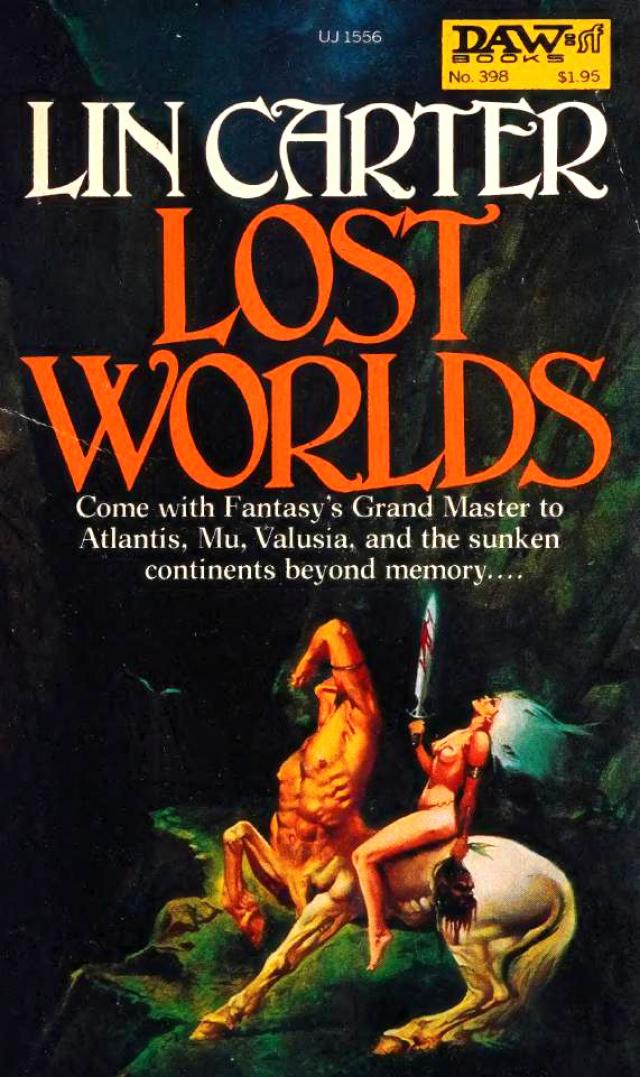
LOST WORLDS
Our fabled shores none ever reach,
No mariner has found our beach,
Scarce our mirages now are seen,
And neighborly waves of floating green,
Yet still your oldest charts contain
Some dotted outlines of our main. ,…
—Thoreau
Lin Carter
DAW BOOKS, INC.
donald a. wollheim, publisher
1633 Broadway, New York, N.Y. 10019
Copyright ©, 1980, by Lin Carter
All Rights Reserved.
Cover art by Enrich.
I dedicate these legends of the lost worlds to my favorite editors
—to August Derleth and Donald A.
Wollheim, Roy Torgeson and Ted White
—who are also among my best friends.
—Lin Carter
FIRST PRINTING, AUGUST 1980
1 2 3 4 5 6 7 8 9
daw trademark registered
u.s. patt. off. marca registrada. hecho en u.s.a.
PRINTED IN U.S.A
Contents:-
The Introduction: LOST WORLDS OF TIME
HYPERBOREA
THE SCROLL OF MORLOC
THE STAIRS IN THE CRYPT
MU
THE THING IN THE PIT
LEMURIA
THIEVES OF ZANGABAL
KEEPER OF THE EMERALD FLAME
VALUSIA
RIDERS BEYOND THE SUNRISE
ANTILLIA
THE TWELVE WIZARDS OF ONG
ATLANTIS
THE SEAL OF ZAON SATHLA
The Afterword: LOST WORLDS TO COME
ACKNOWLEDGMENTS & PERMISSIONS;
Riders Beyond the Sunrise first appeared in the book King Kull by Robert E. Howard and Lin Carter, Lancer Books, Inc., N.Y., 1967. Copyright © 1967 by Lancer Books, Inc. It appears here by arrangement with the estate of Robert E. Howard.
Thieves of Zangabai first appeared in the book The Mighty Barbarians, edited by Hans Stefan Santesson, Lancer Books, Inc., N.Y., 1969. Copyright © 1969 by Lancer Books, Inc.
The Seal of Zaon Sathla first appeared in the book The Magic of Atlantis, edited by Lin Carter, Lancer Books, Ina, N.Y., 1970. Copyright © 1970 by Lin Carter.
Keeper of the Emerald Flame first appeared in the book The Mighty Swordsmen, edited by Hans Stefan Santesson, Lancer Books, Inc., N.Y., 1970.
The Scroll of Morloc (with Clark Ashton Smith) first appeared in the magazine Fantastic, October, 1975. Copyright © 1975 by Ultimate Publishing Company, Inc. It appears here by arrangement with CASiana Literary Properties.
The Twelve Wizards of Ong first appeared in the book Kingdoms of Sorcery, edited by Lin Carter, Doubleday & Company, Inc., N.Y., 1976. Copyright © 1976 by Lin Carter.
The Stairs in the Crypt (with Clark Ashton Smith) first appeared in the magazine Fantastic, August, 1976. Copyright © 1976 by Ultimate Publishing Company, Inc. It appears here by arrangement with CASiana Literary Properties, Inc.
The Thing in the Pit appears here in print for the first time. |
The Introduction:
Lost Worlds of Time
Something young and alive and deep within me leaps and thrills when I read a phrase like, “Zamora, with its darkhaired women and towers of spider-haunted mystery”… or, “Ilek-Vad, that fabulous town of turrets atop the hollow cliffs of glass that overlook the twilight sea wherein the finned and bearded Gnorri build their singular labyrinths”…or, “the splendid city of Celephais, in the valley of Ooth-Nargai, beyond the Tanarian Hills”…
That something is within you, too, or you would never have plucked from the rack a book with a title like Lost Worlds,
For we are both human, you and I; and to be human is to possess a quality denied the beasts and the angels. Imagination! The sense of wonder; the thirst for marvels; the fascination for that which lies “over the hills and far away.”
We are lovers of fantasy, you and I. I know that I am. I have been a fantasy buff all my life. Before I was old enough to read I was thrilled and delighted by two grand and glorious films, The Wizard of Oz and Snow White and the Seven Dwarfs. When I could, at last, master die secrets of the printed page, I turned to the Oz books, the Greek myths and Norse legends, Doctor Dolittle, Mary Poppins, the fairy tales of Grimm and Andersen, Peter Pan, Kenneth Grahame’s marvelous Wind in the Willows. And so on…and on. Still later, films like Sir Alexander Korda’s immortal Thief of Baghdad seized my imagination, as did the wonderful romances of Haggard and Merritt and the tales of Robert E. Howard and Clark Ashton Smith, and—
But this is turning into an autobiography!
I am trying to make some sort of statement about that quality of imagination which lures us into the world of fantastic literature, not tell the story of my inner life. Some of us are drawn into the incredible realms of science fiction—others to the weird, fee macabre, the ghostly.
I have yielded for years to the attraction of those realms; yes, and yet others, too. But it is fantasy which delights me most And, of all the worlds of fantasy literature, I seem most deeply fascinated by fee lost lands of legend—by those far and mysterious realms and continents presumed by dreamers to have flourished in remote, prehistoric ages.
Primarily, I think, it is the unsolved mystery of those “evening isles fantastical” that teases my curiosity and captivates my imagination. Did the oceans drink down fee shining cities of Atlantis? Did mighty Mu founder beneath the waves before history began? Was there ever a lost polar paradise of Hyperborea? Did the Seven Isles of Antiilia ever exist, amid
The dragon-torn, the gong-tormented sea
or are they all but creations of pure fable?
It is fee exquisite and tantalizing lure of these mysterious “lands feat time forgot,” the romance of these fabulous names, feat attracts me. And, since we cannot look to science or history or archaeology for the age-lost annals of Atlantis or Ultima Thule or Lemuria, we must turn to the writers of fantastic fiction to satisfy our thirst for their marvels. Many a teller of tales has yielded to fee same lure of these lost worlds of time feat so captivates me—H. P. Lovecraft, Edgar Rice Burroughs, A. Merritt, Robert E. Howard, Clark Ashton Smith, Henry Kuttner, Avram Davidson, John Jakes, Poul Anderson, to name only a few recent or contemporary fantasts. Such as these have spun their splendid yarns out of the fabric of fable which clings about these ringing and fabulous names of lands that, perhaps, never really were.
For one reason or another, I find feat over some fifteen years, I have written stories set in several of these romantic realms. In the beginning, it was never my deliberate intention to do so; like so many other things I have done, it just happened. But on fee whole these stories please me, and I hope feat they will please you, too.
Here is a whole bookful of them, anyway.
So come, let the world go by for a little while and, with me,
Push off, and sitting well in order, smite
The sounding furrows; for my purpose holds
To sail beyond the sunset, and the baths
Of all the western stars, until I die.
It may be that the gulfs will wash us down:
It may be we shall touch the Happy Isles,
And see the great Achilles, whom we knew…,
—Lin Carter
HYPERBOREA
Hyperborea was a remote and fabulous land in the Arctic “beyond the North Wind,” discussed in the Greek myths and mentioned by such poets as Pindar. The Greeks assumed it to be a sort of polar Garden of Eden where everybody was happy, went around without any clothes on, and the ripe fruit plopped from every tree, so that nobody had to work for a living. Sounds rather like Bermuda to me.
In 1888, a flamboyant Russian-born spiritualist called Madame Blavatsky published The Secret Doctrine, a bewildering book which sets forth a rather gaudy cosmology that traces human evolution down through successive civilizations, beginning with “Polarea,” then Hyperborea and finally Lemuria and Atlantis. Later-writers in the Theosophical Society filled in the details of her rather sketchy chronology. In the 1930’s the California poet, artist, sculptor, translator and short-story writer, Clark Ashton Smith, laid many of his finest fantasies in his own version of Hyperborea, which owes nothing to the Greeks, or to the Theosophists, for that matter.
Since 1973 I have been working with bis unpublished notes and outlines for stories he never got around to finishing, complete with lists of coined-but-unused names of people and places. My “posthumous collaborations”—like those Derleth wrote “with” Lovecraft— are done in as close an approximation of Smith’s lapidary style as I can manage, and they are also set in Hyperborea. Here are two of my favorites.
THE SCROLL OF MORLOC
with Clark Ashton Smith
The shaman Yhemog, dejected by the obdurate refusal of his fellow Voormis to elect him their high priest, contemplated his imminent withdrawal from the tribal burrows of his furry, primitive kind to sulk in solitude among the icy crags of the north, whose bourns were unvisited by his timorous, earth-dwelling brethren.
Seven times had he offered himself in candidacy for the coveted headdress of black ogga wood, crowned with fabulous huusim plumes, and now for the seventh time had the elders unaccountably denied him what he considered his just guerdon, earned thrice over by his pious and reverent austerities. Seething with disappointment, the rejected shaman swore they should have no eighth occasion to bypass the name of Yhemog by bestowing the uncouth hierarchical mitre upon another, and vowed they should erelong have reason to regret their selection of an inferior devotee of the Voormish god over one of his unique devoutness.
During this period many of the clans of the subhuman Voormis had fled into warrens tunneled beneath the surface of a jungle-girt and mountainous peninsula of early Hyperborea which had yet to be named Mhu Thulan. Their semi-bestial forebears had originally been raised in thralldom to a race of sentient serpent people whose primordial continent had been reft asunder by volcanic convulsions and which had submerged beneath the oceans an eon or two earlier. Fleeing from the slave pens of their erstwhile masters, now happily believed almost extinct, the ancestors of the present Voormis had wrested all of this territory from certain degenerate, cannibalistic subhumans of repellent appearance, whose few survivors had been driven northward to dwelt in exile amid the bleak glaciers of Polarion.
Of late, their numbers inexplicably in decline, their warlike prowess unaccountably dwindling and the vengeful descend* ants of their ancient foes growing ever more populous and restive in the north, many of the Voormish tribes had sought refuge in these underground dwellings. By now the furry creatures were accustomed to the comforting gloominess and the familiar, pervasive stench of their warrens and seldom did they venture into the upper world, which had grown strange and frightening to them with its giddy spaciousness of sky, lit by the intolerable brilliance of hostile suns.
In contemplating self-imposed exile from his kind, the disgruntled shaman was not unaware of the dangers. This particular region of the peninsula would someday be known as Phenquor, the northernmost province of Mhu Thulan. During this early Cenozoic period the first true humans were just beginning to seep into Hyperborea from southerly tropical jungles whose climate had grown too fervent for them, and all of Phenquor was a primal wilderness, uninhabited save for the cavern-dwelling Voormis. Not without peril, therefore, would the shaman Yhemog traverse the prehistoric jungles and reeking fens of the young continent, for such were the haunts of the ravening catoblepas and the agate-breasted wyvern, to cite only the least formidable denizens.
But Yhemog had mastered the rudiments of the antehuman thaumaturgies and had gained some proficiency in the arts of shamanry and conjuration. By these means he thought himself quite likely to elude the. more ferocious of the carnivora to achieve the relative safety of the Phenquorian mountains.
By dwelling subterraneously, it should perhaps be noted here, the Voormis were but imitating the grotesque divinity they worshipped with rites we might deem excessively sanguinary and revolting. As it was an article of the Voormish faith that this deity, whom they knew as Tsathoggua, dwelt in lightless caverns far beneath the earth, their adoption of a troglodytic existence was primarily symbolic. The eponymous ancestor of their race, Voorm the arch-ancient, had early in their history asserted that their assumption of u wholly subterranean habitat would place them in special propinquity to their god, who himself preferred to wallow in the gulf of N’kai beneath a mountain to the south considered sacred by the Voonnis. This dogma the venerable Voorm had pronounced shortly before retiring into chasms near N'kai to spend his declining eons near the object of his worship.
The tribal elders considered the opinions of this patriarch infallible, especially in purely theological matters, for it was believed that he had been fathered by none other than Tsa-thoggua himself during a transient liaison with a minor feminine divinity named Shathak. With this ultimate patriarchal teaching the tribal elders now,’- somewhat belatedly, concurred; to obey the last precept of their spiritual leader was after all, a reasonable precaution considering the profound and disheartening conditions into which the race had so recently, and so abruptly, declined.
In reaching-his eventual decision to shun the dank and fetid burrows of his tribe in favor of a radical change of residence to the vertiginous peaks along the northern borders of Phenquor, overlooking the frigid wastes of Polarion, the shaman Yhemog discovered himself ineluctably sliding into heresy. Unable to reconcile his private inclinations with the pontificial revelations handed down by the eponymous patriarch, he was soon implicitly questioning the validity of the teachings, a tendency which resulted in his eventual denial of their infallibility. Now rejecting as essentially worthless the very patriarchal dogmas he had earlier reverenced, he lapsed from the most odious condition of heresy into the blasphemous nadir of atheism.
This disappointment soured into bitter resentment and resentment festered into vicious envy and envy itself, like a venomous canker, gnawed at the roots of his faith, until the last pitiful shreds of his former beliefs had utterly been eaten away. And naught now was left in the heart of Yhemog save for a hollow emptiness, which became filled only with the bile of self-devouring rancor and a fierce, derisive contempt for everything he had once held precious and holy. This contempt cried out for expression, for a savage gesture of ultimate affront calculated to plunge his elder brethren into horrified consternation. Yhemog hungered to brandish his new-found atheism like a stinking rag beneath the pious snouts of the tribal fathers.
At length he determined upon a course of action suited to his ends. He schemed to steal into the deepest and holiest shrine of Tsathoggua and to purloin an antique scroll which contained certain rituals and liturgies held in religious abhorrence by the members of his faith. The document was among the spoils of war carried off by his victorious forefathers from the abominable race which had formerly dominated these regions at the time of the advent of the Voormish savages into Mhu Thulan. The papyrus reputedly preserved the darkest secrets of the occult wisdom of the detested Gnophkehs, which name denoted the repulsively hirsute cannibals whom Yhemog’s ancestors had driven into exile in the arctic barrens. This scroll contained, in fact, the most arcane and potent ceremonials whereby the Gnophkehs bad worshipped their atrocious divinity, who was no less than an avatar of the cosmic obscenity Rhan-Tegoth, and was attributed to Morloc himself, the Grand Shaman.
Now the Voormis had, from their remotest origins, considered themselves the chosen minions of Tsathoggua, their sole deity. And Tsathoggua was an earth elemental ranged in unrelenting enmity against Rhan-Tegoth and all his kind, who were commonly accounted elementals of the air and were contemned by those of the Old Ones who, like Tsathoggua, abominated the airy emptinesses above the world and wallowed in dark subterranean lairs. A similar degree of mutual animosity existed between those races which were the servants of Tsathoggua, among whom the Voormis were prominent, and those who served the avatars of cosmic and uncleanly Rhan-Tegoth, such as those noxious protoanthropophagi, the Gnophkehs. The loss of the Scroll of Morloc would, therefore, hurl the Voormis into the very nadir of confusion, and contemplation of their horror at the loss caused Yhemog to tremble with delicious anticipation.
The Scroll had for millennia reposed in a tabernacle of mammoth ivory situated beneath the very feet of the idol of Tsathoggua in the holy-of-holies, its lowly position symbolic of the Voormis risen triumphant over their subjugated enemies. In order for the Scroll of Morloc to be thieved away by Yhemog, ere he quit forever the noisome, squalid burrows of his centuries of youth, he must first enter the most sacred precincts of the innermost shrine itself.


