

BAF 47 - Beyond The Fields we Know, page 1
part #47 of Ballantine Adult Fantasy Series
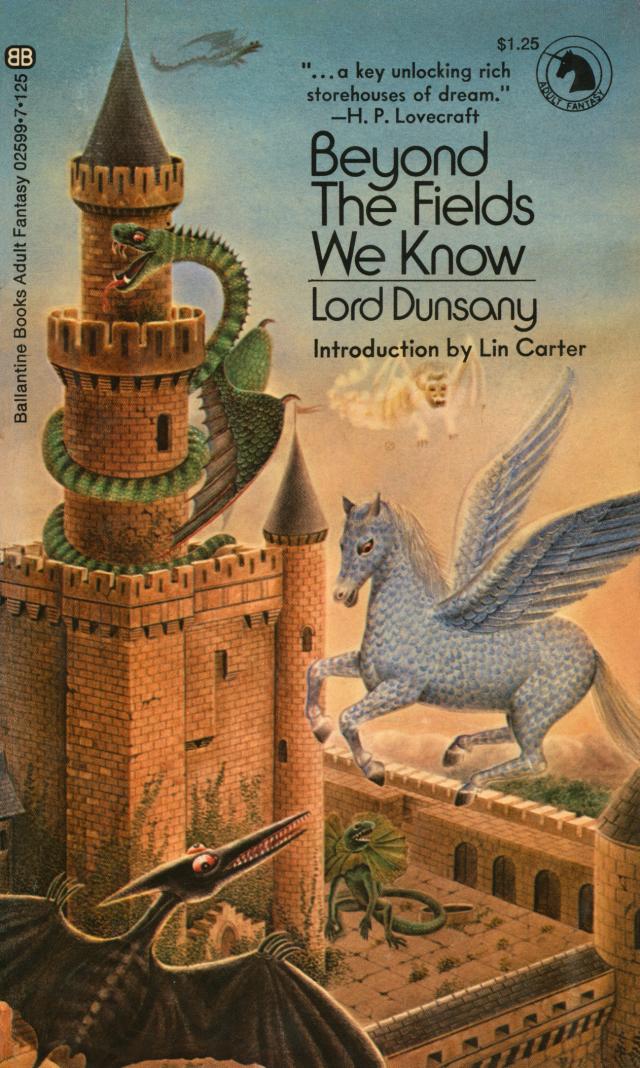


09-07-2024
Among the great writers of fantasy, Lord Dunsany was one of the first: not merely innovative, he was a stylist whose prose has been echoed but never imitated. As Baird Searles has remarked, “His constant repetition of ’the fields we know,’ for instance, is not just a clever phrase. Through it and its ramifications, there is a constant pointing up of the difference between the mundane and the twilit depths of Elfland, where time stands still.”
And L. Sprague de Camp says: “Dunsany’s stories are a priceless possession for any lover of fantasy. Like first-rate poetry, they are endlessly rereadable. Those who have not read them have something to look forward to, and an assortment of Dunsany is the foundation stone of any fantasy collection.”
The publishers are pleased to announce that this collection includes the entire contents of THE GODS OF PEGANA, unavailable since its original publication in 1905, and never before published in its entirety in America.
Other books by LORD DUNSANY in the
Ballantine Adult Fantasy Series:
THE KING OF ELFLAND’S DAUGHTER
AT THE EDGE OF THE WORLD
DON RODRIGUEZ:
chronicles of shadow valley
BEYOND THE FIELDS WE KNOW
Lord Dunsany
Edited,
With An Introduction And Notes, By
Lin Carter
BALLANTINE BOOKS • NEW YORK
An Intext Publisher
Copyright © 1972 by Lin Carter.
“How Slid Made War Against the Gods” (orig. “The Coming of the Sea”), “The Vengeance of Men,”
“When the Gods Slept,” “For the Honour of the Gods,” “The Wisdom of Ord” (orig. “The South Wind”), “Night and Morning,” “The Secret of the Gods,” “The Relenting of Samidac,” “The Jest of the Gods,” and “The Dreams of a Prophet” first appeared in TIME AND THE GODS (London William Heinemann, 1906; Boston: John W. Luce & Company).
“King Argimenes and the Unknown Warrior” first appeared in FIVE PLAYS (Boston: Little, Brown & Company, 1918). Copyright 1914 by Little, Brown and Company. All dramatic rights reserved by the author.
“The Kith of the Elf-Folk” and “The Sword of Welleran” first appeared in THE SWORD OF WELLERAN (London George Allen & Sons, 1908; Bostons John W. Luce & Company, n.d.).
“The Madness of Andulsprutz” and “The Sword and the Idol” first appeared in A DREAMER’S TALES (London: George Allen & Sons, 1910; Boston John W. Luce & Company, n.d.).
“Miss Cubbidge and the Dragon of Romance,”
“Chu-Bu and Sheemish,” and “How Nuth Would Have Practised His Art on the Gnoles” first appeared in THE BOOK OF WONDER (London: William Heinemann, 1912; Boston: John W. Luce & Company, 1912).
“In the Sahara,”
“Songs From an Evil Wood,” “The Riders,” “Th« Watchers,” “The Happy Isles,” “The Enchanted People,” “A Word in Season,” and “The Quest” first appeared in FIFTY POEMS (New York and Londons G. P. Putnam’s Sons, 1929).
“A Story of Land and Sea” first appeared in TALES OF WONDER (London: Elkin Mathews, 1916; published in the United States as THE LAST BOOK OF WONDER, Boston: John W. Luce & Company, 1916; copyright 1916 by John W. Luce & Company). THE GODS OF PEGANA was first published in 1905 by Elkin Mathews in London, and reprinted in 1911 in London by the Pegana Press.
All rights reserved.
SBN 345-02599-7-125
This edition published by arrangement with the Estate of Lord Dunsany.
First Printing: May, 1972
Cover art by Gervasio Gallardo
Printed in the United States of America
BALLANTINE BOOKS, INC.
101 Fifth Avenue, New York, N.Y. 10003
Contents:~
Introduction ~ About BEYOND THE FIELDS WE KNOW
and Lord Dunsany:
PREFACE
THE GODS OF PEGANA
Editor’s Note
Of Skarl the Drummer
Of the Making of The Worlds
Of the Game of the Gods
The Chaunt of the Gods
The Sayings of Kib
Concerning Sish
The Sayings of Slid
The Deed of Mung
Chaunt of the Priests
The Sayings of Limpang-Tung
Of Yoharneth-Lahai
Of Roon the God of Going
The Revolt of the Home Gods
Of Dorozhand
The Eye in the Waste
Of the Thing That Is Neither God nor Beast
Yonath The Prophet
Yug the Prophet
Alhireth-Hotep the Prophet
Kabok the Prophet
Of the Calamity That Befel Yun-Ilara by the Sea, and of the *Building of the Tower of the Ending, of Days
Of How the Gods Whelmed Sidith
Of How Imbaun Became High Prophet in Aradec of all the Gods Save One
Of How Imbaun Met Zodrak
Pegana
The Sayings of Imbaum
Of How Imbaun Spake of Death to the King
Of Ood
The River
The Bird of Doom and the End
TALES FROM PEGANA
Editor’s Note
How Slid Made War Against the Gods
The Vengeance of Men
When the Gods Slept
For the Honour of the Gods
The Wisdom of Ord
TIME AND THE GODS
Editor’s Note
Night and Morning
The Relent of Sarnidac
The Jest of the Gods
The Dreams of a Prophet
King Argimenes and the Unknown Warrior
Editor’s Note
PERSONS
The First Act
POEMS
Editor’s Note
In The Sahara
Songs From An Evil Wood
The Riders
The Watchers
The Enchanted people
The Happy Isles
A Word In Season
Quest
OTHER TALES
Editor’s Note
The Kith of the Elf-Folk
The Sword of Welleran
Editor’s Note
The Madness of Andelsprutz
The Sword and the Idol
Editor’s Note
Miss Cubbidge and the Dragon of Romance
Chu-bu and Sheemish
How Nuth Would Have Practised His Art Upon the Gnoles
A Story of Land and Sea
Guarantee to the Reader
Afterword: The Naming of Names
About BEYOND THE FIELDS WE KNOW
and Lord Dunsany:
Return, to the World’s Edge
William Morris, the renowned Victorian poet, translator, printer and artisan, was the first comparatively recent writer (bom, 1834) to compose fantasy novels set against imagined worldscapes. The first of his pioneering romances, The Wood Beyond the World, was published May 11, 1895. With the publication of that landmark novel, Morris became the first great writer in a glorious tradition that is still going strong today, some seventy-seven years later.
The second great fantasy writer in the imaginary world tradition was a youth of seventeen when The Wood Beyond the World was first published. He was born the Hon. Edward John Moreton Drax Plunkett, and his father was an Anglo-Irish peer, the seventeenth Lord Dunsany. To be precise (for those who like to know such details), he was bom at 15 Park Place Square, which is near Regent’s Park in London, and the year was 1878. In time, he succeeded to the family title, becoming the eighteenth Baron Dunsany upon the death of his father.
Lord Dunsany wrote superlative novels of adult fantasy, but his most important work was in the field of the short story; indeed, his importance in the history of fantasy literature lies, in part, in the fact that he was the first writer to adapt William Morris’s invention, the imaginary world romance, to the short story form. While Dunsany’s novels are splendid works of singing and poetic magic—you may know The King of Elf-land’s Daughter, which Ballantine revived in 1969, and Don Rodriguez: Chronicles of Shadow Valley, which we revived in 1971—while such novels as these are splendid stuff, it is in the short story that Dunsany demonstrated his great imaginative genius to the fullest.
I do not think “genius” too strong a word to use in discussing the Dunsanian oeuvre. No one in this world ever excelled Dunsany in the short fantasy, nor is anyone likely to go beyond him in the telling of lyric, exquisite fantasies. Surely he belongs with Tolkien and Cabell among the supreme masters of the genre. He is at very least their equal; in my personal opinion, their superior. Nearly every fantasy writer who has come after him has learned from his art, and many have been powerfully influenced by him. Readers of our Adult Fantasy Series familiar with The Dream-Quest of Unknown Kadath and The Doom that Came to Sarnath know that the great American master of the macabre, H. P. Lovecraft, idolized Dunsany, and admittedly emulated his style in his early “dreamlands” fiction. Dunsanian influence has been admitted by L. Sprague de Camp and Fritz Leiber, and it is clearly visible in the prose of Clark Ashton Smith and Jack Vance. My own cycle of Simrana tales are unabashedly Dunsanian in style and substance.
The best examples of Lord Dunsany’s genius for fantasy are to be found among his first eight short story collections. These books are:
The Gods of Pegana (1905) London: Elkin Mathews.
Time and the Gods
The Sword of Welleran (1908)] London: George Allen & Sons.
A Dreamer’s Tales (1910) Boston: John W. Luce & Company.
The Book of Wonder (1912)’ London: William Heinemann.
Fifty-One Tales (1915) London: Elkin Mathews.
Tales of Wonder (1916) London: Elkin Mathews.*
Tales of Three Hemispheres (1919 Boston: John W. Luce & Company.
* Published in this country under the title of The Last Book of Wonder.
Within these eight slim books lies much of the finest fantasy ever written. But this is the judgment of hindsight; reviewers of the time treated them with contempt and derision—so much so that, as Lord Dunsany remarks in his autobiography, Patches of Sunlight, “Disappointed at the reception of my short stories, I turned to writing novels.”
We who love Dunsany regret that decision deeply; but while we are sad that he wrote no further collections of tales about “little kingdoms at the Edge of the World/* we can be glad we have at least those eight volumes.
I collected thirty of his very finest short fantasies into a book called At the Edge of the World which was published by Ballantine in March 1970. Naturally, I drew upon the eight books listed above. But I had far from exhausted Dunsany’s supply of brilliant stories, as the present collection attests.
Rather than simply repeat the format of that first collection, I have varied the fare in this one to include, besides stories, one of Lord Dunsany’s fantasy plays—the best of them all, in my opinion—and a pocketful of poems as well.
This is the fourth of Lord Dunsany’s books to appear under th$ Sign of the Unicorn’s Head. Its contents should be almost entirely new to most of my readers; so far as I am aware, only one of the stories has ever appeared in an American paperback before, and that is “Chu-Bu and Shemish.” I hope you enjoy this book as much as you enjoyed At the Edge of the World.
—Lin Carter
Editorial Consultant
The Ballantine Adult Fantasy Series
Hollis, Long Island, New York
Beyond The Fields We Know
Go from here eastwards and pass the fields we know, till you see the lands that pertain clearly to faery; and cross their boundary, which is made of twilight, and come to that palace that is only told of in song.
—The King of Elfland’s Daughter,
PREFACE
There be islands in the Central Sea, whose waters are bounded by no shore and where no ships come—this is the faith of their people.
THE GODS OF PEGANA
Editor’s Note
When I said I drew from those eight great collections of Dunsany’s short fantasies to assemble the book I called At the Edge of the World, I was guilty of a slight inaccuracy. Actually, I drew from the last seven books only, and did not touch the first of them at all. It is The Gods of Pegana. I previously neglected this first collection because the tales in The Gods of Pegana are all interconnected and do not look their best when taken out of context. Indeed, they are almost too slight to be considered, real stories at all; perhaps they could more correctly be termed prose poems. At any rate, I used nothing from The Gods of Pegana in At the Edge of the World.
The Gods of Pegana was the first book Lord Dunsany ever wrote. As he recounted the genesis of the book, during the winter of 1903, when he was a young soldier and sportsman of just twenty-five, he took a house in Seend and divided his time about equally between grouse shooting, fox hunting, and speech-making on the theme of tariff reform, as he was then (briefly) in politics. Up to this point in his life, although he was interested in books and poetry, he had been aware of no vocation in that direction. But before long, Fate provided him with a stimulus. As he describes the event in his autobiography:
It was more a stimulant than an influence, seeing a play at His Majesty’s Theatre called The Darling of the Gods. My imagination had an eastward trend, and here was the East right before my eyes, a place where my imagination wandering in the void could rest before going on again. I had never found anyone doing anything at all like the kind of work that I felt I should like to do; and here all of a sudden was someone doing the sort of thing that I thought I could do easily.
It was as though I had gazed at a country that I believed forbidden to travellers, and suddenly I saw someone trespassing there. So there could be an audience for that kind of thing after all!
The play itself was a gorgeous drama set in a dim and fabulous Japan that never quite was. But it struck fire within the young Dunsany and obsessed his imagination with intoxicating visions. Although Dunsany does not discuss it in his autobiography, he first sat down and sketched out a map of his wonderlands, which he showed to a casual friend, the poet George Russell, who used the pseudonym A E, and who was then, as Dunsany phrased it, “in servitude to an agricultural paper.” Dunsany knew him only slightly, but showed him the map of the magic kingdoms he desired to explore. Before long he began to write down short pieces about these kingdoms, or, rather, about the gods whom these kingdoms worshipped. As Dunsany explained:
And so I began to write, guided then, as ever since, by two lights that do not seem very often to shine together: poetry and humour. And when my bits of writing were all gathered into a book, it began with the words: “There are in Pegana, Mung and Sish and Kib, and the maker of all small gods who is MANA-YOOD-SUSHAI.” By the early summer the book was ready for printing, and I took it to a publisher who promised to publish it for me, though that promise was never kept… .





