

BAF 66 - Merlin's Ring, page 1
part #66 of Ballantine Adult Fantasy Series


09-07-2024
Reworking of an earlier conversion
H. WARNER MUNN has been writing fantasy and science fiction for the best part of thirty years. Throughout the years, Munn worked at his magnum opus,Merlin’s Ring, an epic fantasy of extraordinary sweep and drama. It tells the story of Gwalchmai, godson to Merlin, and of Corenice, an immortal woman of Atlantis, and of a love that spanned centuries of high adventure.
Gwalchmai is an active participant in much of Earth’s development, living in worlds both magical and real. Throughout he carries the ring of Merlin, which gives him certain arcane powers. Throughout runs the thread of the very moving love story of Corenice and Gwalchmai—lovers separated poignantly time and again by the adventures that take Gwalchmai from Atlantis to the Norseland, from the elf-world to pre-history, from Arthur’s Court to the Far East, from Cathay to Irish mythology, from medieval Rome to the burning of the Maid of Orléans. Seldom has such a huge canvas so successfully combined major historic events with the worlds of magic and wonder.
Merlin’s
Ring
H. Warner Munn
BALLANTINE BOOKS • NEW YORK
Copyright © 1974 by H. Warner Munn
Introduction copyright © by Lin Carter
All rights reserved under International and
Pan-American Copyright Conventions.
SBN 345-24010-3-195
First Printing: lune, 1974
Third Printing: September, 1975
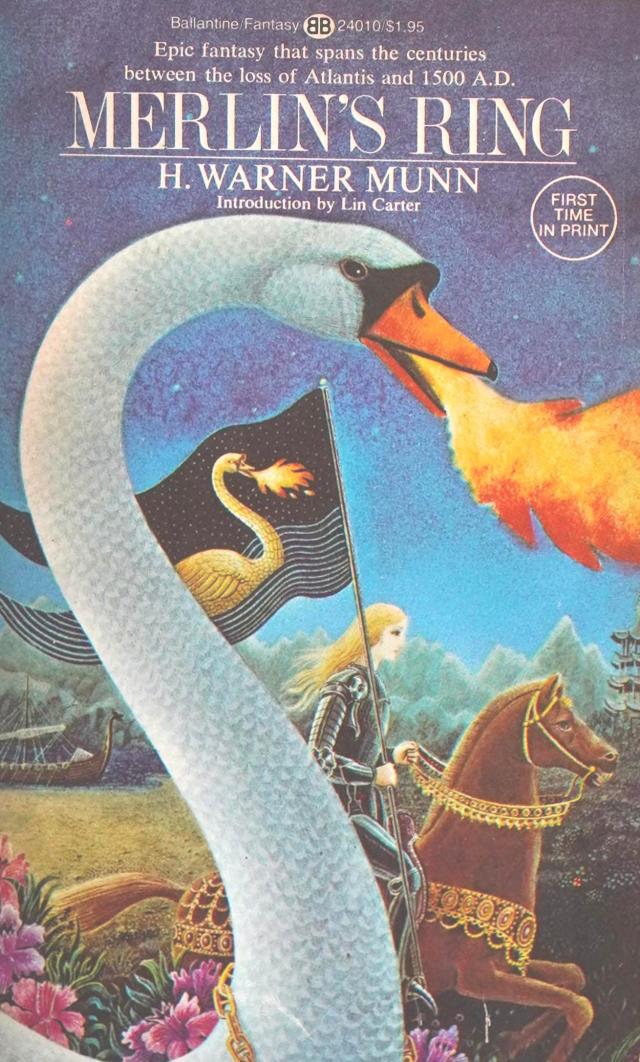
Cover painting by Gervasio Gallardo
Printed in the United States of America
BALLANTINE BOOKS
A Division of Random House, Inc.
201 East 50th Street, New York, N.Y. 10022
To your Corenice; your Gwalchmai;
By whatever other names you may know them;
In whatever Land of Dream.
Contents: ~
Introduction ~ About Merlin’s Ring and H. Warner Munn:
PART I ~ Merlin’s Ring
1 - The Man in the Ice
2 - Merlin’s Godson
3 - The Celi Dei
4 - Out Oars for Alata!
5 - The Spae-wife
6 - The Land of the little
7 - The Blasted Heath
8 - The Hunt for the Unicorn
9 - The Sword of Arthur
10 - King Once— and King To Be
11 - Arngrim and the Golden Girl
12 - For the Honor of Roland
13 - Rome at Last
PART II ~ The Sword of The Paladins
14 - The Catacombs
15 - In Search of Prester John
16 - Through the Magic Door
17 - The Firedrakes
18 - ‘The Land of Dream
19 - Soldier of Fortune
20 - Forward—The Banner
21 - Corenice—At Last
22 - For the Maid!
23 - The Marketplace of Rouen
24 - The Plays The Thing
25 - The Fiend of Mâchecoul
26 - The ’Traveler
27 - Merlin Explains
Epilogue
About Merlin’s Ring and H. Warner Munn:
Through the Ages
The Ballantine Adult Fantasy Series has been in business for several years now, and among the many different varieties of the fantasy that have appeared under the Sign of the Unicorn’s Head one surprising omission stands out. I refer, of course, to the Arthurian fantasy. This is due to mere chance, not to any antipathy for the subject. Most of the fine books centered on the Arthurian legend are in print—The Once and Future King, The Crystal Cave, The Sword in the Stone —to mention only a few.
Quite recently, however, an odd coincidence has occurred. Two different writers have written two very different books and submitted them to Ballantine Books; both happen to be Arthurian fantasies, and both happen to be superbly imaginative and thoroughly entertaining works of fantastic fiction. So at last we are able to complete the fantasy spectrum by including Arthuriana among all the other varieties of fantasy thus far published under this colophon.
The first of these books you will already have seen, if you are the sort of reader who haunts the paperback stands and regularly picks up the new releases in the Series. I refer, of course, to that spectacular romance, Excalibur, (August 1973) a new novel by a new writer named Sanders Anne Laubenthal. The second of these two books is the novel you are about to read, Merlin’s Ring, by H. Warner Munn.
While Miss Laubenthal is new to the ranks of fantasy writers, Mr. Munn is an old hand at the craft. He was one of the original Weird Tales writers, and his first story, “The Werewolf of Ponkert,” appeared in the issue for July 1925, during the second year of that magazine’s existence. During the next fifteen years, Mr. Munn published about a dozen stories, including novels and serials, in that greatest of all pulp magazines, and his last tale appeared in 1940.
In those days Weird Tales was dominated by the circle of writers who centered on H. P. Lovecraft Munn was one of this group and knew Lovecraft well. They exchanged not only letters, but visits as well; Lovecraft came“ up to Munn’s home in Athol, Massachusetts, and Munn made the trip down to Lovecraft’s home in Providence. Something in one of Lovecraft’s letters started Munn off as a writer. In the letter column of Weird Tales, Lovecraft asked why no one had thought of writing a werewolf yarn from the werewolf’s point of view. His remark intrigued Munn, whose thoughts led him eventually to write that first story, ”The Werewolf of Ponkert.“
Since he was, in a way, indebted to Lovecraft for a story idea, it must have pleased him to have been able to return the favor a while later. Munn had been mulling over ideas for a completion or a sequel to Poe’s unfinished novel, The Narrative of Arthur Gordon Pym. Munn himself didn’t get far with the notion, but his mention of it in their correspondence started Lovecraft thinking, and he was in time inspired to write one of his most memorable stories, At the Mountains of Madness, which remains the most celebrated novella of Antarctic horrors since the Poe fragment Realizing that Lovecraft’s story had turned out a lot better than his own try, Munn amiably abandoned the attempt
A while later, having moved to New York, Munn was introduced to some of the writers of Lovecraft’s set. “Through him I met Tallman, Kirk, Long, Loveman, Bodenheim, and some others of the junior literati… and corresponded with Seabury Quinn and other writers. It was a stimulating atmosphere,” Munn recalls.
Writing for Weird Tales was an enthusiasm of his youth, and one he eventually put aside to face the serious problem of making a living. Munn says, “After I married, I drifted out of writing… under the stress of building a house and supporting a family during the Depression and the pre-war years, and gave it up, even as a hobby, during the war.” Some years later he moved his family out to Tacoma, Washington, where he still resides.
Now in his early seventies, H. Warner Munn is one of the few living survivors of the early days of Weird Tales. Besides him, only E. Hoffman Price, Edmond Hamilton, Donald Wandrei, and a few others are still alive, and of these, only Munn is still writing steadily in the field.
For he returned to writing a decade ago, perhaps stimulated by the revival of interest in some of his early work. Don Grant, the -Providence bookseller and publisher, reissued in 1958 in a limited, signed edition a book called The Werewolf of Ponkert. The book contained not only the title story but also its sequel, “The Werewolf’s Daughter,” which was a three-part serial in the magazine, beginning with the issue for October 1928. In a brief foreword, the publisher mentioned that Munn considered his finest story to be “King of the World’s Edge.” This novel, which: ran as a four-part serial in Weird Tales beginning with the issue for September 1939, was revived in paperback by Ace Books in 1966, and was followed a year later by a new sequel called The Ship from Atlantis. Ever since then, H. Warner Munn has been working on a lengthy and intricate narrative about twice the size of an ordinary novel.
I mean Merlin’s Ring, of course.
This new book is the culmination of a long and interesting career. In one way or another, H. Warner Munn has been involved with the figure of Gwalchmai for over thirty-five years, and with the mysterious and enigmatic girl from Atlantis, Corenice.
The strands of his plot are intricately woven. Three generations after the last of the Roman legions withdrew from the isle of Britain, Ventidius Varro, a centurion under the leadership of the man whom legend remembers as King Arthur, led a fleet from the doomed land, which lay helpless before the menace of the Saxons. Guided by Merlin, the sage and prophet, their ships ventured farther into the dim regions of the unknown west than any ships had gone before. They found an uninhabited realm there at the World’s Edge, and, yet farther south, a strange and barbaric civilization called Miapan. There Varro became King—“King of the World’s Edge”—and, anxious that this untouched new continent should provide a haven for a Rome beleaguered by its enemies, he dispatched his son, Gwalchmai, to cross the seas and bear news of the great discovery to whatever emperor then ruled beside the Tiber.
Thus the young Roman-British prince embarked on the strangest journey ever undertaken by a human being upon this globe, a journey that was to cover centuries of time and would lead him into the most curious adventures known to the annals of heroic deeds. In that mysterious region known to explorers as the Sargasso Sea, the youth found a weird metal ship surviving from the lost age of High Atlantis, on which there still lived an Atlantean sorceress, an ageless and beaut
The story of Merlin’s Ring is a colossal achievement of sheer imagination. From the moment the wandering spirit of the sorceress from Atlantis occupies the body of a Viking maid and liberates Gwalchmai from his frozen tomb within an iceberg, wherein he has lain in suspended animation for centuries, the tale expands to include shamans and witches and magical and supernatural forces. The vast canvas of this novel pictures a panoply of figures from history and myth and legend as background to a love story that survives the ages and traverses entire continents. Joan of Arc is but the most familiar of these, and the period of the Crusades form but a segment of a much larger history.
Seldom have I encountered a more ambitious narrative in my exploration of fantasy, and seldom has a gripping human drama of such strength and vigor invested a story of such sweep and scope and vaulting imaginative power. I am amazed at the realistic detail, at the tremendous cast of characters, and at the surge of centuries spanned by a single tale. Prose epics of this magnitude are most often the work of a writer in the first enthusiasm of his creative power. But with the publication of Merlin’s Ring a literary career that began nearly half a century ago reaches its culmination; and now it can be seen that the career of H. Warner Munn is that of a writer slowly and meticulously developing and testing his powers, in anticipation of a masterpiece.
For in all of fantasy few stories of this magnitude and scope have been so vividly realized. The epic of the immortal adventurer who survives through the ages has given us many classics—Phra the Phoenician, Valdar the Oft-Born, and My First Two Thousand Years are examples that spring first to mind. To these milestones of fantastic literature, it is our privilege to add one more masterpiece, Merlin’s Ring.
—LIN CARTER
Editorial Consultant,
The Ballantine Adult Fantasy Series
Hollis, Long Island, New York
Merlin’s Ring
PART I
Merlin’s Ring
1
The Man in the Ice
Five days out from Streymoy, in the Faroes, having been borne far into unknown seas by a violent westerly, the little fishing boat came to a new land and a fair day.
When the wind and driving rain had stopped and the sun had come out to warm them, the crew of four were grateful to the gods. They had at no time experienced undue fear. They were all good sailors. Still, they had been glad to finger the small gold piece each Norse sailor carried, for it is an unlucky thing to go empty handed into Ran’s Hall when one has been drowned.
Their greatest inconvenience had been the lack of want! food. Cheese and hard biscuit are nourishing but not tasty, and raw cod is a poor second. Now they were running out of water, though it had been nursed along sparingly and they had caught some rain.
There was floating ice, but it was new ice and still brackish, the salt not yet having leached out of it. In search of a better source they turned north where an ice-blink against the scattered clouds told them that land lay beneath it.
The owner of the knorr was Skeggi Harvadsson, whom men called Hairymouth, though not to his face. There was also Thyra, his daughter, and Biarki, to whom she was pledged.
Biarki was son of Onn, son of Ketil, the Strong. His ancestry was a curse to him, and Biarki took no pride in it, for he could not forget it and his means did not permit him to live as he would. Although he was Skeggi’s partner and owned half the boat and enjoyed the promise, yet to come, that Thyra would be his, he resented his lot as a fisherman and longed to go a-Viking. Only in this manner, he thought, could he attain fortune and honor.
Besides these three, there was Flann, the thrall from Erin, who was wont to raise his eyes above his station. He also had a grievance. Although Skeggi and Thyra regarded him as a valued member of their family, he still wore the iron collar. It was his only mark of servitude. Although it was no thicker than a wire and scarcely marked by the others, upon Flann it lay as a yoke.
He had been taken as a boy, at the sacking of Lindisfarne, his parents unfortunately visiting that holy island at the time.
He had been traded from one master to another, suffering many a beating, but he still remained firm in the faith and was always willing to enter into argument with those he considered as heathen. He could read and write and one of his sorrows was the lack of books.
Because he had a fine voice and could chant to music he was liked by most people. Still, he was a contentious man and some felt that he spoke when he should remain silent. Biarki hated him for his quick tongue.
Now he sneered as Biarki looked down into the calm sea, stirred only by waves scarcely more than ripples and commented, “Ran’s Bath runs deep, but Thor has quieted the winds for us and will guide us safely home.”
Flann muttered, “The old gods are dead. Have you not heard?”
“Now, by Thor’s hammer!” Biarki’s moods turned easily into rage. He stood menacingly over the thrall. “How much shall a man take from this son of a black robe? Skeggi, I will pay the were-gild now and slay him! He is never quiet and I can stand no more. Here is his worth!”
He threw down a copper coin and seized his dagger.
Flann did not move or change his mocking expression, but Thyra stood up in the rocking boat and gripped Biarki’s arm. Her face was pale.
Skeggi raised his hand from the tiller. “If he deserves death for an honest opinion! which I do not grant, then he shall have it on that day from me. He is my thrall, Biarki, not yours, and blood spilt from my household must be paid for with blood, not money. Put away your dagger, unless you are prepared to see mine.”
Biarki glared. His face reddened almost to purple above his matted, salt-rimed beard. There had been times, men said, that his family had brought forth baresarks and Biarki was perilously near that uncaring mania at the moment. Still, the feeling of Thyra’s small hands upon his arm was calming and his fury passed.
He grunted and sat down. Thyra remained standing, leaning against the short mast, looking out over the sea. Only occasionally now a gentle puff of air bellied out the drooping sail, but it always drove the boat in the same direction— in the way they wished to go.
At that moment, as though it were a good omen, a raven dropped out of the sky and circled the boat thrice, inspecting them wisely before landing upon the masthead to take rest. It cocked its head from side to side and opened its beak soundlessly, eyeing them as though it would speak.
Biarki took heart. “See, Odin’s messenger! He comes to lead us to land. That is more than your god would do, thrall!”
Skeggi also turned sternly upon Flann. “This time you are wrong. The old gods still rule, for Ragnarok has not yet befallen. Your White Christ, of whom you continually prate, may be strong in the southland, but here he has no strength. If you pray for help, pray as we do to Odin, that we may be saved all together and not all lost to Aegir’s net because of you. Nay”—when Flann would have spoken —“be silent! I shall hear no more. Now, by Odin, what-ails the girl?”


