

The Case of the Step-Daughter's Secret, page 26
part #70 of Perry Mason Series


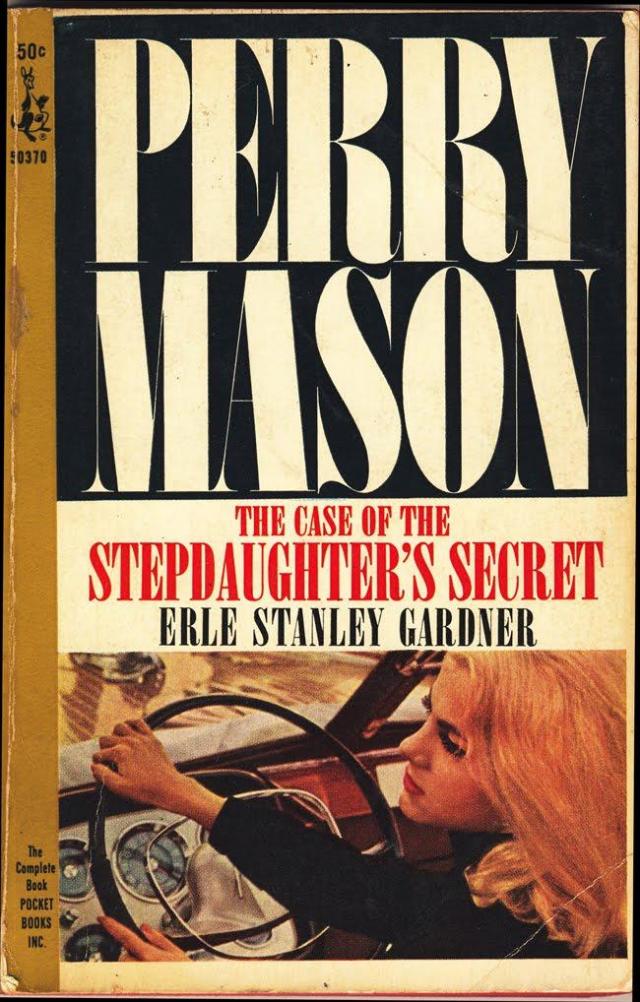
The Case of the
Stepdaughter’s Secret
Erle Stanley Gardner
Foreword
James Davis was an American Indian.
He was attuned to Nature in a way most modern-day city dwellers can’t understand. At times he would put on his old clothes, go down to the river, and sit on the bank for hours, just watching the swirl of the water and listening to the wind in the trees.
In this way he kept in tune with the infinite and renewed his spiritual courage. It was as if he were listening to the voice of Nature.
James Davis had been admitted to the California Bar and subsequently elected to the office of District Attorney of Siskiyou County. The citizens of the county liked and respected him.
Then, one night in 1936, two popular officers were killed while trying to arrest two men who had been in a fight earlier with two other men.
One of the complaining witnesses was killed at the time of the arrest. The other survived. He told his story to the police and then to James Davis.
The story he told Davis did not in Davis’ opinion support a murder charge. A short time later this man again told his story.
I am not concerned here with the truth of the story. I am concerned with Davis’ mental attitude and his moral courage.
Davis said the first story told by the prosecuting witness showed that the two men who had done the shooting had acted in justifiable self-defence. (The officers had taken the prosecuting witnesses with them to the camp where the defendants were in deep sleep. At the moment the officers “jumped” on the sleeping men there was evidence that one of the prosecuting witnesses had yelled, “Pour it to those sons of bitches.” The defendants, awakened from a sound sleep with these words in their ears, had come up fighting.)
However, all that is beside the point. The thing which interests me is not the evidence in the case, but the case in the mind of the District Attorney, and what he did about it.
He refused to prosecute.
In view of the public attitude this was political suicide, and he knew it, but he remained firm and faced the storm of outraged public opinion single-handed.
Newspapers published scathing editorials. The authorities speedily appointed a special prosecutor who presented the case to a jury which found the defendants guilty and sentenced them to death. (After the defendants had spent some two years in death cells, awaiting execution, the sentence was commuted to life imprisonment.)
The political supporters of James Davis dropped from him like autumn leaves falling from the trees.
Davis had this to say; he said it publicly: “It is the duty of a district attorney to be guided by his analysis of the truth or falsity of evidence as he finds it. His business is to seek out the truth, subject always to human error, and be guided by that truth as he sees it, wherever it may point. The attorney for the people must regard the constitutional rights of citizens with care and discretion. He must view the situation in the light of substantial justice and whoever might be killed, whatever might be the roar of the mob. If a district attorney cannot withstand the onslaught of apparent injustice, although he may stand alone in his convictions, that district attorney is not worthy of his job. He takes the oath of office to uphold the constitution of this country, of this state, and all laws made pursuant thereto, and any other stand places him in a position of betrayal of his trust.”
Shortly thereafter Davis was no longer a county official, and not too long after that he died.
Some fifteen years later it was my privilege to be one of a group who investigated the facts in that strange battle which resulted in the deaths of three men. Largely as a result of what we discovered, there was somewhat of a change in public sentiment. The defendants were released on parole.
But the thing that stays in my mind is this courageous District Attorney who stood alone, facing the roar of the mob, and watched his political career crumble away while living in a small community where from day to day he had to face the hostility of those who had once been eager to be his friends.
It was a terrible ordeal. He could have moved away, but he stayed where he was, playing his cards to the end.
He died, but he died upholding his principles. He never knew that years after his death people from the outside would examine the case and commend what he did. It would have made no difference to James Davis.
The voice of Nature in the sound of the rushing water, in the whispering of the wind in the trees, had given this man a moral strength possessed by few men. He used the temple of the outdoors as a place in which to worship his Maker and learn what it takes to be a man.
And so I dedicate this book to the memory of the onetime District Attorney of Siskiyou County, California:
James Davis
Erle Stanley Gardner
Chapter One
At approximately ten forty-five, Della Street nervously began looking at her wrist-watch.
Perry Mason interrupted his dictation to smile at her.
“Della, you’re nervous as a cat.”
“I can’t help it,” she said. “To think that Mr Bancroft telephoned for the earliest possible appointment – and the way his voice sounded over the telephone!”
“And you told him that he could have an eleven o’clock appointment if he could get here at that time,” Mason said.
She nodded. “He said that he’d have to stretch the speed limit to get here, but he’d make it if it was humanly possible.”
“Then,” Mason said, “Harlow Bissinger Bancroft will be here at eleven o’clock. His time is valuable. Every minute is metered, and he plans his business along those lines.”
“But what could he possibly want with an attorney who specializes in the defence of criminal cases?” Della asked. “Good heavens, the legal secretaries say that he has more corporations than a dog has fleas. He has a battery of attorneys who do nothing but handle his work. I understand there are seven lawyers alone in the tax division.”
Mason glanced at his watch. “Wait eleven minutes and you’ll find out. Somehow, I–”
The ringing of the telephone interrupted him.
Della Street picked up the telephone, said to the receptionist, “Yes, Gertie … Just a moment,” placed her hand over the mouthpiece, said to Mason, “Mr Bancroft is in the office, saying he managed to get here a little early, that he’ll wait until eleven if he can’t see you before, but that the time element is highly important.”
Mason said, “Evidently it’s more of an emergency than I thought. Bring him in, Della.”
Della Street folded her shorthand book with alacrity, jumped to her feet and hurried into the outer office. A few moments later she was back with a man in his middle fifties, a man whose close-cropped grey moustache emphasized the determination of his mouth. He had steel-grey eyes and a manner of crisp authority.
“Mr Bancroft,” Mason said, rising and extending his hand.
“Mr Mason,” Bancroft said. “Good morning – and thank you for seeing me so promptly.”
He turned and glanced at Della Street.
“Della Street, my confidential secretary,” Mason explained. “I like to have her sit in on all of my interviews and make notes.”
“This is highly confidential,” Bancroft said
“And she is highly competent and accustomed to keeping confidences inviolate,” Mason said, “She knows everything about all of my cases.”
Bancroft sat down. Suddenly, the air of decision and self-assertion vanished. The man seemed to melt down inside his clothes.
“Mr Mason,” he said, “I’m at the end of my rope. Everything that I have worked for in my life, everything I have built up, is tumbling down like a house of cards.”
“Come, now, it can’t be that serious,” Mason told him.
“It is.”
“Suppose you tell me just what’s bothering you,” Mason said, “and we’ll see what we can do about it.”
Almost pathetically, Bancroft extended his two hands. “Do you see these?” he asked.
Mason nodded.
“I have built everything in life with these two hands,” Bancroft said. “They have been my means of support. I have worked as a day labourer. I have fought and struggled to get ahead. I have gone into debt until I felt there was no possible way of paying off the indebtedness and achieving financial stability. I have sat tight when it seemed that my whole empire was about to come crashing down. I have fought through adverse conditions and faced enemies with not a single ace in the hole but an ability to bluff them into submission. I have gambled by staking my fortune to buy when everyone else was in a panic to sell, and now these hands hold my undoing.”
“Why?” Mason asked.
“Because of the fingertips,” Bancroft said.
“Go on,” Mason told him, his eyes narrowing.
“I am a so-called self-made man,” Bancroft said. “I ran away from home when there wasn’t much of a home to keep me. I got tangled up with some rather wild associates, I learned a lot of things that I shouldn’t have known. I learned how to short-cut the ignition wiring on cars, I learned how to make a living in dark alleys, so to speak, by stealing hubcaps, spare tyres and automobiles.
“I was finally caught and sent to the penitentiary, which probably was the best thing that ever happened to me.
“When I went to the penitentiary, I had a resentment against society. I thought that I had been caught simply because I had been imprudent
“There was a chaplain in that prison who took an interest in me. I won’t say that he gave me religion, because, in a way, he didn’t. He simply gave me confidence in myself and my fellow man, and in a divine scheme of the universe.
“He pointed out that life was too complicated to be accidental, that it took a master plan to account for life, as we knew it; that fledglings emerged from the egg, grew feathers and poised on the edge of the nest with the desire to fly because of what we call instinct; that instinct was merely a divine plan and a means by which the architect of that divine plan communicated with the living units.
“He asked me to consult my own instincts, not my selfish inclinations but the feelings that came to me when I could deliberately disregard my environment and put myself in harmony with the universe. He dared me to surrender myself in the solitude of night to the great heart of the universe.”
“And you did?” Mason asked.
“I did it because he told me I was afraid to do it, and I wanted to show him I wasn’t. I wanted to prove he was wrong.”
“And he wasn’t wrong?”
“Something came to me – I don’t know what it was. A feeling of awareness, a desire to make something of myself. I started to read, study and think.”
Mason regarded him curiously. “You have travelled considerably, Mr Bancroft. What do you do about passports?”
“Fortunately,” Bancroft said, “I started out with enough family pride to conceal my real name. The one I used in the penitentiary, the name that I used during all of the period of wildness, was not the name with which I had been christened. I managed to preserve my incognito.”
“But your fingerprints?” Mason asked.
“There’s the rub,” Bancroft said. “If my fingerprints are ever taken and sent to the FBI, within a matter of minutes it will become known that Harlow Bissinger Bancroft, the great philanthropist and financier, is a criminal who served fourteen months in a penitentiary.”
“All right,” Mason said. “Quite evidently, someone has discovered the secret of your past.”
Bancroft nodded.
“And threatens to expose it?” Mason asked. “Are you being asked to pay blackmail?”
By way of answer, Bancroft took a sheet of paper from his pocket and handed it to Mason.
The paper had a typewritten message:
Get fifteen hundred dollars in ten and twenty dollar bills. Put them in a red coffee can, together with ten silver dollars. Put the lid on tight and await telephone instructions as to the time and place of disposal. Put this note in with the money so we’ll know the police won’t try to trace us through the typing. If you follow instructions to the letter, you have nothing to fear, otherwise the family will face the disgrace of knowing whose fingerprints are on file and where.
Mason studied the paper carefully. “And this was sent to you through the mail?”
“Not to me,” Bancroft said, “but to my stepdaughter, Rosena Andrews.”
Mason raised inquiring eyebrows.
“Seven years ago I married,” Bancroft said. “My wife was a widow. She had a daughter, Rosena, who was then sixteen. She is now twenty-three. A very beautiful, intense young woman, who is engaged to be married to Jetson Blair of the socially prominent Blair family.”
Mason’s eyes became thoughtful. “Why would they strike at her instead of at you?”
“Because,” Bancroft said, “they wanted to emphasize the fact that she was the more vulnerable, particularly during this period of her engagement.”
“A wedding date has been set?” Mason asked.
“It has not been formally announced, but they expect to be married in about three months.”
“And how did you get this?” Mason asked.
“I knew that my stepdaughter was tremendously upset over something. She came in the door with an envelope in her hand and her face was as white as a sheet. She had planned to go swimming in the afternoon, but rang up Jetson Blair and cancelled the date, saying she wasn’t feeling well.
“I knew something was wrong.
“Rosena made an excuse to leave and go to the city. I assumed she wanted to see her mother, who was spending the night in our apartment here in the city. She left early this morning. Well, Mr Mason, after she had left I went to her room. I found this letter under the blotter of her desk.”
“Now, let’s get this straight,” Mason said. “You say she came to the city and you assumed she wanted to see her mother.”
“Her mother is in the city, making arrangements for a charity ball. She spent yesterday and last night in our apartment here. I have been staying with Rosena out at the lake. Rosena’s mother is due back at the lake tonight. That’s why I wanted to see you at the earliest possible moment. I want to get back to the lake and put this letter where I found it, before Rosena returns.”
“Did you tell your wife anything about your criminal record?” Mason asked.
“Heaven help me,” Bancroft said, “I did not. I should have. I have cursed myself a thousand times for being too cowardly to do so, but I was very much in love. I knew that, regardless of how much Phyllis loved me, she would never jeopardize the social career of her daughter by marrying a man with a criminal record.
“Now, Mr Mason, you know my secret. You are the only living person who does.”
“Other than the person or persons who sent this letter,” Mason said.
Bancroft nodded.
“Rosena has enough money to fulfil these demands?” Mason asked.
“Certainly,” Bancroft said. “She has an account of several thousand dollars in her own name, and, of course, she can always get any amount of money from me whenever she asks for it.”
“You don’t know whether she intends to ignore this demand or to comply with it.”
“I feel certain she intends to comply with it.”
“That, of course,” Mason said, “will be only the first bite. One never finishes with a blackmailer.”
“I know, I know,” Bancroft said. “But, after all, after three months – that is, after the wedding is over, there won’t be so much pressure.”
“Not on her,” Mason said. “The pressure will then shift to you. You don’t think your stepdaughter knows?”
“Evidently she does,” Bancroft said. “The people who sent this letter must have telephoned her, giving her enough information so she understands what it is she is trying to avoid. I would certainly assume that to be the case.”
“You say you are staying at the lake?”
“At Lake Merticito,” Bancroft said. “We have a summer home there.”
“I understand,” Mason said, “that the lake is highly exclusive, properties run several hundred dollars a front foot.”
“That is true,” Bancroft said, “except for a three-hundred-foot frontage at the southern end of the lake. That is a public beach and occasionally the characters who come there make trouble. There is a launching ramp, a marina where boats can be rented, and – Well, for the most part, the people who come there are orderly. There is, nevertheless, a certain element of undesirables. They occasionally get out in the lake and make trouble for the regular residents.
“Private property, of course, goes to the edge of the lake at low water and we’re able to keep trespassers off the lands that are privately owned. But the lake is ideal for water-skiing, and occasionally some unpleasantness results from this outside element.”
“I take it that it is state owned as a park?” Mason asked.
“No, it is privately owned.”
“Why don’t the owners get together and buy that strip out?” Mason asked.
“Because of a peculiar provision in the title,” Bancroft said. “The property was left to heirs, in trust, with the understanding that for a period of ten years it would be open to the public on charges to be fixed by a board of trustees.
“The owner of the property was a public-spirited citizen who felt that too much waterfront property was being grabbed up by persons of wealth and the public was being excluded.”
“How is the property operated?” Mason asked.
“On a very high-class level, so far. The owners have done all they could to exclude the rowdy element. It is, however, open to the public with all that this means.”





