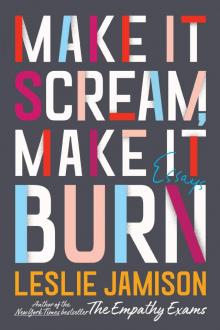
Make It Scream, Make It Burn, page 23


My breakup with Dave, at the end of my twenties, mattered more than any other breakup ever had, and lasted longer—the loss itself, and its aftermath. Dave and I had spent much of our relationship trying to figure out if our relationship could work, and I thought that breaking up would liberate us from that pull-and-tug. It didn’t. We broke up, got back together, broke up again, then talked about getting married. Our split became my partner the way Dave had been my partner. There was an absence that held his shape, and it followed me everywhere.
We often describe our ghosts as voices whispering to us, but I felt Dave as spectral ear, someone to whom I kept wanting to whisper. For years after we broke up, every thought I had was constructed partially for him. I kept a physical list of things I wanted to tell him but couldn’t—mainly silly, daily things: the snow piled between my inner and outer windows during blizzards; how I’d dug out my own car after the storm, and two lawyers had yelled at me for parking in their lot; the broiled grapefruit with a burnt-sugar crust I’d eaten at our local diner, without him, who loved grapefruits; all the men I’d seen or thought about seeing in his absence. “I want a man here to touch me,” I wrote, “just so I’ll put down this list and stop writing to you.”
Memories came at me like the state of Pennsylvania in a rainstorm. Every time I thought he was over, that I’d traveled through him, it turned out he wasn’t over yet. I could go as many miles as I wanted and there would still be more of how it felt to lose him. I seemed okay, because I said so all the time to friends, and often it felt true, as if my feelings were locked away somewhere else, and the key had been taken from me for my own protection. But sometimes in the night, alone, I woke up desperate for that key—to open the door, to get to the locked space. Maybe he would be there, waiting.
After a bad sunburn, when my skin peeled away in curling strips that wadded up like bits of dried masking tape between my fingers, I thought: This is the skin he touched. My ridiculous mourning. No reasoning with it. My skin kept coming off me like shredded paper, drifting in flakes all over my clothes, my little Toyota. He was everywhere, the dust of him.
Standing in an airport line, I watched a blue-eyed couple who teased each other amicably. Who would have to replace his/her passport first? He would! No, she would! He swatted her with his plush neck pillow. They had matching silver-plated luggage tags attached to their matching leather-trimmed roller duffels. In those days, I treated every couple like a crime scene to scour for clues, or a recipe to steal. How did they choose their matching luggage, and how did they stand in line without bickering, and how did it feel to be grooved into a shared last name etched in silver? I wanted to feel superior to the shallow life I projected onto them, but even that meager consolation gave way to wondering: What did they have that we didn’t? What could they manage that we couldn’t?
“Perhaps the hardest thing about losing a lover is / to watch the year repeat its days,” Anne Carson wrote. “It is as if I could dip my hand down // into time and scoop up / blue and green lozenges of April heat / a year ago in another country.” When I dipped my cupped palms into the past I’d shared with Dave, every remembered moment hardened into something cleaner and more purely happy than it had really been. Nostalgia rearranges the rooms of memory: it makes the beds, puts a vase of flowers on the dresser, opens the curtains to let in the sun. It gets harder and harder to say, It was painful to live there. The voice of insistence goes faint: It was. Because we miss it. We miss what was hard about it. We miss it all.
On the first night we ever kissed, I told Dave: “I didn’t feel alive. Now I do.”
Exhibit 9: Bottle of Crystal Pepsi
Queens, New York
After the end of my relationship with the man I thought I would marry, I met an unexpectedly wonderful lawyer who lived in Queens. He took me to trivia night at his local bar in Astoria. He took me to a Christmas party at his law office near Times Square. He took me to the Blazer Pub, near his childhood home upstate, where we ate burgers and played shuffle bowling. I knew he wasn’t “the one” but also suspected I no longer believed in “the one”—not because I’d never met him, but because I had and now we were done. The lawyer made me laugh. He made me feel comfortable. We ate comfort food. We made pancakes with raspberries and white chocolate chips and watched movies on weekend mornings. He found old reruns of Legends of the Hidden Temple, the stupid game show we’d both loved as kids, and gave me a ten-year-old bottle of Crystal Pepsi he’d found online—my favorite soda when I was young, discontinued for years. He was remarkable, but I couldn’t ever quite see him—or see that—because I never really believed in us. Nothing about us made me feel challenged. His devotion started to feel like a kind of claustrophobia. It was like he taught me how much I struggled to live inside love—to understand something as love—without difficulty.
Nine months after Dave and I broke up, I started to see a man who felt like his opposite. Or at least that was the story I told myself. He wasn’t a poet but a lawyer, with an office job in Midtown. We didn’t have explosive fights, perhaps because I hadn’t placed my heart in his hands—in his in-box, in his U-Haul, in his pantry—for safekeeping. But our relationship gave me sustaining laughter and genuine joy, fluttery sensations in my stomach, after years spent fighting for and with a relationship that wasn’t working. It suggested that the things I’d always thought I wanted from a partner—charisma, elusiveness—weren’t necessarily the things I needed most.
In many ways, our relationship was another chapter in the unfolding story of my relationship with Dave, part of its epilogue. When the lawyer and I broke up, it felt less like a fresh sadness and more like a return to the sadness that was already there, missing the one I’d been missing all along. A few months later, I met the man I would marry.
Before I left for Croatia, I thought of bringing the bottle of Crystal Pepsi the lawyer had given me, to donate to the museum as a memento of my last breakup before marriage. But I never put it in my luggage. Why did I want to keep it at home, on my bookshelf? It had something to do with wanting to acknowledge the man who’d given it to me, because I hadn’t given him enough credit while we were together. Keeping his last gift was a way of granting him credit in the aftermath.
The whole time I wandered the Museum of Broken Relationships, I kept imagining all the objects that hadn’t been donated, all the objects that people couldn’t stand to part with, lurking like a ghost collection behind the thousands of objects (more than three thousand) that had. I thought of all the objects my friends had described—the clamshell necklace, the shopping list, the single human hair stuck on the envelope, the four black dresses, and the steel-guitar slide—some lost, some tucked away, some repurposed as part of a new life.
If I’m honest with myself, keeping that bottle of Crystal Pepsi isn’t just about honoring the man who gave it to me, or what we shared. It also has to do with enjoying that glimpse of sadness and dissolution, with holding on to some reminder of the pure, riveting feeling of being broken. These days my life is less about the sublime state of solitary sadness or fractured heartbreak and more about waking up each day and making sure I show up to my commitments. My days in Zagreb were about Skyping with my husband and emailing a good-morning video to my stepdaughter. They were about feeding the fetus inside me: Istrian fuži with truffles, noodles in thick cream; sea bream with artichokes; something called a domestic pie; something called a vitamins salad.
Life now is less about the electricity of thresholds and more about continuance, coming back and muddling through; less about the grand drama of ending and more about the daily work of salvage and sustenance. I keep the Crystal Pepsi because it’s a souvenir from those fifteen years I spent in a cycle of beginnings and endings, each one an opportunity for self-discovery and reinvention and transformative emotion; a way to feel infinite in the variety of possible selves that could come into being. I keep the Crystal Pepsi because I want some reminder of a self that felt volcanic and volatile—bursting into bliss, or into tears—and because I want to keep some proof of all the unlived lives, the ones that could have been.
The Quickening
When you were the size of a poppy seed, I sat in the bathroom of a Boston hotel room and peed on a stick I’d bought from an elderly man at a drugstore near Fenway Park. I laid the plastic on the cold tiles and waited for it to tell me if you existed. I wanted you to exist so badly. It had been a year of chipper emails from my fertility app, asking if I’d had sex on the right nights, and a year of sunken hearts whenever I spotted blood: at work, at home, in a sandy bathroom on a chilly beach just north of Morro Bay. Each rusty stain took away the narrative I’d spent the past few weeks imagining—that this would be the month I found out I was having a baby. My body kept reminding me that it controlled the story. But then, there you were.
A week later, I sat in a movie theater and watched aliens hatch from their human hosts in a spaceship mess hall. Their dark, glistening bodies broke open rib cages and burst through the torn skin. An evil robot was obsessed with helping them survive. When the captain asked him, “What do you believe in?” the robot said, simply: “Creation.” This was just before the captain’s chest ripped apart to show its own parasite baby: horrific, beetle-black, newly born.
When a nurse asked me to step on a scale at my first prenatal appointment, it was the first time I had weighed myself in years. Refusing to weigh myself had been one way to leave behind the days I’d spent weighing myself compulsively. Standing on a scale and actually wanting to see that I’d gained weight—this was a new version of me. One of the oldest scripts I’d ever heard about motherhood was that it could turn you into a new version of yourself, but that promise had always seemed too easy to be believed. I’d always believed more fully in another guarantee—that wherever you go, there you are.
When I was a freshman in college, I walked into my dorm-room closet every morning to step on the scale I kept hidden there. It was embarrassing to starve myself, and so for the ritual of weighing I retracted into the dark, out of sight, tucked into the folds of my musty winter coats. Since my growth spurt at thirteen, it seemed like I’d been looming over everyone. Being tall was supposed to make you confident, but it just made me feel excessive. There was too much of me, always, and I was always so awkward and quiet, failing to earn all the space I took up.
In the years since those days of restriction, I have found that usually when I try to articulate this to people—“I felt like I wasn’t supposed to take up so much space”—they understand it absolutely or not at all. And if a person understands it absolutely, she is probably a woman.
Those hungry days were full of Diet Cokes and cigarettes and torch songs on Napster; a single apple and a small allotment of crackers each day; long walks through frigid winter nights to the gym and back again; trouble seeing straight, as dark flecks crowded the edges of my vision. My hands and feet were always cold. My skin was always pale. It was as if I didn’t have enough blood to go around.
During my pregnancy, fifteen years later, my gums bled constantly. A doctor told me it was because my body was circulating more blood—four pounds more of it—to satisfy the tiny second set of organs. This extra blood swelled me. It heated me. My veins were feverish highways, thick with that hot red syrup, flooded with necessary volume.
When you were the size of a lentil, I flew to Zagreb for a magazine assignment. As our plane banked over Greenland, I ate a huge bag of Cheez-Its and wondered if this was the week your brain was being forged, or your heart. I pictured a heart made of Cheez-Its beating inside me, inside you. Much of that first trimester was spent in awe and terror: astonished that a tiny creature was being gathered in my inner reaches, petrified that I would somehow knock you loose. What if you died and I didn’t know it? I obsessively googled “miscarriage without bleeding.” I kept my hand over my abdomen to make sure you stayed. You were my bouquet of cells, my soft pit of becoming. I cried when I found out you would be a girl. It was as if you had suddenly sharpened into focus. The pronoun was a body forming around you. I was a body forming around you.
When I told my mom I was flying to Croatia, she asked me to consider staying home. “Take it easy,” she said. But she also told me that when she was five months pregnant with my oldest brother, she’d swum the length of a bay in Bari while an elderly Italian man, worried, followed her the whole way in his rowboat.
On our plane to Zagreb, a toddler cried in front of us, and then another toddler cried behind. I wanted to tell you, I know these wailers are your people. I wanted to tell you, The world is full of stories: the men in hand-knit yarmulkes who had delayed our takeoff for an hour because they wouldn’t sit next to any women; the man across the aisle who’d stabbed himself with a blood-sugar needle right after eating his foil-wrapped square of goulash, who watched the little icon of our plane creep over the dull blue screen of the Atlantic. Who could know what he was dreaming? What beloved he was flying toward? I wanted to tell you, Baby, I’ve seen such incredible things in this life. You weren’t a baby yet. You were a possibility. But I wanted to tell you that every person you’d ever meet would hold an infinite world inside. It was one of the only promises I could make to you in good conscience.
When I was starving myself, I kept two journals. One tallied the number of calories I consumed each day. The other described all the food I imagined eating. One notebook was full of what I did; the other was full of what I dreamed of doing. My hypothetical feasts were collages made from restaurant menus and saturated with the minute attention of desperation: not just mac-’n’-cheese but four-cheese mac-’n’-cheese; not just burgers but burgers with melted cheddar and fried eggs; molten chocolate–lava cake with ice cream pooling around its gooey heart. Restricting made me fantasize about the possibility of a life where I did nothing but eat. I didn’t want to eat normally; I wanted to eat constantly. There was something terrifying about finishing, as if I had to confront that I hadn’t actually been satisfied.
In those days, I filled my mouth with heat and smoke and empty sweetness: black coffee, cigarettes, mint gum. I was ashamed of how desperately I wanted to consume. Desire was a way of taking up space, but it was embarrassing to have too much of it—in the same way it had been embarrassing for there to be too much of me, or to want a man who didn’t want me. Yearning for things was slightly less embarrassing if I denied myself access to them, so I grew comfortable in states of longing without satisfaction. I came to prefer hunger to eating, epic yearning to daily loving.
But during pregnancy, years later, the ghost of that old skeletal girl sloughed off like a snakeskin. I moved toward chocolate-chip muffins of unprecedented size. At the coffee shop near my apartment, I licked the grease from an almond croissant off my fingers and listened to one barista ask another, “You know that girl Bruno was dating?” She squinted at her cell phone. “I know she’s pregnant, but…what the fuck is she eating? Horses?”
It took me five or six months to show. Before that, people would say: “You don’t look pregnant at all!” They meant it as a compliment. The female body is always praised for staying within its boundaries, for making even its sanctioned expansion impossible to detect.
When you were the size of a blueberry, I ate my way through Zagreb, palming handfuls of tiny strawberries at the outdoor market, then ordering a massive slice of chocolate cake from room service back at my hotel, then inhaling a Snickers bar because I was too hungry to wait for the cake to arrive. My hands were always sticky. I felt feral. My hunger was a different land from where I’d lived before.
As you grew from lime to avocado, I ate endless pickles, loving their salty snap between my teeth. I drank melted ice cream straight from the bowl. It was a kind of longing that did not imply absence. It was longing that belonged. The word longing itself traces its origins back to pregnancy. An 1899 dictionary defines it as “one of the peculiar and often whimsical desires experienced by pregnant women.”
When you were the size of a mango, I flew to Louisville to give a talk and got so hungry after my daily vat of morning oatmeal that I decided to walk to brunch, and got so hungry on the walk to brunch that I stopped on the way for a snack: a flaky slice of spanakopita that stained its paper bag with islands of oil. By the time I got to brunch, I was so hungry that I couldn’t decide between scrambled eggs with biscuits, or sausage links blistered with grease, or a sugar-dusted stack of lemon pancakes, so I got them all.
This endless permission felt like the fulfillment of a prophecy: all those imaginary menus I had obsessively transcribed at seventeen. Eating was fully permitted now that I was doing it for someone else. I had never eaten like this, as I ate for you.
When I was living on crackers and apple slices, I didn’t get my period for years. It made me proud. The absence lived inside me like a secret trophy. Blood leaking out of me seemed like another kind of excess. Not bleeding was an appealing form of containment. It was also, quite literally, the opposite of fertility. By thinning my body, it was as if I’d vanquished my physical self. Starving myself testified to the intensity of my loneliness, my self-loathing, my simultaneous distance from the world and my hopeless proximity; a sense of being—at once—too much and not enough.