

The Last Thing You Surrender, page 1


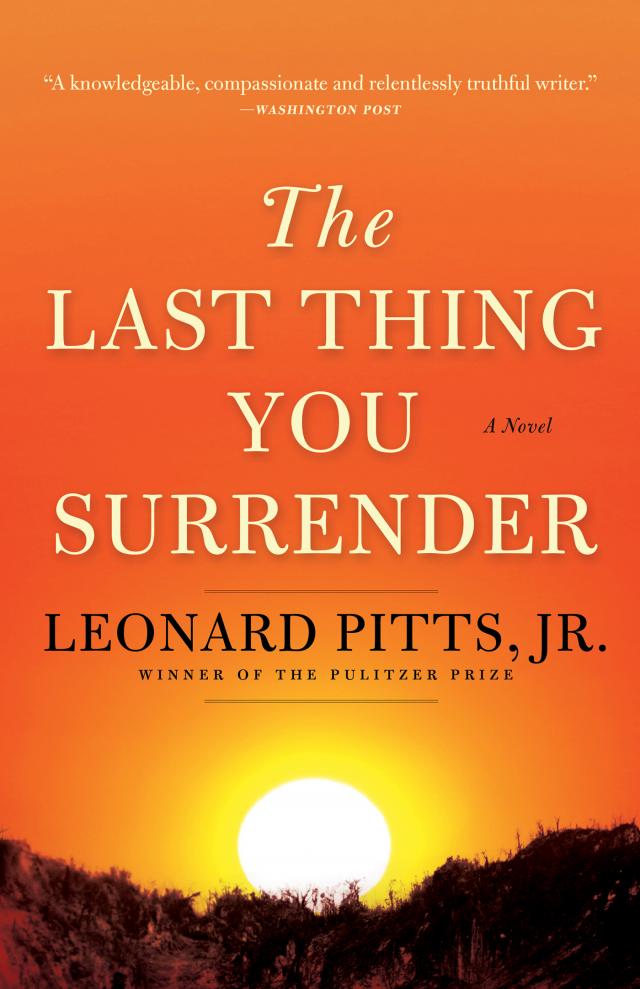
The
LAST THING
YOU
SURRENDER
ALSO BY LEONARD PITTS, JR.
Grant Park
Freeman
Before I Forget
Forward from This Moment
Becoming Dad
The
LAST THING
YOU
SURRENDER
Leonard Pitts, Jr.
BOLDEN
AN AGATE IMPRINT
CHICAGO
Copyright © 2019 by Leonard Pitts, Jr.
All rights reserved. No part of this book may be reproduced or transmitted in any form or by any means, electronic or mechanical, including photocopying, recording, or by any information storage and retrieval system, without express written permission from the publisher.
This novel is a work of fiction. Names, characters, incidents, and dialogue, except for specific fictionalized depictions of public figures, products, or services, as characterized in this book’s acknowledgments, are imaginary and are not intended to refer to any living persons or to disparage any company’s products or services.
Please note that this book contains scenes of graphic violence, including one of sexual assault. Reader discretion is advised.
First printing: February 2019
Printed in the United States of America
10 9 8 7 6 5 4 3 2 1 19 20 21 22 23 24
ISBN-13: 978-1-57284-245-8
ISBN-10: 1-57284-245-8
eISBN-13: 978-1-57284-824-5
eISBN-10: 1-57284-824-3
Bolden Books is an imprint of Agate Publishing. Agate books are available in bulk at discount prices. Single copies are available prepaid direct from the publisher. To learn more, visit agatepublishing.com.
In loving memory of Dad and Mom,
Corporal Leonard G. Pitts, United States Army (1924–1975) and Mrs. Agnes R. Pitts (1926–1988)
Contents
One
Two
Three
Four
Five
Six
Seven
Eight
Nine
Ten
Eleven
Twelve
Thirteen
Fourteen
Fifteen
Sixteen
Seventeen
Eighteen
Nineteen
Twenty
Twenty-One
Twenty-Two
Twenty-Three
Twenty-Four
Twenty-Five
Twenty-Six
Twenty-Seven
Twenty-Eight
Twenty-Nine
Thirty
Thirty-One
Thirty-Two
Thirty-Three
Thirty-Four
Thirty-Five
Thirty-Six
Thirty-Seven
Acknowledgement
About the Author
Reading Group Guide
Though he slay me, yet will I trust in him
—JOB 13:15
I’m lookin’ funny in my eyes and I believe I’m fixin’ to die
I know I was born to die but I hate to leave my children cryin’
—FROM “FIXIN’ TO DIE” BY BUKKA WHITE
one
HE WAS DREAMING OF HOME WHEN THE EXPLOSION CAME.
He came awake in midair, flailing about as the blast, solid as a fist, reverberated around him. He just had time to register what had shoved him off his rack before he landed like a cinder block six feet below, his hip taking the blow, his head cracking against the steel deck.
For a very long moment, Marine Private George Simon could do nothing but lie there, hands cradling his skull. Was he awake? Or was he still curled up on his rack sound asleep and all of this just a very bad dream?
His answer was a bugle call that erupted from the loudspeaker overhead, sharp notes clanging off the bulkhead. This was real. All hell was breaking loose.
“General quarters! General quarters! This is not a drill! Man your battle stations!”
It blared from the same loudspeaker, the voice taut and anxious. Both hatches of the berthing compartment housing the marine guard were closed, but from the other side of the bulkhead, George heard feet rushing by, men shouting, feet clambering up the ladder that connected the third deck to the second and on up to the antiaircraft guns topside, others scrambling down the passageway toward the barbette shielding the number four turret, where they would make their way to the powder handling room and up through the turret to man the big 14-inch guns.
His head chiming like a bell, George tried to push up off the deck and spring to his feet. A bolt of pain lanced through his right hip, and he went right back down, screaming.
Oh God, oh God, oh God. It hurt. Something was wrong. His leg would not support his weight. He was helpless, lying on the deck of an otherwise empty compartment in the stern of the ship. Did anyone even know he was here?
Stop it, George! Get moving!
He got his arms beneath him again and pushed up. Bracing himself with his left arm, he hooked his right over the railing of a bottom bunk. He levered himself up, swung his left arm onto the railing, and pulled himself up, his good leg pushing against the deck. The other leg scraped along after him, his pelvis sending up new signal flares of pain with each inch gained.
George ignored it. He sucked in a deep breath, gritted his teeth, and hauled himself up into the bottom rack. There he lay on his side, facing the bulkhead, trying not to lose consciousness. The compartment swam. His stomach was in his throat, and he felt darkness sinking down upon him. He blinked his eyes and wiped at something trickling on his temple. His fingers came away shining red.
Before he could process this, the loudspeaker screamed again. “General quarters! General quarters! This is no drill, goddamn it! This is the real thing!”
The words galvanized him. It was not just the urgency of the message but also the use of such unprofessional language over the ship’s PA. That, more than anything, told him how serious the situation topside must be.
Were there bombers? An enemy fleet? One thing was for sure, though. It had to be the Japs. It could only be the Japs.
From the passageway on the other side of the bulkhead, George heard a fresh scuffling of feet rushing by. He called out to them, but his cry was lost in another detonation, an explosion so vast the great ship seemed to shudder.
“Help me!” he cried. “Somebody help me!”
George listened for a response without much hope of actually receiving one. Even if the hatch had been open, he doubted anyone could have heard him through the cacophony that had abruptly shredded the quiet Sunday morning. And now there didn’t even seem to be anyone out there. The passageway had gone silent.
All at once, George felt the deck turning beneath him. At first he didn’t believe it, refused to believe it. He told himself it was just the nausea, just the vertigo that kept trying to sweep him into darkness, and he waited for it to pass. It didn’t. The ship rolled again until he felt gravity tugging him, gently but unmistakably, toward the bulkhead. There came a ghostly sound of metal groaning.
It was not his imagination. The ship was listing hard to port. He was still registering this when another explosion lifted him off his rack. Yet another followed hard after that. George hooked his arm through the railing of the rack to keep from being pulled toward the bulkhead. Bad leg or not, he had to get out of here.
The racks were in stacks of three and rows of two throughout the compartment. George reached out and caught the railing of the rack across from him and two levels up. He gripped it firmly with one hand, then the other, and used the railing like a chin-up bar to pull himself out of the lower bunk and climb up. George got his left leg beneath him, reached back and, with his hand, lifted his useless right leg until it was clear of the bottom bunk. The limb was a dead thing hanging off him, and there was no chance of putting weight on it. George would have to hop, leaning on bulkheads and lockers for support, dragging the leg painfully behind, hoping he ran into someone who could help. Most of the men would be at their stations by now, minus those who had spent the night ashore and were at this moment waking up with throbbing hangovers to find themselves behind bars for some half-remembered revelry, or in the warm beds of Hotel Street prostitutes, or otherwise blissfully unaware of what was transpiring at Pearl just a few miles away.
“Man your battle stations!” cried the loudspeaker again. “This is no shit! This is the real thing!”
No kidding, thought George as he hopped toward the hatch on his good foot. The progress he made was barely worth the name. Each hop cost him pain, forced him to pause and breathe through gritted teeth. It took him an hour to reach the hatch. Or at least, that was how it felt. The hatch had not been dogged—the door had not been sealed to hold it in place—so bracing himself, he was able to pull it open with one hand. The passageway was as empty as he had feared. The ladder was just around the corner, just a few feet away. It was then that George realized a new problem. How could he get over the coaming—the raised section at the bottom of the hatch opening—without putting weight on his dead leg? Obviously, he couldn’t just step over it as he had done a thousand times without thinking. Nor could he hop over it; the coaming was too high, the top of the opening too low.
George was pondering this when he felt the ship turn again beneath him. And from somewhere not far distant, he heard a sound that filled his mouth with ashes. It was the rush of water.
There came no reply. How many men had even returned to the ship last night? They’d been at sea on maneuvers until Friday, and the men who had liberty had greeted the return to Honolulu eagerly, looking forward to getting laid, getting drunk, or, in the case of a few, spending the evening smiling dopily into the eyes of local girls who had stolen their hearts. George himself had gone ashore but only for a few hours. He’d had beers with a couple fellows he was friendly with. On the street outside the bar, they had tried to cajole him into joining them in a cab ride down to Hotel Street and had laughed when he declined, even though they had known he would.
“Can you imagine Reverend George here with some pretty blonde whore?” crowed Swifty. His Brooklyn accent rendered “whore” with two syllables—“whoo-er.”
“Nah,” agreed Babe, as he flipped open his Ronson to light the cigarette bobbing in his lips. “Definitely not the Reverend’s style,” he added, blowing out smoke.
George had laughed, but laughing felt like duty, like something he had to do so the fellas would think he was a good sport. Truth to tell, he hated it when they called him “Reverend” or “Saint,” which they did often. It was a strange thing, he thought: if you asked them, probably the vast majority of the men on the ship would have told you they believed in God. Most even went to services, if only occasionally. But if you acted like that belief really meant anything, they treated you like you were not quite right, like some nancy boy with a screw loose.
And Lord help you if you made the mistake of admitting that you were a virgin, that you were saving yourself. They snickered or made jokes, guffawed at you while your cheeks burned and you tried to smile, grateful when they finally changed the subject. What could you do but take it? So he had made himself grin as Swifty widened his eyes, let his face go slack, and spoke in a rube’s voice that was meant to be George. “Duh … I-I-I don’t kn-kn-know, Miss. I d-d-don’t think what you’re d-d-doing is allowed in the B-B-B-Bible.”
George had a stammer when he was excited. He’d had it since he was a kid. “All right, you guys,” he’d said through the same tolerant smile. “Cut it out.”
Babe had clapped him on the back. “Ah, you know we’re just kiddin’ with you, Rev.”
“Yeah, Rev,” said Swifty, lighting up a smoke and shaking out the match. “You go on and catch yourself a movie. Us sinners are going to see what we can do about finding something to dip our wicks into. Pray for us, why don’t ya?” He made the sign of the cross with the hand holding the burned-out match, then flipped it into the gutter and burst out laughing. They had parted company there. Babe and Swifty had hailed a cab, and he had walked a couple blocks to a movie house that was showing Abbott and Costello in Keep ’Em Flying. It had been a warm evening—all the evenings here were warm—and the streets were crowded with swabbies and marines on shore leave walking in boisterous groups, Christmas shoppers balancing their bags and leading their children. Bright blinking lights in primary colors were strung around windows and doorways. A light breeze had rustled the palm fronds high above.
Had they made it back to the ship? And if so, had they managed to escape when the attack came? Or were they trapped down here just like him? George shook the thought off. What was the sense of wondering? If they were trapped, there was nothing he could do about it. Remembering Babe and Swifty, George found himself thinking idly (and not for the first time) how much Father would hate it if he knew George’s pals in Honolulu were a Polack and a dago. This, even though Father himself had come over as a boy. Stick to the white guys, Father would have advised—meaning the guys without funny-sounding names and the stink of greenhorn all over them.
Of course, Father hated that he was in Honolulu as a marine in the first place and, worse, that he had enlisted as a lowly grunt. “Allow me to at least arrange a berth for you in Officer Candidate School,” John Simon had said once he finally, reluctantly, accepted that George would not be shaken from his determination to join the Corps right out of high school. It had been a tempting offer. George knew it would be easier to spend his hitch giving orders than taking them. But how would that look? He had already been raised with every privilege that wealth and station could bestow. But he was a man now, and he was striving to be a moral man. Otherwise, he might as well have gone to college and then applied to law school as Father had planned. He could join Father’s firm, take it over when Father retired, amass a fortune, enjoy the admiration of lesser men and women, live a comfortable life. But the problem was, it was more important to George to be the sort of man who did the right thing, not for honor or gain, but simply because it was the right thing. And joining the Corps as an enlisted man, among other common men—he had felt in the pit of his stomach that this was the right thing. A war was coming. He had known that, too, in the pit of his stomach. People told him he was wrong. “We’ll stay out of this one,” Father had intoned sagely. “We got our fill of helping Europe last time. This time, we’ll let them figure it out for themselves. You’ll see.”
George didn’t buy it. Nor did he buy Lindbergh’s “America First” isolationism or Roosevelt’s promises that American boys would not be fighting in “foreign wars.” How could America stand to the side with Hitler gobbling up Europe and the Japanese rampaging in China? Sooner or later, his country would have to take a stand. And when the fighting started, when they came to pull poor boys out of tenements and farms and sent them out to hazard their lives in defense of their country, why should he be excused—or given some cushy job—just because he was a rich man’s son? What kind of Christian would that make him? What kind of man? No, George Simon was a moral man. And he needed very much to prove himself to himself.
So this time, he had not bent to Father’s will. He would not wait, and he would not hide behind some officer’s desk, either. George Simon would ante up. He would sign up to be a marine—yes, Father, a lowly grunt, no better or worse than any other lowly grunt. It was, he had realized with a start, the first time he had made an important decision about his own life and stuck to it. It had felt good.
And perhaps God had heard that thought and decided to underscore it. Because it was in that instant that George saw seawater rising toward him from the port side of the ship. His heart took a painful leap in his chest. He was running out of time.
With that realization fueling him, he reached through the opening, grabbed the piping that ran along the overhead, and pulled. Thus braced, he was able to lift his good leg clear of the coaming—like chinups again—and set it down in the passageway. Still holding the piping with his left hand, he reached back with his right and drew the injured leg through the hatch, snarling from the pain and trying not to think how much additional damage he was doing to himself.
“Piece of cake,” he told himself, aloud. His voice sounded strained in his own ears. Bracing himself against the passageway, George paused to catch his breath before hopping to the ladder. He tried not to think of how he would haul himself up to the next deck. One problem at a time, he told himself.
And then the world exploded. The ship was hit again—and then yet again, two cataclysmic blasts that lifted the vessel and George with it, tossing him back through the hatch into the compartment he had just escaped. And there it was again, that sensation of flying helplessly through the air. But this time, his flailing hand managed to snag something—the rim of the hatch—and this kept him from falling completely ass over teakettle to the deck.
George was thanking God for this gift of good fortune when he felt the ship lurch hard toward port. As the deck tilted, gravity seized the hatch door and flung it shut—right on the fingers of George’s left hand.
They snapped like pencils. He heard the sound. And he would have reflexively yanked his hand away, except that the closed door prevented this and besides, the same gravity that had closed the door was pushing him against it and he was powerless to resist, to even find enough leverage to pull the hatch off his fingers. Worse, chairs, footlockers, tables—everything that was not secured—were beginning to slide in the same direction. Most of them came to rest against the bulkhead. One of the chairs rolled up against George’s feet.





