

Freeman, page 1


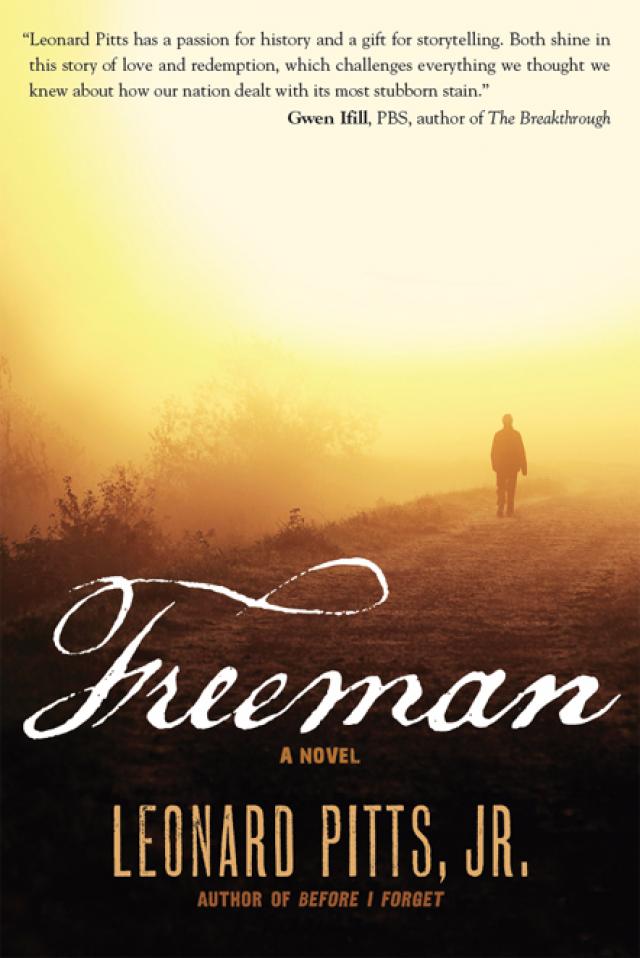
Freeman
Copyright© 2012 by Leonard Pitts, Jr.
All rights reserved. No part of this book may be reproduced or transmitted in any form or by any means, electronic or mechanical, including photocopying, recording, or by any information storage and retrieval system, without express written permission from the publisher.
Library of Congress Cataloging-in-Publication Data
Pitts, Leonard.
Freeman / Leonard Pitts.
p. cm.
Summary: “At the end of the Civil War, an escaped slave first returns to his old plantation and then walks across the ravaged South in search of his lost wife”--Provided by the publisher.
ISBN-13: 978-1-57284-699-9 (ebook)
1.Freedmen--Fiction. 2.African-Americans--Fiction. 3.Reconstruction (U.S. history, 1865-1877)--Fiction. 4.Southern States--History--1865-1877--Fiction.I. Title.
PS3616.I92F74 2012
813’.6--dc23
2012009592
Bolden is an imprint of Agate Publishing. Agate books are available in bulk at discount prices. For more information, go to agatepublishing.com.
Freeman
A NOVEL
LEONARD PITTS, JR.
BOLDEN
AN AGATE IMPRINT
CHICAGO
For Marilyn
(and all the Tildas everywhere)
Contents
Chapter 1
Chapter 2
Chapter 3
Chapter 4
Chapter 5
Chapter 6
Chapter 7
Chapter 8
Chapter 9
Chapter 10
Chapter 11
Chapter 12
Chapter 13
Chapter 14
Chapter 15
Chapter 16
Chapter 17
Chapter 18
Chapter 19
Chapter 20
Chapter 21
Chapter 22
Chapter 23
Chapter 24
Chapter 25
Chapter 26
Chapter 27
Chapter 28
Chapter 29
Chapter 30
Chapter 31
Chapter 32
Chapter 33
Chapter 34
Chapter 35
Chapter 36
Chapter 37
Chapter 38
Chapter 39
Chapter 40
Chapter 41
Chapter 42
Chapter 43
Chapter 44
Chapter 45
Chapter 46
Chapter 47
Chapter 48
Chapter 49
Chapter 50
Chapter 51
Acknowledgments
About the Author
His first thought was of her.
Outside, something heavy thudded the sky and the old house shuddered hard as if its floorboards had been stomped upon by giants. He put his book aside and swung down from the bed where he had been resting, fully dressed. Maybe it was thunder. The skies had been leaden all day.
But thunder rolls and this was a percussive boom such as he had heard many times on the battlefield. This was cannon fire. Then, overtop the cannons, came the sound of bells, every kind of bell there was, fire bells, church bells, school bells, all pealing at the same time in a perfect confusion of joy. And all at once he felt it, hope fluttering in his chest like a butterfly in a cage. It was difficult to breathe.
Lifting the oil lamp from the stand by his bed, he made his way down the dark hallway, down the stairs, each step taking him deeper into pure bedlam. When he emerged onto the stoop, he found his landlady, the widow Brewster, standing among a small knot of people, watching the crowded avenue flow by. Her face, usually so pinched with contempt for him and every other living thing, glowed with beatific light. Tears shone on her cheeks. At the sound of his approach, she turned and, to his great surprise, smiled. If he didn’t know better, he’d have thought her beautiful.
“It’s over,” she said, and her voice trembled under the weight of just those two words. She said it again: “It is over.”
His mouth fell open but not a sound came out. A trail of fire sizzled across the sky and broke high above them in a star of silver and gold. The impromptu parade surging past, the shopkeepers and floor sweepers, the countermen and maids, every Negro in Philadelphia, it seemed, all craned their heads as one to look, point, and exclaim. All of them chattering at once and waving tiny American flags. Someone lifted three cheers for the United States. Edwina Brewster hugged him. Actually wrapped her arms around his waist and squeezed. It was over. The war was done.
And his first thought was of her.
He had called her Tilda. She had called him Sam.
These were names they had given one another for their own private use and amusement and they were, he thought, the names truest to who they really were. But they’d each had other names.
When he was born, his mother—a careworn face, barely recalled—had named him Henry. The woman who bought him when he was seven had told him she already had a Henry on her place and did not want the confusion. She had named him Hark. When that woman died eight years later, leaving no heirs, he was sold at an estate auction and bought by a woman who disliked his name yet again. All her slaves were named after figures in classical Greek literature, she explained, not looking at him as a footman accepted her gloves and another unhitched the horses from her fine rig.
She appraised him with a brief glance, a gangly, frightened boy, lying manacled in the back of the wagon, hair unkempt and flecked with bits of straw. “You’ll be Perseus,” she announced. And then she walked away.
He was still looking after her when the footman produced a skeleton key and opened the ring of metal around his wrist. “You think that’s bad,” he grumbled. “She call me Zeus.”
Later that same day, he was sitting in front of the cabin he had been given, wearing the rough clothes he had been issued, eating with his fingers from the bowl of cornbread and greens someone had handed him, when he felt eyes on him. He looked up and beheld her for the first time. He almost dropped his bowl.
She stood hip thrust with one hand akimbo. He judged that she was his age or close to it, but she already had a woman’s curves, her thighs round and strong beneath the faded house dress, her breasts straining against the plain fabric. He felt a stiffening in his groin and moved the bowl to cover it.
“She call you Perseus, hmm?” Her smile was gentle and amused. “That woman and her Greek.”
“What she call you?” he stammered. His throat was so dry it hurt.
“Danae,” she said. “Do I look like some Danae to you?”
She looked like…beauty. Lush black hair plaited in a single braid that fell back from a dark, radiant face. Her eyes were almond shaped, her lips full, and, just now, pursed in thought. In that very instant, he loved her and knew that he would love her always.
“I’m gon’ call you Sam,” she said finally. “That all right with you?”
“Yes,” he said, uncomfortably aware that anything she wished to call him would be all right with him. Then out of nowhere, he heard himself say, “And I’m gon’ call you Tilda. You mind that?”
“Tilda,” she said, contemplating the darkening sky. Then she looked at him and smiled. “No, I don’t mind that. I kind of like that.” And he felt something warm break open inside his chest.
“Well, I got to go,” she said. “See you later, Sam.” She turned to walk way.
He watched her go, his bowl of greens forgotten. “See you later, Tilda,” he said.
It was fifteen years since he had seen her. He didn’t know the last time he had thought of her. Sam had trained himself not to think of her, because thinking of her only made it hurt worse, only reminded him how far his poor life had meandered from everything that made living it worth the trouble. So he had learned to lie flat on his belly in an orchard, Minié balls chewing up peaches and men indiscriminately, and not think of her. He had learned to languish on a train, pulse thudding in his temples, fighting for breath, the air rent with the moans of dying men, and not think of her. He had learned to live quietly, to take his meals alone in a corner of Edwina Brewster’s kitchen, to recline on his narrow bed in a narrow room on the top floor of a rooming house and read his books, not thinking of her.
Now a bonfire blazed to life at the end of the block, people dancing in golden light, now a parade carried Jefferson Davis by in effigy, a linen figure stuffed with straw hanging by the neck from a pole, now someone raised three cheers for U.S. Grant and bells tolled all over the city and flags fluttered and Edwina Brewster wept unreservedly and thinking of Tilda was all he could do. Tilda. His Tilda.
It was too much. Sam slipped back inside, climbed the stairs to his room, sat on his bed, and opened his book.
He tried to remember how not to think of her. It had been so long. Would she be thinking of him? He did not think she would.
Surely it would hurt her too much, not just the years they had been apart but also the years they had been together, the son they’d had. And lost.
Down went the book. He went to his window, where he was met by his own reflection: dark skin, a broad, strong nose, full lips, and deep set brown eyes. To his surprise, the sober, unrevealing face he had long ago trained himself to show the world, the white world in particular, had cracked open. Tears were running out.
The tumult from below came to him as an indistinct murmuring. Another string of fire flung itself across the sk
Now conscience wakes despair
That slumber’d,—wakes the bitter memory
Of what was, what is, and what must be
Worse.
John Milton. And the words were sour to him in their unutterable truth.
All the things he had trained himself not to remember came rushing in on him. He remembered how Tilda had looked, sweaty, exhausted, and aching from her labors, but smiling for him. He remembered how his son had looked, smudged with blood and afterbirth, hair matted to his scalp, eyes pressed closed. And he remembered how the boy had looked fourteen years later, lying with mouth agape in a muddy bog. You would have thought him asleep, except for the bloody red hole in his back. Ajax, the woman had called him, another of her Greek names. But to Sam and Tilda, he had always been Luke.
It confused him some at first. “Why I got two names?” he had asked one evening when they had all come in staggering from a long day in the fields.
The look Tilda gave him then caused him to shrink away. “She call you what she want,” Tilda had said, jerking her head toward the big house. “But to us, you always be Luke.”
Mistress was aware they had their own names for each other, but she never said anything about it. She was, Tilda always said, a good mistress, all things considered.
To which Sam had always replied, “Yeah, but she still a mistress.” It was their one argument.
Enough, he thought, turning from the window. Enough.
Tilda was years behind him now. He did not even know where she was. Maybe still with Mistress. Maybe long since sold away. And even if she still belonged to Mistress, who was to say Mistress was still on the old place down in Mississippi? So many masters and mistresses had abandoned their properties because of the war, had taken their slaves and run to Texas.
There was no telling where Tilda was. She might be anywhere. She might even be dead.
Sam lay back on the bed. He did not pick up the book again, knowing it would be useless. Instead he lay there with eyes closed listening to the thump of fireworks and the muted cheers from the streets, trying to remember how not to think of her.
Sleep was long in coming.
In the morning, he walked through streets littered with tiny American flags and the charred remains of bonfires. The city was in a stupor of joy. He bought a paper from every paperboy he saw. The headlines shouted:
Victory!! Victory!!
Lee Finds His Waterloo
The Rebels Want Peace
The Nation’s Thanks To Its Glorious Heroes
He read as he walked. Robert E. Lee had surrendered at a place in Virginia called Appomattox Courthouse. Gen. Grant had declined to take him prisoner. A day of thanksgiving had been declared on the recommendation of the governor. Churches were expected to be packed all day.
“I might have known,” said Billy Horn, as Sam entered the reading room of the Library Company of Philadelphia. “War or peace, you will come through the door right on schedule with your head buried in a newspaper.”
“Good morning,” said Sam. The sight of a colored man reading was a never-ending source of wonder and consternation to his coworker. Sam set the papers on a counter.
Louisa Prentiss had thought the law forbidding slaves from being educated a foolish one and had made a show of flouting it. But no one bothered her about it. Mistress was the widow of a former Mississippi governor, the wealthiest woman in the county, and one of its most powerful people of either gender. It was generally accepted that she was “unconventional,” and if she pampered her slaves, if she gave them fancy Greek names or allowed them to read books openly, or refused to sell them even when you offered her a fair price because she didn’t believe in breaking up families—even nigger families—well, no one dared say anything about it. “Miss Prentiss’s niggers,” her slaves were called and it was generally understood that they were untouchable.
Nevertheless, Sam had been glad to land in Philadelphia, where, he thought, a colored man with a book in hand would be no particular novelty, nor incite sidelong glances of threat and hostility. He had been mostly right about that, but there were exceptions. Billy Horn was one of them. Sam hoped without any real expectation that the white man would have nothing more to say on the subject. But that was impossible, he knew, for this particular white man on the first day of peace.
Horn was a shaggy young man who had been one of the first volunteers to join the federal army, driven by a profound conviction that no state could be allowed to just pick up and leave the Union whenever it so pleased. He had lost an arm in the first big engagement at Bull Run, convalesced, and then returned to Philadelphia where he promptly lost his fiancée, who could not envision her prospects married to a man with one arm. But as far as he was concerned, the ultimate betrayal had come the next year, when Abraham Lincoln issued his Emancipation Proclamation.
“He turned it into a slavery war,” Horn had groused darkly one day. He had been talking to a patron, but staring at Sam, who stood above him on the catwalk that circled the reading room, shelving books from a cart. “I did not sign up for that, sir. This was supposed to be a war to restore the Union, nothing more. I did not lose my arm for nigger freedom.” He had raised his voice on the last words. People had looked around reproachfully. Mary Cuthbert, the no-nonsense spinster who managed the library, had called him into her office.
He would apologize the next day. He would say he had been drunk. Sam knew better. Billy Horn had been sober as a funeral dirge. He came around the desk now, grinning beneath the heavy underbrush of a brown beard, and clapped Sam heartily on the shoulder. “I suppose you are pleased,” he said.
“We are at peace again,” said Sam. “I would think we would all be pleased.” He said it the way he said everything, especially to white men: his voice even and clear and free from any trace of Negro dialect. His enunciation was always pointedly correct. Everything about him was always pointedly correct. Especially with white men.
“You know what I mean,” Horn said, leaning close. His voice was like metal scraping stone and Sam smelled the awful, fermented breath. There would be no need for Horn to lie about it this time.
“You have been drinking,” said Sam.
“I have been celebratin’,” said Horn. “I’d expect you would, too. The slavery war is over. The niggers are free.”
Sam made himself smile, made his voice amiable. “Look, Billy, I have books to shelve.”
Horn’s face clouded. “Oh, now you think you’re good enough to give orders to a white man, is that it? I guess I shouldn’t be surprised. That’s what comes of nigger freedom.”
“You are inebriated,” said Sam.
Horn’s brow wrinkled as Sam had known it would. “Inny-what?” he demanded.
Sam smiled. He liked using big words, five-dollar words, on people who presumed to treat him as less than he was just because he was a Negro. He especially liked using them on white men like Horn, arrogant without just cause. It amused him to see them have to grope for the definition.
“It means you are drunk,” he said, turning on his heel and walking away. Not only were there books to shelve, but also returns to sort through, floors to sweep, garbage to empty. He did not have time for this. Sam began to gather the books patrons had left on the table Saturday night at closing. It did not escape him that it had been Horn’s job to re-shelve them before leaving work.
Sam got two tables away before Horn moved to intercept him. “Please allow me to pass,” said Sam. He spoke politely, spoke correctly, and he tried to ignore the heat he felt spike in his chest.
“You do like giving orders to white men, don’t you?”
“I have work to do,” said Sam. “Please allow me to do my work.”
“Free niggers,” snarled Horn with contempt. The big right hand came up and he shoved Sam. The books fell from Sam’s arms and he rocked back a single pace.
It was enough. Sam’s hands came up and before he could think, his right fist shot forward and smashed the tip of the bigger man’s nose. Billy Horn staggered, right hand coming up to catch the blood that gushed from his nostrils.


