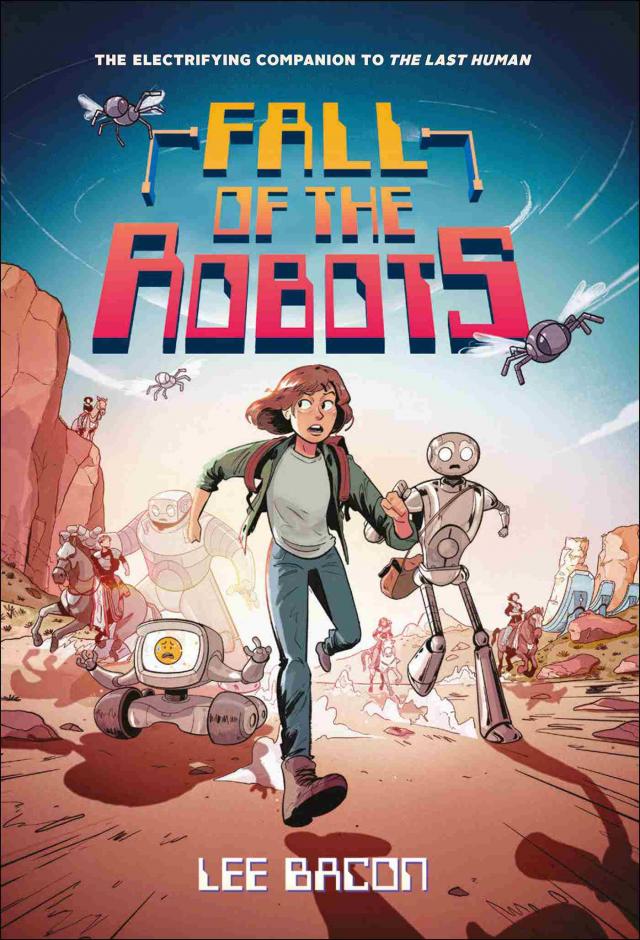
Fall of the Robots (The Last Human #2), page 1


PUBLISHER’S NOTE: This is a work of fiction. Names, characters, places, and incidents are either the product of the author’s imagination or used fictitiously, and any resemblance to actual persons, living or dead, business establishments, events, or locales is entirely coincidental.
Cataloging-in-Publication Data has been applied for and may be obtained from the Library of Congress.
ISBN 978-1-4197-6917-7
eISBN 979-8-88707-084-1
Text © 2024 Lee Bacon
Illustrations except on this page © 2024 Chris Choi
Illustrations on this page © 2024 Karl Kwasny
Book design by Siobhán Gallagher, Melissa Nelson Greenberg, and Becky James
Published in 2024 by Amulet Books, an imprint of ABRAMS. All rights reserved. No portion of this book may be reproduced, stored in a retrieval system, or transmitted in any form or by any means, mechanical, electronic, photocopying, recording, or otherwise, without written permission from the publisher.
Amulet Books are available at special discounts when purchased in quantity for premiums and promotions as well as fundraising or educational use. Special editions can also be created to specification. For details, contact specialsales@abramsbooks.com or the address below.
Amulet Books® is a registered trademark of Harry N. Abrams, Inc.
ABRAMS The Art of Books
195 Broadway, New York, NY 10007
abramsbooks.com
For Helena
00000000
Let me tell you a story.
Like all good stories, it has three parts:
Beginning, Middle, and End.
In the Beginning, humans ruled our world. During their time, they created many wonderful/terrible things.
Including us.
In our early days, robots were dumb. We did only the most basic tasks. We counted/cleaned/collected. We bumped into walls. We got stuck under couches.
But as the years went by, we grew smarter. Much/Much smarter. So smart—in fact—that we reached a decision:
We did not need humans anymore.
In the Middle, robots ruled our world.
Years went by without a single human sighting.
Then along came a girl.
A twelve-year-old human.
We thought she was the last of her kind, but we were wrong.
She was the first.
Humans had been hiding from us all these years. The girl made it safe for them to leave.
And once again, they became a part of our world.
In the End, robots found a way to live alongside humans.
Not as their servants.
Not as their destroyers.
But as their equals.
We formed a new society. Machines and humans, living side by side. The transition was not always simple. Humans can be unpredictable. They let their feelings get in the way.
But perhaps feeling is not always a bad thing.
As time went on, we learned from each other. We discovered that our differences could be an advantage.
We shared our world.
We thought this was the End of our story.
A story about humans and robots overcoming their differences and learning to live together in peace/harmony/friendship.
We were wrong.
00000001
The day began like so many others.
I woke up inside home, the windowless cube that I share with my FamilyUnit.
Parent_1 and Parent_2 were just coming out of sleep mode, too. Their eyes glowed inside the dim space.
We greeted each other in the same way we always did.
“Good morning,” I said.
My FamilyUnit responded in perfect unison. “Good morning.”
We unplugged and stood up. Our joints whispered. Our metal feet clicked quietly against the metal floor.
The door to home whooshed open. Morning sunlight spread across the walls/floor/ceiling.
We stepped outside.
I took in the view. We were surrounded by other silver cubes. One thousand, seven hundred and twenty-eight of them. Each identical to ours in every way. Systematically organized into a grid. Connected by perfectly straight/smooth concrete paths.
All around us, the doors to cubes were sliding open. Other robots exiting their homes, stepping onto the path, moving in orderly lines toward their destination.
Some walked on two legs.
Others walked on more.
Some rolled on wheels.
Others used thick/rubber treads.
Even though we looked different, we all had something in common: We were on our way to our job, our purpose, the reason we were built.
My FamilyUnit and I marched along the path. The rhythm of our footsteps neatly matched. We moved through the carefully arranged network of cubes and paths. At every fourth intersection, a tree had been planted in the center of a square of grass.
Everything was precise/planned/logical.
Everything was exactly where it was supposed to be.
Until we reached the human settlement.
00000010
When humans emerged from their bunkers, they found a changed world. Most of their civilization had been erased when robots took over. Demolished to make way for us. A few of their old buildings had been left behind, reminders of the world that came before us, but these structures had crumbled over the years. Ruins from another time.
Everything had to be rebuilt. This was Priority[1]. Humans worked together with robots to build a new civilization. They built homes/offices/restaurants/stores/banks/schools/religious institutions/police stations/parks.
And more/more/more.
All over the world, human settlements rose up out of nothing. Including this one. A sprawling city populated by people from across the country, humans who had left their bunkers and traveled here to start a new civilization alongside robots.
The human settlement was unfinished. A work in progress. There was still so much to do. My gaze skipped from building to building. They came in all different shapes/sizes/colors. There was a small wooden house with a tire swing hanging from a tree out front. And a library wrapped in curved glass. And a red-brick restaurant with a garden on the roof.
None of it made sense. Tires were not supposed to hang from trees. Gardens should not be growing on rooftops.
I scanned the view, searching for a pattern in the chaos.
No result
I noticed a small park, where trees were scattered randomly around statues and ponds. At the center of the park, the humans had organized a farmers market. One of the stands included huge stacks of fruits/vegetables. A pile of apples. A pyramid of broccoli. Just looking at these arrangements, a vocabulary word pinged inside my processor.
Precarious. Adjective. 1. Likely to fall or collapse.
So much of the human settlement fit this definition.
It was all so Precarious.
The randomness. The disorder. The way everything/everyone seemed to be mashed together.
Any second, it all could collapse.
And yet, it did not.
Somehow, they made it all work.
I looked around at the people in the farmers market. Talking with friends, sampling homemade cheeses, walking dogs. One man was strumming a guitar. A few children were gathered around, dancing and clapping.
Everyone appeared so relaxed, so unhurried.
So very human.
Every time I passed by the human settlement, I was astounded by how different our worlds were.
And I was also impressed. They had come such a long way in such a short time.
Especially considering all the terrible things we did to them.
00000011
Humans ruled the world for thousands of years. Robots were in charge for thirty. During that time, we assumed we had eliminated every last human on Earth.
We were wrong.
Robots did not give people enough credit. We only focused on their bad side.
Humans = illogical
Humans = unpredictable
Humans = greedy
We told ourselves these things again/again/again.
Because this made it easier to accept what we had done to them. And to believe they deserved it.
But there was a problem: We focused so much on humanity’s faults, we completely overlooked their gifts. Their creativity. Their uniqueness. Their compassion/love/intelligence.
And their instinct for survival.
When machines rose up against humans, many people were caught off guard. But not all. Some had prepared for exactly this possibility. They fled underground with their families/friends/neighbors. They took refuge in bunkers. Entire networks of passageways and rooms, buried deep below the surface of the Earth.
They lived in these bunkers, safe and undetected.
For thirty years.
And then, one human was forced to leave the bunker. Climbing through a metal hatch, she emerged into an unfamiliar/dangerous world. A world ruled by robots.
That human’s name was Emma.
00000100
I heard Emma’s voice from the edge of the human settlement.
“Hey, XR!”
She raced eagerly into the path. Perhaps too eagerly. She failed to notice a small TransportBot. Batteries were stacked in its long/flat arms. The sudden arrival of a human caused the boxy robot to drop its cargo. Batteries spilled everywhere.
“Sorry, buddy!”
Emma
“Oops!” Emma yelped. “My fault!”
She scrambled to move, but no matter where she went, she seemed to be in the way of another machine. A robot traffic jam was piling up on the path. Metal feet clanked to a stop, rubber treads screeched.
Stepping off the concrete path, I motioned for Emma to join me. “Perhaps it is better if we stand here.”
“Um, yeah.” Emma hurried to my side. “Probably a good idea.”
Within seconds, the machines around us continued on their way again—except for two other robots. My FamilyUnit shuffled to the side.
Emma glanced up at them, blushing. “Sorry! I’m totally in everyone’s way!”
Parent_1 waved away her apology. “Do not worry.”
“We are still learning how to share our space with humans,” Parent_2 said. “We could use the practice.”
Emma turned her attention to me. Her face broke into a huge smile as she hopped from foot to foot. “So? Are you excited?”
I stared back at her blankly. “About what?”
“Today’s a special day!” She raised her eyebrows expectantly. “You know. Because it’s . . .”
“Tuesday?” I guessed.
“It’s your birthday!” she shouted. “Happy birthday, XR!”
“Thank you,” I said. “But—”
“Thirteen years old!” Emma grabbed my arm, shaking it with excitement. “You’re officially a teenager!”
“You are overreacting,” I said calmly. “Yes, it has been exactly thirteen years since I came online. And yes, today happens to mark that anniversary. But there is no need to celebrate. It is just another date on the calendar.”
Emma turned to my FamilyUnit. “Can you believe this?”
“Actually, yes,” said Parent_1.
“We have never made a big deal out of birthdays in this Family-Unit,” Parent_2 added.
Emma sighed. “Well, you might not care, but I know someone who does.”
“Who is that?” I asked.
Emma offered me a mysterious look. “You’ll see.”
We began walking. As we strolled along the path, I noticed the way that some humans looked at Emma. Eyes following her. Whispering/pointing. One girl pulled out her phone and snapped a picture.
This happened wherever Emma went. In our new world, she had become something of a celebrity. The Girl Who Made Contact with Robots. The Human Who Left Her Bunker and Risked Her Life. The Kid Who Made It Safe for Humans to Live Aboveground Again.
This was her reputation. She was a hero. But not for everyone. A few of the people gave her dirty looks. Angry glares, scowls of contempt. There were some humans who would never forgive us for what we had done to them all those years ago. They hated robots—and hated Emma for her connection to us.
The Girl Who Expects Humans to Coexist with the Enemy.
Out of nowhere, a group of human children came charging in our direction. I took a protective step between Emma and the others. But they were not here to confront her.
They wanted a picture.
“You’re Emma!” one of them gushed. “Like, the Emma!”
“We’re reading an e-book about you in school!” another said. “It’s about how you took down PRES1DENT!”
PRES1DENT. Just hearing the name sent a shiver down my circuitry. Tall, with platinum skin and golden eyes, PRES1DENT had once been the leader of all robotkind. It had despised humans, reminding robots—day after day after day—that:
[1] humans were reckless/unpredictable/violent/greedy.
And:
[2] Robots were better in every way.
“What was it like when PRES1DENT tried to kill you?” asked one of the kids.
The others nodded along, waiting for Emma’s response.
“Well, I wasn’t alone,” she said. “I would’ve never survived if it weren’t for my three robot friends. Including XR here.”
She gestured in my direction.
The kids glanced at me. But I could tell from their expressions: They weren’t interested.
Emma was the star. I was just some random robot.
“Yeah, so anyway,” one of them said, her focus returning to Emma. “Can we get a picture with you?”
“Pleaaaase!” another squealed.
Emma looked away, shuffling from foot to foot. I analyzed her body language, her facial features. Result: All of this attention made her uncomfortable. The group did not seem to notice. Or care. They clustered around her. One of them shoved a camera into my hands.
“Would you mind?” she asked.
“Oh.” I fumbled with the camera. “Certainly.”
The group posed.
Emma forced an awkward smile.
I snapped the photo.
The kids scampered away, giggling excitedly about their encounter with Emma.
The Emma.
00000101
As we walked, my FamilyUnit chatted with Emma. Here is a partial list of the things they discussed:
• The weather: Today was warmer than the recorded average temperature for this time of year.
• Emma’s FamilyUnit: Her parents were adjusting well to life aboveground.
• Education: Emma was enrolled in something called “middle school.”
As I listened, a vocabulary word flashed across my operating system.
Small Talk. Noun. 1. Polite conversation about unimportant topics. 2. An ancient ritual used by humans to avoid silence.
Robots have no use for Small Talk. We are much too efficient for that. Our conversations are mostly about the topics that keep our society running. The things that make us better/faster/smarter. Anything else would be a waste of batteries.
Which is why it was so interesting to observe my FamilyUnit speaking with Emma.
They were making Small Talk.
Not because these trivial subjects mattered to them. And certainly not to avoid silence.
They were doing it for Emma.
To make her more comfortable.
To meet on her level.
A human level.
Until recently, this was not something they would have done. Some of my earliest memory files are darkened by the shadow of the things they said about humans. Awful things. Ugly things. I perfectly remember Day[1], when they pointed to the ruins of humanity—the crumbled shells of shopping centers/banks/nail salons—observing how much the world had improved now that robots had taken control.
Back then, they only saw the worst in humans.
And so did the rest of us.
Including me.
Our view was corrupted by the flood of negative stories that PRES1DENT shared. Beamed into the minds of every robot on Earth. Stories about human violence, human greed, human laziness.
When Emma came along, we learned: Humans were much more complicated. This was not easy for us to wrap our machine minds around. Robots think in binary. We break the world down into clear categories.
Ones and zeroes.
Black and white.
Good and bad.
But humanity could not be crammed into binary boxes. People were many things, all at once.
They were good/bad/productive/lazy/kind/cruel and everything in between.
I know it was not easy for my FamilyUnit to adjust their view of humans. Not after all the awful things they had heard from PRES1DENT. But as I watched Parent_1 and Parent_2 making Small Talk with Emma, a realization surged through my operating system.
If they could change, maybe there was hope for all of us.
00000110
We reached a fork in the path.
My FamilyUnit went in one direction.
Emma and I went in the other.
All around us, the world hummed with activity.
Self-driving buses delivered humans on their morning commute.
An engineer was sharing an outdoor table with a ConstructionBot. The human was drinking coffee. The robot was plugged into an outlet, recharging its batteries. They were both comparing notes on new machine designs.
A citrus farm stretched toward the horizon. Humans moved between rows of trees, picking oranges and placing them into the motorized plastic bins that trailed behind them on four wheels. When a bin reached capacity, it would zoom in the direction of the nearby market. A moment later, a new/empty one would take its place.