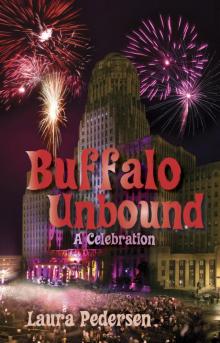
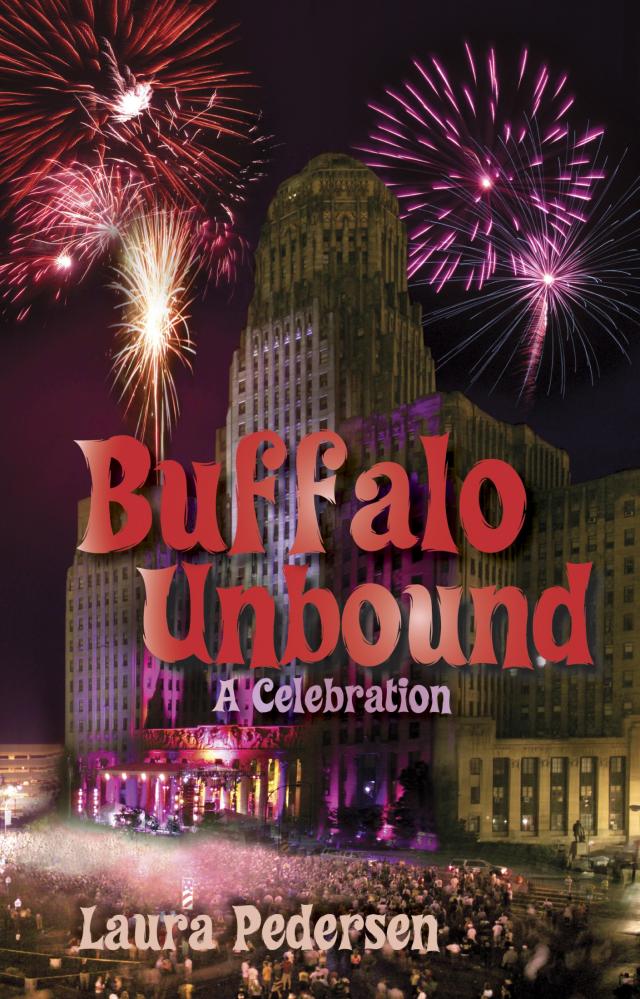
Buffalo Unbound, page 1


Critical Acclaim for Laura Pedersen
Buffalo Gal
“This book is compulsively readable, and owes its deadpan delivery to the fact that she has performed standup comedy on national television (The Oprah Winfrey Show, Late Night with David Letterman, Today, Primetime, etc.).”
—ForeWord Magazine
Best Bet
“The book’s laugh-out-loud funny, and readers will find themselves rereading lines just for the sheer joy of it.”
—Kirkus Reviews
The Big Shuffle
“Although it’s a laugh-out-loud read, it’s an appealing, sensitive, superbly written book. One you won’t want to put down. I loved it.”
—The Lakeland Times
“Be prepared to fall in love with a story as wise as it is witty.”
—The Compulsive Reader
The Sweetest Hours
“To call The Sweetest Hours a book of short stories would be like calling the Mona Lisa a painting.”
—Front Street Reviews
“Pedersen weaves tales that blend humor, sorrow, and sometimes surprise endings in the games of life and love.”
—Book Loons
Heart’s Desire
“Funny, tender, and poignant, Heart’s Desire should appeal to a wide range of readers.”
—Booklist
“Prepare to fall in love again because Laura Pedersen is giving you your ‘Heart’s Desire’ by bringing back Hallie Palmer and her entire endearing crew. In a story as wise as it is witty, Pedersen captures the joy of love found, the ache of love lost, and how friends can get you through it all—win or lose.”
—Sarah Bird, author of The Yokota Officers Club
“This book will make you laugh and cry and like a good friend, you’ll be happy to have made its acquaintance.”
—Lorna Landvik, author of Angry Housewives Eating Bon Bons
Last Call
“Pedersen writes vividly of characters so interesting, so funny and warm that they defy staying on the page.”
—The Hartford Courant
“This book is a rare, humorous exploration of death that affirms life is a gift and tomorrow is never guaranteed. Pedersen writes an exquisitely emotional story. A must-have book to start the new year.”
—Romantic Times
Beginner’s Luck
“Laura Pedersen delivers…if this book hasn’t been made into a screenplay already, it should be soon. Throughout, you can’t help but think how hilarious some of the scenes would play on the big screen.”
—The Hartford Courant
“Funny, sweet-natured, and well-crafted…Pedersen has created a wonderful assemblage of…whimsical characters and charm.”
—Kirkus Reviews
“This novel is funny and just quirky enough to become a word-of-mouth favorite…Pedersen has a knack for capturing tart teenage observations in witty asides, and Hallie’s naiveté, combined with her gambling and numbers savvy, make her a winning protagonist.”
—Publishers Weekly
“A breezy coming-of-age novel with an appealing cast of characters.”
—Booklist
Going Away Party
“Pedersen shows off her verbal buoyancy. Their quips are witty and so are Pedersen’s amusing characterizations of the eccentric MacGuires. Sentence by sentence, Pedersen’s debut can certainly entertain.”
—Publishers Weekly
Play Money
“A savvy insider’s vastly entertaining line on aspects of the money game.”
—Kirkus Reviews (starred review)
Also by Laura Pedersen
Nonfiction
Play Money
Buffalo Gal
Fiction
Going Away Party
Beginner’s Luck
Last Call
Heart’s Desire
The Sweetest Hours
The Big Shuffle
Best Bet
www.LauraPedersenBooks.com
© 2010 Laura Pedersen
All rights reserved. No part of this book may be reproduced or transmitted in any form or by any means, electronic or mechanical, including photocopying, recording, or by an information storage and retrieval system—except by a reviewer who may quote brief passages in a review—without permission in writing from the publisher.
Library of Congress Cataloging-in-Publication Data
Pedersen, Laura.
Buffalo unbound / Laura Pedersen.
p. cm.
ISBN 978-1-55591-735-7 (pbk.)
1. Buffalo (N.Y.)--History. 2. Buffalo (N.Y.)--Social life and customs. 3. Buffalo (N.Y.)--Biography. I. Title.
F129.B857P43 2010
974.7’97043--dc22
2010014920
Design by Jack Lenzo
Cover photo © Jim Bush, www.jimbushphotography.com
Fulcrum Publishing
4690 Table Mountain Drive, Suite 100
Golden, Colorado 80403
800-992-2908 • 303-277-1623
www.fulcrumbooks.com
I think when you die, your soul goes to a garage in Buffalo.
—George Carlin (1937–2008)
Buffalo Unbound
A Celebration
Laura Pedersen
Contents
Acknowledgments
Introduction
Black Is the New Black
I’ve Got the World on a String Theory
The United States of Iroquois
Buffalo Burning
Mo’ Better Bagels
Leave It to the Beavers
Angola Horror
Forest to Forest Lawn
Father Baker’s Dozen
Form Follows Freedom
Cleveland Hill Fire
Bada Bing Boom, Black Cadillac
A Tale of Two Eddies
School Days—A Few Flakes Short of a Snowball
How I Was Exposed
Arborgeddon
Ridin’ on the Thruway
Loss of Critical Mass: When the Saints Go Marching Out
Increase the Peace
Life in Amherst
The Best-Kept Secret
Let’s Go, Buffalo!
Connecting the Drops
To Be Perfectly Frank
Good Bones
Living Here in Allentown
Buffalo Past and Prologue
City of Great Neighbors (and Cat People)
About the Author
Acknowledgments
Special thanks to Buffalo News sports columnist Mike Harrington, who patiently explained why it’s wrong to say “a runhome” and “a downtouch.” And to John Koerner, author of The Father Baker Code; Jonathan L. White, a Frank Lloyd Wright enthusiast and senior interpretive guide at Forest Lawn Cemetery; and Janice Burnett, Patrick Kavanagh, and Sandra Starks at Forest Lawn Cemetery. Ongoing gratitude to the staff and volunteers at the Buffalo and Erie County Public Library and the Buffalo and Erie County Historical Society for their assistance and all the good work that they do. Much appreciation and a big bucket of wings to all the talented, kind, smart, and helpful folk at Fulcrum Publishing who made both Buffalo books possible, including the supportive and perspicacious publishers Sam Scinta (Sweet Home Class of ’87!) and Derek Lawrence, editor extraordinaire Carolyn Sobczak, ingenious and resourceful marketing superwomen Erin Groce and Katie Wensuc, and crackerjack designer Jack Lenzo. A big shout-out to the high priestess of skiing fast and Western New York public relations, Martha Buyer. Thanks to Peter Heffley for his willingness to share an especially difficult chapter in his family’s history. Kudos to my mother, Ellen Pedersen, a.k.a. Eagle-Eye Ellen, who has been the proofreader of last resort for all of my work, except those attendance notes I forged in high school. And many thanks to my husband, Willie Pietersen, for his constant encouragement and eternal patience. As for outstanding office manager Aimee Chu, what would we do without you?
No buffalo were harmed during the writing, editing, and printing of this book.
Introduction
B uffalo Gal is a memoir I wrote about growing up in Western New York, the title taken from an American folk song with the chorus “Buffalo gals, won’t you come out tonight and dance by the light of the moon.” It was quickly brought to my attention that most historians believe “Buffalo gals” were prostitutes. However, in my purple snorkel jacket lined with neon orange nylon, black cap with Piglet earflaps, and silver moon boots, I’m certain that I appeared more serial killer chic than streetwalker.
The action took place during the fiscally forlorn stagflation seventies, featuring the decline of manufacturing, an unpopular war in Vietnam, the biggest recession since the Great Depression, and an energy crisis. As the home of Big Steel, the Buffalo area was hit exceptionally hard. And along with being a flash point for antiwar demonstrations, race riots, and pro-life rallies, it was a place where energy was particularly coveted, especially in the form of heat during the winter months. Money was so tight that working-class people didn’t stamp their phone and electric bills, and nary a one ever came back. The only heated toilet seats were in the homes of large families, where an endless line of cross-legged customers impatiently waited to sit on them, which is thought to be the root of I
Santa Claus was kind of a cruel story to tell Western New York children when I was growing up in the seventies. You could ask for a pony or a motorbike all you wanted, but no matter how good you’d been, you weren’t going to get it. In retrospect, the Santa situation must have dealt just as hard a blow to parents. With every new round of layoffs, dreams of their children having a better life were dying in ditches like so many fairground fish. They could promise a white Christmas and not a lot more. Harmonica-toting blues singers with writer’s block headed to Buffalo from all over the country for inspiration, while natives packed up for good as entire neighborhoods became synonymous with drugs, gangs, graffiti, crime, and prostitution. The snowplows wouldn’t even go down certain streets, leaving residents to fend for themselves in the scariest driver’s ed movie ever made. The city was in its late Elvis period—deteriorating, self-destructive, barely hanging on, and swiftly losing fans.
While completing Buffalo Gal, I was struck by how much things had improved in the Buffalo area and decided that having covered The Fall, and despite an overwhelming urge to add to the sixteen thousand–plus tomes on Honest Abe by scribing Lincoln: A Car for All Seasons or A Penny for His Thoughts, my next volume would be about The Rise, or rather, The Resurrection. Plus, it would be something to fill the time while waiting for my dream job as the stage manager at a Samuel Beckett festival.
Buffalo was the nation’s eighth largest city in 1900, poised to overtake Chicago. Millionaires twirled their canes and sashayed past elegant mansions on Delaware Avenue, making their way to the exclusive Buffalo Club while their white-gloved wives rode in carriages to the Twentieth Century Club. There’d even been a locally manufactured automobile called The Buffalo back in 1901. It was a light, tiller-steered runabout that came in both gas and electric. Either ahead of its time, behind its time, or just a very bad name for a car, The Buffalo lasted all of a year. By the sixties, “progress” had translated into steel and auto manufacturing moving abroad, while the Saint Lawrence Seaway, railroads, and highways siphoned commercial traffic off the Erie Canal, and well-heeled families fled to the suburbs.
However, by the beginning of 2008, it seemed that Buffalo was once again on the verge of becoming a thriving metropolis, only instead of grain and steel, the businesses at hand were now healthcare, banking, education, and technology, and Buffalo enjoyed all the cultural benefits of a top-tier city with no rush hour. The National Civic League had given the area one of ten All-America City awards in 1996 and again in 2002. Reader’s Digest had named Buffalo the third cleanest US city environmentally in 2005, a huge achievement in view of the fact that Lake Erie was declared DOA in the sixties and seventies (if you don’t include spontaneous combustion), nearby Love Canal had been designated the nation’s first Superfund toxic cleanup site in the eighties, and parts of the botanical gardens had to be rebuilt several times because of acid rain.
Preservationists were winning out over demolition crews. “Buffalo could eventually offer a blueprint for repairing America’s other shrinking postindustrial cities,” wrote Nicolai Ouroussoff in a lengthy Sunday New York Times story titled “Saving Buffalo’s Untold Beauty” in the fall of 2008.
Friends from high school who’d moved away in the eighties because of the lack of opportunity talked excitedly about returning home. They missed the small-town friendliness, and it wasn’t nostalgia for a past that no longer existed. Buffalo has long held the well-deserved nickname City of Good Neighbors. It might be hard to quantify warmth and sociability, but USA Today named Buffalo the nation’s number one City with a Heart in 2001 (a tribute to midwestern hospitality or else a nod to Buffalonian Wilson Greatbatch, coinventor of the pacemaker). It was the nation’s friendliest city, according to readers from more than 120 cities who’d responded by declaring Buffalo the place for which its residents felt the most affection.
Then there’s the downstate prying-eyes brain drain. It’s been well established that savvy high school grads from Long Island choose Buffalo for college not because these local schools have outstanding reputations, which they do, but because they’re as far away as one can get from helicopter parents while still enjoying in-state tuition and quality pizza. However, students who come for college are finding the area is a place where they want to live and work after completing their degrees.
The West Side of Buffalo, renamed Elmwood Village, was voted one of the ten greatest places to live by the American Planning Association in 2007. And New York magazine ran a lengthy article in August of 2008 about young professionals moving from New York City to Buffalo for a better quality of life. The diaspora had ended! Indeed, a reverse migration was in effect.
Black Is the New Black
As a result of being born in 1965 in blue-collar Buffalo, New York, that polestar of the Rust Belt constellation, I seem to have missed the golden age of everything—ancient Greece, Pax Romana, Spanish sonnets, the Hollywood musical, air travel, and even the ozone layer. Instead, I’ve been part and parcel of the shock-and-outrage age of high gas prices, global warming, death by trans fat, and nationwide bankruptcy.
On September 29, 2008, the day that Buffalo Gal arrived in stores, the Dow Jones average dropped 778.68, the largest point drop in history, placing the country firmly in the grips of the Great Recession. We were also in the midst of another energy crisis, gas having recently hit an all-time peak of $4.11 a gallon, with prices at Western New York pumps the highest in the nation. Buffalo appeared in the top ten of the Forbes list of America’s Fastest-Dying Cities. We were five years into an increasingly unpopular and unwinnable war in Iraq and seven years into what appeared to be a costly but futile hunt for terrorists in Afghanistan. Had I jinxed us? Were Afros, sideburns, bell-bottoms, disco, and Toni home perms lurking around the corner?
The Buffalo Bills, who’d made it clear early in the season that they wouldn’t be fitted for Super Bowl rings, weren’t exactly raising morale in the fall of 2008. As the team lost to the New York Jets, the game was interrupted by breaking news of then president George W. Bush ducking shoes lobbed at him during a press conference in Iraq, and compared to the Buffalo players on the field, Bush looked positively agile. In fact, putting on a Bills game had suddenly become a way to empty out a bar, much the same way my grandfather used to do by singing World War I songs (all verses) in Tommy Martin’s speakeasy at 12 1/2 Seneca Street.
President George W. Bush went from lame duck to dead duck as Congress passed a $700 billion package to rescue the nation’s banks from the worst financial crisis since the 1930s. Or, as my seventy-seven-year-old father put it, “Mark Twain came in with Halley’s Comet and went out with it, so I guess I came in with the Great Depression and will go out with that.” The Emergency Economic Stabilization Act of 2008, more commonly known as the Bailout, was unpopular with the public, who by and large felt they were being flimflammed once again by the same people who’d brought them the hypercapitalism of no-money-down mortgages with adjustable rates that had been adjusted upward, and credit cards that started with no or low interest rates and promptly skyrocketed until they reached debt collection agencies. The government that gave us Operation Enduring Freedom (which sounded more like a new type of birth control or maxi pad), Operation Spartan Scorpion, and Operation O.K. Corral might have considered tagging their “bailout” package with a catchier name, such as Operation Rip-Roaring Rescue and Reinvestment.
Our very first MBA president (Harvard, no less) oversaw a budget death spiral that went from a $236 billion surplus to a $500 billion deficit. Obviously the thinking here was, “This is money that we owe ourselves so let’s just forget about it.” Remember your parents constantly scolding, “Money doesn’t grow on trees!” Actually, it turns out that it does. Money is a paper product, just like toilet tissue, and so long as there are forests, we can just print some more, regular or two-ply.