

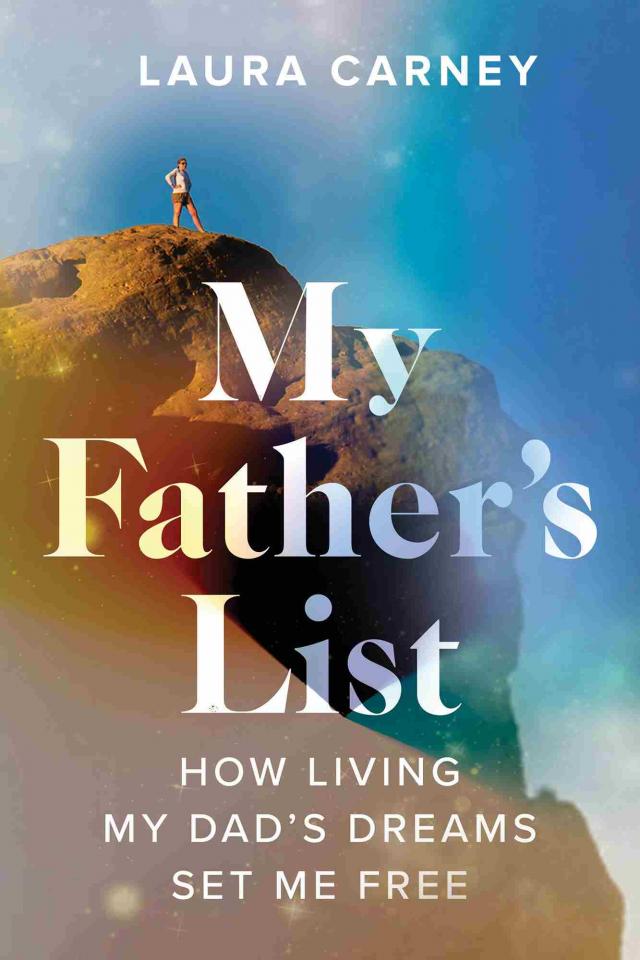
My Father's List, page 1


Advance Praise for
My Father’s List
“Brave, big-hearted, compulsively readable, My Father’s List is a joyful affirmation of embracing life to its fullest after a terrible loss. Carney’s energy to fulfill her father’s dreams is infectious, and her refreshing vulnerability had me rooting for her on every page.”
—Katie Arnold, author of Running Home: A Memoir
“Living out her father’s bucket list was the vehicle through which Laura Carney would find herself and her freedom. My Father’s List is a delightful book that reminds us of all the possibility that lies within each of us to do things we never dreamed possible. This book inspires and will touch you deeply.”
—Siri Lindley, two-time triathlon world champion, Olympic coach,
author of Finding a Way: Taking the Impossible and
Making It Possible, speaker, survivor, and thriver
“In this call-to-action memoir, Carney pays homage to her deceased father, and in so doing, keeps him very much alive. It made me wonder what dreams felt complete to my own father at the time of his passing. And reinforced what Carney’s father told her: ‘You’re the best thing I’ve ever done.’ We are lucky to have a champion in a father, and I was moved to dream along with my own because of this book.”
—Laura Munson, author of the New York Times best-selling memoir This Is Not the Story You Think It Is: A Season of Unlikely Happiness and the USA Today best-selling novel Willa’s Grove; founder of the acclaimed Haven Writing Retreats in Montana
“With all the memoirs that have been written in recent years, you might think there was nothing new left to do with the form. Laura Carney’s My Father’s List would prove you wrong. This is an original, brave, and inspiring book that will make readers think about their own life goals—and maybe even their lives—in a whole new way.”
—Ben Yagoda, author of Memoir: A History and About Town:
The New Yorker and the World It Made
“I lost count of how many times I wiped away tears while reading My Father’s List. What a gorgeous, exhilarating story of perseverance and the beauty we can make from grief.”
—James Tate Hill, author of Blind Man’s Bluff: A Memoir
“Real, honest, and hopeful, My Father’s List is a story about what it really means to be brave and love without limits. It’s about building a life after devastating loss and how the people we’re sure we can’t live without continue to shape and grow us after they’re gone. It’s a no platitudes story about how loss can transform, nudging us to become who we were meant to be all along. A wonderful, memorable read.”
—Janine Urbaniak Reid, author of The Opposite of Certainty:
Fear, Faith, and Life In Between
“Fulfilling her late father’s bucket list required persistence and courage, as Laura Carney parachuted out of a plane, swam a river, rode a fast horse, and more. But the tougher challenge lay deeper, as she reckoned with her family’s sometimes painful history and the hidden corners of her own heart. This is a profound story of faith, determination, and above all, love.”
—Dawn Raffel, author of Boundless As the Sky and The Strange Case of Dr. Couney: How a Mysterious European Showman Saved Thousands of American Babies
“An expansive, illuminating memoir about Laura Carney’s extraordinary undertaking of the seemingly impossible—a jolting, serendipitous journey sparked by pain and completed with enormous heart, intuition, wisdom, and spirituality. This luminous book is a thin place.”
—Ethel Rohan, author of In the Event of Contact
“I had a chance encounter with Laura in Plains, Georgia, as she crossed off another item (meeting a president) on her father’s list. The story of her and her journey inspired me inside and out, and I’ve followed her from afar ever since. Her remarkable story is now complete (or is it?) and My Father’s List is her and her dad’s gift to us all.”
—Arthur Milnes, public historian, former memoirs assistant to the Right Honorable Brian Mulroney, former speechwriter for Prime Minister Stephen Harper, and author of 98 Reasons to Thank Jimmy Carter and Jimmy and Rosalynn Carter:
A Canadian Tribute
“This beautifully written memoir is an honest, deeply moving look at love, determination, and self-reflection. Anyone who has experienced the sudden loss of a loved one and worked to reconcile the past with the present will connect with Laura’s incredible journey.”
—Karen Bischer, author of The Secret Recipe for Moving On
“In My Father’s List, writer and activist Laura Carney weaves the past and present together in exquisite detail and heartfelt prose. Her story of checking off items on her late father’s bucket list is also a story of self-discovery, of that universal journey toward self-acceptance we’re all on. Laura’s powerful words show us that what we hold most dear—family and a father’s love—transcends time, space, and even death.”
—Melissa Blake, author of the soon-to-be released
Beautiful People: My 12 Truths About Disability
“From beginning to end, My Father’s List is a master class in storytelling. Carney beautifully and vulnerably shares the story of finishing her late father’s bucket list while weaving in tales of life, loss, and learning to live authentically. Her poignant memoir reminds us that we are capable of more than we know and death is not the end.”
—Kiersten Parsons Hathcock, author of Little Voices: How Kids in Spirit Helped a Reluctant Medium Escape and Heal From Abuse and cofounder of the National Institute for Law and Justice
“A beautiful reminder of the urgency to LIVE. In a tribute to her father, and even more so herself, Laura shows us what courage looks like in action. A moving, honest, and vulnerable account of finding out our truths and transforming the pain into something positive. Laura not only transforms her own but becomes an incredible inspiration for all of us to do the same. I read this in less than two days and I have already begun my own bucket list. A MUST READ, A MUST DO!”
—Mary Latham, founder of More Good Today
“An intertwined tale of loss and conquest, My Father’s List is a meditation eager minds will devour.”
—Jim Freed, author of The Illiterate: A Novel
“Honest, passionate, and brave define Laura Carney, who has not only honored her beautiful dad by completing his list, but also faced all of her fears in becoming her authentic self. This emotional journey will transform and challenge you to face all of your fears, believe in the goodness of people, and accept your path in life. Like a bottle of 1974 Mondavi, My Father’s List is the finest memoir you will read. ‘Well, history’s about to change….’”
—Shaun Zetlin, author of Emotional Fitness: Empower Yourself Emotionally Through Exercise and The Push-up Progression Series: A 24 Push-up Journey to Stabilization, Strength, and Power
A POST HILL PRESS BOOK
ISBN: 978-1-63758-638-9
ISBN (eBook): 978-1-63758-639-6
My Father’s List:
How Living My Dad’s Dreams Set Me Free
© 2023 by Laura Carney
All Rights Reserved
Cover design by Jordan Wannemacher
Cover photo by Steven Seighman
Interior design and composition by Greg Johnson, Textbook Perfect
All people, locations, events, and situations are portrayed to the best of the author’s memory. While all of the events described are true, two names have been changed to protect the privacy of the people involved.
Although every effort has been made to ensure that the personal and professional advice present within this book is useful and appropriate, the author and publisher do not assume and hereby disclaim any liability to any person, business, or organization choosing to employ the guidance offered in this book.
No part of this book may be reproduced, stored in a retrieval system, or transmitted by any means without the written permission of the author and publisher.
Post Hill Press
New York • Nashville
posthillpress.com
Published in the United States of America
For Steven
“When old age shall this generation waste,
Thou shalt remain, in midst of other woe
Than ours, a friend to man, to whom thou say’st,
‘Beauty is truth, truth beauty—that is all
Ye know on earth, and all ye need to know.’”
—John Keats, “Ode on a Grecian Urn”
“Strange, isn’t it? Each man’s life touches so many other lives.
When he isn’t around he leaves an awful hole, doesn’t he?”
—It’s a Wonderful Life
Contents
Foreword
Prologue
Chatper 1: Run Ten Miles Straight
Chatper 2: Swim the Width of a River
Chatper 3: Skydive at Least Once
Chatper 4: Ride a Horse Fast
Chatper 5: Talk with the President
Chatper 6: Go to the Rose Bowl
Chatper 7: Help Laura Win a Scholarship
Chatper 8: Grow a Watermelon
Chatper 9: Visit London
Chatper 10: Make More Money Than I Need
Chatper 11: Go Sailing by Myself
Chatper 12: Own a Black Tux
Chatper 13: Plant an Apple Tree
Chatper 14: Visit Vienna
Epilogue
Things I Would Like to Do in My Lifetime!
Write Your Own Bucket List!
Acknowledgments
About the Author
Foreword
“Miracle shall follow miracle, and wonders shall never cease.”
—Florence Scovel Shinn
It can take years to understand all that is lost when your loved one dies. As a mental health professional, a coauthor of a book about grief, and someone who has endured my own share of losses (including the loss of my father), I know that after the death of a loved one, the ground beneath feels uneven. And the suffering that follows is a silent cold because nothing is ever the same again. We’re heartsick and long for that which no longer exists.
Many cope with their grief in a quiet, inner way because in the wake of loss often the intense pain that comes can be related to secrets and regrets. It takes a great deal of courage to move onward as Laura did.
In the process of living out her father’s list, Laura’s story intersects our own stories of loss and resilience. As humans we take comfort in knowing we are not alone with our fears, doubts, and sorrows. And yet, we as humans also have an uncanny ability to lose track of all the ways in which we are connected, leaving us feeling depleted and isolated. We each handle memories differently—some find hope in them and others decide to rearrange where they lie, no longer making them the center of one’s mind.
There’s a stillness that happens when grief sets in, and for some it can be paralyzing, but for Laura, it became the fulcrum at which new life grows.
Laura presents her story in unexpected ways and also with great wonder. Each time she does one of the items on the list, she puts us in touch with the part of ourselves from which love comes, so that the song Laura sings, or the miles she runs, or the letter she writes deepens our own understanding of what true love looks like.
At the end of the day, healing also comes from special and comforting things—a photograph, a conversation, a remembrance. When we can pair those things with bittersweet memories, we’re able to hold onto our loved ones in a new and meaningful way.
Above all, in completing her father’s list Laura invites us all to live with more truth, tenderness, compassion, and awe.
With heartfelt lament and bittersweet gratitude,
Kristin A. Meekhof, M.S.W.,
Coauthor of A Widow’s Guide to Healing
Prologue
We were visiting my brother in Salem, Massachusetts, when we found it.
As we gathered around Dave’s granite-topped kitchen island, catching up on his wedding plans, my future sister-in-law, Jaime, went into their bedroom to retrieve something.
“Oh yeah,” my brother said. “I wanted to show you this.”
When she returned, her long blonde hair matching the walls of the rustic kitchen, she was holding a small brown suede pouch with a drawstring. She turned it upside down and out tumbled a silver ring and a driver’s license, along with three pieces of folded notebook paper.
“We found it when we were unpacking,” Dave said. “Do you know about this?”
I unfolded the papers and started reading. At the top of the first page was “Things I Would Like to Do in My Lifetime!” in my dad’s handwriting.
He wrote the list when he was twenty-nine, covering both sides of each page. The first item said, “I would like to live a long, healthy life at least to the year 2020.” The last said he hoped to dance at his grandchildren’s weddings.
But both those goals were rendered impossible on August 8, 2003, the day he was killed by a distracted driver.
That summer I was twenty-five, pursuing my dream of becoming a writer in New York. My dad had encouraged this more than anyone, so I knew I couldn’t give up on it. He wasn’t there when I accomplished my goal of working at a women’s magazine eight years later. And he wasn’t there five years after that, when I needed him to walk me down the aisle.
But on that afternoon in my brother’s kitchen, I felt connected to him as we chuckled at his often indecipherable handwriting. I wondered aloud if he’d kept the list his whole life. He’d never told us about it. But then Dave remembered the World Series game he’d checked off.
“Look,” he said. “He even wrote the score.”
“As proof?” I asked.
Then something strange happened: we realized that many of his want-to-dos were things we’d already done. “I did that!” I cried about number thirty-one, “Get my picture in a national magazine.” “And you did that!” I reminded my brother when we saw he’d wanted to record five songs (Dave recorded his with his a cappella group in college). All in all, there were thirteen items we’d accomplished. Not a small dent, considering he wrote down sixty.
But in my father’s entire lifetime, he’d only checked off five.
Item number twelve said, “Give my children the most love, the best education, and best example I can give.” He never checked that one off, but he should have. Because it’s the reason I did this.
I decided to finish the list.
As soon as my husband, Steven, suggested it, I saw my dad in my mind’s eye, smiling and nodding.
As the story goes, my mom found the list in a dresser in 1978, the year I was born, and read it in disbelief. She says they laughed over “have my own tennis court” and even harder at “correspond with the pope.”
But at the time she was secretly concerned that the man she’d married had room in his head for much other than changing diapers.
I knew I was tempting fate by going after his ideas now on purpose.
***
The last time I sat down alone with my dad was when I was twenty-five, a week before I moved away from home. It was my last “every Wednesday and Sunday.” That’s how often he said he’d see us when he left. And that’s how often he did, for nineteen years, usually in restaurants, movie theaters, bowling alleys, roller rinks, sports arenas, swimming pools, malls, arcades, every park in Wilmington, Delaware, and in summers at the Jersey Shore.
My brother had moved to Arlington, Virginia, getting a job in accounting soon after college. I’d lingered in my mom and stepdad’s house longer, which felt unnatural as I was two years older. As we talked over lunch, my dad knew I was embarrassed by this.
He told me he envied what I was about to do, try to find my way in New York as a writer, because it was something he’d wanted to do when he was my age. He told me that of all the talents my brother and I possessed, what made him the proudest of us was our kindness. He told me we were the best thing he’d ever done.
He said this all the time, “You’re the best thing I’ve ever done,” so that was nothing new. But I hadn’t known it was our kind hearts that filled him the most with pride. He’d so often tried to predict our careers, athletic and otherwise, that somehow I’d missed it.
“You’re audio,” he’d say to Dave, “and you’re visual,” he’d say to me, acknowledging my brother’s gift for singing, passed down from him, and mine for drawing. He’d say that someday we’d run our own business, with my brother as the accountant and me as the editor.
When it came to sports, you’d think we were forming a team he’d drafted. I had the excellent tennis backhand, but my brother had the “power forehand”—and later, in adolescence, the “power serve,” backed by a muscular build I could no longer compete with. My tenacity on defense on the basketball court earned me the nickname “the female Bobby Jones” while my brother had “the second-fastest hands in the East”—“second” because my dad’s were “first.”
I didn’t possess Dave’s coachability; I was more flappable. So my dad taught me to take my time, to look squarely at the basket and visualize the ball swooshing through. To imagine success before it happened.
The day my brother finally beat me in a race was not a good one. At age eleven, my baby fat shed, I’d emerged a long-legged goose of sorts. “Look at those long strides,” my dad said. “You’re going to be a long-distance runner.”


