

Friends Among Wildflowers, page 1


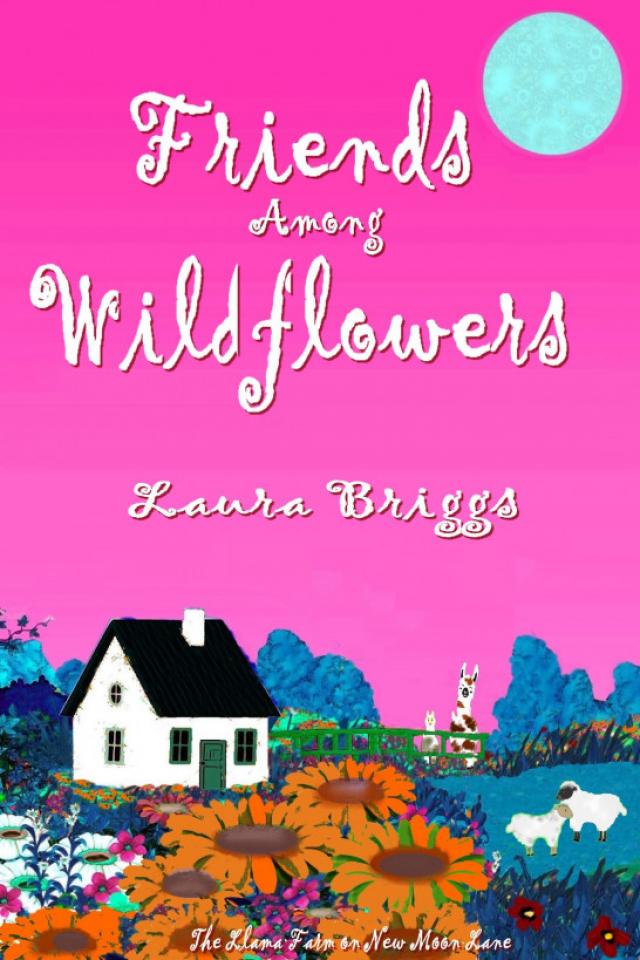
Friends Among Wildflowers
By Laura Briggs
Smashwords Edition
Copyright 2024 Laura Briggs
This ebook is licensed for your personal enjoyment only. It may not be re-sold or given away to other people. If you would like to share this book with another person, please purchase an additional copy for each recipient. If you’re reading this book and did not purchase it, or it was not purchased for your use only, then please return to Smashwords.com to purchase your own copy. Thank you for respecting the hard work of this author.
Cover Image: “Wild Flowers on New Moon Lane”. Original art, “Cartoon farm scene” by Maciej Sojka, “Cartoon Farm Characters (Part 2)” by Jacklooser, “Llama Alpaca. The klan card,” by Yamalinaaa, “Winter landscape with a house” by Viktoriia Protsak, and “Red farmhouse. Rural landscape with Barn house in rustic style on green field with cypresses,” by Mspoint.Used with permission. http://www.dreamstime.com/
Title Page: “Yorkshire Sheep”. Original Art, “Cartoon Farm Characters (Part 2)” by Jacklooser Used with permission. http://www.dreamstime.com/
Table of Contents
Big Steps
Chapter One
Chapter Two
Chapter Three
Chapter Four
Blue Ribbons for Brilliance
Chapter Five
Chapter Six
Chapter Seven
Chapter Eight
Chapter Nine
Practice and Pruning
Chapter Ten
Chapter Eleven
Chapter Twelve
Chapter Thirteen
Chapter Fourteen
Chapter Fifteen
Lucy is Learning
Chapter Sixteen
Chapter Seventeen
Chapter Eighteen
Chapter Nineteen
Big Steps
Chapter One
Newton the baby alpaca was doing well.
Lucy watched him as he wobbled in the corral, with his legs splayed at those odd angles from his bone condition. He was trying to get the baby llama Lillibet to play with him, bobbing his head like a dashboard toy. True to his mother Fiona in so many ways.
She offered the llamas and the donkey some bits of carrot through the gate. The last of her winter stores were getting to the point that they were better used as animal treats than for herself to eat, since the time to plant new ones was almost here.
Dimitri the donkey was the most enthusiastic recipient. Both Philomena the female llama and Fiona were more interested in some clover hay that Lucy had put in the hay rack this morning, where their babies were learning that dry grasses were as much fun to play with as to eat.
Llarry, however, sampled one, nibbling it interestedly. Like her, he preferred to watch and not get involved in the lighthearted scuffling between the new llama families. She gave him the rest of the carrots, slightly withered at their ends. She knew the animals were probably disappointed that the green tops had been distributed as snacks previously and were gone.
In her muddy chicken-print wellies, she walked back to the cottage, pausing to look at the mists on the mountains, and the bright green of the field across the lane on a cloudy morning, which was grey with rain. A few cows grazing, behind old fences of stone.
She shooed the geese away from the stoop, where they were looking for stray cranberries long dried from Christmas's garland. Inside, she slipped off her shoes, and made a cup of herbal tea before settling into the squishy red chair with her laptop.
Her ritual was the same almost every day, but a little variation on the routine kept life fresh. Like feeding the geese her toast crumbs as she watched the dawn appear slowly over the mountains; or waking extra early to finish tufting the cap on a needle felted titmouse. Finding the last of her wool had been used with that project, then spending an hour shopping online for new supplies.
She had learned to make different birds, and spotted toadstools in sets of three, along with foxes and hedgies, little llamas of varying patterns, and a rooster, which took three tries before he looked anything like the one scratching the ground in her back garden. She made a delicate spider with brown stripes, winding wool around slender wire legs. A web like a crocheted doily, from a pattern she worked back in Reading, when she first took up crochet and knitting from online tutorials.
Now she was making a bear. It had a very small face and snout. Its sleek coat was made from Llarry's wool, dyed with a black walnut paste she purchased online. For eyes, she planned to use tiny black beads. Joseph used to use them to make eyes for his animals.
The collection on the mantel was growing. Sometimes she gave them away, sometimes she stuck them between books on a shelf, or into corners of the Welsh cupboard with its plate display racks and shallow buffet ledge.
She was between work projects, presently, for her third children's book was being read by the editor at the publishing company. Until they asked her to begin making changes, she had nothing to do but wait. Sometimes it was a matter of weeks, sometimes a month, before they contacted her again. Sometimes it moved quickly afterwards, depending upon whether it was her words or her artwork which needed changing.
Between the two previous books published, sat a needle felted squirrel holding an acorn from the wood. His fluffy tail was made from Fiona's wool, dyed a light grey. The llama and alpaca wool was soft and light, almost hair-like. It was easy to fashion into sleek coats and feathery tufts.
Usually in the mornings, Lucy woke early, and brushed and braided her hair, cleaned her glasses, and took her meds for fatigue and for anxiety, if she thought she needed them, which was less frequently than in the past. She made a cup of tea and a slice of toast, and looked outside at the garden. She put on her wellies, and fed the animals, then worked in the garden if needed, or simply stood, hands in her pockets, if there was nothing to be done except look.
The morning air in her lungs was rejuvenating. Sometimes the dawn's light was clear and warm, like butter melting to gold; other times, there might be mist on the mountains, like this morning, or dew on the fields. She would think of the words that the mysterious Margot had written on a piece of paper, a poem about sunrise in the Yorkshire countryside. She shared in the same feeling, looking across her garden damp with dew on its grasses, with birds in the hedges and the bright-eyed hedgehog under a broken pot in the old compost heap, slipping off to nap after a night's forage.
Sometimes Dave the milkman drove up with the morning delivery, coming into view through the back garden wall's crumbly part. Lucy would wave.
Next on the routine's list, she typically checked her email. As usual, there were notices for products on sale, and from people pretending to be foreign princes who needed to transfer their funds to someone else's account in haste.
Pingtech, the game development corporation for whom she had worked until this past year, still sent regular updates on their work. For the past month, they had not renewed their invitation for her to develop another game. She had never quite decided if she was going to decline if they did. Maybe. Maybe not.
She liked creating games. Only she wasn't sure if she had time for doing it and for writing the books. The books were earning nearly as much as either Hedgeholes or Time Tumblers had earned, and that should be enough. Perhaps if she stopped some of her hobbies — no more knitting, no more making little animals of felted wool — and needed something to fill her time.
The latest email was nothing more than a notice about an online event for the debut of a much-anticipated new game, about fighting zombie vampires in a creepy Victorian cemetery. Lucy did not like online virtual meetings or Zoom parties; she avoided anything but chats where people used the old-fashioned pseudonyms and thumbnails of cats or cartoon characters.
The only other new email was the publisher's newsletter. It was about ways to promote your work online, by hosting 'live conversations' with people on Twitter.
Lucy deleted it.
~~~
The vet Arthur Elliot came periodically to check on Newton and sometimes to bring more bone-strengthening supplements to help. When Lucy saw his old brown car turning off the lane, she put aside her sketch notebook of drawings and ideas and put on her boots and coat.
He parked the car near Lucy's little one. As she walked by, Lucy saw a cage in the passenger seat, containing a large tortoise and part of a lettuce head.
The vet was looking over the corral fence at the little alpaca stumbling along behind its baby llama friend, attempting a gambol that resembled a rather messy flailing of limbs and head. He tipped over, and struggled up again, giving his head a little shake as if to say 'silly me.' He attempted another gambol, following Lillibet around the corral. He never seemed to grow tired of keeping up, Lucy noticed.
Doctor Elliot laughed.
"He's not a shy little lad," he remarked. "Like Fee. She's always the first one to show off for people."
"He doesn't know when to stop sometimes," said Lucy. "Lillibet gets tired of playing before he does, and tries to hide behind Philomena. He doesn't see the hint."
She smiled a tiny bit. Sometimes Fiona played with him instead, frisking around in a similar fashion. She tossed her silly mop head, then gave him a gentle bump that sent him toppling again. True to form, Newton flailed a bit, then found his way to his turned-out feet again like nothing happened.
Both Lucy and Arthur chuckled. They exchanged glances, and Lucy's smile grew a tiny bit bigger. This embarrassed her a little however, so she looked
"Do you think you're going to keep them both?" he asked. He offered Fiona a treat from his pocket, which contained several little edibles for his patients, Lucy had observed, from dog biscuits to dried apple slices.
"Yes," she said. "I have to keep him, anyway." An alpaca with his condition wouldn't be of much use to anybody. "I think it would be better to keep them both."
"I understand," said the vet. "You may need more help, though. You've almost doubled your flock. It's more feed and more chores both."
She nodded. More money to spend also, by necessity. She didn't see any other way that would be right, however.
"I can always use more wool in my crafts," she joked. More llama wool for making tiny rabbits and dogs.
The vet looked at her again. "Would you like some sheep, by chance?" he asked.
The question surprised her. She felt confused. "I don't know," she answered. "Why?"
"I have a client who's had bad news recently by way of recent tests, that part of his new flock is unhealthy and not very thrifty. Chronic parasite problems that mean they can't stay with the others. They're not good animals for breeding or pasturing, but they could still be sheared. But he won't be keeping them and no other farm would want them."
He gave a treat to Llarry, who approached, wanting his mane rubbed. "I've asked a few others who don't mind keeping livestock for pets, but no one is interested so far," he said. "If you're not, I'll ask someone else."
She understood that if no one wanted them, they were probably going to be destroyed. Farmers couldn't keep very many poorly animals in their barnyards. 'Not thrifty' meant the animals were sickly and unlikely to produce strong lambs. Not good for the health or the expansion of the flock.
Probably not very good wool, either. Not the kind anybody would want for a jumper, or a nice scarf anyway.
"How many does he have?"
"Two," said Arthur.
Two did not sound so bad.
Chapter Two
The veterinarian came back a few days later. Behind the brown car, a small lightweight livestock trailer was hitched. Lucy had envisioned the sheep riding in the back seat, and was rather glad that was not the case.
She put on her jacket. The act of her opening the door shooed Kenny the rooster away from the doorway. He scuttled off, talking busily, as if he was planning to go along for the trip.
"I'll be back." It felt silly to say it aloud — it wasn't as if Kenny understood her. She opened the passenger door of the vet's car and climbed in. Today there were no retriever dogs in plastic cone collars or bowls of unwanted guppy fish.
He smiled in greeting. He shifted the gears. The car turned onto the lane, making a turn to the right. The llama Llarry was standing at the far corner, ears perked as he watched them go. Lucy did not wave. That would feel far too silly.
She was quiet. The vet drove along. She looked down. The floor mat had bits of seed and an empty crisp packet. A coiled-up dog leash. A lettuce leaf looking very shriveled.
"What happened to the tortoise?" she asked.
"Who?"
"The tortoise."
"Oh, him. A pet who had an unfortunate tussle with a canine visitor to the house," he said. "It injured his front limb. He should be fine with a bit of bandaging and some medication to ward off infection."
"He didn't look like your other patients."
"No, I don't have many tortoise. I do have a couple of chinchillas at present. Nothing else very exotic."
The farm was called Lonely Winds, on a lane of the same name, like Lucy's home. In the field close by, dozens of sheep, like patches of white and tan cotton, balled together as they ran across the green.
Someone in a mac and a pair of black wellies was power washing a muddy quad bike. They waved as the vet's car parked.
"Here for the sheep?" the person called.
"Are they in the shed?"
"Let yourself in. I'll be 'round in a moment, got to finish this before the lad gets back from fetching the lamb bottles."
"It's all right. I can handle it on my own," said the vet. "This is Lucy Granger, she's the one taking them on."
"Eh? Lovely to meet you." The farmer nodded to her. "I'm Sully."
"Hello." Lucy put her hands in her pockets. She stared down slightly, feeling shy. She had forgotten that there would be farmers, not only sheep.
"If you need help, me or the lad will sort them. They spook a bit."
The two sheep were locked in a small pen together. They were hard to see without much light, except what came through the open door. They were the kind with white faces, and some form of white wool. One was slightly taller. Both backed into the corner when people approached.
"Come on, lasses." The vet's tone was coaxing. He unlatched the gate. "Let's be off. You don't want to spend the whole day in this shed, do you?"
"Will we have to herd them?" Lucy felt worried. Would these be like the geese, opposed to persuasion? A rogue band of sheep? On telly, a dog was supposed to do this part.
"These two are a bit shy," said the vet. "Probably better that we lead them in. I have a simple loop leash in my pocket."
He looped it around the biggest one. "Come along," he said. He gave it a gentle tug. Lucy opened the gate as he led it out, and closed it in time to keep the other one from escaping.
The smaller one dug in its heels. The vet's pull was gentle but persistent. Lucy pushed from behind. She noticed the sheep's wool was dingy, caked with mud. Now she wished she had brought her farm chore gloves.
She was also glad that the vet had offered to drive her, and she had not put them into the back seat of her car.
Both sheep were bleating inside the little trailer. Perhaps they were calling to the others in the field, Lucy thought. She felt rather badly that they were leaving their friends. Animals didn't know when there was no other choice.
"All right, Sully, we're off," called Arthur. "Thanks much."
"Thanks for taking them on," the farmer called back. He finished spraying off the bike's tires.
Behind them, in the trailer, the sheep bleated as the car drove along, and Lucy could hear them when the car was quiet.
"Should I have offered him something for the sheep?" she asked.
"Money? I suppose you could have. But he couldn't have sold them to anyone, really. Parasite problems are the bane of any flock. Farmers generally can't afford to keep animals that are chronically susceptible, for the sake of the rest."
She had prepared the pen adjoining one of the old sheds, the one that was once some kind of drying shed for flowers. The dirt floor had dried panicles and seeds covering it like a soft brown bird's down. It had a little yard enclosed by another rail fence with a kind of mesh stretched across it, meant to keep sheep in — she had found it among the old fence posts and balled-up wire that Joseph must have used a long time ago.
The sheep didn't seem any happier, once they were ensconced. They both looked very dingy, and had matted, dirty wool behind them. Part of the parasite issue, the vet explained.
"There are some drops for them to take, and a regular treatment to help combat them contracting others," he said. "The ones they've already contracted are a type that enters the bloodstream, and are nearly impossible to eliminate. That's what causes animals to have health issues, by weakening their immunity," he explained.
"They'll get sick a lot," said Lucy.
"Sometimes. But not always," he said. "Some animals that have enough attention and care can remain relatively healthy for the remainder of their lives. But that's not possible on most farms with large flocks."
"They need a bigger pen," she said.
"Maybe you can enclose behind Joseph's old studio as well," suggested the vet. "Or you might even find a grazing spot somewhere. They're very good at keeping down grass and weeds. For now, though, this should be sufficient space."


