

Narrator: A Thriller, page 1


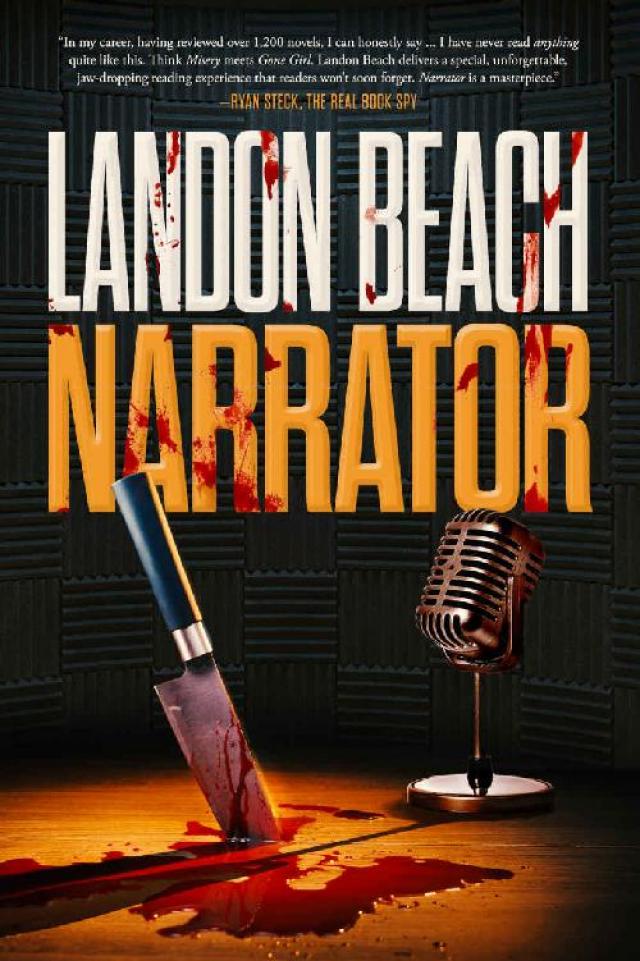
Narrator
A Thriller
Landon Beach
Landon Beach Books
Copyright © 2022 Landon Beach
All rights reserved
The characters and events portrayed in this book are fictitious. Any similarity to real persons, living or dead, is coincidental and not intended by the author.
No part of this book may be reproduced, or stored in a retrieval system, or transmitted in any form or by any means, electronic, mechanical, photocopying, recording, or otherwise, without express written permission of the publisher.
Cover design by: Design for Writers
Printed in the United States of America
For Scott Brick—actor, narrator, virtuoso, luminary, and friend.
from “They Are Not Long”
They are not long, the days of wine and roses:
Out of a misty dream
Our path emerges for a while, then closes
Within a dream.
—Ernest Dowson
from “Annabel Lee”
For the moon never beams, without bringing me dreams
Of the beautiful Annabel Lee;
And the stars never rise, but I feel the bright eyes
Of the beautiful Annabel Lee;
And so, all the night-tide, I lie down by the side
Of my darling—my darling—my life and my bride,
In her sepulchre there by the sea—
In her tomb by the sounding sea.
—Edgar Allan Poe
“You’re my number-one fan.”
—Paul Sheldon, Misery
“Step carefully, Nick, step very carefully.”
—Nick Dunne, Gone Girl
“She never gets old. Marci can’t be real. She never gets old.”
—John Nash, A Beautiful Mind
“And you were such an apt pupil! What fun you two must have had, playing games with me! Why me? Why did he pick on me?!!...And the necklace. Carlotta’s necklace. That was your mistake, Judy. One shouldn’t keep souvenirs of a killing. You shouldn’t have been that sentimental.”
—Scottie Ferguson, Vertigo
from “The Continuity of Parks”
“Through the blood galloping in his ears came the woman's words: first a blue parlor, then a gallery, then a carpeted stairway. At the top, two doors. No one in the first bedroom, no one in the second. The door of the salon, and then the knife in his hand, the light from the great windows, the high back of an armchair covered in green velvet, the head of the man in the chair reading a novel.”
—Julio Cortázar
PART I
Research and Narrating
1
Carmel-by-the-Sea, September 2022
Why do authors have to kill off characters we love? I, Shawn Frost, sit in my darkened recording booth and stare at the final paragraph of the novel I am narrating. Almost there. Finish it. Finish it right. Finish it with a flourish.
But I can’t. Not right now.
For I am crying. The main character, Nehemiah Stone, died two pages ago in a self-sacrifice that I had not seen coming. The book, The Paris Sanction, is author M. Scott Sala’s fourth Nehemiah Stone thriller, which I have waited patiently for two years for the chance to narrate. Five years ago, Simon & Schuster thought I was the perfect narrator for the job when they contacted my agent, David Killian, whom I affectionately refer to as “Killy.” At that point in my career, the beginning of it, I was reading mid-list mysteries, a handful of Christmas-themed romances that always had a dog and a character that needed saving, and zero thrillers—especially from any top-tier talent. But, I had built a loyal following in addition to my fan base that stemmed from my two-time Tony Award-winning writing and acting career—before the spectacular fall occurred that almost ended my life. In any case, Killy heard that thriller legend M. Scott Sala was shopping around book one of a planned decade-long series featuring a new protagonist, Nehemiah Stone, who was, and Killy quoted Sala’s agent, ‘The Cain to Sala’s Abel, longtime protagonist Billy Rollins.’ It was big news because Sala, who had become a legend in part due to Hall of Fame audiobook narrator Michael Hunnie’s narration of all twenty of Billy Rollins’s adventures, was looking for a different narrator for his new series. Have you guessed my feelings for Michael Hunnie yet?
Every rivalry has history, and ours is no different.
I’m the new guy, and he’s the legend.
Now, the audiobook narrator community that I am a part of is one of the nicest, closest-knit, and most supportive communities that you will ever find, and I’m invested in it. You won’t find the kind of mentoring and giving that takes place in our community in other acting circles. However, the profession is not immune from being vicious, cutthroat, and unforgiving, and you better have some grit and chutzpah to survive. And we do have our disagreements: You should read a book before you narrate it; you should never read a book before you narrate it. That kind of stuff. However, there is one thing that, minus one person, we all unanimously agree on: We all hate Michael Hunnie. To be fair, he is an extraordinary talent. In fact, Hunnie’s voice is the homophone to his last name—pure, smooth, golden honey, and it will forever be attached to Sala’s most enduring character, the loveable drifter Billy Rollins. But. Even though Hunnie, by the point I was chosen for the new series, had already accumulated more Best Male Narrator Audies than he had fingers on his right hand, Sala reasoned that for Nehemiah Stone, he needed a deeper, naturally coarser voice for the character. Stone was the dark side of Billy Rollins, and the books would not be globe-trotting adventures with Billy getting laid every hundred pages and having his faults illuminated by the comedic foil of Boykins Wrathbone, an ex-con who was drunk for most of each outing.
No, Nehemiah Stone was a vigilante with an impenetrable veneer and a sledgehammer for a fist. He had an ex-wife whom he couldn’t seem to get out of his life, he liked fast cars and fast boats, and he enjoyed an Islay scotch now and again. There was no partner, no best friend, no sentimentality, and nothing clean about anything in Nehemiah’s life—except for his ability to work outside of the law and bring justice to hopeless cases. Rarely were the stakes larger than this, and the beauty of the novels was that they didn’t have to be. One climbed onboard a Nehemiah Stone novel for Nehemiah Stone, plain and simple.
And so, Killy told me that he had been on the lookout for the perfect vehicle to put me in the spotlight where he could raise my profile so I could start to compete with Hunnie and other narrators for top books. I remember saying, ‘I’ll never get that series, but go ahead and give the publisher my demo.’ This was met with a stern, ‘Let me do the figuring, okay, Shawn?’ from Killy. ‘I sent it over a month ago—and met with M. Scott Sala. The reason that I’m here, in your home right now, is to tell you that you got the job.’
After feeling the initial rush that accompanies the news of landing a major gig, I was left with questions. Did I get the job because the publisher, Sala, and Sala’s agent loved my demo? Was it because of my theater accolades or the success of the works I had already narrated? Or was it because of Killy’s power?
The answer…
Mostly because of Killy’s power.
And so began the climb to the top of the audiobook world. Most people in the business ended up agreeing that I was the perfect fit for the series, and, after book one became a runaway bestseller—better than the ten previous Billy Rollins thrillers—I signed on for the rest of the series. After that, it was one book a year until two years ago when, for the first time since the series started, Killy came over for dinner and told me that the fourth book had been delayed indefinitely. Sala couldn’t get past the first third and was caught up in writing the screenplay for the ninth Billy Rollins film, which would soon start production and eventually join the first eight on Netflix. The series—addictive and huge budget—had already won numerous Golden Globes and featured Adam Driver, sporting an unforgettable mullet, as Billy Rollins and Cedric the Entertainer as Boykins Wrathbone, and fans were clamoring for ‘like fifty more of them, bruh.’
By this time, I was narrating other top thrillers, but my favorite character, the one my eyes still got big for when the manuscript arrived, was Nehemiah Stone. I should also mention that narrating the series has been my best-paying job ever since leaving New York. In the audiobook world, performing a series is the very definition of financial security.
And so I waited and waited. Months went by, and then years.
Then, finally, on a cool September morning, Killy rang my doorbell at 7 a.m. and delivered the manuscript for the spectacularly overdue novel The Paris Sanction. I was immediately thrown off because Killy had never delivered a manuscript before; Simon & Schuster usually handled it, and the book was always sent via a secure file-sharing application because they trusted me. But this novel was delivered via a company iPad. Once Killy placed it in my hand, he immediately called his contact at the publishing house and said that I had possession of the novel. Then, Killy and I did a page count with the contact. The new safeguards didn’t bother me. However, the strangest change to my usual process was that I was to perform the book cold. It should have been an unmistakable hint that something was up, but I loved the series so much, and it had been two years since I’d performed the last one. I figured this was just an added precaution so that details about the novel would not leak before the release. Hell, we had six more novels to go after this one.
What had impressed me the most was that Simon & Schuster had hired someone to do the usual cold-bastard
‘Someone went to a lot of trouble here, Killy,’ I said to my antsy agent. ‘Is there something I should know about this one?’
When David Killian wants to be as unreachable as Nehemiah Stone, he has an uncanny way of turning his normally friendly brown eyes into two of the cruelest daggers that I have ever seen. And, at that moment, Killy’s eyes could have sliced me up for chum. ‘Not that I’m aware of. Publisher is just being careful. Now, get after it. S & S needs it in a week.’
And now, with one paragraph left in the book, I decide that if Killy was here right now, I’d at least attempt to rip off the head that rested on my mega-agent’s six-foot-four-inch frame.
Killy had known. Hell, they all must have known that this was my beloved character’s swan song. But…why was it his swan song?
Looking back now, I had become suspicious in the last twenty pages. Nehemiah had never been under such pressure. The character he had been called to save in this edition was an orphan named Kara—who was only known as that: Kara—for the entire novel. But the stakes were more than just Nehemiah helping Kara find her biological family. That would have been too easy of a challenge for Nehemiah Stone to conquer in a book that had taken two years to reach my booth. No, the twist was delivered with a master stroke by Sala midway through part two. Nehemiah and Kara discovered that one of the orphanages in Paris that she had grown up in was a front for an elite group of five assassins who, for the right price, would sanction political opponents who got in the way of keeping France’s elite socialist party in power. The top floor of the enormous, decrepit three-story orphanage, which the orphans were never allowed to see, was, in fact, the business offices and training center for the assassins.
By the time I turned the page to start the final chapter, Nehemiah had done away with four of the assassins, but the best of them, a man known only as “Reich,” was still very much alive and now hunting Kara and Nehemiah in an office building where they had run to after Nehemiah killed assassin number four but not before the assassin had shot Nehemiah through the right shoulder, rendering his shooting arm useless. I gasped at that point and clicked my tally counter to signal that I was re-reading the lines so that the post-production crew could delete the gasp. Nehemiah Stone had been injured before, but never like this. It was just before midnight, and the building was empty save for the three of them; there would be no help. They raced up the stairs, floor after floor of close calls.
With Reich closing in on the rooftop, Nehemiah hugged Kara goodbye and got her safely into a corner stairwell, where she headed downstairs to shelter. Reich was around a service structure and had not seen Kara’s escape. He sprinted around the building and found a waiting Nehemiah Stone who, in classic M. Scott Sala prose, clotheslined Reich with his good arm. Certain that Nehemiah had regained the initiative and would soon finish off the assassin, I slouched in my chair, looked at the ceiling, and exhaled into the claustrophobic air of the booth.
I clicked my tally counter because of the exhalation and sat back up, my eyes tiptoeing down until they found the correct spot on the page.
And now, my performance came back to me as I struggled to hold back more tears:
With his left hand, Nehemiah pulled out his Bowie knife from the large black sheath on his waistband. He went down to one knee, already pulling the knife back, ready to drive it through the heart of Reich. It would be a righteous kill, a necessary kill, a needed kill for him. The blade, a silver moonbeam against the starry night, continued to descend toward the open target on the ground below. Down, down, dow—
Suddenly, as if powered up by an overwhelming energy source, a collision of particles that would have outlined his features in neon, Reich’s body twisted, and Nehemiah’s knife plummeted into the empty space where its target had been a second ago.
Unable to stop his momentum, Nehemiah continued his insidious downward arc until the knife point struck the rooftop’s concrete floor. The energy from the impact transferred from the knife handle into Nehemiah’s wrist, which made a sick crunch as he felt it dislocate in a rush of smoldering heat. The physical pain overcame his sensory message from his brain to his hand, which told his hand to hold on to the weapon. He dropped the knife.
And now, Reich, with one swift motion, took his own knife out and drove it into Nehemiah’s stomach…
I shake my head, which takes me out of my memory of the performance. I search the booth for a tissue box, but I have never needed one for the ending of a Nehemiah Stone novel before. I would be starting a New York Times bestselling romance novelist’s newest tear-jerker after supper tonight and had planned on grabbing the tissue box then; she always got me crying—and probably every other reader—within the first chapter when some horrible offering of life’s unfair outcomes befalls a sweet, innocent person who leaves life prematurely and forces the main character to start a journey of discovery and healing by going through hell. I knew it would happen, welcomed it, really—who doesn’t love a good, cleansing cry in the privacy of a place like the booth? But now? At the moment when I should be smiling at how Nehemiah Stone has once again “taken the garbage out” (another M. Scott Sala trademark phrase) and thus resumed his slow drift across the U.S. à la David Banner in The Incredible Hulk TV show? Before starting the final chapter, I even queued up “The Lonely Man” theme from the show, which is my tradition after finishing Nehemiah Stone’s latest adventure. It signifies the end of another journey with my favorite character to narrate and helps me transition from a state of sadness—each ending is like losing a friend for an indefinite amount of time—to a state of anticipation for the day when the next installment of Nehemiah Stone’s life shows up from Simon & Schuster—the lonely man returning to my life.
Now, I knew that day was never coming because M. Scott Sala has taken Nehemiah Stone away from me. He’s dead, Kara is on the run, and Reich is after her.
My eyes well up again.
I yell, “Who in the hell is going to save her now?”
Tears burst from my eyes, and between sobs, I get out, “God damn you, Killy. You knew. You knew. And you didn’t even warn me.”
A few minutes pass, and I regain control and wipe my eyes with the shirtsleeve of my ten-year-old Monterey Jazz Festival shirt—another tradition that will now die; I’ve worn it the last day of recording for every single Stone thriller.
The word “thriller” makes my stomach turn.
Let’s get something straight. I am a pacifist. I have never and will never own a gun, don’t believe in violence—especially hunting or hurting other human beings—and I’m of the mind that if someone up the road in Silicon Valley created a chip that, when inserted into our brains, brought about harmony and world peace…I’d kind of be okay with it. Except I wouldn’t. There’s a catch to my utopian dreams: I love thrillers and could never give them up. Murder, destroying shit, affairs, knives in backs, raids, secret missions, guns with silencers—count me in for all of it. Just because I believe in the concept of world peace and John Lennon’s Imagine doesn’t mean that I’m not human. I just prefer to work these things out and experience them in a fake world, hoping that I never see them, let alone go there myself in the real world. As I’ve narrated books, I’ve thought about what I would do in certain situations, but I just can’t see myself being violent beyond my language, which, as you can see, goes south when I feel surprised, stressed, or off-balance. Seriously, I think I would run at the first sight of a knife. And getting robbed? Yeah, I’m the guy who can’t get his wallet out of his pocket and the rings off his fingers fast enough to hand them over and wish the thief a long and happy life.


