

The Wheels of If, and Other Science-Fiction, page 1


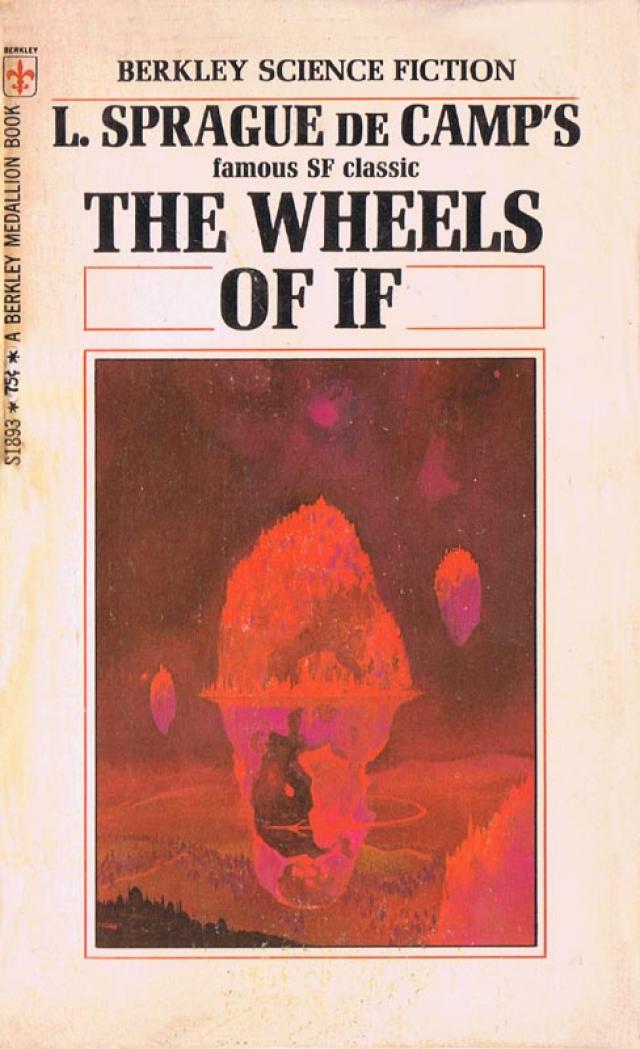
The Wheels of If
And Other Science-Fiction
(1949)*
L. Sprague de Camp
Contents
Foreword
The Wheels of If
The Best-Laid Scheme
The Warrior Race
Hyperpelosity
The Merman
The Contraband Cow
The Gnarly Man
Book information
Foreword
PEOPLE sometimes accuse me of writing satire. This, if not exactly a vile canard, is at least an inaccurate statement, because in the strict sense satire Ls ridiculing established conditions, conventions, or institutions by exaggeration or burlesque in the hope of changing them. In other words, it has social significance, which is just the thing I studiously avoid in my stories. These yarns are meant purely to amuse and entertain, and neither to instruct, nor to incite, nor to improve. If you get instructed, incited, or improved as a result of reading them, don't blame me, for such was not my intention. Don't think for instance, that The Contraband Cow contains my opinions on the subject of world government; I have such opinions, but I don't necessarily incorporate them into my stories.
These tales all appeared cither in Astounding Science-Fiction or in Unknown during the years 1938-1942. They can all be called fantasies in the broad sense; that is, " 'tain't so" stories. In a strict sense they are science-fiction stories: that is, stories based upon scientific or pseudoscientific assumptions, as opposed to fantasies in the strict sense: stories based upon mythological or supernatural assumptions.
However, let's not get ourselves involved in the dusty science of taxonomy at this point. Let's rather read the stories, and I hope you like them.
L. Sprague de Camp.
Landsdowne, Penn.
20 October 1948
THE WHEELS OF IF
King Oswiu of Northumbria squirmed in his chair. In the first place these synods bored him. In the second, his mathematics comprised the ability to add and subtract numbers under twenty on his fingers. Hence all this argument among the learned clerics, assembled in Whitby in the year of Our Lord 664, about the date of Easter and the phases of the moon and cycles of 84 and 532 years, went over the King's head completely.
What did the exact date of Easter matter, anyhow? If they wanted to, why couldn't the Latins celebrate their Easter when they wanted, and the Ionans celebrate theirs? The Ionans had been doing all right, as far as Oswiu could see. And then this Wilfrid of York had to bring in his swarms of Latin priests, objecting to this and that as schismatic, heretical, etc. They were abetted by Oswiu's queen, Eanfled, which put poor Oswiu in an awkward position. He not only wanted peace in the family, but also hoped to attain to Heaven some day.
Moreover, he liked the Abbot Colman, leader of the Ionans. And he certainly didn't want any far-off Bishop of Rome sticking his nose into his affairs. On the other hand ...
King Oswiu came to with a jerk. Father Wilfrid was speaking to him directly: "... the arguments of my learned friend—" he indicated the Abbot Colman of Lindisfarne "—are very ingenious, I admit. But that is not the fundamental question. The real decision is, shall we accept the authority of His Holiness of Rome, like good Christians, or—"
"Wait a minute, wait a minute," interrupted Oswiu, "Why must we accept Gregory's authority to be good Christians? I'm a good Christian, and I don't let any foreign—"
"The question, my lord, is whether one can be a good Christian and a rebel against—"
"I am too a good Christian!" bristled Oswiu.
Wilfrid of York smiled. "Perhaps you remember the statement of our Savior to- Peter, the first Bishop of Rome? 'Thou art Peter; and upon this rock I will build my Church; and the gates of Hell shall not prevail against it. And I will give unto thee the keys of the Kingdom of Heaven; and whatsoever thou shalt bind on earth shall be bound in Heaven; and whatsoever thou shalt loose on earth shall be loosed in Heaven.' You see?"
Oswiu thought. That put a different light on the matter. If this fellow Peter actually had the keys of Heaven ...
He turned to the Abbot Colman and asked: "Is that a correct quotation?"
"Just a minute, just a minute. You'll get me all confused again if you start arguing. Now, can you quote a text showing that equivalent powers were granted to Saint Columba?"
The grave Irishman's face registered sudden dismay. He frowned in concentration so intense that one could almost hear the wheels.
"Well?" said Oswiu. "Speak up!"
Colman sighed. "No, my lord, I cannot. But I can show that it is the Latins, not we, who are departing from—"
"That's enough, Colman!" Oswiu's single-track mind, once made up, had no intention of being disturbed again. "I have decided that from, this day forth the Kingdom of Northumbria shall follow the Latin practice concerning Easter. And that we shall declare our allegiance to the Roman Bishop Gregory, lest, when I come to the gates of Heaven, there would be none to open them for me—he being my adversary who has the keys. The synod is adjourned."
King Oswiu went out, avoiding the reproachful look that the Abbot sent after him. It was a dirty trick on Colman, who was a very decent chap. But after all, it wouldn't do to antagonize the heavenly doorman. And maybe now Eanfled would stop nagging him ...
-
Allister Park rubbed his eyes and sat up in bed, as he usually did. He noticed nothing wrong until he looked at the sleeve of his pajamas.
He could not recall ever having had a pair of pajamas of that singularly repulsive green. He couldn't recall having changed to clean pajamas the night before. In short, he couldn't account for these pajamas at all.
Oh, well, probably, Eunice or Mary had given them to him, and he'd put them on without thinking. He yawned, brushing his mouth with the back of his hand.
He jerked his hand away. Then he cautiously felt his upper lip.
He got out of bed and made for the nearest mirror. There was no doubt about it. He had a mustache. He had not had a mustache when he went to bed the night before.
-
'Abd-ar-Rahman, Governor of Cordoba for the Khalifah Hisham ibn 'Abd-al-Malik, Lord of Damascus, Protector of the Faithful, etc., etc., paced, his tent like a caged leopard with claustrophobia. He hated inactivity, and to him the last six days of tentative skirmishing had been just that.
He glowered over his pepper-and-salt beard at his chiefs, sitting cross-legged in an ellipse on the rugs. "Well?" he barked.
Yezid spoke up. "But a little longer, Commander-in-Chief, and the Franks will melt away. The infidels have little cavalry, save Gothic and Aquitanian refugees. Without cavalry, they cannot keep themselves fed. Our horse can range the country, supplying us and cutting off help from our enemies. There is no God but God."
Ya'qub snorted. "How long do you think our men will abide this fearful Frankish climate? The winter is almost upon us. I say strike now, while their spirits are still up. This rabble of Frankish farmers on foot will show some rare running. Have the armies of the Faithful come this far by sitting in front of their enemies and making grimaces at them?"
Yezid delivered an impressive snort of his own. "Just the advice one would expect from a dog of a Ma'ddite. This Karel, who commands the infidels, is no fool—-"
"Who's a dog?" yelped Ya'qub, jumping up. "Pig of a Yemenite—"
'Abd-ar-Rahman yelled at them until they subsided. One major idea of this foray into Francia was to bury the animosity between members of the two parties. Yezid's starting a quarrel on political grounds put the Governor in an embarrassing position, as he was a Yemenite himself. He was still undecided. An intelligent man, he could-see the sense to Yezid's Fabian advice. Emotionally, however, he burned to get to grips with the army of Charles, Mayor of Austrasia. And Yezid should be punished for his insulting remark.
"I have decided," said 'Abd-ar-Rahman, "that, while there is much to be said, on both sides, Ya'qub's advice is the sounder. Nothing hurts an army's spirit like waiting. Besides, God has planned the outcome of the battle anyway. So why should we fear? If He decides that we shall win, we shall win.
"Therefore tomorrow, Saturday, we shall strike the Franks with all our force. God is God, and Mohammed is His prophet ..."
But the next night 'Abd-ar-Rahman lay dead by the banks of the River Vienne, near Tours, with his handsome face waxy in the starlight and blood in his pepper-and-salt beard. The Austrasian line had held. Yezid, who had been right, was dead likewise, and so was Ya'qub, who had been wrong. And the surviving Arabs were fleeing back to Narbonne and Barcelona.
-
Allister Park opened the door of his apartment and grabbed up his Times. Sure enough, the date was Monday April eleventh, just as it ought to have been. The year was right, too. That ruled out the possibility of amnesia.
He went back to the mirror. He was still a slightly stout man in his middle thirties, with pale-blue eyes and thinning sandy hair. But he wasn't the same man. The nose was different. So were the eyebrows. The scar under the chin was gone ...
He gave up his self-inspection and got out his clothes. At that juncture he got another shock. The clothes weren't his. Or rather, they were clothes for a man of his size, and of the quality that a self-indulgent bachelor with an income of $12,000 a year would buy. Park didn't object to the clothes. It was just that they weren't his clothes.
Park gave up speculation about his sanity for the nonce; he had to get dressed. Breakfast? He was sick of the more cardboard-like cereals. To hell with it; he'd make himself some French toast. If it put another inch on his middle, he'd sweat it off Sunday at the New York Athletic Club.
The mail was thrust under his door. He finished knotting his necktie and picked it up. The letters were all addressed to a Mr. Arthur Vogel.
Then Allister Park, really awake, did look around. The apartment was built on the same plan of his own, but it wasn't the same. The furniture was different. Lots of little things were different, such as a nick in the wall that shouldn't be there.
Park sat down and smoked a cigarette while he thought. There was no evidence of kidnapping, which, considering his business, was not too unlikely a possibility. He'd gone to bed Sunday night sober, alone, and reasonably early. Why should he wake up in another man's apartment? He forgot for the moment that he had also awakened with another man's face. Before he had time to remember it, the sight of the clock jostled him into action. No time for French toast—it would have to be semi-edible cardboard after all.
But the real shock awaited him when he looked for his briefcase. There was none. Neither was there any sign of the sheaf of notes he had so carefully drawn up on the conduct of the forthcoming Antonini case. That was more than important. On his convicting the Antonini gang depended his nomination for District Attorney for the County of New York next fall. The present D. A. was due to get the bipartisan nomination to the Court of General Sessions at the same time.
He was planning, with thoroughly dishonorable motives, to invite Martha up for dinner. But he didn't want to have dinner with her until he'd cleared this matter, up. The only trouble with calling her up was that the address-book didn't have her name in it—or indeed the name of anybody Park had ever heard of. Neither was he listed in the 'phone book.
He dialled CAnal 6-5700. Somebody said: "Department of Hospitals."
"Huh? Isn't this CAnal 6-5700?"
"Yes, this is the Department of Hospitals."
"Well what's the District Attorney's office then? Hell, I ought to know my own office 'phone."
"The District Attorney's office is WOrth 2-2200."
Park groggily called WOrth 2-2200. "Mr. Park's office, please."
"What office did you ask for, please?"
"The office of Assistant District Attorney Park!" Park's voice took on the metallic rasp. "Racket Bureau to you, sister."
"I'm sorry, we have no such person."
"Listen, young lady, have you got a Deputy Assistant D. A. named Frenczko? John Frenczko? You spell it with a z."
Silence. "No, I'm sorry, we have no such person."
Allister Park hung up.
-
The old building at 137 Center was still there. The Racket Bureau was still there. But they had never heard of Allister Park. They already had an Assistant D. A. of their own, a man named Hutchison, with whom they seemed quite well satisfied. There was no sign of Park's two deputies, Frenczko and Burt.
As a last hope, Park went over to the Criminal Courts Building.. If he wasn't utterly mad, the case of People v. Cassidy, extortion, ought to come up as soon after ten as it would take Judge Segal to read his calendar. Frenczko and Burt would be in there, after Cassidy's hide.
But there was no Judge Segal, no Frenczko, no Burt, no Cassidy ...
-
"Very interesting, Mr. Park," soothed the psychiatrist. "Very interesting indeed. The most hopeful feature is that you quite realize your difficulty, and come to me now—"
"What I want to know," interrupted Park, "is: was I sane up to yesterday, and crazy since then, or was I crazy up to then and sane now?"
"It seems hard to believe that one could suffer from a coherent set of illusions for thirty-six years," replied the psychiatrist. "Yet your present account of your perceptions seems rational enough. Perhaps your memory of what you saw and experienced today is at fault."
"But I want to get straightened out! My whole political future depends on it! At least—" he stopped. Was there such an Antonini gang? Was there a nomination awaiting an Allister Park if they were convicted?
"I know," said the psychiatrist gently. "But this case isn't like any I ever heard of. You go ahead and wire Denver for Allister Park's birth-certificate. We'll see if there is such a person. Then come back tomorrow ..."
-
Park awoke, looked around, and groaned. The room had changed again. But he choked off his groan. He was occupying a twin bed. In its mate lay a fair-to-middling handsome woman of about his own age.
His groan had roused her. She asked: "How are you feeling, Wally?"
"I'm feeling fine," he mumbled. The significance of his position was soaking in. He had some trouble suppressing another groan. About marriage, he was an adherent of the why-buy-a-cow philosophy, as he had had occasion to make clear to many women by way of fair warning.
"I hope you are," said the woman anxiously. "You acted so queer yesterday. Do you remember your appointment with Dr. Kerr?"
"I certainly do," said Park. Kerr was not the name of the psychiatrist with whom he had made the appointment.
The woman prepared to dress. Park gulped a little. For years he'd managed to get along without being mixed up with other men's wives, ever since ...
And he wished he knew her name. A well-mannered man, under those circumstances, wouldn't refer to the woman as "Hey, you."
"What are we having for breakfast, sweetie-pie?" he asked with a sickly grin. She told him, adding: "You never called me that before, dear." When she started toward him with an expectant smile, he jumped out of bed and dressed with frantic haste.
He ate silently. When the woman inquired why, he pointed to his mouth and mumbled: "Canker sore. It hurts to talk."
He fled as soon as he decently could, without learning his "wife's" name. His wallet told him his name was Wallace Heineman, but little else about himself. If he wanted to badly enough, he could not doubt find out whom he worked for, who his friends were, which if any bank he had money in, etc. But if these daily changes were going to continue, it hardly seemed worth while. The first thing was to get back to that psychiatrist.
Although the numbers of the streets were different, the general layout was the same. Half an hour's walking brought him to the block where the psychiatrist's office had been. The building had been on the southeast corner of Fifty-seventh and Eighth. Park could have sworn the building that now occupied that site was different.
However, he went up anyway. He had made a careful note of the office number. His notebook had been missing that morning, like all the rest of his (or rather Arthur Vogel's) things. Still, he remembered the number.
The number turned out to be that of a suite of offices occupied by Williamson, Ostendorff, Cohen, Burke, and Williamson, Attorneys. No, they had never heard of Park's brain-man. Yes, Williamson, Ostendorff, Cohen, Burke, and Williamson had occupied those offices for years.
Park came out into the street and stood a long time, thinking, A phenomenon that he had hitherto noticed only vaguely now puzzled him: the extraordinary number of Union Jacks in sight.


