

Enchanter Reborn, page 1


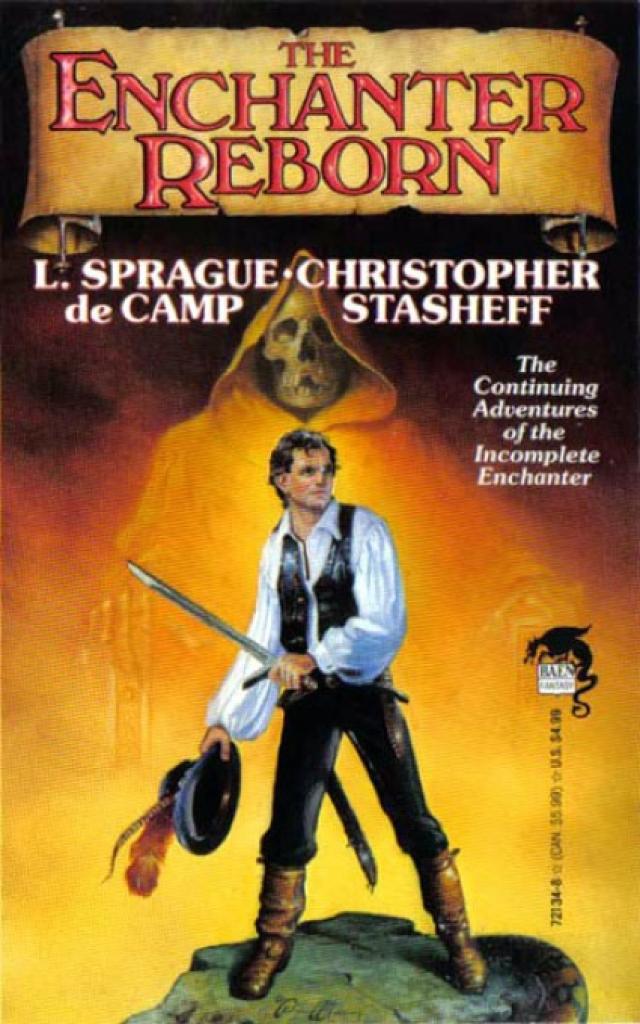
The Enchanter Reborn
by
L. SPRAGUE de CAMP and CHRISTOPHER STASHEFF
The Continuing Adventures of the Incompleat Enchanter
THE ENCHANTER REBORN
This is a work of fiction. All the characters and events portrayed in this book are fictional, and any resemblance to real people or incidents is purely coincidental.
Copyright © 1992 by L. Sprague de Camp and Christopher Stasheff
Acknowledgements—A few of Don Quixote's statements in Knight and the Enemy have been quoted from Don Quixote by Miguel de Cervantes Saavedra, translated by J.M. Cohen, Penguin Books' Penguin Design Classics Edition, Viking Penguin, NY, copyright 1950.
—Quotations from the Te Tao Ching are from a translation by Robert G. Henricks, Ballantine Books.
All rights reserved, including the right to reproduce this book or portions thereof in any form.
A Baen Books Original
Baen Publishing Enterprises
P.O. Box 1403
Riverdale, N.Y. 10471
ISBN: 0-671-72134-8
eISBN: 978-1-62579100-9
Cover art by Dean Morrissey
First printing, September 1992
Distributed by
SIMON & SCHUSTER
1230 Avenue of the Americas
New York, N.Y. 10020
Printed in the United States of America
INTRODUCTION
Christopher Stasheff
I grew up reading a bit of everything, as most of us do—a few biographies, a few mysteries, the occasional Western, some historical novels, the usual run of juvenile books, and, now and then, a science fiction book. SF was only part of my literary diet then. You see, I would finish my current book, but I wouldn't be able to get to the library until Monday night, and there were science fiction books and magazines here and there around the house. My father had been a steady reader of SF since before Hugo Gernsback—the only reason he didn't qualify for First Fandom was because they hadn't invented fandom yet. Mind you, he never read SF exclusively—he insisted on taking time out to read James Joyce, or James Michener, or Henry James, or . . .
No, now, wait a minute. It is not true that Dad only read books by people whose names were "James" In fact, he and Mom had both been English teachers officially, and remained so unofficially all their lives—still are, in fact; he can't help himself, has to read my manuscripts with a red pencil—so there were great works of literature in the bookcase downstairs, in the bookcase upstairs, on the end table . . . I think my mother began her weekly trips to the library just to cut down on the clutter. Anyway, a bored boy could always find a book to read, but there was just as good a chance of finding a Heinlein as a Costain. So I read my merry way through childhood and adolescence. For a while there, I celebrated Christmas every year by rereading Jules Verne's Journey to the Center of the Earth. But I was scarcely an avid science fiction fan.
Then, one bored and rainy Tuesday during Easter vacation, I ran out of books to read. As usual, I started looking through the shelves in the living room—and I found a modest-looking volume with the title, The Incompleat Enchanter. Well, that looked interesting—especially since someone had apparently made a spelling mistake on "incomplete"—so I took it off to my room, lay down, and opened the first page.
Well. This was interesting. An eccentric psychologist, and a boss who had an idea about traveling to parallel universes.
Parallel universes?
Universes besides ours, where magic might really work? Hey, that was fascinating! And the idea that magic might work according to rules? Hypnotizing!!
Then Harold Shea hit the world of the Norse myths, and I was lost in the Fimbulwinter. It seemed only a short while later that the sound of Heimdall's horn was filling my ears, Ragnarok had begun, and Shea was back in his own universe.
I was hooked. From that time on, I've been a diehard SF reader.
Oh, mind you, I do still read the occasional non SF book. I try to read a little bit of everything Louis L'Amour, Thomas Pynchon, some Regency romances, Umberto Eco, John D. MacDonald—but ninety percent of what I read is science fiction and fantasy. All because of The Incompleat Enchanter.
"Dad!" I said. "This is really great!"
"Like that, do you?" he said, and pulled another book off the shelf. With a proud smile, he opened it to the title page, displayed it before my eyes—and there, to my amazement and incredulity, was a signature that definitely spelled out "L. Sprague de Camp."
"Dad! You got it autographed!"
"That I did." And my father went on to explain, with great delight, that he had actually talked with L. Sprague de Camp. His pedestal instantly grew three inches higher.
Maybe that was part of the magic—finding out that my own parents had actually talked with the fabled greatness of the author of so splendid a story. In the terms de Camp explained in the book, maybe it was the Law of Contagion—or maybe it was just that it suddenly made the author real to me. Up until that time, of course, I had thought of authors as being remote and mythical, sort of like Arthur and his knights. That autograph, and my parents' telling me about their acquaintanceship (yes, it turned out Mom had known L. Sprague and Catherine Crook de Camp, too), were my first hints that authors were human beings, and lived not on Olympus, but in Pennsylvania.
So I became a devout reader of science fiction—and of course, I read everything by de Camp that I could get my hands on.
Of all my reading, I enjoy science fantasy most, even though some eminent authorities in the field assure me that mixing science fiction and fantasy is almost impossible to do well. One of these authorities has written several science fantasies himself (which have influenced me almost as much as The Incompleat Enchanter), so I suppose he knows what he is talking about. I agree that it's hard to do well, so I've built my own writing career trying to do just that.
Of course, any time I start having difficulty, I just remember The Incompleat Enchanter.
As Dorothy Parker has assured us, when you learn to read, you'll want to write, and so I did. Of course, I didn't try to write science fiction—to do that, you had to know something about science, and not being a chemistry major or a physics major, I was sure I didn't.
Then, a year out of college, bored and lonely in a new town, I saw an ad for a contest in a science fiction magazine, and decided, Why not? All I had to lose was time, and I had too much of that hanging heavy on my hands, anyway. So what if it didn't work? Nobody but me would ever know.
But it did work, because I'd learned more than I knew.
I'd learned from L. Sprague de Camp, and Lester del Rey, and Robert Heinlein. I had learned from Hal Clement and Theodore Sturgeon and Fritz Leiber. I had learned from Frederik Pohl and Poul Anderson and Isaac Asimov. I had never met any of these illustrious gentlemen, of course—but I had read their books.
And it was The Incompleat Enchanter that had set me on the road to this fabled kingdom, that had opened the door to the magical realm.
So my new novel turned into science fantasy very quickly.
That was what I had the most fun with, you see—coming up with scientific explanations for magic, or trying to make science seem magical (which, for me, has never needed much trying, frankly). So I wrote a novel about a secret agent for democracy, who landed on a planet in our own universe, but on which magic seemed to work. The locals assumed his high-tech gadgets were magical, and decided he was a warlock, which he adamantly denied.
Of course, looking back on The Warlock In Spite of Himself now, I can see the resemblances between Harold Shea and my own Rod Gallowglass very easily—the young man who doesn't fit in, has a lower self-image than he deserves, and goes looking for a world in which he does fit. Both of them are also emissaries from our mundane universe to magical worlds, and both of them have to learn about magic on the job, and fast. The Incompleat Enchanter blended adventure, humor, and romance. I tried to do the same.
The resemblances are even stronger in Her Majesty's Wizard, where my hero, Matt Mantrell, has to learn how to work magic under fire, and gets it wrong as often as he gets it right.
An English professor once told me (and the rest of the class) that, in one sense, all modern American authors have been trying to rewrite Moby Dick. I suppose I've spent my whole career trying to rewrite The Incompleat Enchanter.
But I'm not alone.
There are at least half a dozen authors who have written variations on the magician who has to try to learn magic on the job, and whose spells misfire. This self-taught magus almost always works in a world in which magic operates according to clear, consistent rules that can be learned by anyone who is willing to work at it.
Pratt and de Camp started something—not just an anomalous book, not just a rare hybrid, but a new idea that has grown into a whole sub-genre. New writers keep joining it, new variations keep shooting off. It's alive and very healthy, and produces some of the most delightful, most whimsical, stories of our time.
But the one thing that very few of us manage to do, is to teach as we amuse—at least, not as well as Pratt and de Camp did. Harold Shea goes where no SF hero has gone before, and few have gone since—into the myriad worlds of classical literature. It was from the Harold Shea stories that I first learned of Spenser's Faerie Queene; it was "The Roaring Trumpet" that first made the world of Norse myth come alive for me. "Castle of Iron" introduced me to the Orlando Furioso, and "The Green Magician" showed me the wondrous world of Irish mythology.
We have tried to do th
Because, you see, when I found out there was a new Harold Shea project in the works, I just had to be part of it. The opportunity of actually writing a story about Harold Shea, is the stuff of dreams.
The dream has come true, for me, and Mr. de Camp has been gracious enough to allow me to write a story within his universe. I have enjoyed it immensely. I hope you will, too.
PROFESSOR HAROLD AND THE TRUSTEES
Christopher Stasheff
They were meeting in the conference room just off the President's office. It was a stalwart old room, panelled in walnut and lighted by tall lamps in the corners. Beneath them were low bookcases and one tall one, filled with leather-bound volumes that looked as though they'd never been opened. The chairs were upholstered in burgundy plush, and the Trustees were upholstered in pin-striped suits.
"It's rather difficult for me to answer any of your questions, gentlemen,'' Shea temporized. "I'm only a junior member of the staff'
"Yes, we're aware of that," said Trustee Incise. He was the lean, ferret-faced publisher of the local newspaper, and wrote editorials that were carried by papers in St. Louis, Chicago, and Cincinnati.
"Since three of the four members of the Institute's professional staff have taken leave of absence, you can understand our concern,'' said Archangle, the Chairman of the Board of Trustees. He was in his sixties, still affecting a pince-nez with a long black ribbon connecting it to his lapel. He had bulldog jowls and a few strands of hair arrowing back from the center of his forehead to the grizzled fringe, neatly trimmed, looking very much the banker that he was.
Trustee Windholm rumbled agreement. He was tall and wide, with pale skin and paler eyes, a wisp of a mouth, and wispy hair. He rarely spoke, but often made meaningful sounds.
Athanael pressed on, undeterred. "Being part of Curling Stone University, the Institute is supposed to serve not only as a mental hospital, but also as a teaching laboratory; we do have graduate students studying the patients as advanced work in psychology. But the Institute's founders and patrons were also hoping for some fame accruing to the University, through the research efforts of its staff." He turned to Shea. "If your colleagues are developing results that will be publishable, Dr. Shea, we would scarcely want to discourage them. A revolutionary idea in psychology, soundly buttressed by valid data, would definitely enhance the reputation of the college."
"Well, perhaps if it's genuinely earth-shaking," Trustee Lockjaw said impatiently. He was a square-chinned, hard-eyed lawyer with a Roman nose.
Athanael turned to Shea. "Precisely what is the nature of the research that has required all three of them to leave campus for the year?"
Shea took a deep breath. This was going to require some fancy footwork, since the plain truth of the matter was that he and Chalmers had both gone a-wandering to escape the suffocating life of academia, not to augment it—and though Bayard and Polacek had gone off as much out of curiosity as anything else, that curiosity had scarcely been academic.
Anyway, plain truth was not what college trustees wanted to hear.
"We began by studying the logic patterns of Garaden patients," Shea said, "then moved farther afield to engage in other case studies. We discovered that delusional patients seem to be living half in worlds of their own invention, and half in the world that is real. Dr. Chalmers, Dr. Bayard, Mr. Polacek, and myself, are hoping that, by charting the principles underlying such delusional worlds, well be able to find ways to bring the patients into correspondence with the principles of the real world, then into identity with it, thus curing them."
"A fascinating notion, and it does clarify the rather lengthy explanation in your briefing," Archangle harrumphed. "I can understand why some of you needed to continue the field work—but why send you back? Why didn't you stay?"
Because I brought back what really mattered—Belphebe. Shea couldn't say that aloud, of course; instead, he merely shrugged. "I'm the youngest member with a doctorate."
"And you're sure that there really is a need for further field studies?" Incise snapped.
"Oh, I think that's quite clear." Turning back to Incise, Athanael said, "I think you can see, though, that if the project is successful, it could produce a revolution in therapy, and redound greatly to the credit of the University."
"Oh, yes, no question about it." Windholm's rumbling finally turned into words. "If they can make it work, it might even give us a counter-argument for the notion that movies and radio plays are leading people into fantasy lives."
Shea remembered that Windholm owned three radio stations, and that one of them had started a Western that had become so popular, a national network had picked it up.
"It could offer a valuable yardstick in legal insanity cases," Lockjaw said thoughtfully.
"Then we're agreed." Archangle didn't sound happy about it. "We'll let the current situation continue through the spring semester—but by midsummer, Dr. Shea, we really do need to see some preliminary results."
"We should stipulate, however, that the research of Doctors Chalmers and Bayard be published under the Institute's auspices," Lockjaw pointed out, "and frankly, gentlemen, I must question whether Dr. Shea has enough experience to coordinate such a group effort by himself. No offense intended, of course, Doctor."
"None taken," Shea ground out.
"Yes, there is need for more experienced direction," President Athanael said easily. "Dr. Shea, we really must insist that you do your best to persuade Dr. Chalmers to oversee the effort, at least in the capacity of a consultant."
"It would also help if you could persuade Dr. Bayard to resume correspondence," Incise advised.
Shea sighed. "I'll try my best, gentlemen—but it may be very difficult to contact Dr. Chalmers."
"Can't you reach him by telephone?"
"No," Shea said. "I'm afraid there aren't any, where he's gone. You might say it's a rather remote location."
"So that's all I'm supposed to do," he told Belphebe over a predinner martini, in tones of exasperation. "As though all I had to do were to mail a letter or send a telegram!"
"Naetheless," she said, smiling proudly, "you have triumphed, Harold."
"Triumphed?" Shea did a double take. "How do you figure that?"
"Why, because your Institute will continue, and the University will not even insist on hiring new men to replace our friends," Belphebe answered. "That is what you had said you did dread, is it not?"
"Why yes, now that you mention it," Shea said slowly, with a thoughtful look. "I did, didn't I?"
"Then surely you have triumphed in averting both catastrophes." She squeezed his hand, eyes glowing.
Shea squeezed back, with a very fond smile. "I'm awfully lucky I met you." She was tall and slim, with red-gold hair trimmed in a long bob. It went splendidly with the green dress she was wearing, somehow suggesting the forest that was her natural home. Shea reflected once again on his amazing good luck in finding her, and the unbelievable phenomenon that she had actually fallen in love with him. "Maybe we can't begin to plan for the future yet, but at least the present is safe—for a little while."
Belphebe frowned. "Odd words, for a knight-errant."
"This knight-errant has suddenly begun to be more interested in security than in adventure," Shea said sourly, "and his native universe is certainly higher in the former, than any of the others he had visited."
Belphebe smiled, touching his hand, her face glowing. "Wherefore so huge a transformation?"
"It has something to do with having a wife at home," Shea admitted. "I tell you, dear, when Archangle hinted that the "project" might be eliminated, it sent a chill through me. He implied that the Institute might need an overall replacement of personnel, myself included. I never would have thought the hint of losing my job would send me into such a panic."





