

The Queen of Zamba, page 1


28-12-2023
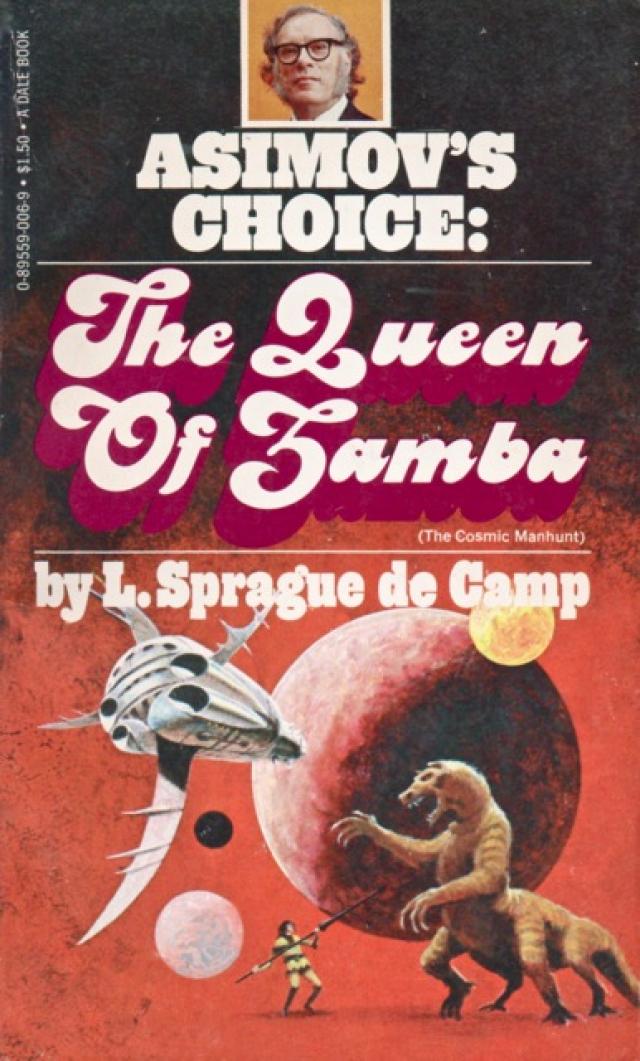
ASIMOV’S
CHOICE:
The Queen of Zamba
DAVIS PUBLICATIONS, INC.
229 PARK AVENUE SOUTH
NEW YORK, N.Y. 10003
Contents:-
FOREWORD
THE QUEEN OF ZAMBA
I.
II.
III.
IV.
V.
VI.
VII.
VIII.
IX.
X.
XI.
XII.
XIII.
PERPETUAL MOTION
I.
II.
III.
IV.
V.
DAVIS PUBLICATIONS, INC.
229 PARK AVENUE SOUTH
NEW YORK, N.Y. 10003
Copyright © 1977 by L. Sprague de Camp
All rights reserved.
Library of Congress Catalog Card Number: 77-82627
ISBN 0-89559-006-9
Printed in the United States of America
The Queen of Zamba, copyright © 1949
by Street & Smith Publications, Inc.;
copyright renewed 1976 by L. Sprague de Camp.
Perpetual Motion, copyright © 1950 by Columbia Publications, Inc.
Cover and interior artwork by Jack Gaughan
Cover and interior artwork by Jack Gaughan
FOREWORD
I wrote this novel from November 1948 to January 1949, and it was published as a serial in Astounding Science Fiction for August and September 1949. In 1954, Ace Books bought the paperback rights and published the story as half of an Ace Double, the other half being Clifford D. Simak’s Ring Around the Sun. Donald A. Wollheim, then editor at Ace, changed my title to Cosmic Manhunt.
Don also insisted upon another change. In the original version, the hero’s side-kick was a Chinese, Chuen (rhymes with “one.”) The Ace publication took place soon after the signing of the armistice that ended the Korean War. The Chinese were then unpopular because of their intervention in this war, so I was asked to change Chuen’s nationality. After some argument (Wollheim wanted to make him an (East) Indian, which I said would have been all wrong) we compromised by making Chuen an Okinawan, Yano. The Ace version was reprinted in 1966 by Roberts & Vintner, Ltd., of London, as A Planet Called Krishna.
The present version is the original Astounding one, except that I have made minor editorial changes, mostly in punctuation, spelling, &c, in line with my present canons of style.
L. Sprague de Camp
THE QUEEN OF ZAMBA
I.
Victor Hasselborg shook the reins and spoke to his aya: “Hao, Faroun!” The animal swung its head and blinked reproachfully at him from under its horns, then started to move. The carriage wheels crunched on the gravel of the Novorecife drive.
Beside him on the seat, Ruis said: “Give him a looser rein, Senhor Victor. And you must learn not to speak to him in so harsh a tone. You hurt his feelings.”
“Tamates, are they as sensitive as all that?”
“So—yes. The Krishnans carefully grade the tones in which they speak to their beasts—”
The drumming of the aya’s six hoofs mingled with Ruis’s chatter to put Hasselborg into a slight trance. He smiled a little as he thought: No comic-book hero he, with ballet suit, ray gun, and one-man rocket. Instead he was about to invade the planet Krishna in this silly native outfit with its divided kilt, wearing a sword, and driving a buggy!
It had been some weeks before by subjective time that Hasselborg had drawn on his client’s expensive cigar and asked: “What makes you think your daughter has gone off Earth?”
He watched Batruni narrowly. Although at first he had been ready to dislike the man, he was now beginning to think the textile manufacturer a friendly, generous, well-intentioned sort, if inclined to be lachrymose.
Yussuf Batruni shifted his paunch and blew his nose. Hasselborg, visualizing hordes of germs flying out of Batruni’s nostrils, shrank back a little.
Batruni said: “She talked about it for months before she disappeared, and she read books. You know, The Planet of Romance, The Martian’s Vengeance, and trash like that.”
Hasselborg nodded. “Go on.”
“She had enough money for the trip. I fear I gave her more than was good for a young girl alone in London. But she was all the family I had, so nothing was too good—” His voice caught and he shrugged sadly.
“I’ll go over her belongings,” said Hasselborg. “Meanwhile, do you think she went with somebody?”
“What do you mean?”
“I said, d’you think she went with somebody? And I don’t mean your Aunt Susie, either.”
“I—” Batruni stiffened, then checked himself. “Excuse me. Where I come from, we take care of our daughters’ virtue, so I cannot help— But, now that you bring it up, I am afraid the answer is yes.”
Hasselborg smiled cynically. “The Levant ought to advertise its virgins the way Egypt does its pyramids. Who’s the man?”
“I do not know.”
“Then how d’you know there is one?”
“There are only—little things. Nothing you can put a finger on. On my last trip to London, when I asked her about her young men, she evaded. Talked about other things. That was a big change from the times before, when I would learn every detail of the young man’s appearance and habits whether I was interested or not.”
“Don’t you suspect anybody in particular?”
“No, just a vague general suspicion. You are the detective; you draw the inferences.”
“I will,” promised Hasselborg. “As soon as I’ve looked over her apartment, I’ll wire Barcelona for the passenger lists of all the spaceships that have left in the last month. She couldn’t get away under an assumed name, you know, because her prints would be checked against the European Central File as a matter of routine.”
“That will be good,” said Batruni, looking out of the window into a fog that had so far defied the efforts of the fog sweepers. His great Levantine nose showed in profile. “Do not spare the expense, and when you find where she has gone, follow her on the very next ship.”
“Wait a minute!” said Hasselborg. “To chase somebody on another planet takes preparation: special equipment, training—”
“The very next!” said Batruni, beginning to wave his hands. “Do you think I like sitting around? Speed is of the utmost importance. I will pay you a bonus for speed. Have you never heard of the early bird, Mr. Hasselborg?”
“Yeah, and I’ve also heard of the early worm,” said Hasselborg. “Nobody gives him a thought.”
“Well, this is no joke. If you cannot hurry, I will go to—” He broke off in a fit of sneezing.
Hasselborg held his breath to let the germs settle, then said: “Now, now, I assure you I won’t waste a minute. Not a microsecond.”
“You had better not,” said Batruni. “And if you can return my Julnar—ah—unharmed, I will add fifty percent to the fee.”
Hasselborg cocked an eyebrow, thinking that if you could only strap a howdah to Batruni’s back, he’d fit perfectly into a circus parade. “I get your point. However, Mr. Batruni, while I can trail runaways, I can’t bring back the infirm glory of the positive hour, nor can I put Humpty Dumpty together again.”
“Then you don’t think there is any chance—?”
“About as much chance as there is of having an Irishman turn down a drink when you offer it to him. However, I’ll do my best.”
“Fine,” said Batruni. “By the way, Mr. Hasselborg, you do not talk like a Londoner. Are you Swedish?”
Hasselborg pushed back the brown hair that drooped untidily over his broad forehead. “By descent only. I’m a North American; born in Vancouver.”
“How did you happen to settle in London?”
“Why—” Hasselborg became wary, not wishing to go into the sordid details of his fall and partial resurrection. “After I left the Division of Investigation to go into private work, I specialized in insurance frauds. And Europe offers a good opportunity for that kind of work now.” He laughed apologetically. “Investigating them, I mean. Follow me?”
“Yes.” Batruni looked at his watch. “My plane leaves in an hour, so you must excuse me. You have the photographs, the key to her apartment, the list of addresses, and the letter of credit. I do not doubt that you will live up to your recommendations.” However, he said this with a rising inflection that did imply a doubt.
Hasselborg, as he stood up, worked the little trick that he sometimes used on dubious clients: he pushed back his hair, straighted his scarf, took off his glasses, pulled back his shoulders, and stuck out his big square jaw. By these acts he changed in a couple of seconds from a nondescript, mild-looking person with an air of utter unimportance to a large, well-built character whom an evildoer would think twice about meddling with.
Batruni smiled with renewed confidence as he shook hands.
Hasselborg warned him: “I’m no miracle-working yogi, you know. If she’s gone outside the. Solar System, it’ll take years to bring her back. There’s no extradition from most planets, and once I get her aboard the Viagens Interplanetarias she’ll be under Earth law and I can’t drag her by main force. It would cost me my license at least.”
Batruni waved a hand. “Never mind that. I will take care of your future if you get me my darling. But to wait all those years—” He seemed ready to blubber again.
“You could put yourself in a t
“And wake up to find those bad Socialists had stolen all my factories? No, thank you. It is not the time—the doctors tell me I have another seventy-five years at least—but the suspense. It will not be so long for you.”
“The Fitzgerald effect,” said Hasselborg. “If you’re not back from Aleppo when I shove off from London, I’ll leave a report for you. Mah salami!”
Viagens Interplanetarias wired back a list of names from Barcelona, and the name of Julnar Batruni turned up on the list for the Jurud, bound for Pluto with four other Londoners in addition to other passengers. Of the Londoners, one was a well-known spinster sociologist, two a minor World Federation official and his wife, and the remaining one a radio announcer named Anthony Fallon.
Hasselborg trotted around to the BBC offices, where he unearthed the Personnel Director and asked about Fallon. He learned that Fallon was in his early thirties—a little younger than Hasselborg himself—a native of London, married, with a varied background as a World Police trooper, a cameraman on a scientific expedition to Greenland, a hippopotamus-farmer, an actor, a professional cricket player, and other jobs. No, BBC had no notion where he was now. The blighter had simply called Personnel one fine day, told him he was resigning, and walked out. (That was two days before the Jurud left Barcelona.) And really you know, this is England, where a chap can go where he pleases without some copper checking up on him.
Finding the Director of Personnel stuffy, Hasselborg inquired among the staff, adding details to his picture of Fallon. The man, it transpired, had cut something of a swath among the female help; he’d apparently led not a double but a quadruple or quintuple life. The men liked his tall tales without altogether believing them; on the other hand they thought him a bit of a cad and a trouble maker. Good thing he’d gone. (These uninhibited guys have all the fun, thought Hasselborg sourly.)
Hasselborg wrote up his visit on his shorthand pad and went to Fallon’s address, which turned out to be an ordinary Kensington flat. A pretty blonde girl opened the door. “Yes?”
Hasselborg got a jolt—the girl looked like his lost Marion. “Are you Mrs. Fallon?”
“Why, yes. What can I—”
“My name’s Hasselborg,” he said, forcing what was meant for a disarming grin. “May I ask you a few questions about Mr. Fallon?”
“I suppose—but who are you really?”
Hasselborg, thinking that the direct approach would work here as well as any, identified himself. The strong Briticism of her speech made him almost forget her resemblance to his ex-wife. The girl was of medium height, sturdily built, with substantial ankles, wide cheekbones, rather flat features, and a vivid pink-blue-and-gold coloring.
After some hesitation, she asked him in. Most people did, since they were more thrilled than resentful over being investigated by one of those fabulous creatures, a real sleuth. The only trouble was to keep them on the subject; they wanted to know about your romantic adventures and wouldn’t believe you when you assured them that investigation was a dull and sordid trade, which brought you into contact with a singularly unlikable lot of people.
She said: “No, I’ve no idea where Tony went. He just told me he was going on a trip. Since he’d done that before, I didn’t worry for the first week or two, and then I learned he’d quit his job.”
“Did you ever suspect him of—uh—playing around?”
She smiled wryly. “I’m sure he did. You know, tales of how he had to stay late for spot broadcasts, which later turned out never to have taken place.”
“Do anything about it?”
“I asked him, but he only flew into a temper. Tony’s a very peculiar man.”
“He must be, to leave a girl like you—”
“Oh,” she smiled deprecatingly. “I’m afraid I bored him. I wanted the usual things, you know—a real home and lots of children.”
“What did you intend to do when he went this time?”
“I hadn’t decided. I can’t help liking him in a way, and he was wonderful when we first—”
“I understand. Did he ever mention a Syrian girl, Julnar Batruni?”
“No; he was cagey. You think he went with her?”
Hasselborg nodded.
“Where to? America?”
“Farther than that, Mrs. Fallon. Off Earth.”
“You mean millions and millions—Oh. Then I suppose I shan’t see him again. I don’t know whether to be relieved—”
Hasselborg said: “I’m trying to find Miss Batruni and, if possible, bring her back. Want me to try to fetch your man, too?” (He found himself, he couldn’t imagine why, hoping she’d say no.)
“Why… this is all so unexpected. I’d have to think—” Her voice trailed off again.
“Mind if I take down some data?” The shorthand pad appeared. “What was your maiden name?”
“Alexandra Garshin. Born in Novgorod, 2103. I’ve lived in London most of my life, though.”
Hasselborg grinned, “Tony’s the only Cockney in the case.” After a few more questions he said: “While I don’t usually mix business with pleasure, it’s nearly dinner time, and I think we could pursue the subject better over a couple of reindeer steaks. What say?”
“Oh! Thanks, but I couldn’t impose on you—”
“Come on! Old man Batruni’ll be paying for it.” Hasselborg looked studiedly friendly and harmless, hoping that his expression would not seem to be to the unprejudiced observer like that of a hungry wolf. Or at least a coyote. *
She thought, then said: “I’ll come; but if you ever meet my parents, Mr. Hess… Hass—”
“Vic.”
“Mr. Hasselborg, don’t say I went out with you on such short acquaintance.”
“Cocktail?” he said.
“Thank you, a blackjack.”
“One blackjack and a glass of soda water,” he told the waiter.
she raised eyebrows. “Teetotaler?”
He smiled regretfully. “No. Narasimachar treatment.”
“You poor man! You mean you’re really conditioned so a good drink makes you gag?”
He nodded. “Sad, too, because I used to like the stuff. Too well, that was the trouble, if you follow me.” He wouldn’t go into the story of his moral collapse after Marion— “When I get a case where I’ve got to drink with the boys for professional reasons,* boy, then the going is rugged. But let’s talk about you. Are you fixed for support while I chase your errant spouse beyond the cranky comets and behind the mystic moons?” He washed down a couple of pills with his soda water.
“Don’t worry. I’ve got a promise of a job, and if the worst came to the worst I could go back to my parents—if I could stand hearing them say ‘I told you so.’”
The physician laid down his last hypodermic and said: “Really, that’s all I can think of.” He counted them off on his fingers. “Tetanus, typhus, typhoid, small pox, yellow fever, bubonic, pneumonic, malaria. It’s a wonder you’re not dead from all the shots you’ve had lately. Maybe you’d like to be shot for whooping cough?”
Hasselborg met the doctor’s gaze squarely, although he guessed that the word in the doctor’s mind was “hypochondriac.”
“Thanks, I’ve had it. Got those prescriptions? Wish I could take time to have my appendix jerked.”
“Is something wrong with your appendix?”
“No, but I don’t like wandering around some strange planet with one inside me that might go wrong. For all I know, I’m going some place where, when you get sick, they chop off a finger to let out the evil spirits. And I hope my teeth hold out; just had ‘em checked.”
The doctor sighed. “Some chaps with everything wrong can’t be bothered with elementary medical care, while the healthiest individual I’ve seen in years— But I suppose I shouldn’t discourage you.”


