

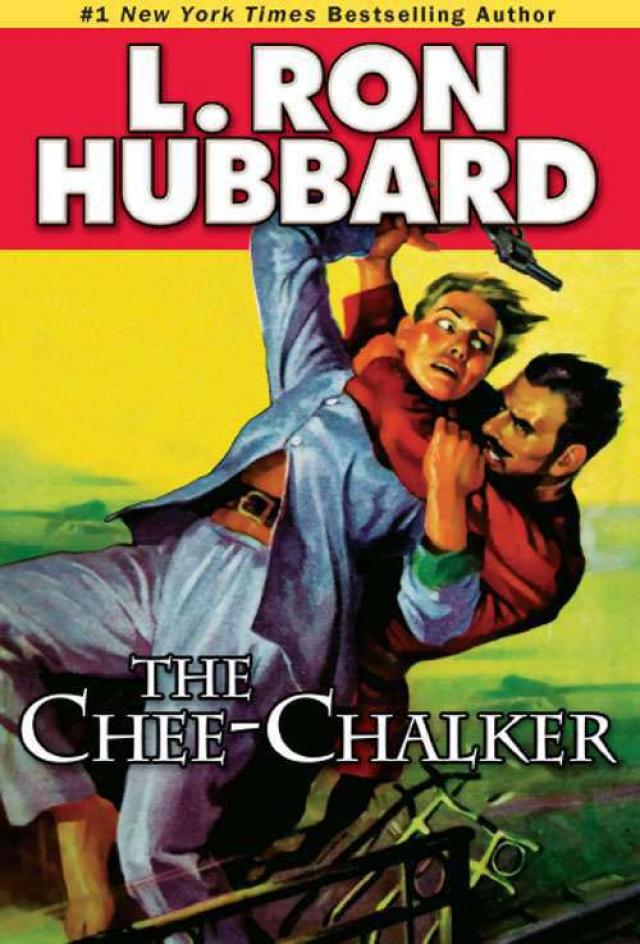
The Chee-Chalker, page 1


SELECTED FICTION WORKS
BY L. RON HUBBARD
FANTASY
The Case of the Friendly Corpse
Death’s Deputy
Fear
The Ghoul
The Indigestible Triton
Slaves of Sleep & The Masters of Sleep
Typewriter in the Sky
The Ultimate Adventure
SCIENCE FICTION
Battlefield Earth
The Conquest of Space
The End Is Not Yet
Final Blackout
The Kilkenny Cats
The Kingslayer
The Mission Earth Dekalogy*
Ole Doc Methuselah
To the Stars
ADVENTURE
The Hell Job series
WESTERN
Buckskin Brigades
Empty Saddles
Guns of Mark Jardine
Hot Lead Payoff
A full list of L. Ron Hubbard’s
novellas and short stories is provided at the back.
*Dekalogy—a group of ten volumes
Published by Galaxy Press, LLC
7051 Hollywood Boulevard, Suite 200
Hollywood, CA 90028
© 2008 L. Ron Hubbard Library. All Rights Reserved.
Any unauthorized copying, translation, duplication, importation or distribution, in whole or in part, by any means, including electronic copying, storage or transmission, is a violation of applicable laws.
Mission Earth is a trademark owned by L. Ron Hubbard Library and is used with permission. Battlefield Earth is a trademark owned by Author Services, Inc. and is used with permission.
Cover art from Top-Notch Magazine and horsemen illustration from Western Story Magazine is © and ™ Condé Nast Publications and is used with their permission. Fantasy, Far-Flung Adventure and Science Fiction illustrations: Unknown and Astounding Science Fiction copyright © by Street & Smith Publications, Inc. Reprinted with permission of Penny Publications, LLC. Story Preview illustration from Detective Fiction Weekly is © 1936 Argosy Communications, Inc. All Rights Reserved. Reprinted with permission from Argosy Communications, Inc.
ISBN 978-1-59212-653-8 Mobipocket version
ISBN 978-1-59212-527-2 ebook version
ISBN 978-1-59212-354-4 print version
ISBN 978-1-59212-174-8 audiobook version
Library of Congress Control Number: 2007903547
Contents
FOREWORD
THE CHEE-CHALKER
CHAPTER ONE
CHAPTER TWO
CHAPTER THREE
CHAPTER FOUR
CHAPTER FIVE
CHAPTER SIX
STORY PREVIEW:
DEAD MEN KILL
GLOSSARY
L. RON HUBBARD
IN THE GOLDEN AGE
OF PULP FICTION
THE STORIES FROM THE
GOLDEN AGE
FOREWORD
Stories from Pulp Fiction’s Golden Age
AND it was a golden age.
The 1930s and 1940s were a vibrant, seminal time for a gigantic audience of eager readers, probably the largest per capita audience of readers in American history. The magazine racks were chock-full of publications with ragged trims, garish cover art, cheap brown pulp paper, low cover prices—and the most excitement you could hold in your hands.
“Pulp” magazines, named for their rough-cut, pulpwood paper, were a vehicle for more amazing tales than Scheherazade could have told in a million and one nights. Set apart from higher-class “slick” magazines, printed on fancy glossy paper with quality artwork and superior production values, the pulps were for the “rest of us,” adventure story after adventure story for people who liked to read. Pulp fiction authors were no-holds-barred entertainers—real storytellers. They were more interested in a thrilling plot twist, a horrific villain or a white-knuckle adventure than they were in lavish prose or convoluted metaphors.
The sheer volume of tales released during this wondrous golden age remains unmatched in any other period of literary history—hundreds of thousands of published stories in over nine hundred different magazines. Some titles lasted only an issue or two; many magazines succumbed to paper shortages during World War II, while others endured for decades yet. Pulp fiction remains as a treasure trove of stories you can read, stories you can love, stories you can remember. The stories were driven by plot and character, with grand heroes, terrible villains, beautiful damsels (often in distress), diabolical plots, amazing places, breathless romances. The readers wanted to be taken beyond the mundane, to live adventures far removed from their ordinary lives—and the pulps rarely failed to deliver.
In that regard, pulp fiction stands in the tradition of all memorable literature. For as history has shown, good stories are much more than fancy prose. William Shakespeare, Charles Dickens, Jules Verne, Alexandre Dumas—many of the greatest literary figures wrote their fiction for the readers, not simply literary colleagues and academic admirers. And writers for pulp magazines were no exception. These publications reached an audience that dwarfed the circulations of today’s short story magazines. Issues of the pulps were scooped up and read by over thirty million avid readers each month.
Because pulp fiction writers were often paid no more than a cent a word, they had to become prolific or starve. They also had to write aggressively. As Richard Kyle, publisher and editor of Argosy, the first and most long-lived of the pulps, so pointedly explained: “The pulp magazine writers, the best of them, worked for markets that did not write for critics or attempt to satisfy timid advertisers. Not having to answer to anyone other than their readers, they wrote about human beings on the edges of the unknown, in those new lands the future would explore. They wrote for what we would become, not for what we had already been.”
Some of the more lasting names that graced the pulps include H. P. Lovecraft, Edgar Rice Burroughs, Robert E. Howard, Max Brand, Louis L’Amour, Elmore Leonard, Dashiell Hammett, Raymond Chandler, Erle Stanley Gardner, John D. MacDonald, Ray Bradbury, Isaac Asimov, Robert Heinlein—and, of course, L. Ron Hubbard.
In a word, he was among the most prolific and popular writers of the era. He was also the most enduring—hence this series—and certainly among the most legendary. It all began only months after he first tried his hand at fiction, with L. Ron Hubbard tales appearing in Thrilling Adventures, Argosy, Five-Novels Monthly, Detective Fiction Weekly, Top-Notch, Texas Ranger, War Birds, Western Stories, even Romantic Range. He could write on any subject, in any genre, from jungle explorers to deep-sea divers, from G-men and gangsters, cowboys and flying aces to mountain climbers, hard-boiled detectives and spies. But he really began to shine when he turned his talent to science fiction and fantasy of which he authored nearly fifty novels or novelettes to forever change the shape of those genres.
Following in the tradition of such famed authors as Herman Melville, Mark Twain, Jack London and Ernest Hemingway, Ron Hubbard actually lived adventures that his own characters would have admired—as an ethnologist among primitive tribes, as prospector and engineer in hostile climes, as a captain of vessels on four oceans. He even wrote a series of articles for Argosy, called “Hell Job,” in which he lived and told of the most dangerous professions a man could put his hand to.
Finally, and just for good measure, he was also an accomplished photographer, artist, filmmaker, musician and educator. But he was first and foremost a writer, and that’s the L. Ron Hubbard we come to know through the pages of this volume.
This library of Stories from the Golden Age presents the best of L. Ron Hubbard’s fiction from the heyday of storytelling, the Golden Age of the pulp magazines. In these eighty volumes, readers are treated to a full banquet of 153 stories, a kaleidoscope of tales representing every imaginable genre: science fiction, fantasy, western, mystery, thriller, horror, even romance—action of all kinds and in all places.
Because the pulps themselves were printed on such inexpensive paper with high acid content, issues were not meant to endure. As the years go by, the original issues of every pulp from Argosy through Zeppelin Stories continue crumbling into brittle, brown dust. This library preserves the L. Ron Hubbard tales from that era, presented with a distinctive look that brings back the nostalgic flavor of those times.
L. Ron Hubbard’s Stories from the Golden Age has something for every taste, every reader. These tales will return you to a time when fiction was good clean entertainment and the most fun a kid could have on a rainy afternoon or the best thing an adult could enjoy after a long day at work.
Pick up a volume, and remember what reading is supposed to be all about. Remember curling up with a great story.
—Kevin J. Anderson
KEVIN J. ANDERSON is the author of more than ninety critically acclaimed works of speculative fiction, including The Saga of Seven Suns, the continuation of the Dune Chronicles with Brian Herbert, and his New York Times bestselling novelization of L. Ron Hubbard’s Ai! Pedrito!
The Chee-Chalker
Chapter One
THE corpse was floating just at the bottom of the ladder where the dock lights reached thinly through the murky rain. The corpse was floating on its face, the way men will, and the back of the head seemed to move, though that was just the tide running through the hair. The tide had the corpse pinned against a piling so that the arms trailed out at an angle with the head and the feet curved in the same direction. The tide bubbles were full of phosphorus and lit it up all along one side.
Sven Nordsen had been drinking for about seven or eight hours and the quality of the liquor in Ketchikan had finally overcome even his strong stomach. He was so sick now that he was nearly sober. He stood on the Tamgas Trading Dock and wished he was back at sea in the Mary D, peacefully trolling for salmon with only a storm or two to worry about and maybe fog. Sven didn’t see the corpse right away. When he did he leaned out and stared. Then he gave a shuddering kind of scream and went staggering up the dock to tell somebody about it. It was a somewhat wild night, even for Alaska, and so much had happened since dinner time that just one scream attracted no attention. Sven found Kelly, the night patrolman, and told him.
Kelly went down to the Tamgas dock and looked at the corpse. It was still there. Kelly flashed his light on it, looked at it for a little while and then said, “You go find Chief Danton, Sven. He’s up at the Anchor.”
Sven went up to the Anchor, more sober now, interested enough in his mission to avoid the three fights which lay in his path even though two of his friends were definitely interested. He found mild, serious Chief Danton.
“There’s a corpse down at the Tamgas Dock, Mr. Danton.”
“Who is it?” said Danton, finishing his drink.
“I don’t know. Kelly said for you to come down.”
“Have a drink, Sven?”
“Brrrrrrr! No.”
“Never say I didn’t offer you one.”
“Well, maybe I better have one.”
“Give him a drink, Morris,” said Chief Danton, picking up his uniform cap.
“Something up?” said the barkeeper.
“Naw. Just a body down at Tamgas.”
“Who is it?” said Morris the barkeeper, blowing his nose on his apron.
“I dunno,” said Danton.
Sven watched Danton climb into his black slicker and leave. Morris set up a drink of rotgut.
“Takes the fog out of your bones,” said Sven apologetically as he drained the glass.
“Who found it?” said Morris, faintly interested.
“I did,” said Sven. “I looked down and there it was.”
“Anything on him?”
“How do I know? I ain’t got any love for hauling stiffs around. I tell you it sure was some shock to see it down there. Must’ve been in the water a month or two.”
“Naw,” said Morris authoritatively, “they go to pieces in a month.”
“Damned if they do!” said Njiki the wolf trapper, down the bar. “I seen a floater up in Sitka one time that had been in the water two months.”
“It’s colder in Sitka,” said Morris.
“Yeah, the hell it is. The water’s warmer. It’s closer to Japan, isn’t it?”
A young man took a seat near Sven and threw down a silver dollar. He motioned Morris to fill up Sven’s glass.
“You said something about a corpse?” said the young man.
Sven looked at him with suspicion. He was too well dressed and too neatly shaven to be an Alaskan. He had a peculiarly thorough way of looking at a person which wasn’t polite. He must be a chee-chalker. Still he looked strong and it was better to be polite. Besides, he had bought him a drink, as Sven belatedly discovered.
Norton repeated his question.
“Yea. It was down by the Tamgas Trading Dock.”
“Did you find it?” said Norton.
“Yah, I found it.”
“Guess I’ll go down and have a look,” said Norton. He left his change on the bar and took up his raincoat. It was a nearly white trench coat with a wide skirt. Norton pulled his broad-brimmed city hat down over his eyes and walked out. The rain was sweeping in regimental fronts along the dark boardwalks. The neon signs in the bars made little progress against the soggy dark. Norton walked down past the Sourdough Hotel and out on the Tamgas dock. A stiff wind was blowing up Tongass Narrows, blowing froth off the tops of the waves which were faintly luminous patches of white in the blackness.
Norton looked around. A light was on in the Fish Exchange and a lot of men were standing around in there. Norton pushed through the huddle at the door and came up alongside Fagler, the Federal marshal, who was talking to Chief Danton.
Fagler stopped talking and looked at Norton. “Hello, Norton.” There was faint antagonism in his voice as though he resented Norton’s butting in. The FBI was not too popular with the Ketchikan marshal, for it tended to override him in certain matters.
Norton looked at the corpse. It was stretched out on the floor, leaving a wide pool of water which ran out and mixed with the water streaming off the raincoats of the men who stood about it. The face was eaten away by fish. It was bloated and the flesh was gleaming white where it had been cut. Other places it was black.
“Who is it?” said Norton.
Fagler, the marshal, didn’t answer.
“It’s James England, the man who owns the radio station here.” Chief Danton displayed the name inside the dead man’s coat.
“Probably got drunk and walked into the water,” said Fagler.
Bill Norton was only professionally interested. The FBI was not concerned with murder until it became part of other things. But Bill Norton didn’t like the officious assurance in the marshal’s voice. He bent down and turned the head to one side. There was a spot where the skull had been caved in.
“Fell and hit a piling before he went in,” said Fagler.
“Yah,” said Norton. “Every time I see a corpse pulled out of the water in this town it hit a piling when it fell in and broke open its head.”
“It’s easy to do,” said a new voice, that of Thomas Hecklin, the local banker. He stood eyeing Norton from under the yellow brim of a sou’wester.
“That’s right,” said Chief Danton. “Besides, there ain’t any call to stir up a lot of trouble with an investigation.”
“Dead by accidental drowning,” said the coroner, writing in a book. “Isn’t that what you say, boys?” His jury nodded their heads.
Norton just looked around.
“Well? What would you do, then?” said Fagler.
Norton looked at the marshal and walked out. He walked out on the dock and stood there for a while letting the rain cool off his face. He hated being squeamish but he had never gotten so calloused that he did not get sick when he had to look at a drowned corpse. The nausea would come over him and stay with him for sometimes an hour. He looked at the patches in the dark made by the whitecaps and wished he was as tough as people thought he was. Or he wished that people wouldn’t think he was tough so that he wouldn’t have to be tough.
The men came out of the Fish Exchange and a wagon came for the corpse of James England. Paul Wagner came up and stood beside Norton in the dark rain.
Paul Wagner owned the Tamgas Trading Company and was a very important man in Ketchikan, even in Alaska. “Aren’t you with the FBI?”
Norton looked at him from under his hat brim.
“Fagler said you were and I wanted to know what you thought about it. I’m Paul Wagner.”
“Well?”
“I wanted to know what you thought about this. It is serious. James England was an important fellow to Alaska. His station up there on the knoll is Alaska’s biggest and best. Now what’s going to happen to it? I depend on him, or rather did, for my advertising. What do you make of it?”
“Make of what?” said Norton.
“Why, his murder.”
“I thought they said it was suicide.”
“They said it was accidental.”
“I wasn’t listening very closely.”
“What do you make of it?”
“Why should I make anything of it? It’s none of my business.”
“I thought you were in town to look into his disappearance.”
“Did you?”
“Well,” said Wagner, his dark face turned full on Norton now, “that was my impression. The Federal marshal wasn’t making any progress and so I thought you had been sent down to look into it.”
“Know anything about it?”
“About his disappearance?”
“Yes.”


