

Tomb of the Ten Thousand Dead, page 1


SELECTED FICTION WORKS
BY L. RON HUBBARD
FANTASY
The Case of the Friendly Corpse
Death’s Deputy
Fear
The Ghoul
The Indigestible Triton
Slaves of Sleep & The Masters of Sleep
Typewriter in the Sky
The Ultimate Adventure
SCIENCE FICTION
Battlefield Earth
The Conquest of Space
The End Is Not Yet
Final Blackout
The Kilkenny Cats
The Kingslayer
The Mission Earth Dekalogy*
Ole Doc Methuselah
To the Stars
ADVENTURE
The Hell Job series
WESTERN
Buckskin Brigades
Empty Saddles
Guns of Mark Jardine
Hot Lead Payoff
A full list of L. Ron Hubbard’s
novellas and short stories is provided at the back.
*Dekalogy: a group of ten volumes
Published by
Galaxy Press, LLC
7051 Hollywood Boulevard, Suite 200
Hollywood, CA 90028
© 2008 L. Ron Hubbard Library. All Rights Reserved.
Any unauthorized copying, translation, duplication, importation or distribution, in whole or in part, by any means, including electronic copying, storage or transmission, is a violation of applicable laws.
Mission Earth is a trademark owned by L. Ron Hubbard Library and is used with permission. Battlefield Earth is a trademark owned by Author Services, Inc. and is used with permission.
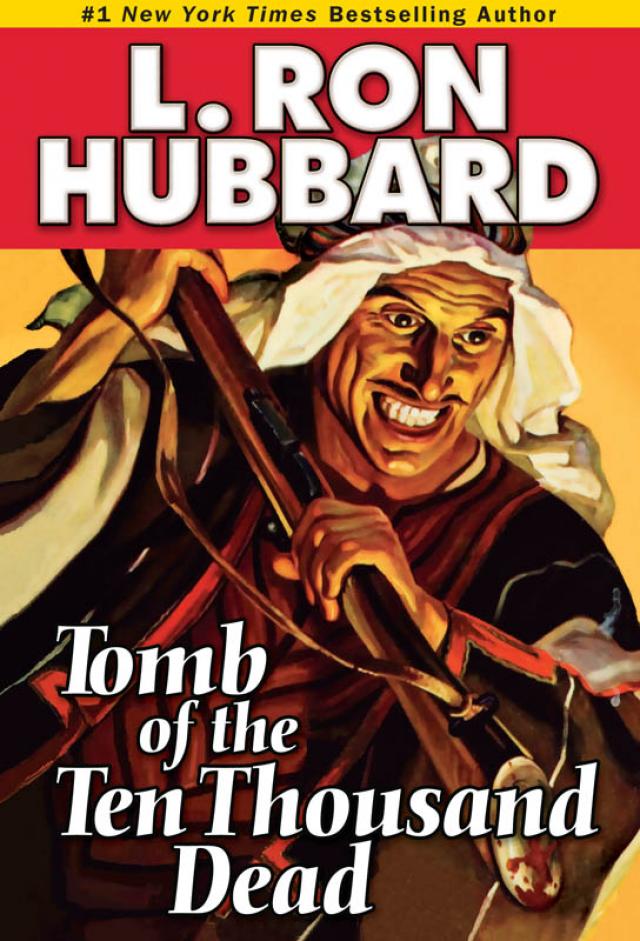
Cover art and Tomb of the Ten Thousand Dead and ™ Price of a Hat story illustrations: © 1935 Metropolitan Magazines, Inc. Reprinted with permission of Hachette Filipacchi Media. Starch and Stripes story illustration from Dime Adventure is © 1935 Argosy Communications, Inc. All Rights Reserved. Reprinted with permission from Argosy Communications, Inc. Horsemen illustration from Western Story Magazine is © and ™ Condé Nast Publications and is used with their permission. Fantasy, Far-Flung Adventure and Science Fiction illustrations:Unknown and Astounding Science Fiction copyright © by Street and Smith Publications, Inc. Reprinted with permission of Penny Publications, LLC.
ISBN 978-1-59212-622-4 ePub version
ISBN 978-1-59212-335-3 print version
ISBN 978-1-59212-323-0 audiobook version
Library of Congress Control Number: 2007903527
Contents
FOREWORD
TOMB OF THE
TEN THOUSAND DEAD
CHAPTER ONE
CHAPTER TWO
CHAPTER THREE
CHAPTER FOUR
PRICE OF A HAT
STRARCH AND STRIPES
STORY PREVIEW:
HURRICANE
GLOSSARY
L. RON HUBBARD
IN THE GOLDEN AGE
OF PULP FICTION
THE STORIES FROM THE
GOLDEN AGE
FOREWORD
Stories from Pulp Fiction’s Golden Age
AND it was a golden age.
The 1930s and 1940s were a vibrant, seminal time for a gigantic audience of eager readers, probably the largest per capita audience of readers in American history. The magazine racks were chock-full of publications with ragged trims, garish cover art, cheap brown pulp paper, low cover prices—and the most excitement you could hold in your hands.
“Pulp” magazines, named for their rough-cut, pulpwood paper, were a vehicle for more amazing tales than Scheherazade could have told in a million and one nights. Set apart from higher-class “slick” magazines, printed on fancy glossy paper with quality artwork and superior production values, the pulps were for the “rest of us,” adventure story after adventure story for people who liked to read. Pulp fiction authors were no-holds-barred entertainers—real storytellers. They were more interested in a thrilling plot twist, a horrific villain or a white-knuckle adventure than they were in lavish prose or convoluted metaphors.
The sheer volume of tales released during this wondrous golden age remains unmatched in any other period of literary history—hundreds of thousands of published stories in over nine hundred different magazines. Some titles lasted only an issue or two; many magazines succumbed to paper shortages during World War II, while others endured for decades yet. Pulp fiction remains as a treasure trove of stories you can read, stories you can love, stories you can remember. The stories were driven by plot and character, with grand heroes, terrible villains, beautiful damsels (often in distress), diabolical plots, amazing places, breathless romances. The readers wanted to be taken beyond the mundane, to live adventures far removed from their ordinary lives—and the pulps rarely failed to deliver.
In that regard, pulp fiction stands in the tradition of all memorable literature. For as history has shown, good stories are much more than fancy prose. William Shakespeare, Charles Dickens, Jules Verne, Alexandre Dumas—many of the greatest literary figures wrote their fiction for the readers, not simply literary colleagues and academic admirers. And writers for pulp magazines were no exception. These publications reached an audience that dwarfed the circulations of today’s short story magazines. Issues of the pulps were scooped up and read by over thirty million avid readers each month.
Because pulp fiction writers were often paid no more than a cent a word, they had to become prolific or starve. They also had to write aggressively. As Richard Kyle, publisher and editor of Argosy, the first and most long-lived of the pulps, so pointedly explained: “The pulp magazine writers, the best of them, worked for markets that did not write for critics or attempt to satisfy timid advertisers. Not having to answer to anyone other than their readers, they wrote about human beings on the edges of the unknown, in those new lands the future would explore. They wrote for what we would become, not for what we had already been.”
Some of the more lasting names that graced the pulps include H. P. Lovecraft, Edgar Rice Burroughs, Robert E. Howard, Max Brand, Louis L’Amour, Elmore Leonard, Dashiell Hammett, Raymond Chandler, Erle Stanley Gardner, John D. MacDonald, Ray Bradbury, Isaac Asimov, Robert Heinlein—and, of course, L. Ron Hubbard.
In a word, he was among the most prolific and popular writers of the era. He was also the most enduring—hence this series—and certainly among the most legendary. It all began only months after he first tried his hand at fiction, with L. Ron Hubbard tales appearing in Thrilling Adventures, Argosy, Five-Novels Monthly, Detective Fiction Weekly, Top-Notch, Texas Ranger, War Birds, Western Stories, even Romantic Range. He could write on any subject, in any genre, from jungle explorers to deep-sea divers, from G-men and gangsters, cowboys and flying aces to mountain climbers, hard-boiled detectives and spies. But he really began to shine when he turned his talent to science fiction and fantasy of which he authored nearly fifty novels or novelettes to forever change the shape of those genres.
Following in the tradition of such famed authors as Herman Melville, Mark Twain, Jack London and Ernest Hemingway, Ron Hubbard actually lived adventures that his own characters would have admired—as an ethnologist among primitive tribes, as prospector and engineer in hostile climes, as a captain of vessels on four oceans. He even wrote a series of articles for Argosy, called “Hell Job,” in which he lived and told of the most dangerous professions a man could put his hand to.
Finally, and just for good measure, he was also an accomplished photographer, artist, filmmaker, musician and educator. But he was first and foremost a writer, and that’s the L. Ron Hubbard we come to know through the pages of this volume.
This library of Stories from the Golden Age presents the best of L. Ron Hubbard’s fiction from the heyday of storytelling, the Golden Age of the pulp magazines. In these eighty volumes, readers are treated to a full banquet of 153 stories, a kaleidoscope of tales representing every imaginable genre: science fiction, fantasy, western, mystery, thriller, horror, even romance—action of all kinds and in all places.
Because the pulps themselves were printed on such inexpensive paper with high acid content, issues were not meant to endure. As the years go by, the original issues of every pulp from Argosy through Zeppelin Stories continue crumbling into brittle, brown dust. This library preserves the L. Ron Hubbard tales from that era, presented with a distinctive look that brings back the nostalgic flavor of those times.
L. Ron Hubbard’s Stories from the Golden Age has something for every taste, every reader. These tales will return you to a time when fiction was good clean entertainment and the most fun a kid could have on a rainy afternoon or the best thing an adult could enjoy after a long day at work.
Pick up a volume, and remember what reading is supposed to be all about. Remember curling up with a great story.
—Kevin J. Anderson
KEVIN J. ANDERSON is the author of more than ninety critically acclaimed works of speculative fiction, including The Saga of Seven Suns, the continuation of the Dune Chronicles with Brian Herbert, and his New York Times bestselling novelization of L. Ron Hubbard’s Ai! Pedrito!
Tomb of the
Ten Thousand Dead
CHAPTER ONE
THE POTTERY JAR
I have been asked to tell this story a hundred times. I have only told it once—to the British government, when they were quizzing me about the slaughter of the Lancaster-Mallard Expedition to Makran, Baluchistan.
My part was a major one only because I was the only man who escaped with his life. And that was strange because I had no real interest whatever in the findings of this expedition.
I am a pilot. Let it suffice to say that I was hired by Lancaster, a professor in a small Midwestern college, to pilot the cabin job they had bought across these awful wastes.
The expedition was boring most of the time until . . .
Tyler lay on his face in front of my tent. The morning sun was shining upon half the blade of a dagger. A spreading stain welled out over his back. Furrows were in the sand where his hands had clawed in the last agonies of death.
I blinked in the morning sunlight, unable to realize that young Tyler was really dead. No one had any reason to murder him. He was harmless, good humored. I was seized with the awful premonition that I might be next. Something was afoot, something horrible.
I stepped over the stones and knelt beside him, looking at the knife. In the silence I could hear his watch ticking, clickety-click. Funny that it was still running while Tyler was dead. Funny that a machine should outlast its master.
Dazed by the sudden discovery, I looked blankly about me. A small pottery container was lying on the earth beside him. I remembered seeing it before. It had contained some document Mallard had unearthed.
I put out my hand to touch the knife.
“Don’t touch it!” a voice behind me cried. “I’ve got you, Gordon. I’ve got you!”
Amazed, I turned slowly and stared into the muzzle of a revolver. Mallard’s hand was shaking and his eyes were cold. He had me covered and I did not know why.
He was a big-headed, narrow-shouldered man. He was the kind you see poring over ancient skulls and ancient pottery finds in museums. He was as dry as the dust of the bones he found.
“Put away the gun,” I said.
Lancaster, a brawny giant with a black beard, came out of his tent and stood there, staring at the tableau.
“Look what Gordon’s done,” said Mallard in a shaking voice.
“Wait a minute,” I cried. “What do you mean by that? My God, Mallard, I know you’ve been ill and that you’re upset, but don’t get the idea that I’d kill Tyler.”
Lancaster’s eyes were baleful as he looked at the dead man. “I think you did. You quarreled with him the other day. No use to try to lie out of it, Gordon. We’ve got the drop on you. Here, what’s this?”
Lancaster stooped and picked up the vase. He looked inside. “It’s empty! Damn you, Gordon, where’s that map?”
This was all coming too thick and fast for me. I stood up. “Don’t jump at conclusions, Lancaster. I know nothing about your damned map.”
“He’s stalling,” said Mallard. “He knows what that map means. He knows we’ve come out here to find—”
“Shut up,” barked Lancaster. “Gordon, you’ll throw your revolver this way and you’ll march into your tent and stay there, understand? We’re holding you for Tyler’s murder.”
Our native guide, a Dehwar named Kehlar, shuffled out of the cook tent and leaned indolently against a pole. He had an amused expression on his face.
“You won’t shoot, Mallard,” I said. “In the first place you haven’t got the nerve, and in the next place, if anything happened to me, who’d fly that plane out of here? I’m the only man here who can fly and if I’m killed, you’ll starve in this desert. This place has swallowed up the better part of three armies. There isn’t a water hole for fifty miles. Go on and shoot, Mallard.”
I walked toward him, deliberately. I thought I had the upper hand for the moment. Suddenly Lancaster dived for me.
He was bigger than I was and when he hit me I skidded ten feet through the coarse sand. I lit with him on top of me. He started to let me have it with his fist, but I jackknifed and threw him away from me.
Mallard stood back, gun limp in his hand, an expectant stare masking his nervousness.
Lancaster flipped and came at me again. Sand spurted in tan geysers when he hit the ground beside me. He whipped one into my jaw and sent me reeling.
The ferocity of his attack was something which would not be withstood. His hands were great things, as big as basketballs, and when those knuckles struck they left a deep and heavy mark.
I tried to make my wiriness count as much as I could, but it was a losing fight from the first. I had to stand up and slug with him.
His fists came like cannonballs and each time he landed on my body or face, great, round lights soared up and exploded behind my eyes. He was standing there, letting me have it, and I couldn’t get away. I tensed myself for one good crack at the point of his jaw before he knocked me out.
I let drive and connected so hard that it numbed my whole arm. He rocked on his heels and then crouched down. I struck again, furiously. Blood pinked his cheek.
He cuffed out with his hairy fist and rocked me into a pile of stones. I staggered up, stunned, and walked into his left. He sent me reeling again. I could taste hot, salty blood.
I went down into the swirling dust and Lancaster kicked me deliberately in the side. Mallard brought out a length of rope. They held me down and tied my hands behind me. Kehlar, unmoved, helped them carry me into the tent.
I spat out a mouthful of blood. “You’ll have a hell of a time getting out of here without me,” I raged.
“I think you’ll fly us out,” said Lancaster with a growl. “You’ll fly us far enough when we want you to. And we’ll turn you over to the British and let them hang you for this. I think that’s best. Yes, and it’s simple. You’ll fly and when we contact a British patrol, we’ll turn you over to them for trial and execution.”
“You are correct,” said Mallard in his weak, piping voice. “I came out and saw him kneeling there, making sure that Tyler was dead.”
“He’s been too sly, anyway,” said Lancaster. “Maybe if we search his stuff we’ll find the map.”
They searched and failed to find anything but shaving cream and a pair of socks I had thought long lost. They finally gave up and posted Kehlar outside the tent with a rifle to make sure I didn’t get away.
And there I was, in the center of the Makran wastes, on my back and helpless, waiting for a British patrol.
And who would believe an unknown pilot when his word was stacked against that of two eminent scientists?
Nobody.
That was the way it all started. And I lay there while the sun fanned down its barrage of heat and cursed the flies, Lancaster, Mallard and Kehlar.
We had been scouting this bleak section for months, looking into the archaeology and ethnology of the place. So far we had had little trouble. Mallard and Lancaster, spouting Latin and Persian and Greek, had dug happily in the sands and scorching rocks, getting excited over bits of pottery and other relics of the past. Tyler had not had much enthusiasm for that sort of thing. He had been more interested in the material, adventurous side of life.
Tyler had been in bad several times. He was the black sheep of the expedition. I minded my own business because I was too tired from nerve strain to do anything else. Tyler had had additional energy. Several times he had been in fights with the natives over women and such, but I had liked his devil-may-care way of doing things. He always had a grin which contrasted wonderfully with the sour expressions of the two professors.
And now Tyler was probably wooing the angels and getting the dickens for it, and I was lying here in the heat, swearing and going mad with the flies.
After a little I quieted down and began to wonder who would pilot the cabin plane if I wasn’t there. Neither Mallard nor Lancaster knew anything about flying, as evidenced by their demands that I land in impossible places so that they could inspect their beloved mounds.
Moral people, Lancaster and Mallard. They had always lectured Tyler on his taste for living and had always reproved me for my lack of interest in ancient things. They thought we should have availed ourselves of this beautiful chance to improve our minds and we had not.
Then I began to think that this was a rather flimsy excuse for nailing me down this way. They knew that I liked Tyler. Why had they suddenly turned on me like that?


