

The Dead Withheld, page 1
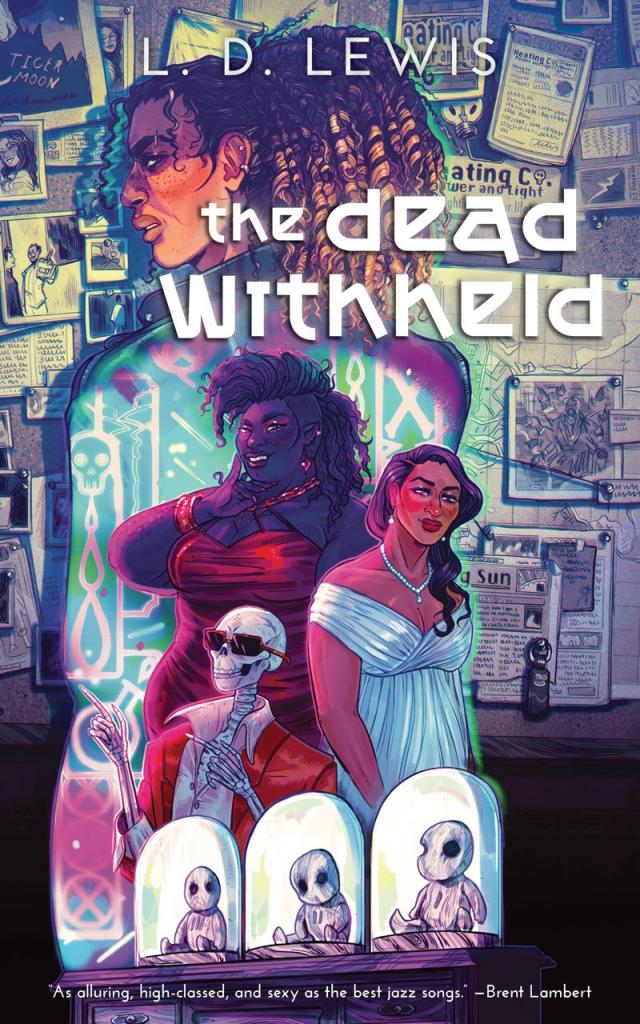


the dead withheld
L. D. LEWIS
advance praise
FOR THE DEAD WITHHELD
“The Dead Withheld is a dazzling noir from a master of world building. L. D. Lewis stirs her novella with vengeance and grief and serves it deliciously queer to her lucky readers. Broken-hearted Dizzy Carter will capture your own heart. You will root for her on her dogged quest for justice through San Guin’s colourful underbelly. Filled with hot succubi girlfriends, adorably damned henchmen, and soul sucking demons, this is a must read for fans of wounded, badass, lesbian investigators. Go buy this book. Now.”
—Suzan Palumbo, author of Countess and Skin Thief
“As alluring, high-classed, and sexy as the best jazz songs, The Dead Withheld moves with undeniable, intoxicating rhythm. Dizzy Carter brings a 'tired of your shit' edge to supernatural noir that sits on the palette like a good whiskey. Elegant prose and intensely driven characters—what's not to love!”
—Brent Lambert, author of A Necessary Chaos
“Not even the dead can stop Dizzy Carter from solving her wife's murder, and there is nothing more compelling than a grieving badass's relentless search for her own closure. The Dead Withheld is a perfect noir infused with magic, secrets, and all the tantalizing trappings of a night out in the underworld.”
—Ladz, author of Ice Upon a Pier
“The Dead Withheld by L. D. Lewis will leave you breathless, exhilarated, and as dizzy as our so-named heroine as she haunts the streets of San Guin, searching for the soul of her dead lover. At turns terrifying, explosive, joyous, and bittersweet, Lewis's novella of ghosts, demons, and the damned truly has a beating heart of humanity at its core.”
—Martin Cahill, author of Audition For The Fox
“A gritty noir spattered with neon rainbows, The Dead Withheld shines. Grief seeps through the cracks in the city of San Guin as Dizzy Carter careens through a search for her wife's lost soul in bloody lows and soaring highs that leave the reader breathless.”
—A.Z. Louise, author of Off-Time Jive
Neon Hemlock Press
www.neonhemlock.com
@neonhemlock
© 2025 L. D. Lewis
The Dead Withheld
L. D. Lewis
All rights reserved. No part of this publication may be reproduced, stored in a retrieval system or transmitted in any form or by any means, electronic, mechanical, photocopying, recording or otherwise without the prior permission of the publisher or in accordance with the provisions of the Copyright, Designs and Patents Act 1988 or under the terms of any license permitting limited copying issued by the Copyright Licensing Agency.
This novella is entirely a work of fiction. Names, characters, places and incidents are the products of the author’s imagination or are used fictitiously. Any resemblance to actual events, locales, organizations or persons, living or dead, is entirely coincidental.
Cover Illustration by Shan Bennion
Interior Illustration by Shan Bennion
Interior Design and Layout by dave ring
Edited by dave ring
Print ISBN-13: 978-1-966503-07-1
Ebook ISBN-13: 978-1-966503-08-8
contents
Chapter 1
Chapter 2
Chapter 3
Chapter 4
Chapter 5
Chapter 6
Chapter 7
Chapter 8
Acknowledgments
About the Author
About the Press
one
Dizzy Carter teetered on her barstool. It was less because she was six fingers into this fifth of bourbon and the world was on a tilt, and more because its uneven legs stuck in the crumbling brick of the alley’s ancient walkways. This was Mark Street, a string of pocket bars and taquerias set up in the mouths of candy-painted shipping containers and strewn with lantern lights kinder to bloodshot eyes. It catered to people who preferred the dark to San Guin’s nighttime neon hell, people without a fear of mayhem or the uncanny magics that made up their expanded reality.
She slugged down the last vestiges of liquor and refilled her glass, trying to make it an even ten fingers instead of six. The owner, N, cut and lit a cigar behind the bar and flipped to a news screen she watched on mute. N was a leathery old woman with large eyes and a gravel scratched voice who also sold bootleg brujeria supplies to rich tourists and their terrible children. Her shelves were dotted with human eyes and rattlesnake tails and likely her own backwash suspended in artisanal glass bottles of grain alcohol. And if she didn’t like you, she’d swear on your god (never hers) that they were potent in their spiritual properties and worth every cent you had on you at the time.
N made a good living.
Dizzy stuck with the bourbon.
She moved her glass from where her phone vibrated testily against it and instead watched raindrops alight on the invisible heads and shoulders of the dead milling among the oblivious living. The long wall of the noodle shop behind them was caked with bright graffiti, tithes of the all-seeing Color Man’s disciples. Between the rain and the swimming of the liquor in her blood, the colors danced in Dizzy’s vision arrhythmically to the bass bumping in the noodle house.
It was late on a Friday (or early on a Saturday, she’d have to look at her phone to know) and she could do with a moment left alone. But still, her phone vibrated. Any other profession, these would have been her off-hours.
Deadwalkers existed for centuries as lone witches, scattered throughout the world and held sacred as messengers of the dead to the living. Dizzy Carter was one of them but little was sacred anymore. Fewer folks knew that about her than knew she sang the blues; even that was little more than a poorly kept secret.
Six years ago she’d been in love and on the verge of more. More attention, better gigs. A career worthy of the life she shared with Lonnie Baxter. Then the Fallen Angels serial killer dropped the love of her life off the roof of their apartment building.
Dreams of that night forced themselves on her when she was either too exhausted or not stoned enough. She was a private investigator now, and well aware of the cliche. The calls she ignored were undoubtedly from clients, people searching for cheating spouses or blackmail fodder on people they owed money. The police had long since halted the search for the Fallen Angels Killer. On quiet Friday nights in the dim glow of N’s paper lanterns, Dizzy considered she should as well. After all, not even the dead could find Lonnie Baxter.
A silhouette shrouded in raindrops approached the bar and stood beside Dizzy.
“Evening, friend,” she greeted the dead patron in respect. The words slid from her numbing mouth. She wasn’t in a state to hear them speak back.
A chill breeze cut the humid alley air and Dizzy plied the hood of her jacket before deciding home would be warmer. She polished off her drink and reached across the bar for another short glass into which she poured a slug of bourbon—an offering—for the invisible guest before rapping her goodbye to N and pressing a gold coin on the bar top by way of a tip.
Her first steps were trickier than she thought they’d be, poorly measured and on no certain path. She looked around to measure her drunkenness by the steps and ramblings of other patrons on the strip and paused as a face disappeared between two bodies at a street vendor’s stall. Despite herself, her heart skipped and she squinted trying to find some magical way to peer between raindrops.
Lonnie?
Lonnie’s face appeared again, closer. She was smiling, great almond eyes cut to glimmering half moons and lips moving in excited, silent speech as she walked closer. But she was translucent, little more than a bright shadow in an old band t-shirt against the bodies moving behind her. She wasn’t a ghost. This was a memory.
Dizzy stayed riveted to the spot as the memory of Lonnie approached and then passed her in the alley. And then she matched Lonnie’s steps as they headed to the street, desperate to remember this moment in their past, to hear her voice match the words she mouthed and the laughter in them.
They walked for blocks, well past the place Dizzy was living now. She remained unfazed as strangers clipped her shoulder walking the other direction and immune to their curses when she walked into them. She drifted through crosswalks shunning crowds with their umbrellas and the onslaught of car horns. If she stayed beside Lonnie’s walking form, she could catch her eye, feel the wonder of being seen by her again. She knew better than to reach for Lonnie’s hand, to try and touch her or she may disappear.
Rain and neon light from the signage of nightlife crashed through Lonnie and threatened to obscure her completely until she stopped on the sidewalk on a calmer street. They stood before a wrought-iron screen backlit in warm sunset-orange light. For full seconds, Lonnie looked into Dizzy’s eyes, a smile playing on her lips.
“I miss you,” Dizzy whispered. “Can you hear me?”
The memory of Lonnie kept smiling and appeared to burst into laughter, pointing at something well over their heads across the street. Instinctively, Dizzy turned to look at what was only a billboard of lights, advertising Heating Co. Power and Light. She remembered this part of the memory. On this day, it had been the movie poster for Lonnie’s first major performance, a throwback noir flick called Tiger Moon.
Dizzy remembered this next part, too, when the excited memory of Lonnie raised her hands to the sides of Dizzy’s face and kissed her. She closed her eyes in hopes she might feel it. When she opened them, the memory was gone. And Dizzy, as she’d always been, was alone.
two
She was center-stage under searing light at the Crane Lounge, a bougie spot known for its gold leaf cocktails and backroom gangland symposiums. They usually liked their doll-faced, moody darlings on piano in the dark but there she was bathed in gold, all hoodoo and gutter blues and a little lipstick. The room was packed with San Guin’s upper-crust citizens entranced with the magic of her voice. Cherries of expensive cigars dotted a sea of brown faces under hazy blue lights. They toasted with brown liquor and clapped and swayed to her rhythm in their seats.
And then her B string snapped. The chandelier lights flickered. The crowd froze as if time had stopped and all their eyes—their impossibly wide, glowing eyes—were on her.
The music still played in her head. She kept singing. People scattered throughout the audience began to vibrate. Three of them. Ten. Twenty-one. She was terrified. The buzz became deafening and then she blinked and they were gone and all was silent. The audience, the stage crew, the bartenders, the waitstaff. All gone except for a woman in a white dress at the bar with her back to her.
Dizzy fled the stage as a new pitch grew in her ears. She crossed the dining room to the bar in the back and the pitch grew louder until it was clearly discernible as a scream. Filled with dread, she reached out and touched the woman’s shoulder. Lonnie turned to face her. It was always Lonnie. Her eyes were white like the dead always were. And when she went to smile, Dizzy caught the puckering of knots in the corners of her sewn-shut mouth. Then Lonnie kissed her and filled her head with her scream until she felt like she was falling and...
Dizzy’s eyes flew open and immediately took in the listless ceiling fan and pink-amber morning of a bedroom. It wasn’t much of a view, but sunlight filtered through patterned curtains and wooden blinds and the windows along the wall were open to let in new air and early traffic sounds of the city. Her gun, two aspirin, and a glass of water waited on the bedside table.
This was Carmen’s place. She ran the Rising Sun, a bordello of exquisite and highly skilled spies, sirens, and succubi. Its success proved that some men would volunteer their lives for an orgasm rumored to be worth it.
She reached, but the bed was empty beside her. The plum-colored sheets were barely rumpled but Carmen’s scent lingered there on her pillow. Dizzy swung her feet over the edge of the bed and waited for her equilibrium to right itself.
“Morning,” Carmen called from the bathroom.
“Hey.” Dizzy grimaced, tasting her own breath. She downed the aspirin and dug her phone from the pocket of her jeans on the floor to begin swiping through her notifications. Four missed calls. It was Saturday. At least she’d only slept the night this time.
“You alright? You look like shit.”
“Long night. We can’t all wake up looking like goddesses.”
“You’re right.” Carmen smiled into the mirror. “You sticking around long enough to eat something?”
“Nah, I need to get going. I’ve been slacking on this case.”
Carmen turned to face her in the doorway. She was impossibly beautiful, full and soft in her curves and the pout of her lips. Her eyes were round, brown, and disarming, but in the right sunlight the pupils flickered to slits and golden scales shimmered just below the surface of her perfect brown skin. She was a demon, after all. Sometimes it felt rude not to be in love with her.
“Oh yeah? New lead on Lonnie?” she asked.
Dizzy shook her head, trying to forget the Tiger Moon billboard, the memory on the street. There hadn’t been a lead in years.
“Then I’ll rephrase. You’re sticking around long enough to eat something.”
Dizzy was both hungry and in no mood to argue. “You’re the boss.”
Satisfied, Carmen sauntered over and kissed her. Dizzy was immune to the soul-stealing drain inflicted on men. She let the nerves in her lips tingle with Carmen’s venom and inhaled the heady fruit scent of her. “Brush your teeth,” Carmen winked. “See you downstairs.”
The door clicked shut behind her and Dizzy stared through the windows a moment longer at the faded billboards and outed neon signs of sleeping nightlife hotspots. She’d found herself here in this room with this view more often than she expected. She’d started work as a PI a few years ago, when looking for Lonnie’s murderer became a financially unsustainable obsession. She’d found the bordello contained a wealth of information and they found her story sweet enough to give it to her. The relationship with Carmen herself had gradually become more personal but short of love.
They understood each other’s positions perfectly well. The tormented Dizzy was emotionally unavailable and Carmen hadn’t the energy to waste bringing her out of it. Still, they enjoyed each other’s company.
Her phone vibrated. She didn’t recognize the number so she shimmied into her jeans and boots while she waited for it to go to voicemail. The untied laces whipped the dark hardwood floor as she made her way to the bathroom.
She sighed at herself in the mirror. Her brown and heavily freckled face was lacking lately in its glow. Her lips were pale and parched. Last night’s eyeliner smudged itself into an unkempt ring around her eyes and she’d sweat out the gel keeping the edges of her hair in line. At least she’d had the sense to gather it into an ombre pineapple on top of her head before passing out in Carmen’s bed.
She docked her phone in the mirror console. Three green dots blinked in the mirror before the home screen’s at-a-glance information organized itself along its edges. Weather and Traffic brought to you by Heating Co. Power and Light. Eighty-eight degrees and sunny. Accident on the expressway, tack 30-minutes onto your commute.
“Read new messages,” Dizzy commanded before running the tap cold and splashing the water on her face. A transcript of her newest voicemail appeared and scrolled up the mirror.
NEW MESSAGES
09:14 - Miss Carter this is Carol Underwood. Roger has been gone four days now. You agreed to help me but you too are missing. Where are you? I need to know if the bastard is dead or just gone.
Ah, Mrs. Underwood. Dizzy shook her head. She wasn’t lying when she said she was behind on a case but this wasn’t her first creeping husband assignment. All she had to do was rule out Mr. Underwood being dead.
The missed calls log read all the same numbers since last night. Mrs. Underwood had been persistent.
“Desert weather,” Dizzy said, and a weather map on the mirror revealed a stormfront rolling in from the east. It would be over San Guin around nightfall. She had time.
She managed to wrangle her curls into a neat-enough braid, then scrubbed the taste of morning and bourbon and caapi cigarettes from her mouth. Deadwalkers relied on certain herbs to maintain their connections to the dead world and the blended cigarettes she used had stained a black spot inside her bottom lip where they’d rested over the years. She poked at the spot. Her stomach growled. She collected her phone and the gun from the bedside table and headed downstairs.
The Rising Sun was six floors of violet-painted hallways, a dozen rooms each with gold doors. The interior of the elevator Dizzy rode down was painted in baroque tapestries of intermingling kings and conquered warriors and the lascivious demons who owned them; a bit on-the-nose, but exactly this clientele’s kink. The elevator stopped on most of the floors and the men who’d survived the night stepped anxiously inside. They appeared wasting away inside yesterday’s suits, their gazes vapid and distant, looking through Dizzy and the men beside them. By contrast, the sirens who accompanied them on the ride down were radiant and made up in every variation of perfect. They allowed the weaker men to lean on them and kept conversation to make sure their clients didn’t pass out in the elevator.


