

Everything Like Before, page 1


Copyright © Kjell Askildsen
First published by Forlaget Oktober AS, 1953-2015
Published in agreement with Oslo Literary Agency
English language translation © Seán Kinsella, 2021
First Archipelago Books Edition, 2021
“The Dogs of Thessaloniki,” “The Grasshopper,” “The Nail in the Cherry Tree,” “A Lovely Spot,” and “Everything Like Before” are reprinted with permission from Dalkey Archive Press.
All rights reserved. No part of this book may be reproduced or transmitted in any form without the prior written permission of the publisher.
Library of Congress Cataloging-in-Publication Data
Names: Askildsen, Kjell, 1929- author. | Kinsella, Seán (Translator), translator.
Title: Everything like before / Kjell Askildsen; translated from the Norwegian by Seán Kinsella.
Other titles: Alt som før. English
Description: First Archipelago Books edition. | Brooklyn, NY : Archipelago Books, 2021. |
First published as Alt som før by Forlaget Oktober.
Identifiers: lccn 2020026811 (print) | lccn 2020026812 (ebook) |
isbn 9781939810946 (trade paperback) | isbn 9781939810953 (ebook)
Classification: lcc PT8950.A769 A2 2021 (print) | lcc PT8950.A769 (ebook) | ddc 839.823/74—dc23
LC record available at https://lccn.loc.gov/2020026811
LC ebook record available at https://lccn.loc.gov/2020026812
Ebook ISBN 9781939810953
Archipelago Books
232 3rd Street #A111
Brooklyn, NY 11215
www.archipelagobooks.org
Distributed by Penguin Random House
www.penguinrandomhouse.com
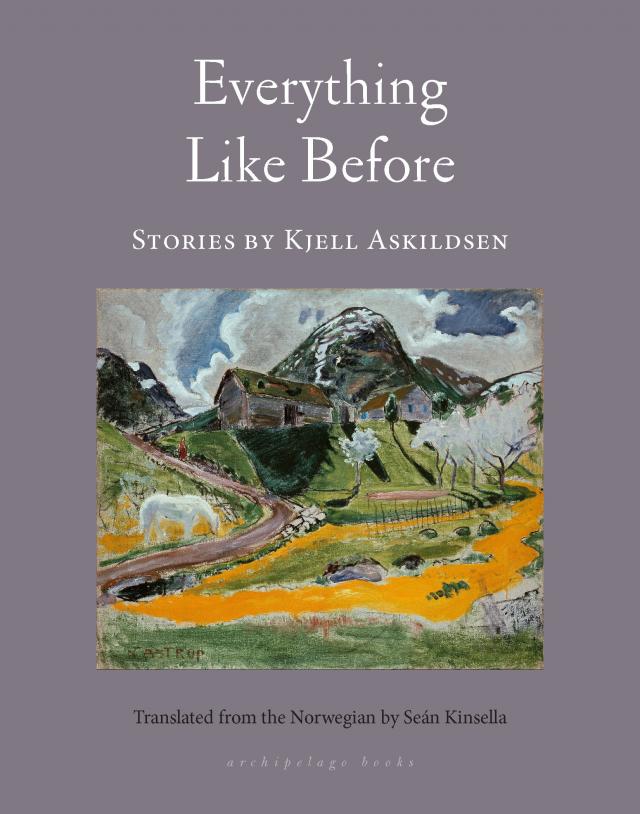
Cover art by Nikolai Astrup
This translation has been published with the financial support of NORLA.
This publication was made possible with support from the Lannan Foundation, the New York State Council on the Arts, a state agency, the New York City Department of Cultural Affairs, and the Carl Lesnor Family Foundation.
a_prh_5.6.1_c0_r0
Contents
A Bucket of Time
A Lovely Spot
A Sudden Liberating Thought
Encounter
Everything Like Before
I’m not like this, I’m not like this
Mardon’s Night
Midsummer
The Dogs of Thessaloniki
Sunhat
The Grasshopper
The Joker
The Nail in the Cherry Tree
The Other Dream
After the Funeral Service
Georg
Gerhard P
Gustav Herre
Konrad T
Marion
The Cost of Friendship
The Toilet Bag
Nothing for Nothing
The Wake
An Uplifting Funeral
Thomas F’s Final Notes to the Public
Carl Lange
Chess
Carl
My Goodness
Café-goers
Maria
Mrs. M
The Banister
The Disturbance
At the Barber’s
Thomas
A Bucket of Time
It was either in October or November; I ought to remember if the leaves had fallen, there’s something reassuring about specifying a precise time, for how can I rely on that part of my memory dictating the event itself when I’ve forgotten important details of the setting, one thing being so dependent on other things after all, and time is part of the setting.
I spotted him as I emerged from the woods and was about to cross the road. I ran back into the woods. He was coming from the city and was on the way home. He was carrying the bucket in his hand – a bucket of time you might say – and I lay quite still behind a stone, hearing the alarm clock tick. He was a big man and moved heavily; he was wearing an old, ankle-length coat; I imagined I knew his smell but that was most likely a delusion influenced by my secondhand knowledge of his miserable existence.
I followed him, at a safe distance – I knew where he was headed after all. I acted in accordance with my nature, my voyeuristic disposition: I’ve experienced little in my life but seen a great deal, in other words my experiences are for all intents and purposes secondhand. So I followed him, but pretended – also to myself – as though it simply came about, that I happened to be going the same way. It’s important not to set one’s goals too clearly, so as to safeguard oneself against failure. I watched him leave the road and make his way across the field along the stream; I myself walked along the edge of the woods, hidden by the willow scrub so he couldn’t see me. I believe that a man walking that way – alone on his way home from the city – is thinking about the past, that he’s sad yet relieved to have put people behind him, above all children, because you can’t walk around with an alarm clock in a milk pail with impunity, whoever does that must either be full of forbearance or full of contempt. I believe he was thinking about the past, perhaps – it being an autumn day – about having lived so long only to be so lonely. I remember now that it must have been in November, otherwise I wouldn’t have wondered what kind of Christmas a man like that would have; I was child enough to measure a man’s loneliness by how he spent Christmas Day – you can see by that how time enters into it.
He lived in one corner of a dilapidated outlying barn enclosed by forest on all sides. He went inside but emerged immediately afterward and sat down on a stool. There wasn’t much to look at, he just sat there, with his elbows on his knees; I was thinking he was old enough to stay sitting there until the sun went down, and I felt he must be the loneliest person on earth. So really not much to look at – an old man on a stool – and I was about to leave when he moved. He took something from his inside pocket: a whistle. He put it to his lips and blew the hymn Nu Titte til hinanden – it was very beautiful, a morning song in an evening wood, played by an old man on a stool in front of a ramshackle barn.
He played the tune twice, then put the whistle in his pocket and stood up. He gazed between the tree trunks, a long searching look, as though to assure himself he was alone. Then he began to speak, slowly and distinctly, as though the trees were hard of hearing. It was the kind of speech you make in private, words from the top of your head, seemingly absurd digressions spun off tenuously connected themes; if I hadn’t used nature as an auditorium for similar speeches myself, I’d probably have thought he’d lost his mind, but I knew better. He stood putting himself to rights after his trip to the city; he spoke about stares as long as church steeples and made his tormentors out to be rats and a brood of vipers; he was vague but eloquent – it was a wonderful performance, played out as the sun set behind the silent forest, and when he stopped there fell a hush, as though after a mournful song.
The silence was suddenly broken by a round of applause, and from out of the woods emerged two young men, the sons of Ellerman, the tinsmith. They continued to clap as they approached the old man, who stood motionless beside the stool. They came to a halt in front of him.
“So, you squeak, do you?”
He made no answer.
“Sit down.”
He remained standing. They pushed him onto the stool.
“What are we to do with an idiot like this?”
“He squeaked, didn’t he?”
One of them put his hand inside the old man’s coat and pulled out the whistle. He held it between two fingers and said something I couldn’t make out. The old man let out a yell and tried to grab it from him. That was ill-advised, his resistance provoked them. I saw the whistle fly in an arc through the air, landing a few meters away from me; it sounded like it struck a stone. I was angry but didn’t allow myself to be lured, my anger was in check, as always; cowardice often prevents one from acting rashly; it’s no coincidence that cowardly people are often credited with high intelligence. So I did nothing, but allowed developments run their course independent of my disgust. I did not hear everything they said but saw all the more for that. One of the brothers went into the barn and appeared again with the milk pail. He was holding his nose.
“Gosh, dat was a glose gall!”
The other brother laughed. They lifted the lid off the bucket and bent over it. The old man cried out and stood up but they paid him no attention. It was an old-fashioned alarm clock, almost as big as the lid of the bucket. They talked and pointed skyward.
“No!” the old man yelled. “You don’t know what you’re doing!”
They glanced at him, and I think they almost thought better of it; I’m willing to credit them with some hesitation, a moment’s indecision, before prestige got the upper hand.
“Do you reckon this is his heart?”
“Sounds like it. What do you think it looks like?”
“We’ll see.”
They began picking the alarm clock apart, talking and laughing, and dropping the loose parts into the bucket. The old man stood a few steps away, silent and motionless. The sun was gone; it was so quiet I could hear the screws ring against the bottom of the bucket. Then it was over.
“That wasn’t much of a heart.”
The old man didn’t move; he stood li
The brothers seemed oddly harmless after finishing their deed. They tried to drag out their easy victory with taunts, but it was no use, the victory was slipping from their grasp, leaving only losers: the old man, the brothers, me, and a forest full of defeat. Then they withdrew among the tree trunks, without rounds of applause but with jarring laughter.
The voices faded, dusk fell. I emerged from my hiding place and began looking for the whistle. He saw me no doubt but he didn’t move. The whistle wasn’t hard to find. I picked it up and approached him, I, the brothers’ counterpart, an outstretched hand.
“It’s in one piece.”
He took it without a word and without looking at it. I’d never been so close to him before; time had plowed deep furrows in his face. I couldn’t think of anything to say. His big eyes rested on me. It was uncomfortable; I had let my emotions get the better of me and broken the voyeur’s first commandment: never be seen. He saw, and perhaps I gave him a little comfort, because he must surely have despised me. But he didn’t say a word, and after a moment he bent down, grabbed the bucket and headed for the door.
I entered the forest where the trees grew most densely, walking slowly, so he wouldn’t see that I was ashamed. But I doubt he was thinking about me, because I hadn’t taken many steps before an awful din broke out in the ramshackle barn, a racket so loud it sounded like everything behind those four walls was being smashed to pieces. The whistle too, perhaps.
A Lovely Spot
“Aren’t you driving a little fast?” she said.
“No,” he said.
A little while later he turned off the motorway and onto the narrow winding road towards the fjord.
“It’s so green since we were last here.”
“Yes,” he said.
“It’s as if the road is narrower,” she said.
“I’m not driving too fast,” he said.
Just before they got to the big oak tree where he usually left the car, she said she had a feeling that something wasn’t quite right. She usually said that when they were drawing close to the summerhouse, and he didn’t reply. One time she may be right, he thought.
He parked the car. He helped her with the lightest backpack.
“Just start walking,” he said.
“I’ll wait for you,” she said.
“I’ll catch up,” he said.
He caught up with her halfway down the steep, overgrown dirt road. She was standing waiting for him.
“Is it heavy?” he said.
“No,” she said.
They walked on. After a few minutes the house came into view below them. He slowed down; she always walked in front for the last few meters. She opened the gate, then she said:
“Somebody’s been here.”
“Oh?” he said.
“I left a stone on the gatepost,” she said, “and now it’s gone.”
“Well,” he said, “I guess somebody’s taken it. Was there something special about it?”
“No,” she said, “an ordinary stone.”
He closed the gate after himself.
“I don’t like the fact someone’s been here,” she said.
He did not reply. He saw that the apple tree was in bloom.
“Look at the apple tree,” he said.
“Yes,” she said, “isn’t it beautiful.”
She reached the door. She took off the backpack. He walked over to her, placed the shopping bags beside her backpack and took the key from his pocket.
“Do you want to open it?” he asked.
“You do it,” she said.
He opened the door and went inside. He put down his backpack on the kitchen floor and continued into the living room. He opened a window and stood looking out over the fjord. She called to him. He went out to her.
“Would you be a dear and hoist the flag,” she said.
“Now?” he said.
“I like people to see that we’re here.”
He looked at her, then picked up the shopping bags and went back inside. He fetched the flag from the drawer of the dresser in the hall. “It was always the first thing Dad did,” she said, “hoist the flag.”
“Yes,” he said, “I’m aware of that.”
“You don’t mind, do you?”
“I just got it, didn’t I,” he said.
He went over to the flagpole.
* * *
—
They were by the kitchen table. They had eaten. She sat looking out the window, in the direction of the dense forest.
“Isn’t this a lovely spot,” she said.
“Certainly is,” he said.
“I don’t think there’s anyone who has a nicer place,” she said.
He did not reply.
“I just wish we could cut back all that scrub at the edge of the forest.”
“Why?” he said.
“It’s just so…you can’t see what’s behind it.”
“It’s not on our property,” he said.
“No,” she said, “but still. Dad used to always cut it back.”
They sat in silence for a while.
“What will we do tomorrow?” she said.
“Are we going to do something?” he said.
“No, I don’t know,” she said. “Take the rowboat out. To Ormøya, for example.”
“It’s nice just being here,” he said.
“Of course. Yes, we’ll stay put then, will we? Besides we’ve got plenty to do here.”
“We’re going to take it easy tomorrow,” he said.
“But the outside toilet needs to be emptied,” she said.
“There’s no hurry,” he said.
“No, just as long as it gets done.”
* * *
—
They stood on the concrete jetty, the sun was about to set.
“Oh, how I love this place,” she said.
He did not say anything.
“There. I fell into the sea right there.”
“Yes,” he said, “you’ve told me.”
“I must have been about four years old,” she said.
“Five,” he said.
“Yes, maybe. I struck my head against one of the stones you can see there and it left a deep cut above my ear, and if Dad hadn’t – What was that?”
“It sounded like an animal,” he said.
“It was someone shouting,” she said.
“No, it sounded more like an animal.”
“Let’s go inside,” she said.
They walked towards the house.
“We have to remember to take down the flag,” she said.
“It’s not necessary,” he said.
“We’ve always done it,” she said.
“Yes,” he said, “I know.”
“There’s a rule requiring you to,” she said.
“I know,” he said.
“I want you to do it, Martin. If not, I’ll do it myself.”
“All right, all right, I’ll do it.”
* * *
—
When he came in, he said:
“I’m opening a bottle of wine.”
“Yes, do that,” she said.
She sat down on the bench. He poured wine in her glass.
“Thanks, that’s enough,” she said.
He poured himself twice as much and sat down by the window.
“That’s where Dad used to sit,” she said.
“Yes, you’ve told me,” he said. “And where did your mother usually sit?”
“Mom? She…Why do you ask?”
“I was just wondering. Cheers.”
“I think she normally sat here on the bench.”
She sipped at her wine. They sat in silence. He pushed his chair back a little so he could look out at the fjord without having to turn his head. He drank.
“It’s so quiet,” she said.
He did not reply. Then he said:
“There’s a man standing over there on the headland.”
She got up and went to the window.
“He’s looking this way,” she said.
She opened the window.
“Why are you opening the window?” he said.


