Kamikaze, page 23
part #1 of Dungeon Samurai Series


At the far end of the hall, awaiting his turn, Yamada tumbled a string of a hundred and eight prayer beads with his thumb. The monks had given the mourners the juzu as a solemn reminder of the cycle of birth, death and rebirth—and that by following the teachings of the Buddha, this cycle would be broken.
He had come so close to death, pushing himself so hard. He wasn’t sure why he hadn’t blacked out immediately the third time he used Kamikaze. Maybe he’d gotten stronger, or maybe kami-sama was watching out for him.
He had awoken in the aid station at the FOB to the sight of Katsura fussing over him. He couldn’t stay for long; Commander Marshall insisted on pushing the casualties up to the surface for monitoring and follow-on treatment, but secretly it pleased him to see a girl, to see her, worried for him.
He hoped he could talk to her soon.
But for now, for today, he owed a duty to the dead. To Ono Kaoru, Matsumoto Ryou, Kobayakawa Aki and Oshiro Takeshi. The penitents would hold their own ceremonies elsewhere; this tsuya, this wake, was for the Japanese.
The juzu, carved of plain wood, grew warm and moist. Clouds of fragrant incense tickled Yamada’s nose. Physically he was fine. But mentally, emotionally, he felt like the inside of his heart had been scraped out, leaving behind an empty husk. He didn’t know if he would feel better again. Only that he still had to discharge his duty.
When it was his turn, Yamada pressed his palms together and bowed to the priests, the altar, and the dead.
A tray of incense rested on a nearby table. He gathered up a pinch of powder with his fingertips and raised his fingers to eye level. He paused for a moment, then gently sprinkled the powder into an incense burner.
He repeated the ritual twice more. Then he held his hands together in prayer.
Thank you for your service. We will carry on where you have left off. May you be reborn into a better realm, free from war and suffering and bloodthirsty demons.
He bowed to the dead. Bowed to the living. And left.
Traditionally the family of the deceased would offer incense. But there was no family here. Only brothers in arms. Off-duty samurai joined in the procession, offering their last respects. Yamada sat on an empty patch of floor next to Hiroshi.
When it was his turn, Hiroshi did not pray, nor did he turn the juzu. Instead, he stood solemnly before the coffins for a moment, then turned and bowed to the audience.
Fujiwara frowned mightily. Hiroshi pretended not to notice.
The monks completed their chants. Some of the samurai departed. The rest remained.
Now it was time for the vigil. There was no idle chatter. Only quiet contemplation, the occasional exchange of stories, rehearsals for the following day. A grim mood hung over the air. But in front of so many people, the men retained their poker faces.
The men took turns to stand watch, armed with yari and katana and tanto. The night passed in silence, broken only by lonely gusts of wind.
At daybreak, the priests came by again. Now it was time for the kokubetsushiki, the separation ceremony.
The pallbearers, six to a coffin, lifted the bodies and followed the priests. Yamada adjusted his blades, shouldered his yari and joined the escorts.
As the procession passed through the town, a party of laborers joined them, carrying wheelbarrows filled with logs. Passers-by stopped and bowed to the deceased until they were past.
The road to the cemetery passed through the forest. Yamada watched the trees, his senses on high alert.
“Monsters do not respect our customs and processions,” Fujiwara had said. “It is the final duty of the living to defend the dead.”
The dirt trail led to a wide clearing filled with tombstones. Some were carved into the shape of crosses, others marked with swastikas, the rest were stone slabs with names carved into them.
The priests directed the procession to a pavilion. As the laborers arranged the logs, the priests prepared offerings of incense, salt, and water. The pallbearers carefully lowered the coffins on the logs.
The priests addressed the dead, assigning them new Buddhist names. Yamada had read once that this practice prevented the dead from being called back into the world. He approved. No one should be called back here, ever.
As a laborer chipped away at slabs, engraving the new names in stone, the others piled the logs together and started a fire. The wood blazed merrily, throwing clouds of thick smoke into the air. The priests lowered their heads and chanted.
“Kanjizai bosa gyojin hannya haramitta ji sho ken go un kai ku do issai ku yaku…”
The scent of smoke mingled with the sweet fragrance of cooked pork. The mourners and the laborers mimicked the monks, tumbling and turning their juzu, and chanting alongside them. Hiroshi declined to participate, instead standing guard at the cemetery’s edge. Yamada joined him, trying to close his wounded heart and focus on his current mission.
He tried.
“Gyatei gyatei haragyate harasogyate boji sowaka!”
A single tear trickled down Yamada’s right eye. He wiped it away and continued standing watch.
The chanting continued, cycling through different sutras. Two hours later, the pyre burned out, leaving a heap of blackened ash.
The monks continued chanting until the ashes cooled. Taking long wooden chopsticks, the samurai recovered the bones of the dead. They passed the bones from man to man, chopsticks to chopsticks, depositing them in an urn. They moved from the feet to the skull, and when the last bone was transferred, the priests closed and covered the urns.
The samurai carried the urns away, following the priests to their assigned plot. Slowly, carefully, they lowered the urns into the shallow hole, and covered the grave with a thick slab of stone. The laborers fixed the tombstones in place, and the priests placed their offerings of flowers, ashes and water.
As they departed, the men sprinkled salt over themselves, a final act of ritual cleansing.
The mess hall had prepared a special menu for okiyome, the post-funeral meal. The cooks served plates of sushi rolls, prepared with oats instead of rice, bowls of miso soup and mugs of beer.
Standing at the table, Fujiwara raised his cup.
“Kenpai!” he called.
“Kenpai!” the men echoed, lifting their mugs.
Kanpai was a toast to the living, kenpai for the dead.
Over breakfast the men exchanged more stories, more jokes, and drank heartily from their mugs. Yamada wasn’t in a mood for talking, but he listened all the same, and ate his meal silently.
All he tasted were ashes.
* * *
It was the Sabbath day. Yamada had no further duties today, so when the okiyome was over, he received his pay, changed into his red uniform kimono and made his way to town.
The scent of smoke and incense hovered around him. The presence of people repulsed him, but walking down empty streets was unbearable. Finally, he climbed the steps to the jinja-ji, where he saw Katsura sweeping the courtyard.
He shouldn’t be here. It was taboo for mourners to visit a shrine. But he wasn’t a traditionalist, and he didn’t want to be alone.
Exchanging brief greetings, he offered salt and prayers, once at the shrine and once at the temple, once for the dead and once for those who remained.
Finally he returned to the courtyard and sat under a sakura tree. Katsura joined him.
“Kokoro yori okuyami moushiagemasu,” she said. From my heart I offer my condolences.
“Thank you,” he said.
“You must have been close to the deceased.”
“We…” He chuckled. He had to laugh, or he would cough and choke on unshed tears. “We’ve known each for a few short months. But it was the span of a lifetime. We were strangers in many ways. Yet we were also brothers in arms, brothers in blood, brothers in truth. We’d give our lives for each other. And we did.”
“Se ya na… How are you feeling?”
“I’ll live.”
“Se ya…”
For an aeon they sat in silence.
“This world wants to kill us all,” Yamada said, finally.
“Un,” Katsura said. “I lost count of funerals I’ve assisted with. If I hadn’t had duties today I’d have helped too.”
“This is my first funeral, but I don’t think it’ll be my last.” Yamada sighed. “Chong was right. This place is Hell.”
Her fingers brushed against his.
“The dead are free from suffering,” she said.
“And we who are left behind must carry on.”
“Is there anything I can do to help?”
“Just… stay with me.”
She stayed with him until it was time to go.
* * *
By tradition, mourning lasted for forty-nine days. But they were samurai. They could only afford one day. Tomorrow, they would return to war.
Yamada found Hiroshi lingering near the front gate. The men exchanged nods and walked the road back to camp.
The setting sun fired the sky in orange, and deep blue hues covered where the sun could not touch. Long shadows crept from the silent trees. There were soldiers ahead of them, soldiers behind them, but for now, the duo was surrounded in a bubble of isolation.
“Daijoubu?” Yamada asked.
“Daijoubu. What about you?”
“Hai. I’ll be ready for whatever comes next.”
“I heard we’re going to get transfers from other squads to make up the numbers.”
“I hope they’re up to scratch.”
“Me too.”
They walked in silence for a while. Yamada took the opportunity to frame his thoughts.
“I messed up,” Yamada said.
“Eh?”
“That first time, when I used Kamikaze. It was a mistake. It didn’t help us finish the boss. It merely drew its attention.”
“It also bought time for the sohei to heal the wounded and strike the demon with norito.”
“Sa, but it didn’t appreciably harm the tree either. And that second time, when I used it again, I charged the tree… and I had no idea how to kill it.”
“Truthfully, neither did I.”
The men shared a tired chuckle.
“Kamikaze has its place, but it has to be integrated properly with norito and other tactics,” Yamada said. “Otherwise, it’ll put everyone at risk.”
“Fujiwara knows how to use it best.”
“Yes, but when he goes down? We must study heiho too.”
“Absolutely.”
“How long can you maintain Kishi?”
“Longest I tried was fifteen minutes. No ill effects.”
Hiroshi had once suggested running the dungeon with Kishi active at all times. Fujiwara vetoed it immediately. The characteristic bright blue light would quickly draw all the monsters of the deeps—or so he said.
“Lucky. I can only manage a minute with Kamikaze,” Yamada said.
Hiroshi smiled. “Cheer up. It’s far longer than you managed during basic training.”
“Maybe because Kishi was active too.”
“It boosts everyone’s skills. Perhaps it augments your endurance too.”
“Perhaps. Speaking of endurance, I also noticed another interesting interaction between Kamikaze and Kishi.”
“What is it?”
“When I activate Kamikaze, I gain great strength at the cost of emotional self-control. But if you use Kishi after Kamikaze kicks in, I calm down and regain control while still retaining the benefits of Kamikaze.”
“Sou ka? It seems Kishi’s combat buffs cancel out Kamikaze’s weakness.”
“Exactly. There’s great synergy between our skills. If we use them right…”
“We’ll be invincible.”
Acknowledgments
Writing a novel is tough. Writing an entire trilogy at once is even harder. Fortunately, many people stepped up to help along the way. I would like to thank the following:
The 29 backers who funded this project on Kickstarter. Special thanks to Li Sha, Hanns Tan Han Yong, Loh Ai Lee, Lai Kim Lian and Yip Kum Fei for their generous donations. Keep an eye out for John Lambert, Hanns Fong, and Emily Tse.
Rawle Nyanzi for naming the heroes and heroine.
Matthew Schmidt, Thomas Bridgeland, Kevin Menard and others for reading the early drafts and offering valuable advice and insight.
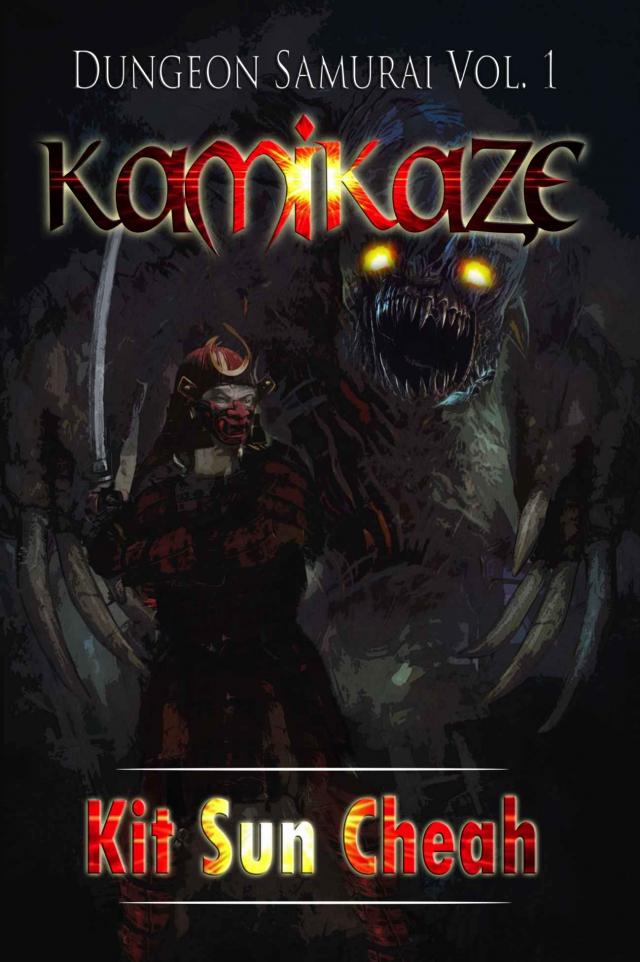
Bobobooks for producing the cover art.
Yukakology for providing the Japanese and Kansai-ben translations.
The PulpRev and Superversive movements for showing the way to a better world of fiction.
The Animal List for the profound discussions about violence, preparing for violence, and what comes after.
Jasmine, for helping me with the Kickstarter campaign and supporting me every step along the way. Once again, this one’s for you.
Last, but not least, you, dear reader, for reading this work. If you’ve enjoyed this story, please leave a review on Amazon so other readers will know why you love it. Thanks for your time, and I hope to see you in Dungeon Samurai Volume 2: Kami no Kishi.
About the Author
Cheah Kit Sun is Singapore’s first Hugo and Dragon Award nominated writer. A blogger and martial artist, he is the Herald of the Pulp Revolution, combining the aesthetics and mindset of the pulp era with modern-day tastes and tradecraft. As Kai Wai Cheah, he created the Covenant Chronicles and Song of Karma series, available through Castalia House and Silver Empire respectively.
Social Media
Website: cheahkitsun.com
Twitter: @thebencheah
Facebook: benjamin.cheah.7
MeWe: bit.ly/2D1L2UK
Steemit: @cheah
Narrative: @Cheah
Kit Sun Cheah, Kamikaze