

Great Short Books, page 1


Thank you for downloading this Simon & Schuster ebook.
Get a FREE ebook when you join our mailing list. Plus, get updates on new releases, deals, recommended reads, and more from Simon & Schuster. Click below to sign up and see terms and conditions.
CLICK HERE TO SIGN UP
Already a subscriber? Provide your email again so we can register this ebook and send you more of what you like to read. You will continue to receive exclusive offers in your inbox.
For my family
Joann
Jenny and Colin
Kit and Archer
In these tales will be found a variety of love adventures, bitter as well as pleasing, and other exciting incidents, which took place in both ancient and modern times.
—Boccaccio, The Decameron
There should therefore be a time in adult life devoted to revisiting the most important books of our youth.
—Italo Calvino, “Why Read the Classics?”
17. Omit needless words.
—William Strunk Jr. and E. B. White, The Elements of Style
INTRODUCTION Notes of a Common Reader
Time. We all wish we had more of it. To do errands. To hit the gym or take a long walk. To bake bread or whip up that recipe we clipped last year. And, maybe, to simply read. The intrusion of the screen—first the big ones in our living rooms, then those sitting on our desks, and finally, the little ones many of us carry around—has made it more challenging to make space for the simple joy of getting lost in a book.
“In our society, where it is hard to find time to do anything properly, even once, the leisure—which is part of the pleasure—of reading is one of our culture-casualties,” writes novelist Jeanette Winterson. “For us, books have turned into fast food, to be consumed in the gaps between one bout of relentless living and the next.”
And then a pandemic made it even more challenging. For many of us, reading anything besides the deluge of news—catastrophically bad, between Covid-19 and the toxic political atmosphere—became increasingly difficult, particularly for those who felt compelled to “doom scroll.”
The pandemic changed the way we all think, feel, and behave. Sleep became harder. Our normal patterns of working and socializing were demolished by “languishing,” a term coined by sociologist Corey Keyes, and what psychologist Adam Grant called “Zoom fatigue.” We all stressed about finances, jobs, our children’s education, and the basic right to pursue happiness. These demands hit hard at our attention spans, which meant less time and motivation for reading, even though many experts advised this was the right prescription for what ailed us.
During the first months of the Covid outbreak in early 2020, and then as a bitterly contested presidential election tested the very soul of American democracy, I rediscovered the balm of reading fiction. Not as an escape from the constant press of dreadful news, but as an antidote. Fiction can provide insight, instruction, and inspiration, even as it takes our minds from the anxiety of the moment.
An expansive universe, fiction includes mystery, historical fiction, science fiction, fantasy, thriller, romance. For those who seek a complete education, reading fiction occupies a central pillar of our “Cultural Literacy.” For many people, that still means commencing with the classics, the so-called Great Books or Western Canon. You know those literary heavyweights we were all supposed to read and even reread: Anna Karenina, Bleak House, Pride and Prejudice, Middlemarch, and Moby-Dick. Not to mention all seven volumes of Proust’s In Search of Lost Time.
Of course, some of those literary sacred cows have been supplanted by a new generation of modern classics, an alternative canon that is more inclusive of overlooked women writers as well as people of color and gay writers.
But let’s get real. Even when we’re not in lockdown mode, many of us simply lack the energy, inclination, or patience to get through some of those illustrious but weighty tomes, in spite of our very best intentions. Whether you were inclined to read the old or new classics, I am reminded of Mark Twain’s definition of “classic”: “A book which people praise and don’t read.”
Then I found a simple solution: short novels.
During an earlier plague, the Italian writer Boccaccio understood this basic truth: short is beautiful. As the Black Death struck Florence in 1348, Boccaccio began writing a series of stories he completed in 1353. Boccaccio’s Decameron is a collection of one hundred brief tales, each called a novella. In this masterpiece, ten characters—seven women and three men—each tell a story every day for ten days as they seek refuge from the plague in a villa near Florence. A combination of parables, adventures, and love stories, some quite bawdy and many skewering the Church and the priesthood, Boccaccio’s work was composed in the vernacular Italian. It remains a foundational text in Western literature.
Early in the pandemic, I began reading one tale a day from the Decameron. And I realized that Boccaccio was on to something. There is a liberating quality about brief tales told in the midst of a pandemic. From Boccaccio, I moved on to short novels.
At first, my reading was dictated by the books on my shelves, as the library and bookstores were also in lockdown and the very valuable and pleasurable act of browsing was out of the question. When my local branch of the New York Public Library reopened, it was one of the most liberating moments in the pandemic. I read as the books I had requested became available for “grab and go.” Praise the library! I soon had a stack of thirty books—the library’s max checkouts allowed. Then my local bookstore, Three Lives & Company, reopened for five customers at a time—another moment of jubilee.
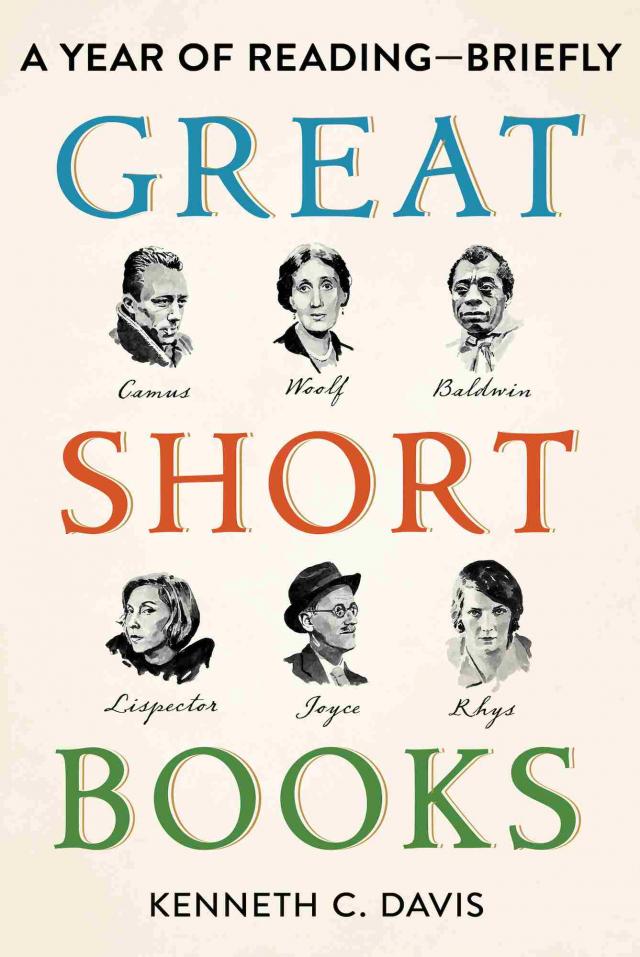
In celebration of this tradition of plague-bound short narratives, welcome to Great Short Books: A Year of Reading—Briefly. Based on my reading experience over a year in lockdown, and considerable research into the world of literature, this survey offers a curated book lover’s guide to some of the greatest short fiction from around the world and published in English.
Why short books?
A short novel is like a great first date. It can be extremely pleasant, even exciting, and memorable. Ideally, you leave wanting more. It can lead to greater possibilities. But there is no long-term commitment.
Short novels can often be read in one to several sittings. With careful rationing, they can be easily enjoyed at the rate of one book per week. And that is why I have chosen fifty-eight books: one for each week in the year plus six bonus books, the literary equivalent of the proverbial “baker’s dozen.” That still means getting through fewer than five books per month. It is highly reasonable to suggest that most readers could easily navigate all of the titles in Great Short Books in a year’s time. Thus, a year of great reading—briefly.
Here you will find fifty-eight entries, each featuring a single work, listed in alphabetical order by title, along with the author and original year of publication.I In addition, I have noted the publisher, publication year, and the page length of the edition I read. Several of my selections are works in the public domain and available from various publishers; others are more recently reissued editions. I also sought out the most current and authoritative English versions of translated works. This basic information is followed by the novel’s opening passages and a brief overview of the plot and action—NO SPOILERS! I once accidentally revealed the fate of Captain Ahab of Moby-Dick to my daughter. I have never lived down the ignominy of this grievous error.
Next comes a life of the author in which I offer a sense of how the author’s times and circumstances are reflected in the work. It is impossible to encounter such writers as Alberto Moravia, Natalia Ginzburg, or Albert Camus among others without recognizing their confrontations with fascism and Nazis.
I would add that researching these biographies has often been a study in profound unhappiness. Mental illness, alcoholism, broken marriages, and struggles with sexual identity plagued many of these writers. Did they write because they were troubled? Or were they troubled because they were writers? Or were they just troubled people who happened to be writers? Questions, perhaps, for another book.
“Why You Should Read It,” brief observations that include critics’ appraisals alongside my own reflections, follows. Finally, “What to Read Next” offers suggestions for exploring some of the author’s other works.
* * *
By now you may be asking: Why doesn’t such a guide to short novels already exist?
For me, the answer is simple. Short novels are literature’s equivalent to stand-up comedian Rodney Dangerfield’s signature line: they “get no respect.”
Certainly, when set against short stories they do not. Esteemed magazines such as the New Yorker continue an honored tradition of publishing short stories, which are often the writer’s stepping-stone to producing longer work. And many novelists have published prizewinning story collections, including Ernest Hemingway, Katherine Anne Porter, and others in this guide. At the other extreme are those long novels and multivolume sagas that attract the attention of critics, reviewers, and many readers.
Short novels, on the other hand, have been shortchanged. They occupy the place of the neglected middle child of the literary world. It is as if length determines merit. Short-listed—no pun intended—for the prestigious Man Booker Prize in 2007, Ian McEwan’s On Chesil Beach provoked controversy because it was deemed too short—sniffed at as a mere novella. So, a degree of critical prejudice—call it literary sizeism—exists against short fiction.
This raises the first question: What is short? Number of pages? Word count? Weight?
A
Brevity is chief among the short novel’s virtues. So, size matters—at least in this book. And while it should go without saying, I will say it: brevity does not mean lack of artistry. Great Short Books pack timeless themes and powerful stories into profound but highly compressed narratives. As novelist Ian McEwan told a literary festival audience in 2012, “the novella is the supreme literary form…. The prose is better, more condensed, more rigorous.”
Short can be masterful. Short can be rewarding. Evidence of that fact is the inclusion of several Pulitzer-winning books and eleven Nobel Prize winners in this collection. The short work of such Nobel laureates as Thomas Mann, Ernest Hemingway, Nadine Gordimer, Doris Lessing, Toni Morrison, and Kazuo Ishiguro offers ample evidence of why these literary virtuosos won their accolades.
So why these books? Definition set, how did I make these selections?
Like many lists, this one reflects my prejudices, preferences, and passions. The most difficult part of creating this guide was culling down an extensive list of short fiction, including the recommendations I sought from friends, librarians, publishing colleagues, and others. There will be considerable debate over my choices—especially the books and writers omitted. I anticipate howls of, “How could you leave out _________! [fill in the blank].”
I set out to reflect a broad diversity of writers and voices. This is not just about “dead white guys,” although they are well represented. My first rule was to include an equal number of male and female novelists, based upon how they themselves chose to identify. Next, I chose a mix of books that might be deemed established classics alongside more recent works. For me, that meant revisiting some familiar works.
“The classics are books that exert a peculiar influence, both when they refuse to be eradicated from the mind and when they conceal themselves in the folds of memory, camouflaging themselves as the collective or individual unconscious,” wrote Italian novelist and essayist Italo Calvino. “There should therefore be a time in adult life devoted to revisiting the most important books of our youth.”
But I also set out very deliberately to encounter writers for the first time. These include several novelists whose work might be less familiar to many American readers. My own attempt to learn Italian is reflected in the choice of several Italian novelists whose work was recommended by my professors.
I hope, Gentle Reader, that you too will venture out of your literary comfort zone, stretching to experience unfamiliar or challenging writers. Many of these selections plumb the most consequential literary themes, from coming of age and coming out, despair, marriage and its discontents, to confronting racism, totalitarianism, and fundamental questions of meaning. Did I mention sex?
I wanted to make certain that this collection included “Must Reads”—books by writers everyone should experience at least once. I also focused, first unintentionally and then more deliberately, on works that reflect the current atmosphere of politics and society. A novel is a measure of the times in which it is written.
The relevance of these books to our time is clear in such works as Animal Farm. After I witnessed the January 6 Capitol insurrection and recently published Strongman, a nonfiction book about the rise of dictators and the threats they pose to democracy, the dangers of authoritarianism were very fresh in my mind. Several selections also explore the act of writing, including The Ghost Writer by Philip Roth, Joyce’s A Portrait of the Artist as a Young Man, and Clarice Lispector’s The Hour of the Star.
This guide also represents a form of lifelong learning: having enrolled in a local community college several years ago to learn Italian, I strongly believe that the process of ongoing education is critical, especially as we age. Reading fiction is just one more way to achieve that. In the end, the lifelong learner may find a richer, deeper sense of fulfillment in life, especially in a moment when it feels in such short supply.
When the pandemic’s intrusion meant a shift to remote learning, I must confess I dropped out. Without classes to attend and missing the personal connections with professors and fellow students, my daily reading became even more important. This book is meant to convey some of what I have gleaned in my year of reading briefly. There are few pleasures greater than sharing the experience of a beloved book.
This guide is not a lecture or dissertation. It is a conversation—a friendly exchange among book lovers. I do not consider myself a literary scholar or a book critic. I view myself as what Virginia Woolf once described as “the Common Reader” who “differs from the critic and scholar.”
“He is worse educated, and nature has not gifted him so generously,” wrote Woolf. “He reads for his own pleasure rather than to impart knowledge or correct the opinions of others. Above all, he is guided by the instinct to create for himself, out of whatever odds and ends he can come by, some kind of whole—a portrait of a man, a sketch of an age, a theory of the art of writing.”
For most of my life, I have been that “Common Reader.” I suspect that a great many people would place themselves in that category. Whatever genre or style they might prefer, they read for their “own pleasure,” as Woolf put it. I take exception to the notion that any reading constitutes a “guilty pleasure.”
While many readers might know me for works of history, my life has largely been about books. Yes, I wrote Don’t Know Much About History, which gave rise to a series of books and audios on geography, the Civil War, the Bible, and mythology, among other subjects. More recently, I have written about people enslaved by presidents, the 1918 influenza pandemic, and the rise of dictators and the fall of democracy.
But as a child, my world was shaped by trips to the majestic, temple-like Mount Vernon Public Library, an Andrew Carnegie jewel, just outside New York City. My mother took me there weekly—until I could get there by myself—and those visits were rituals as significant to me as going to church on Sunday.
I remember the day I graduated from the street-level Children’s Room to the Adult Room. That entailed a climb up a grand staircase into a reverential world of books. These visits were supplemented by the weekly arrival of the Bookmobile: if you couldn’t get to the library, the library came to you in the form of a large, bus-like vehicle. You climbed aboard, and it was lined with books, floor to ceiling. At the rear exit, a librarian awaited with an inky red stamp that filled in the due date.
As a kid I might have loved playing soldier, basketball, and football, but I also loved to read. Along the way, I had influential guides. There were the librarians and teachers who made recommendations and got me started on Dos Passos, Upton Sinclair, and Steinbeck. There was the lady in the church choir who handed me a copy of Dubliners when I was about fourteen. It would take me some time to appreciate James Joyce, and I have often wondered why that woman gave me that book at that moment.
Halfway through college with an uncertain path as an English major, I dropped out of school to start my professional life in the book business by packing and checking out orders at a book wholesaler in Westchester County. From there, I moved to work in a small independent bookstore in Manhattan. But I still had no clue that I could, or would, become a writer. In that shop, I met a woman who read my college writing. She told me I was wasting my time selling books, I should be writing them. And yes, I did marry her. (She hates it when I tell that story, but it is true.)


