

Dragons, Droids & Doom, page 1
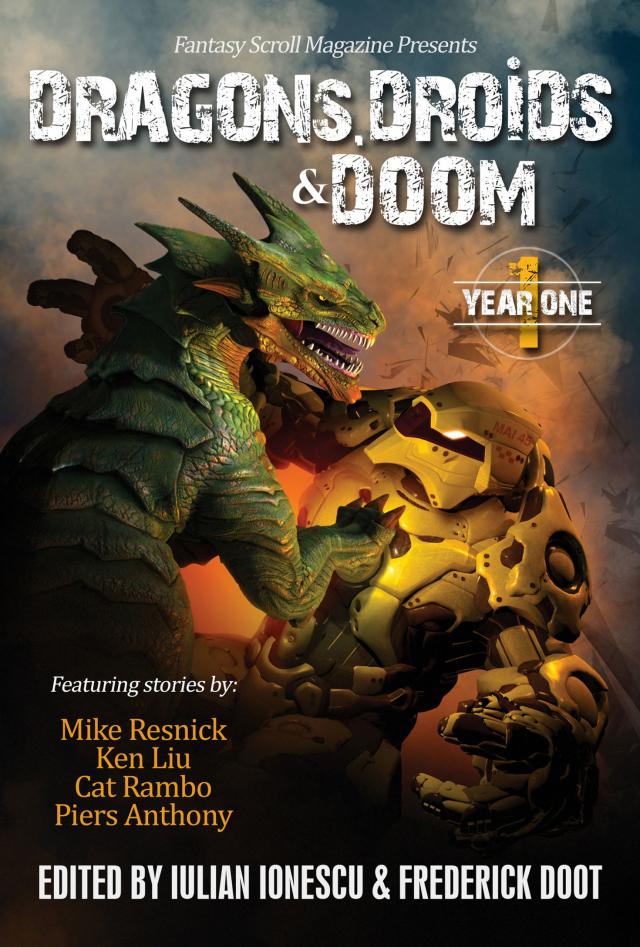


Dragons, Droids & Doom
Fantasy Scroll Magazine - Year One
Speculative Fiction
This is a work of fiction. Names, characters, businesses, places, events, and incidents are either the products of the author’s imagination or used in a fictitious manner. Any resemblance to actual persons, living or dead, or actual events is purely coincidental.
Edited by Iulian Ionescu and Frederick Doot
Cover Art: Mondolithic Studios
Published by Fantasy Scroll Press LLC Publishing at Smashwords
New York, NY
Copyright © 2015 by Fantasy Scroll Press
All Rights Reserved. This book or any portion thereof may not be reproduced or used in any manner whatsoever without the express written permission of the publisher except for the use of brief quotations in a book review.
ISBN:978-0-9916619-9-2 (trade paperback)
ISBN: 978-0-9968891-0-0 (ebook)
ISSN: 2333-4932
www.FantasyScrollMag.com
Dragons, Droids & Doom - Fantasy Scroll Magazine Year One
September, 2015
Contents
INTRODUCTION
Editors' Note
Introduction by Mike Resnick
FICTION
"Da Capo Al Fine" - Patrick Jameson
"A Trade of Tears" - Tony Peak
"The Unforgiving Minute" - Seth Chambers
"Single-Bit Error" - Ken Liu
"The Sculptor's Son" - Jason Gorbel
"Four Scenes From Wieczniak’s Whisk-U-Away, And One Not" - Ferrett Steinmetz
"In the Shadow of Dyrhólaey" - KJ Kabza
"Letters to the Editor of Tempestas Arcana" - Alexander Plummer
"Descant" - Piers Anthony
"My Favorite Photos of Anne" - Aaron Polson
"Missing Tessa" - Anna Yeatts
"Circus in the Bloodwarm Rain" - Cat Rambo
"A Concert of Flowers" - Kate O'Connor
"The Memory-Setter's Apprentice" - Alvaro Zinos-Amaro
"Winter Solstice" - Mike Resnick
"Kindle My Heart" - Rebecca Birch
"The Dragonmaster's Ghost" - Henry Szabranski
"The Peacemaker" - Rachel A. Brune
"Forever" - Rachel Pollack
"Feeling All Right" - Richard Zwicker
"Seaside Sirens, 1848" - Anna Zumbro
"Verdure" - Brandon Barrows
"The First First Fire" - Alexander Monteagudo
"Burn in Me" - Carrie Martin
"Incriminating Evidence" - Charity Tahmaseb
"The Contents of the Box with the Ribbon" - David Neilsen
"Skipping Stones" - Erin Cole
"Sponsored By . . . " - Hank Quense
"Orc Legal" - James Beamon
"Posthumous" - James B. Willard
"Reanimators" - J. Kenneth Sargeant
"The Unworthy" - J.W. Alden
"Your Cities" - Anaea Lay
"The Fine Art of Fortune-Telling" - Michelle Ann King
"Verisimilitude" - Alan Murdock
"Seven Conversations in Locked Rooms" - Alex Shvartsman
"Passenger Space" - Julia Watson
"Hither and Yon" - Anatoly Belilovsky
"Marshmallow Walls" - Brittany Foster
"Your Lair or Mine?" - Cathy Bryant
"Shades of the Past" - Kurt Kirchmeier
"Grimm's Home for Geriatrics" - Rebecca Demarest
"These Are The Things Our Hands Have Made" - Andrew Kozma
"Million Hearts in the Valley of Death" - Savannah Hendricks
"Restart" - William Reid
"The Perfect Book" - Alex Shvartsman
"Universe in a Teacup" - Seth Chambers
"Wind in the Reeds" - David Sklar
"#Dragonspit" - William Meikle
"JC The Ski Bum" - Joyce Reynolds-Ward
"Smew of Skray" - Rebecca Brown
ABOUT
About the Authors
About the Editors
About Fantasy Scroll Magazine
Acknowledgments
Starlight Patrol
Editors' Note
Iulian Ionescu & Frederick Doot
Iulian Ionescu
I am very happy to introduce you to Fantasy Scroll Magazine's first annual anthology—Dragons, Droids & Doom: Year One. When we started this magazine, our goal was to give our authors as much exposure as we can, and releasing an annual compilation in both electronic and print format was one way to go.
As I've read again and again through the material published in 2014, I am amazed by the wide variety of stories we've captured. We've published works from well-known writers such as Mike Resnick, Ken Liu, Piers Anthony, and Cat Rambo to up-and-coming writers to writers who published their very first story in our magazine.
We've covered subjects ranging from wizards and pixies, to monsters and orcs, to future and impossible worlds. This approach explains the title of our anthology: a mixture of fantasy, science-fiction, and horror. I know what you'll say: spreading out across multiple speculative genres will prevent us from attracting a steady readership. I beg to differ.
Since we started the magazine in January of 2014, our readership has grown steadily. Running a short story magazine is tough, I'll give you that. The entire market is highly polarized and new markets come and go almost every month. The fact that, at the time of writing this, we are approaching our tenth issue and the end of our second year is a good sign.
One thing that I've truly enjoyed during the editing process is getting to know a lot of interesting writers and editors. It was a humbling and enlightening experience to learn their life stories and share them with the world through interviews. I can say without a doubt that every single writer and editor I've met has taught me something new and shed a different light on the writing process for me. So, thank you!
Another dimension of this project, which might not be as visible, consists of the many wonderful people who contributed to it. I am talking about the first readers, copyeditors and proofreaders, editors and graphic designers and illustrators. I want to extend my thanks to all of them: without you, none of this would have been possible. You can read all their names in the acknowledgment page.
Next, I'd like to thank our Kickstarter backers. In 2013, I came up with the crazy idea to start a speculative fiction magazine. My wife was pregnant at the time and our life was rather complicated since we already had a three-year-old. But I wanted to take a leap of faith and do this. My wife was very supportive and helped me a lot in the process.
The Kickstarter campaign was a hit and we launched our first issue in March of 2014, and I can't thank you enough for that.
Today, I am really excited to see this anthology come to life and I hope you enjoy it all the way through. Please visit our site at fantasyscrollmag.com and tell us what you think.
Iulian Ionescu
November, 2015
Find us on the web:
Magazine site: http://www.fantasyscrollmag.com
Facebook: https://www.facebook.com/FantasyScroll
Twitter: https://twitter.com/FantasyScroll
Editors' Note
Iulian Ionescu & Frederick Doot
Frederick Doot
They say the sky's the limit. I disagree.
I knew Iulian from our writers' group, The Writers of the Weird, a sub-group of the Science Fiction Association of Bergen County. He and I attended a few meetings together, and I knew he was a damn good writer, and a fine critiquer as well. And impeccable hair . . . but we'll get to that later.
On January 7th, 2014, he posted to our group's email list announcing that he was in the beginning stages of publishing a new online magazine, Fantasy Scroll Magazine, and was looking for volunteers for slush-reading. Having recently taken on editing full time and doing more and more speculative writing, I thought this would be a worthwhile venture for both of us. I could help Iulian and get myself more exposure to improve my skills. It was a win/win. I had no idea what to expect from FSM but if it was anything like Iulian's hair, I knew it would be done right. Upon first glance of the website he designed and even the spreadsheet he created to handle incoming submissions, I realized I had still underestimated his abilities.
In the anthology you hold in your hands, you will find fifty-one short stories collected and published on our website in 2014. Some are by legends such as Piers Anthony and Michael Resnick, others are by established and up-and-coming authors, and others are by talented new writers we plucked from the slush pile (if you hold the book close and inhale, you'll still get a whiff of that new author smell!) We're excited to be showing their fiction to the world through Fantasy Scroll Magazine. And we are proud to be sharing their fantastic (and fantastic!) stories within our pages.
When starting a new venture filled with promise and potential, the common cliché, "the sky's the limit" is often used. I disagree.
With Iulian at the helm of Fantasy Scroll Magazine and our team of volunteers and contributors offering a constant supply of quality and entertaining stories and content submitted every day, the sky is not the limit.
The sky is just the start. And I'm honored to be on board.
Hop on and join us, will ya? Whether you're a reader or writer, I'm confident you'll enjoy the ride.
Frederick Doot
November, 2015
Introduction
Mike Resnick
So why should you bother reading Fantasy Scroll Magazine, which supplied the material for this anthology?
Well, for one thing, it's loaded with fine stories, as this anthology clearly demonstrates. Some are by authors you know, like Piers Anthony, Cat Rambo, and Ken Liu. Some are by up-and-coming authors I know (I edit a rival magazine), like Alex Shvartsman and Alvaro Zimos-Amaro. And some are by authors that you and I will be very glad we met in its pages.
But of course that's not all. When you're competing with long-established magazines, you've got to give your readers a little something extra. So along with a minimum of twelve stories per issue, every issue has not only reviews but at least three interviews.
And have I mentioned the cover art? No? Then let me do so right now, because it's as eye-catching as any publication on the stands not owned by some guy named Hefner.
It takes a lot of talent to put together something like Fantasy Scroll, and a lot of dedication, and (every publisher can vouch for this) more than a little money. And to maintain your quality, issue after issue, which the magazine has done, is a truly remarkable achievement.
Which brings me to Iulian Ionescu, who is the publisher, and the editor, and the workhorse, and the visionary behind Fantasy Scroll. Yeah: visionary. There's always one guy with a vision: for Astounding it was John Campbell, for Galaxy it was Horace Gold, for Asimov's it was Gardner Dozois, and now, for Fantasy Scroll, it's Iulian Ionescu. He's the guy who shapes the magazine, solicits and edits the stories, chooses the cover art, conducts the interviews. Hell, for all I know, he stands on a nearby street corner and hawks the magazine to passers-by.
This has never been an easy field for beginners to get established. It still isn't. Which is yet another reason why we need publications like Fantasy Scroll.
I believe all of the above answers the question I began with, so let me ask you another one:
Why are you reading this introduction when you could move ahead and start reading the best of the stories from Fantasy Scroll's first year?
Da Capo al Fine
Patrick G. Jameson
Jack put resin to bow, an absence in his eyes. The violin's neck was warm beneath his callused fingers. He had placed it upon the radiator to push back the midwinter frost, the musician within him fighting to preserve his instrument even as all else lay in ruins. Jack maintained it as he did his own body, by force of habit rather than any true effort of will, and in the past few days even the regular grind of sustenance and sleep had fallen away in the pursuit of his goal.
The object of his fervor sat before him upon a broken stool; a battered messenger bag that held a surcease to sorrow, an end to pain. From its leather folds he withdrew a stack of vellum pages, bound with twine and covered in neat, fluid notation. Settling them atop the music stand, Jack looked hungrily on the rows of notes marching hypnotically from left to right.
The Song to End the World.
He had stumbled upon them by accident, or fate, or through some divine act of will by an otherwise disinterested creator. The how was unimportant, it was the why that mattered now. Why it had come to him, why he held the pages, and Jack was convinced he knew the answer.
The notation was of an old style, early 1600s at the latest, and difficult to read. Partial notes and scattered damage to the pages would require significant effort and skill to restore. The positioning shifts of the melody alone would have been difficult for a master, but the rapid sequencing in the central section was nearly impossible for all but the most gifted of players. Jack believed that he alone in all this wretched life possessed both the ability and the will to perform this task, and it burned in him to do so.
When he had first found the pages, Jack had thought little of it, aside from briefly considering how much they might be sold for. In some idle searching online he had translated the song's name from the original Italian, Il Canto che Finisce la Terra, and snorted aloud at the composer's arrogance. Later, numb with boredom and dulled by drink, he had touched bow to string in an effort to delay the black depression that settled upon him every evening.
A stanza later he fell to his knees, filled with the certainty that this was all it claimed to be. He awoke the next morning held by a stony purpose such as he had not felt in years, and set to repairing what was lost from the cracking pages. As he pieced together note and rhythm he saw beneath them the bones of a song far older than the renaissance, more ancient than the lyre or lute that were the progenitors of the instrument he now held. What genius had discovered this pattern interwoven with the fabric of creation Jack did not know, the signature smeared by age to a black mark of ink.
It had taken three months of labor, testing and trying and practicing until he was again in the form he had fallen so far from. Three months until he was capable of bringing the full glory of this masterpiece into existence. For this all-consuming mission he had sold what remained of their home, his home, to keep himself alive as the snows of winter fell.
So now he sat within the bare gray walls of a slum husk in the poorest part of town. He had found the former resident departed at the end of a needle, having rigged the radiator to give some spare heat and then shuffled free from the mortal coil by his own hand, drawn away into the darkness by whatever drugged pleasure had been his life's vice. Jack had removed the man, a distant part of his mind feeling pity for the wretch—one more reason to make certain that the source of such misery was finally, and permanently, removed.
To this purpose he took up his bow and read again the small note he had translated below the unknown composer's name.
To bring forth the end, one must start at the beginning.
And so he began to play.
As before, when the first long, slow notes flowed forth from within his violin, the light began to drain from the room. The sun's watery winter rays grew weaker every moment, leaving Jack in a lonely dimness that seemed to have neither distance nor time. He could not read the notes before him, but it did not matter. This passage he knew by heart, as it echoed the yawning hollow he carried within his chest.
With almost immeasurable grace the tempo began to increase, throwing out swirling bright notes to burn like errant embers against the lightless melody. Jack drew breath in deep, preparing for the rise he knew to be coming, tears slipping from beneath closed eyes. As he burst into the swelling harmony he was pulled again to that moment so long ago, when his son first woke to him and smiled. The melody alighted upon days of pure life and light, the softly formed vibrato, a child's quick blue eyes as he laughed aloud at a world still new. Fresh air streamed through the window cracks, bringing with it the impossible scent of dandelion and freshly cut grass.
The memory sunk bitter claws into his soul, tearing old wounds anew, and Jack surged on into the coming fall. As he forced such thoughts from his mind, the music slowed once more, dropped down an octave, and brought to mind a freshly cooling world. The wild heat of youth abandoned for a more stable and dependable base. Unbidden, it called forth in Jack's mind his own adolescence, playing the slow progression of a young man locked away from the sun and forced to try and create beauty. Within that darkness he had found a love for his art, but a violent love that carried with it an edge too sharp to hold, the edge that would drive him long past reason in pursuit of utter perfection.
Still slower dipped the song, all but coming to a halt as the steady rhythm of new-formed seas washed in and out against unnamed shores. The tune held in it a potential to stay in stasis, a steady erosion of sound, pulsing forth for eternity. Yet Jack opened his eyes now to see the page before him and brought forth the first flutter of life. It was nearly unnoticeable at first, a gentle addition to the whole, yet distinctly different and on a time scale entirely removed from the stately dance of continents. As the newcomer grew into longer pulls of the bow, Jack heard the soft murmur of a living heart, and the starting notes of love.
He had seen her first in the subway station, a passing pause in the crowd opening to create a perfect window. Jack had seen her face and been struck by a rare moment, in which every fiber of his being cried out to meet her, to hear her speak his name, and then was crushed as she disappeared between doors sliding closed. A day that had been fine turned sour in that moment, and he left lovelorn for a woman who never saw his face. When she had gotten in the same elevator later that afternoon he very nearly died, and departed with a phone number he had fervently prayed was not fake.


