

Darkhaven, page 1
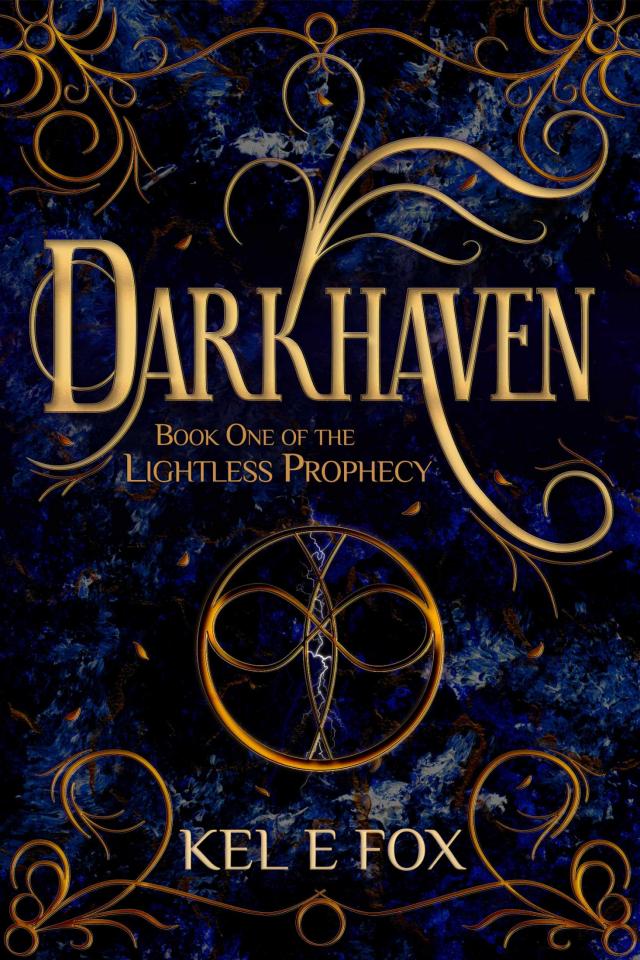


Darkhaven
Book 1 of the Lightless Prophecy
Kel E Fox
Outfoxed Media
Copyright © 2021 by Kel E Fox
All rights reserved.
No part of this publication may be reproduced, stored in a retrieval system, or transmitted, in any form or by any means, without the prior written permission from the publisher or author, except as permitted by the Australian Copyright Act 1968. Quotes may be extracted for review purposes.
This publication is a work of fiction. Names, places and events described in this book are products of the author’s imagination or used fictitiously. Any resemblance to actual persons, living or dead, locales and events (except for satirical purposes) is entirely coincidental.
Outfoxed Media
Perth, Western Australia
Contents
Content Warning
Note about Aussies
Dedication
The Good Night
Prologue
1. A Chocolate Overdose Kind of Problem
2. Oil Over Velvet
3. Impossible Blanks
4. Unkillable Woman
5. Decision Eclipse
6. Petrichor
7. Not-Chocolate Overload
8. God of Lightning
9. Superhuman Jeans
10. A Bad Plan and a Deal
11. Stereos and Sun Orchids
12. Secret Wafer Stash
13. Poker Face
14. Apologies
15. Rally
16. Wattle Blossoms
17. All the Secrets
18. Tim Tams and Lemonade
19. Tie Off
20. Cohort 3
21. Hearts Beat
22. More Like Mutants
23. Option B
24. More Than a Boyfriend
25. Poetry
26. The Shoemaker Clue
27. Breaking All the Rules
28. Take My Memories
29. Making Fakes
30. Diversions and Decisions
31. One Bullet
32. No Excuses
33. Expressionless Eyes
34. A Bittersweet Ache
35. Stupid Cute Puppy
36. Sounds Like Stealing
Epilogue
Everfire
Thank you!
Acknowledgments
Also By
About the Author
Content Warning
If this book was a film, it’d be rated something like M15 in Australia – recommended for mature audiences 15 years or older. PG-13 in America, maybe? All that’s presumptuous about age and relative maturity anyway and doesn’t take personal experience into account, so here it is: there are violence and self-harm themes and occasional coarse language. Nothing too grim or gory, but if you’re concerned, please visit my website kelefox.com for full details. Wishing you safe and enjoyable reading!
Note about Aussies
This book is set in Australia and follows Aussie spelling, punctuation and grammar conventions. We say ‘maths’, mate. (As opposed to ‘math,’ bro. Or y’all. Ya get the idea.) Since our protagonist is leaving-school-age, you may find this a handy reference page.
ATAR: Australian Tertiary Admission Rank. It’s the number you want to get into university. Students have to choose suitable ATAR subjects at fifteen, study relentlessly for two years, sit a bunch of difficult exams, then wait patiently in the sweltering Australian summer for their results. You can get into uni without an ATAR, either by hammering on the front door and yelling loudly, or, when that fails, making a deal with the fae.
TAFE: Australia’s largest vocational training institution. You can learn all sorts of useful things there, under some of the best teachers. And, like anywhere, some of the worst.
TISC: Tertiary Institutions Service Centre. They are best known for producing a booklet and application form for all available university-based study avenues in Western Australia and piling on the stress in the final months of high school by asking decision-averse students to finally make up their minds about what they want to do with, oh, you know, the rest of their lives. No biggie.
For everyone who suspects that magic might be real.
The Good Night
Lovely is the night!
A hiding place
Fit for the most beautiful dreams.
Lit by soft moonlight
And the glow of distant stars,
Harsh, bright giants
Far away so
They do naught
But dance for us
Across the inky blue.
Safe is the night.
A dwelling place
Where rivers flow
Unseen by prying eyes;
Chirps and rustlings go unheard
While tangled lovers lie.
Whispers between friends
Any man wants to know
But the night
Keeps her secrets.
Kind is the night.
A resting place,
Somewhere to let a weary head
Be exactly that.
The day pushes,
Relentless,
Urging us about our tasks,
Berating foot faults.
But wait for the night
And our salvation.
Prologue
Gabby's Journal
November something. Exams, ugh
I don’t know when I stopped believing in magic. But whenever it was, I also stopped making decisions, because what hand was worth keeping if magic wasn’t in it?
Now? Now I don’t know. The teachers say it’s science, and they have the labs stuffed with gear and computers full of data, but still when I ask the question, it’s like Year 10 biology all over again.
Why?
I get how it works. That’s like saying if you stack a bunch of books on top of each other you have a pile of books. It doesn’t matter if you stacked them yourself or found them like that, the process is apparent. But why? Why are the books there in the first place? Why stack them in a pile? (I mean, why wouldn’t you want a tower of books? But that’s not the point.)
Flamebeard talked in circles and still never answered the question.
For all our science, there’s way more that we don’t know. Saving lives and building cars and browsing the internet is great, but I no longer believe that science rules out magic.
Maybe it’s just a matter of definition. Maybe this is the way to find out. If the answer is out there, Darkhaven has got to be a good starting point, right?
I just don’t know if it’s worth the cost.
Chapter 1
A Chocolate Overdose Kind of Problem
I had imagined, age five, that an adult was something you suddenly became, probably around the same time you grew that monumental millimetre that made you taller than your parents. After that, you’d no longer be childlike, and you would know exactly what it was you were going to do with your life.
By twelve, I figured adulthood mostly seemed to revolve around the concept of “bills”. I thought, at the time, that it would be a sad day when an envelope sticking out of the letterbox would be something other than a birthday card or a parcel delivery notice.
Now, I was nearly seventeen. It was pretty clear that I was not going to be as tall as Dad, and my mother had died when I was a baby, so I had no idea if I’d reached adulthood by her vertical measurements. I’d complain while paying my mobile phone bill, feeling less like an adult and more like a disgruntled teenager stuck in a limbo of self-doubt and responsibility. I was starting to doubt that adulthood was even a thing. Perhaps adults were just children who no longer believed in magic.
Water ran through my dyed-black hair, slicking the strands down to my shoulders, swirling around my feet and gurgling down the drain. I grimaced at the epic purple bruise on my thigh from Friday’s Phys Ed class – soccer was not my thing, unless stopping my own team’s goals counted as a talent – and tipped my head back, rinsing away the last vestiges of sleep. Someone banged on the bathroom door.
‘Gabby. You’ll be late.’ My uncle Alex. He and Dad worked in national security, which might be really cool – I wouldn’t know, since it was all top secret. I’d spent my childhood shuttling between them as they each went on their undisclosed missions. I was the only reason they talked to each other. Except for similar career choices, they were a study in opposites. Dad was tall and thin and had been bald for as long as I could remember, which he claimed was by choice because he couldn’t stand his untidy hair. Alex was short and muscular and kept his brown-with-grey locks neatly trimmed. Being short and somewhat stocky, I had more of my uncle’s physique, although I definitely wasn’t muscular, or even very fit. I loved Alex, but he was a pedant about punctuality and obsessed with health food, and I was supposed to get a hearty breakfast in before school.
I couldn’t bring myself to turn off the tap. It was hard enough on any day in winter, or any Monday at all, but it was the beginning of July, and we were getting our TISC handbooks for university applications. It was time to make some decisions. Next year I would be eighteen, and apparently well on my way along the path of the rest of my life. I still had no idea which university or course to apply to. None. Well, not sports science.
The warm water flowed around me, unbothered that I didn’t have an answer for The Question: what was I going to do? Or the even harder variant – what did I want to be? God knew. Except I was starting to doubt that God was a thing either.
‘Gabby!’
I grumbled and got
I dressed quickly, then reached for my makeup case and applied foundation, evening my skin tone with satisfaction. Cecelia, my best friend, said I should be happy in my own skin without cosmetics. I just told her right back that I wore makeup because I liked it. I did. I also liked that I didn’t have to worry about a breakout at that time of the month, or the red blotchy patches on my cheeks when I got angry at someone. I liked having less-visible freckles on my nose and shading my cheeks to look slimmer. And I liked the idea that no one in the world except Dad, Alex and my two best friends had any idea what I looked like without sharp black eyeliner and dark red lipstick. I blotted my lips with a tissue and capped the tube.
‘I’m leaving now!’ Alex called from somewhere near the front door. I tucked a matching lip gloss into my jeans pocket, grabbed my not-quite-school-dress-code jacket, zipped on my favourite heeled, black ankle boots and ran out.
Cecelia’s light blue eyes narrowed as I hurried into first-period English – two minutes after the bell – but she greeted me with a smile. She had her pale blonde hair pulled back in its usual tidy ponytail and a piece of apple skin wedged in her slightly askew front teeth. Obviously she hadn’t skipped a wholesome breakfast in favour of makeup, which she never wore. I’d never seen so much as a single pimple on her. Cecelia Wilson, already taller than both her parents and definitely over the cusp of adult maturity, had been my best friend since pre-primary. On the first day of school, our untidy class of five-year-olds had sat in a circle on the mat for a sing-along, all holding hands – reluctantly, in my case, because on one side was the bossy, tone-deaf teacher aide who kept squeezing my fingers encouraging me to join in, and on the other some snotty boy who’d sneezed on me at recess. Directly opposite me was a long-limbed girl with her flyaway blonde hair in pigtail plaits and her face lit up with exuberant song. She beamed when our gazes met, and I decided then that we would be best friends. Probably the best decision I’d ever made. No doubt about her TISC applications: she intended to become the third Doctor Wilson in the family, like her dad and her older brother, Bryce.
I sank into the chair next to her just as Mrs Johnsen waddled in. I’d read some stupid fashion blog once that said you’re either pear-shaped or apple-shaped, depending on your fat distribution. I had pear hips, for sure. Cecelia was a celery stick. Mrs Johnsen was not tall, but wide and round. She kept her thick hair in a tight bun and wore paisley patterns in varying shades from beige to brown, occasionally venturing into a brownish pink. She had missed the memo about bras being a thing again now that the sixties were over, and her unrestrained bosom swung from side to side with more enthusiasm than her shuffling gait warranted. Dark eyes, framed by heavy glasses, glittered ominously. Mrs Johnsen could almost physically poke you with nothing more than her gaze. I sat up straighter. Slightly.
She cleared her throat. ‘Your mid-year assignments were abysmal. Whatever your plans are for next year, you will need the skills required to write a formal essay. Your next assignment will be an analysis of three poems of your choice, from one of the set texts.’ She squeezed between desks, handing out the papers. Apparently she had tortured anguished souls at university during her postgraduate days, and she never lost an opportunity to tell us how unbelievably hard first-year uni was and how unprepared we all were.
‘There will be a ten per cent per day late penalty. You will reference your answers. I don’t want to read a single opinion unless it’s from the mouth of the poet laureate.’
‘But Miss, I’m not even taking English at uni!’ Todd, a dick from way back, called out. Todd was uber-athletic and the object of most high school crushes. Not mine or Cecelia’s – I’d never actually had a crush on anyone, to Dad’s dismay, and Cecelia wouldn’t look up from her textbooks for long enough to notice a boy or a girl.
Martin, an oily-haired slimeball who’d gained popularity by association, elbowed Todd. ‘Hell, I’m not taking any humanities, let alone this girly subject. Unless there’s a “partying one-oh-one”!’ Another original knobhead.
Mrs Johnsen didn’t reply, except to collect two battered copies of Gwen Harwood’s Selected Poems from her desk and advance down the rows. She placed one in front of each boy and leaned her considerable bulk down towards them. Two wide-eyed faces pulled as far back from the unbridled breast display as they could.
‘Then aren’t you lucky you won’t miss out. You’ – she pointed a finger at Todd – ‘read aloud. “Suburban Sonnet”.’
Martin let a snigger out, a wild sound that threatened to escape and dance around on the tense atmosphere. Mrs Johnsen fixed her glare. She could catch an errant outburst with the bat of an eyelid.
‘And you,’ she said with malicious delight as she turned to Martin, ’will present a speech at the end of the week, enlightening us with your understanding of how a feminist might have felt living in a society of 1950s repression. Make sure you emphasise how girly it was.′
She straightened, looking around the room. Any other stray giggles were quickly leashed. Todd completed his reading in a speedy monotone and the class settled into soft whispers as Mrs Johnsen, barking an order to work on our essay plans, plonked down into her desk chair and stuffed her nose in a hefty book.
I doodled an intricate, pointless pattern of swirls and loops on my notebook and wondered if I would feel better about the world if I had an obvious talent, like sports, singing or drawing. Something resembling a pair of eyes emerged from my scribbles, and I spent the rest of the class attempting to turn it into a cat. I didn’t even like cats. I’d always wanted a dog.
‘Time to go,’ Mrs Johnsen declared from her desk without lifting her eyes from her novel. Cecelia packed up her pens and glanced over at my work, a confused frown crossing her face.
‘What is that?’
I sighed, flipping my notebook shut. Clearly, I had zero talent with a pencil. I shoved my stuff in my bag and followed Cecelia out.
I mused all the way to Human Biology, thinking about how to solve my dilemma and nearly walking into a bunch of Year 8 kids gathered around a tablet in the hallway. My old method for choosing classes – picking a subject at random, changing my mind twenty times before the form was due, then rocking up in deputy principal Mr Cantwell’s office in Week One to change it again – now seemed inappropriate. I took my seat next to Cecelia and realised I’d left my textbook in my locker. Oh well.
‘Did you know,’ began Mr Flancinbaum, a gangly, bearded man who insisted we all call him Sam, ‘that lightning only kills ten per cent of the people it strikes? Ten per cent!’
He beamed around the room, hair sticking up above his ears in enthusiastic tufts. Most of the school called him Flamebeard, thanks to an unfortunate lab experiment involving a Bunsen burner – an incident that had become a cherished and well-embellished story among the students. Flamebeard turned on the projector to show a person with spiderwebs of red tracing over half their body.
‘But you still don’t want to take your chances. A bolt of lightning can be five times hotter than the surface of the sun, and – yes, Michaela?’
Michaela, another aspiring doctor and Cecelia’s main competition for Dux of the school, had raised her hand. Next to the four different coloured highlighters, open textbook and red, blue and black pens laid before her was the course summary. ‘Mr Flancinbaum, is any of this going to be in the exam?’
Flamebeard paused, crestfallen. ‘Well, not specifically, but it is fascinating!’
In almost perfect unison, the class packed away their notebooks and pens. Not deterred, Flamebeard pressed on with his lecture on the effects of lightning strikes while my mind drifted. I couldn’t concentrate on Australian poetry or bio-electrical systems with this career-defining, life-altering decision in my head. I was good at a lot of things, but none of them jumped out. I stared out the window, contemplating what fundamental human purpose I was missing, until the class ended.


