

The Sugar Kremlin, page 1


Praise for Vladimir Sorokin
“[Sorokin’s] disorienting prose forces the mind to react—to focus, to sharpen—and urges us to be on guard against revered forms and the literary conventions of authority.”—Harper’s
“Sorokin is widely regarded as one of Russia’s most inventive writers.”
—The New York Times
“His books are like entering a crazy nightmare, and I mean that as a compliment.”—Gary Shteyngart
“. . . an extraordinary writer—a brash, Swiftian ventriloquist whose best work spars ably with the Russian greats of the last century and a half.”—The Nation
“Sorokin, global literature’s postmodern provocateur, is both a savage satirist and a consummate showman.”
—Dustin Illingworth, The New York Times Book Review
“Sorokin is both an incinerator and archaeologist of the forms that precede him: a literary radical who’s a dutiful student of tradition, and a devout Christian whose works mercilessly mock the Orthodox Church. It’s this constant oscillation between certainty and precarity, stability and chaos, beauty and devastation, homage and pastiche, plenitude and rupture that makes Sorokin’s fiction unique.”
—Aaron Timms, The New Republic
“Translated with equal parts delirium and precision by Max Lawton, The Sugar Kremlin collapses reality and satire, present and past with a heedlessness that only Vladimir Sorokin can muster. A brilliant, hilarious, terrifying triumph.”—Mark Krotov, coeditor, n+1
Other Work by Vladimir Sorokin Available in English
Dispatches from the District Committee
Their Four Hearts
Ice Trilogy
The Blizzard
The Queue
Day of the Oprichnik
Blue Lard
Telluria
Red Pyramid: Selected Stories
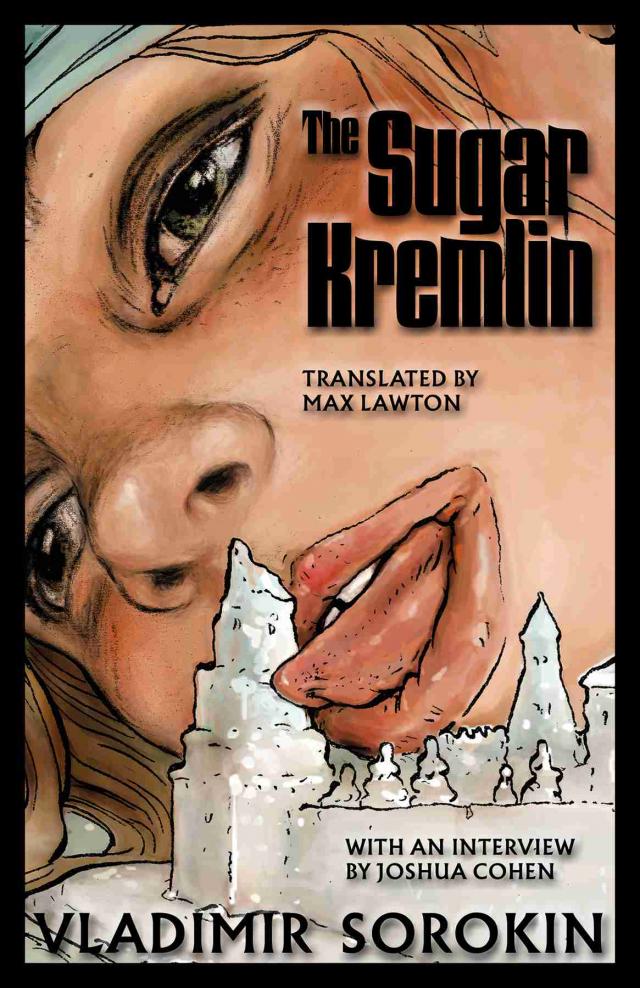
THE SUGAR
KREMLIN
BY
VLADIMIR
SOROKIN
TRANSLATED FROM
THE RUSSIAN BY
MAX LAWTON
FRONTISPIECES BY
YAROSLAV SCHWARZSTEIN
Deep Vellum | Dalkey Archive Press
3000 Commerce Street
Dallas, Texas 75226
www.dalkeyarchive.com
Deep Vellum is a 501c3 nonprofit literary arts organization founded in 2013
with the mission to bring the world into conversation through literature.
Text copyright © 2008 by Vladimir Sorokin
Translation copyright © 2025 by Max Lawton
Originally published in Russian as Сахарный Кремль
by AST, Moscow, Russian Federation, 2008
Introduction © 2025 by Joshua Cohen
Illustrations © 2009 by Yaroslav Schwarzstein
First English edition, 2025
All rights reserved.
Support for this publication has been provided in part by grants from the National Endowment for the Arts, the Texas Commission on the Arts, the City of Dallas Office of Arts and Culture, the Communities Foundation of Texas, and the Addy Foundation.
Library of Congress Cataloging-in-Publication Data
Names: Sorokin, Vladimir, 1955- author. | Lawton, Max, translator. | Schwarzstein, Yaroslav, illustrator. Title: The sugar kremlin / by Vladimir Sorokin ; translated from the Russian by Max Lawton ; frontispieces by Yaroslav Schwarzstein. Other titles: Sakharnyĭ Kremlʹ. English Description: First English edition. | Dallas, TX : Dalkey Archive Press, 2025. | Originally published in Russian as Сахарный Кремль. Identifiers: LCCN 2025009265 (print) | LCCN 2025009266 (ebook) | ISBN 9781628975789 (trade paperback) | ISBN 9781628976168 (ebook) Subjects:
LCGFT: Dystopian fiction. | Novels. Classification: LCC PG3488.O66 S2513 2025 (print) | LCC PG3488.O66 (ebook) | DDC 891.73/5--dc23/eng/20250404 LC record available at https://lccn.loc.gov/2025009265 LC ebook record available at https://lccn.loc.gov/2025009266
Cover art by Yaroslav Schwarzstein
Wrap design by Zoe Guttenplan
Interior design and typeset by Douglas Suttle
Printed in the United States of America
TABLE OF CONTENTS
Introduction
Marfusha’s Joy
Minstrels
The Poker
A Dream
Chow Time
Petrushka
A Tavern
The Queue
A Letter
At the Factory
Cinema
Underground
A House of Tolerance
Khlyupino
Disfavor
Translator’s Note
“Rus’, you are but a kiss in the frost! The midnight roads are going blue.” Velimir Khlebnikov
“But how much despotism lurks in this silence, which attracts and fascinates me so much! how much violence! how deceptive is this peace!” Astolphe de Custine, Russia in 1839
THE GUTS OF THE RUSSIAN BRONTOSAURUS-COW:
A Conversation with Vladimir Sorokin by Joshua Cohen
MY PROBLEMS STARTED MUCH earlier than the night before deadline—they started in my childhood, when I completely failed to learn Russian, and though an inability to function in a writer’s original has never stopped me and shouldn’t stop anyone from pronouncing upon a translation, I admit that in my maturing years I ran into compounding difficulties, including the facts that I’ve never lived and written in a country that proscribes me, that I’ve never had to leave the country of my language and gone to settle abroad, that I’ve never had to live up to or live against a new identity projected onto me in exile as something of an artist-spokesman for political opposition, and—believe it or not—that I’ve never been mistaken for a one-man repository or symbol-embodiment of my literary culture, which happens to be one of the foremost literary cultures in the history of the world. It’s so much easier, I’m realizing now, to introduce a book by a writer who stayed at mediocre home, surrounded by his more-or-less admiring publishers who publish him, and his more-or-less admiring readers who read him; it’s so much easier, in other words, to introduce a book by a writer who is dead, which is admittedly how I feel sometimes, in my shut-into-my-apartment-and-English existence.
Vladimir Sorokin, however, is alive; he is quite alive, and when I asked him how and why (along with a clutch of other questions even more sincere), he obliged me with answers that contained all the intelligence and humor I expected, but also with a startling and I’d even say troubling tenderness and grace. Perhaps I’d missed this in what I’d read of his two-dozen-or-sobooks, or perhaps this is new—a new element that in complete contradistinction to the extraterrestrial Ice that falls to the Siberian earth in his Ice trilogy is loving, positive, constructive (I should also say, speaking in these optimistic terms is novel for me).
The interview that follows transpired via email, and via the author’s prodigious translator Max Lawton in winter 2024-25. I hope its contents convey the high respect I have for Sorokin, who is one of the great prose-writers of his remarkable Russian generation born around the death of Stalin, a generation that includes at least one other estimable Vladimir, the late Vladimir Sharov, and whose best still-living prose-writers and poets now dwell in Berlin, Paris, London, Tbilisi, Yerevan, Zurich, Athens, Rome, Tel Aviv . . .
Joshua Cohen
Reading you over the years at the inevitable delay of translation, I've always thought to myself: this is brilliant, but beware! If I have to distill this thought—this feeling—into questions, I’d ask the following: Is parody dangerous? Does satire of a regime ultimately serve the regime? I guess I should ask a politician instead: can you make fun of something without making it stronger?
Joshua, you’re asking a very important ontological question. I could easily fall into conceptual speculations on this theme so as to justify myself and, I think, would be able to find justificatory arguments regarding my use of satire and humor, referring to Rabelais, Swift, and Hašek, I have done so in many interviews and have also grown a fairly thick skin, off of which such questions quickly bounce. But, in conversing with you, another writer, I don’t wish to do this. When I was writing Day of the Oprichnik, then The Sugar Kremlin, what I was thinking of least of all was the benefit or harm of such texts vis-à-vis the state’s evil or a potential victory over it (and, for me, Russia’s pyramid of power has always been evil). When I start writing any book, I want one thing: for the book to turn out well, which is to say for it to be a self-sufficient work of literature, one unconnected with current issues of people or the state, even if the very subject of the book is the vileness of power.
I asked this because you come from a culture in which writers were once extraordinarily important. What does it mean to be a Russian writer today, though? A Russian in exile—does it feel like exile?—in Germany? (We’ll agree for present purposes that Berlin is Germany.)
I’m going to be frank here: I don’t know what a Russian writer is today. The simplest answer would be someone who writes in Russian. On Nabokov’s grave in Montreux is simply written “écrivain.” I feel very close to this sentiment. In the West, alas, there are still a great many clichés regarding Russian writers: spirituality, the metaphysics of Russian spaces and Russian nature, suffering, deadly love for a femme fatale, the horrors of the Gulag, totalitarianism, etc. I’m not against all of those themes, but I am against the cliché. Circumstances conspired such that I ended up in Berlin. But the last thing I want is to consider myself an emigrant, as Nabokov did. Unlike him, I can re
The Sugar Kremlin, like certain strains of your work, partakes of multiple genres, multiple forms: folktales, theater or film scripts, letters, dreams, and songs—but there’s a sense that this variousness isn’t yet another postmodern reinvention of the novel so much as a waking-up-from-a-long-nightmare declaration that the novel never existed. Do you recognize this reading? What does the novel mean to you?
It seems to me that the best novels are produced when authors creatively disrupt the form of the novel. We need simply recall Gargantua and Pantagruel, Ulysses, or War and Peace. These are referred to as great novels, even though, formally speaking, it’s almost as if they weren’t novels at all. They’re simply novels that are well suited to their time, which is why they turn out to be great novels. The contemporary world is so complex and protean that it is no longer possible to describe it with linear prose and squeeze it into a traditional novel’s structure. In order to conceive of the contemporary world, I make use of complex optics, which can be referred to as faceted vision, like what insects have. Keeping in mind that, today, in post-Soviet Russia, the imperial past, which was not buried in time, presses in on the present like a glacier, the question of the future is suspended. As young Russians admit to me: “we do not feel the future as a vector of life and development.” This is an absolutely pathological situation and a writer needs a special sort of vision in order to adequately recreate this on the page (you’ll notice I say “recreate” and not “describe”). For this, I make use of a system of mirrors set up on two platforms––one is the past and one is the future. You can call this postmodernism or grotesque metarealism, I don’t mind either way. But the grotesqueness of Russian life didn’t begin with post-Soviet Russia, we need only recollect the worlds of Gogol.
Why do you prefer the verb “recreate” to “describe”? What’s the difference? And why, when it comes to the contemporary, does recreation-on-the-page seem to be possible or at least more possible than description? Has something happened to realism or reality?
I don’t like the term “description of the world,” it contains a clear reference to secondariness––to illustrativeness. No, instead, a writer must conceive of his own worlds––not describe the world that’s already been created. Tolstoy, Kafka, and Joyce were able to create their own worlds, which is why their prose stuns with its intellectual authenticity.
And what does style—the music of your sentences—mean to you, especially given that fools like me must read you in translation? What am I missing?
Joshua, I am simply a fool of literature who trusts his intuition alone––it’s all that I have. To put it generally, a book’s intonation is very important to me. That is the locomotive able to pull a novel toward new expanses, new horizons, but also able to knock it down into the abyss of routine. The intonation of a first page is like a melody you catch––a melody that begins a symphony. Which is why there are many books I don’t even finish ten pages of, sensing that they “don’t sound right.” But, alas, I’m also a bad reader . . . In my life, a great deal has been and continues to be devoted to the visual arts.
In what way? I mean, you just scoffed at “illustrativeness.”
Until I was twenty, I thought I was going to be an artist and devoted a great deal of my time to both painting and drawing, which I don’t even remotely regret. In the eighties, I made my living by illustrating books, which allowed me to support my family and write prose in the evenings. You might well say that, ever since, I’ve been standing with only one leg in literature and the other in the art-ocean. This gives me the unique opportunity to look at literature as an art-object. Which is why I really do understand Nabokov, who wished to turn the reader into a viewer, as he once put it. Art helps me to create literary spaces, this way of seeing is always with me, but to explain the principles of such a way of seeing is difficult.
What do you see as the relationship between the chapter here called “The Queue” and my favorite of your early novels, translated as The Queue? Is the line the great unit of our time—and is there anything besides the word itself, or an impatience for meaning, that unites the lines we wait in and the lines we read?
The queue is an eternal theme of the Russian world––but not only of the Russian world. During the pandemic in Berlin, my wife and I stood out in the November cold and rain for four hours to make our way onto the bus where they were administering the Moderna vaccine. All of this was organized with a disgusting lack of humanity. I saw a queue of people trembling in the cold, as if this weren’t the twenty-first century, but the forties of the European twentieth century! Which is why, for me, a queue is an archaic monster that lives inside of us and can easily emerge at any moment, paying no mind to time or century.
So you were vaccinated! Which brings me to questions of paranoia and conspiracy. I feel that novelists, especially in the so-called West, when faced with suspicions or dread, used to ask themselves: “is this true?” Now, in a time when anything, when everything, “can be true,” the new thing to ask is: “can we live with it?” How has fiction changed as the culture has become more and more explicitly self-fictionalizing?
“Is that really true?” is an eternal question in our world, where fakes multiply with each passing minute. But I rely on my intuition, as I did before. My life experience and my inner feeling are all I have when assessing a phenomenon, person, or event. It seems to me that we have nothing else. To take something on faith is a dangerous act in our time.
The politics of this book are quite direct: the Sovereign, who reigns supreme, who builds the wall, is also “a sewer rat,” whose dominion is some amalgam of the Soviet revolutionary era and the near-future New Russia. What connects that historical age to this coming age—or is there no difference, save a few technological breakthroughs and better Chinese food outside of China?
In Russia, all epochs are tied together by one thing: the pyramid of power. It was built by Ivan the Terrible in the sixteenth century and hasn’t fundamentally changed since then. The language spoken by Russians in the sixteenth century changed, but the system of power did not! This pyramid is archaic, opaque, unpredictable, inhumane, and absolutely vicious to the populace around it. At the summit of the pyramid sits a single person who has all of the power for himself––the laws that exist for ordinary citizens do not apply to him. All of the ills of Russia are a function of this pyramid. It was an apposite structure in the eighteenth and even the nineteenth centuries, then, in the twentieth, it gave birth to a beastly totalitarian regime, but, in the twenty-first, it’s a total anachronism, putting the brakes on the development of the country and frightening its neighbors. The consequences of this have now become visible to the whole world. The pyramid of power is a kind of reactor of imperial energy that produces hard radiation. The one sitting on top of it mutates, losing all human qualities and turning into a slave of the imperial idea. Like in The Lord of the Rings.
Is the Russian pyramid primarily a tomb, like its Egyptian predecessor, or some sort of gods-appointed abattoir, like the pyramids of Meso-America? And how does the Russian pyramid—at least your use of it—jibe with Marx’s class pyramid? Or with Freytag’s literary pyramid? Why so many pyramids—and what kind of pyramid is your book’s Kremlin?
The Russian pyramid of power is a mystical object. It was created over the centuries, starting in the sixteenth. In it were united the authoritative principles of the Golden Horde and Byzantium, as well as Russians’ pagan beliefs. In Russia, power took the place of God, this having been especially clear during the Soviet Union when Stalin became a living god and Lenin––a dead one, a mummy who was placed into a pyramid resembling an ancient ziggurat on Red Square. And the Soviet people worshipped this mummy.
Here is my favorite passage of this book:


