

Through (dis)Honest Eyes, page 38


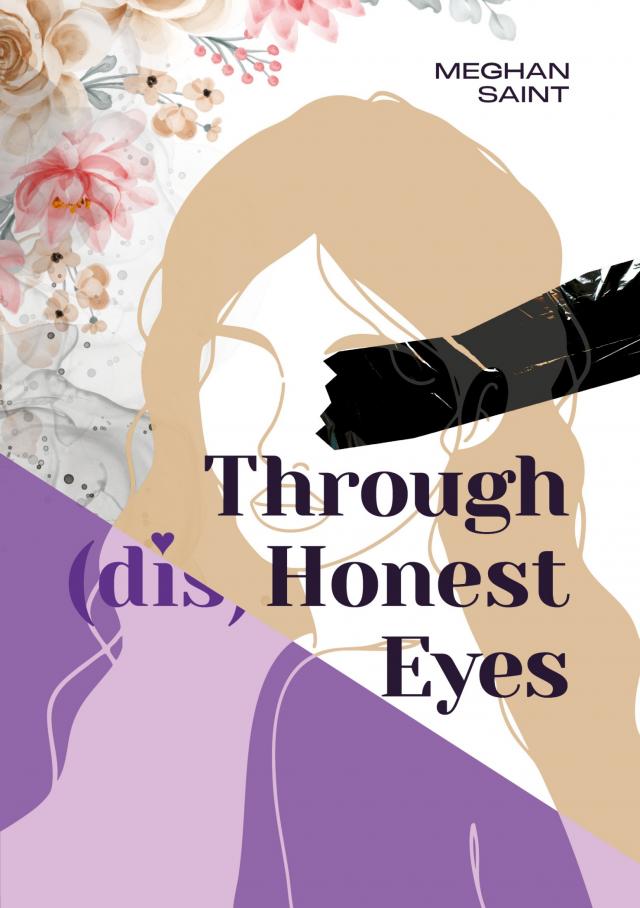
Through
(dis)Honest
Eyes
Meghan Saint
Book 1 of The Truth Hurts Trilogy
All rights reserved. No part of this publication may be reproduced, stored in a retrieval system, or transmitted in any form or by any means—electronic, mechanical, photocopying, recording, or otherwise—without the prior written permission of the author, except for brief quotations used in reviews or scholarly works.
This is a work of fiction. Names, characters, places, and incidents are either products of the author’s imagination or are used fictitiously. Any resemblance to actual persons, living or dead, or actual events is purely coincidental.
While this book draws on emotional themes rooted in lived experience, all characters, events, and conversations have been fictionalized for the purpose of storytelling. The narrative should not be interpreted as a literal or factual account of
real people or events.
Published in Ontario, Canada.
Cover Design & Typesetting by Laine Zvirgzdiņa
© Meghan Saint 2025
www.meghansaint.com
e-Book ISBN: 978-1-0695995-0-6
Print ISBN: 978-1-0695995-1-3
To Bradly and Terry – You keep me tethered
when the world begins to tilt.
* * *
To Cassie – my mirror, my ache, my hope.
We’re still learning. That counts.
TABLE OF CONTENTS
01 The Origins of a Lie
02 Mother Martha
03 The Men in my Life
04 I Deserve Love
05 Catholic Guilt and Other Inherited Delusions
06 Put a Smile On
07 When it Rains
08 Margaritas and Murder-Suicides
09 Merry Christmas
10 The Break Bliss
11 Everybody Talks
12 Consequences
13 Stop Lying
14 Roll back the Stone
15 Let’s Talk About Feelings.
16 Questioning Everything
17 Do it for Love
18 Doing the Work
19 The Birthday Party
20 The Briannas
21 Dog Pile
22 Hard Conversations
23 Breakfast with Therapy
24 The Hospital
25 The Private Room
26 Palliative Care
27 The Paint
28 Self Care
29 Clearing the Air
30 Medicine
31 The Silence
32 Sister(s)
33 The Wait
34 That was Something
35 Understanding Alone
36 Sense of Self
37 To the Rescue
38 Life on the Road
39 The Perfect Weekend
40 Bleach
41 Council of Soot
42 Doctor’s Recommendations
43 The Mediator
44 The Screams
45 Numb
46 Holy Hot, Martha
47 The Performance
48 The Mad Dash
49 Good Day and Goodbye
epilogue Robert
Preface
I began writing this book as part of a series of exercises during therapy for anxiety and postpartum depression in 2023, after my son, Terry, was born. Later, I discovered I had undiagnosed ADHD—a realization that shed light on the persistent feelings of isolation and misunderstanding that had followed me for much of my life.
Through (dis)Honest Eyes is a fictional story about a young woman’s struggle to understand herself and build a future. While many events have been dramatized or fictionalized, they are deeply rooted in the chaos of my own experiences.
Like Brianna, I come from a large, loud family. It wasn’t always happy, safe, or easy. I ask that you experience this story through Brianna’s eyes. At times, she is selfish. Sometimes she’s frustrating. Often, she’s sarcastic and bitter. Her growth isn’t linear—neither was mine. No two journeys are the same, and that’s okay.
This wasn’t always an easy story to tell. But as you turn these pages, I hope you find the humor, stubborn joy, and flickers of hope that made it worth writing—and, in some small way, worth living as well.
This novel contains mature themes and may not be suitable for all readers.
A full list of content warnings is included at the end of the book.
Chapter 1
The Origins of a Lie
*
A lie always has a bit of truth.
The first lie I remember telling was simple. My mother asked me about the orange blossom cookies hidden in the eaves.
In our house, the eaves felt like a secret world—a cramped space behind crooked doors in my parents’ room. The ceiling sloped so low that you had to crawl. Dust-covered boxes lay forgotten beside old toys and family relics, abandoned to cobwebs and silence. Childhood memories lingered there like ghosts, left to decay.
That afternoon, sunlight spilled through the kitchen window, casting a warm, golden glow. Outside, cicadas droned lazily, their hum blending into the quiet of a day that begged for trouble. Smokey, our barn cat, was never allowed inside, but the second I cracked the door, he darted past my legs in a blur of fur.
“Smokey!” I hissed, my heart pounding. My mother would punish me if she caught the cat inside—or worse, if she found me sneaking into the eaves. Serious consequences loomed.
I scrambled to get him out. My gaze landed on the orange blossom cookies, still warm, their sweet scent filling the air, tempting and forbidden. I hesitated. Smokey liked treats, didn’t he? Crumbling one onto the floor, I whispered, “Come here, Smokey,” barely audible.
Crushed cookies scattered like breadcrumbs in a fairy tale, but Smokey darted deeper into the shadows. He left me with nothing but an empty plate.
Later, when my mother discovered it, the air in the kitchen turned sharp and brittle, like glass on the verge of shattering.
“Brianna,” she said, her voice low and tight, freezing me in place. My back stiffened. I felt her gaze burning into me before I dared to turn around. She stood there, arms crossed, lips pressed into the thin, severe line I feared most.
“What happened to the cookies?”
I swallowed hard, the truth twisting into knots in my throat.
“I…I don’t know,” I muttered, barely meeting my mother’s eyes.
Her brow arched slightly. “You don’t know?” she repeated, her voice calm and measured, making it worse. She stepped closer, her shadow looming. “So, they just vanished? Is that what you’re saying?”
My pulse raced. I forced myself to meet my mother’s eyes, then quickly looked away. “Maybe Smokey took them,” I blurted out.
She stared at me momentarily. Her silence left me with only the ache of not knowing what she’d say. Then she spoke. “Smokey doesn’t eat cookies, Brianna.”
Heat rushed to my face, shame prickling my skin, but I couldn’t admit the truth. “I…I don’t know what happened,” I mumbled, clinging to the lie as it unraveled.
The silence stretched, thick and suffocating. My mother’s lips tightened, her disappointment radiating in waves. “Clean up your mess,” she said quietly, her tone colder than any punishment. “And next time, keep the cat outside.”
Her words stung more than I wanted to admit. I turned and walked away, the weight of the lie pressing down on me. I had barely escaped—and I learned two things that day: cats don’t care about cookies, and lies, once told, take on their own lives.
That evening, when the house had quieted and my siblings scattered, I found my mother in the living room. She sat in her chair with a magazine in one hand and a cigarette in the other, the earlier tension lingering between us like a shadow.
“Did you clean up?” she asked, her voice softer but still guarded.
I nodded, standing awkwardly in the doorway. “I’m sorry, Mom,” I whispered.
Her expression softened slightly. “Brianna, I need you to be honest with me. You’re not a little kid anymore. I need to trust you.”
Trust—something I hadn’t earned. I stood there like a child, discovering how easy it was to twist the truth.
“I’ll do better,” I lied, the words slipping out as smoothly as silk.
She studied me for a long moment, then nodded. “Good.” But the silence that followed lingered, a heavy reminder that something between us had cracked.
From that day on, lying came easily, but it took skill to convince others. You have to believe a lie to make it flawless.
I was born Brianna Soot, but that name faded like a photograph left too long in the sun. Lies became my armor, protecting me in a house where love came in small, rationed portions—just enough to keep you hungry for more.
Our house was always loud—chaos, not harmony—the clamor of eight distinct voices competing for attention with six children. Many people imagine large families as the Brady Bunch, but ours was more Lord of the Flies. I learned early that to stand out, I needed more than words. I needed stories—lies that made me shine.
My parents, Martha and Richard Soot were classic Baby Boomers. Friends called
them Maggie and Dickey, and they spent weekends hosting barbecues filled with hot dogs and beer.
Jason, the eldest, was thirteen years older than I—a grown man by the time I understood envy. The youngest, Edward, arrived when I was eight, shifting the household’s balance. He became the golden child, a role I had once held before being cast aside.
My mother used to run her fingers through Edward’s soft blond hair and sigh.
“You used to be just like him, Brianna,” she’d say, her voice laced with a sadness she didn’t try to hide. I pretended not to care, but her words stung. Desperate for attention, I spun more elaborate stories because the truth never earned me anything but silence.
My best lie came from the best source: trauma.
This deception, not my first, but one of the biggest, surfaced when my childhood friend Isaac lost his mother. The neighborhood felt hollow that day as if the birds had stopped singing to mourn. My parents sat me down, their faces shadowed with grief.
“Did you hear about Mrs. Carter?” my father asked gently.
I nodded, but something darker stirred inside me. I wanted my parents’ concern to shift toward me. Before I could stop myself, I said, “I saw her. Isaac and I found her.”
My mother gasped, her hand flying to her mouth. “Oh, sweetheart…” she whispered, her eyes wide with worry. She grabbed my hand and squeezed. “Tell us what happened.”
For a moment, guilt clawed at me, but I silenced it. I painted a vivid scene of fallen leaves, tangled hair, and lifeless eyes beneath a darkening sky. The story grew so detailed that even I began to believe it.
They treated me tenderly for weeks, their attention wrapping around me like a blanket. I soaked it in, intoxicated by their concern.
But lies unravel, details slip, and I failed to keep the story straight. When my mother confronted me, her disappointment hit harder than her anger.
“Why would you lie about something like that?” she asked, her voice trembling.
I shifted, unable to meet her gaze. “Because you never notice me otherwise.”
Her face crumpled. For the first time, I saw the pain I had caused. She didn’t yell or punish me. She stared at me like a stranger, then walked away, leaving me alone in the silence.
Most people would have learned their lesson and turned to honesty. I didn’t. I discovered something else: if you’re going to lie, make it flawless so no one ever doubts you again.
That day, Brianna Soot—the child who believed in magic and hidden places—began to fade. In her place stood Brianna—whoever Martha needed whenever she needed her.
Standing at the edge of something new, I wondered how long my fortress of fabrication would stand before crumbling beneath me.
Chapter 2
Mother Martha
*
Honor thy mother.
Little girls worship their mothers, but teenage girls rage. I saw it early—my sisters, Jean and Louisa, transformed from sweet, adoring daughters into fierce, rebellious forces almost overnight. Their claws came out, clashing with my mother in our narrow foyer, often in the dead of night.
Screams pierced the air, accusations and hurt flooding our cramped home. Bitter fury replaced the warmth my sisters once sought from her. After that, everything changed.
I stayed quiet, slipping into corners during those battles, determined to be different. I swore I wouldn’t become like them.
I decided I would be perfect.
I wielded preeminence like a weapon in a home where love always came with strings. When I couldn’t be perfect, I pretended I was. I learned early on that no one in our family gave affection freely—I had to earn it. My mother offered approval in sharp, fleeting bursts, always unpredictable. My father barely paid attention. He drifted through our lives like a ghost—there in body, absent in every other way, more shadow than man.
Matt, my brother, was my refuge. Four years older and wiser, he shielded me when the house became unbearable. When the shouting grew too intense, he invited me into his room. We’d talk about anything—everything. He saw through the manipulation and control and offered me a glimpse of something better.
“One day, Bree, we’ll get out of here,” he always said. “We’ll live better lives.” I believed him. His words gave me hope.
We had a ritual—hours spent side by side in front of a glowing screen, navigating digital worlds where rules made sense and victory felt within reach. During those games, Matt always asked for stories. “Tell me what happens next,” he’d say when I slipped into one of my daydreams. I spun tales of escape—New York, maybe farther. He listened intently. In those moments, I felt seen.
Then Matt left.
I etched the day into memory as I sat on the couch, watching him pack his things into Dad’s truck. He was heading to a tiny attic apartment near his university—nothing fancy, but it was his. He had even landed a job with Dad’s on-and-off employer, learning to survey land. He carved out his escape, box by box, and didn’t look back.
“It’s only temporary,” he told me the night before, the glow of the video game, Kingdom Hearts, on the dim tube television lighting our faces. “Once I get settled, I’ll give you somewhere to avoid this chaos.”
I wanted to believe him. I told myself this time would be different.
“Tell me what happens next,” he asked one last time.
I spun another story—one of escape and a fresh start. Honestly, I needed to believe it.
I stood in the doorway the next day as he loaded the last box. His absence hit me before he even left.
“I’ll come back for you,” he promised. I nodded, though deep down, I knew better.
He hugged me quickly and promised to call. I watched the truck disappear. He never looked back.
While my sisters fought for my mother’s approval or rebelled against her control, my father stayed in his corner. He read the newspaper or stared blankly at the TV, pretending the chaos didn’t exist. His silence protected him. He could’ve said something to stop the battles, but he didn’t. He let my mother’s words land like stones.
Sometimes, I caught him watching. But he always looked away before our eyes met.
Acknowledging me would’ve meant conceding the mess.
His indifference hurt more than anger ever could.
I realized rebellion wouldn’t work. My father wouldn’t defend me. My mother would turn her cold, disapproving gaze on me. Matt had left. I was alone in the wreckage.
So, I became the quiet one, the obedient daughter, the “please” and “thank you” girl in a house filled with fury. I stayed focused on school, out of trouble, and found sanctuary in friends’ homes where fathers asked about my day and mothers hugged me without expecting anything in return.
But that was my first lie to myself—believing perfection would keep me safe.
Our house, already crowded, was suffocating under the tension. Arguments echoed in the walls long after doors slammed. Every step felt like walking a tightrope. One wrong move could set everything off. I learned to avoid my mother’s glare, my father’s silence, and the absence Matt left behind.
That silence lingered. The damp walls smelled like mildew. Dinner always tasted slightly burnt. The air held the scent of my mother’s perfume and stale cigarette smoke. My father sat having a beer, nodding occasionally at the TV. I wondered, did he see me? Did he notice Matt was gone? Or was it just another absence to ignore?
Even as Martha raged, he stayed mum. He didn’t condone my mother’s cruelty, but her never stopped it either.
My mother’s love came with conditions. I had to do what she wanted—be quiet but friendly; speak slowly but not sound dull. Stop kissing girls. Be palatable to everyone else. Then, maybe, I’d have her love.
Even then, if it existed at all, my father’s love came only in quiet, distant glances.
Jason had no love to give outside of adventures. Jean could only show love through her stories, but her pain would overshadow it. Louisa showed love through service but had no time to give. Edward existed.
Matt, however, had been my only ally, and now he was gone.


