Toad, page 1


Begin Reading
Table of Contents
A Note About the Author
Copyright Page
The author and publisher have provided this e-book to you for your personal use only. You may not make this e-book publicly available in any way. Copyright infringement is against the law. If you believe the copy of this e-book you are reading infringes on the author’s copyright, please notify the publisher at: us.macmillanusa.com/piracy.
FOREWORD
Molly Crabapple
Sally Gunnar is a hermit—by choice. She lives on an ill-gotten pension in a godforsaken town. Occasional visitors aside, her main companions are the goldfish who swim inside an old pickle jug upon her lovingly appointed breakfast table. Who needs humans when you have memories? Ugly, sensuous, and scathing, Sally Gunnar hides within her domestic fortress, content to bake her bread and luxuriate in her regrets, until, one day, her sister-in-law mentions two names that “slit [her] neatly from skull to crotch, and leave two halves gaping bloodily at the fish.”
Sam. Carlotta.
From those two names unspools Toad, Katherine Dunn’s harrowing novel of lust and death set among the hippie burnouts of 1960s Portland, Oregon, where the drugs flow, the pretense flies, the delusion soars, and where, thanks to the counterculture, young women have choices … but all of them are bad. Dunn wrote Toad during the seventies, when she was a single mom slinging drinks at a dive bar so rough that once a patron tried to slit her throat.* It was her third novel, and she wrote it during a deep depression. She never published it. Despair, said her son, Eli Dapolonia, was not her style.*
Her fourth novel was Geek Love. Published in 1989, it smashed the best-seller list, and made Dunn into a bona fide countercultural goddess.
Geek Love is the story of the Binewskis, a family of itinerant carny freaks. Over thirty years after its publication, it is a totem for outcasts—born and made—the world over. It is the novel most likely to be referenced in a tattoo, an illegal mural, a strip club dressing room, or the smokers’ parking lot outside a home for troubled girls. In my own misspent youth, I memorized Geek Love the way British schoolboys memorized The Odyssey. I also wanted to find my fictional forebears. The Binewski parents, Al and Crystal Lil, produced each of their children with love, hallucinogens, and radioactive waste, and taught them to hold themselves haughtily apart from the straight world. I too held myself haughtily apart from the good blond children who liked to throw Coke bottles at my head. For weird kids like me, Geek Love was both a respite and a weapon.
For all the freaks that Al and Crystal Lil created, they had their failures—the six dead babies who floated in jars in a special section of their carnival called The Chute. Until recently, Toad held a similar place. It sat unread and unknown, while Geek Love, Katherine Dunn’s most famous child, splashed its way across the world.
At first, Toad would not seem to have much in common with its flashy older sister. Geek Love is razzle-dazzle. It’s a fan-dance book, a sequined-garter book, a honky-tonk-piano, platinum-blonde-biting-the-head-off-a-chicken type of book, that you could use as an inspiration for a burlesque act, and which, in fact, several women did.* Toad, meanwhile, is based in Katherine Dunn’s life—its pyrotechnic prose all in service of the shit and grit of lived experience.
* * *
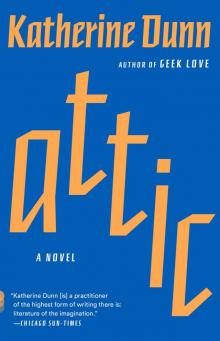
Katherine Dunn was born in 1945, in Garden City, Kansas. Her father ran off when she was two. Working as itinerant fruit pickers, her mother and stepfather took her west, until at last they settled in Tigard, a small town near Portland. In 2021, it seems like most famous American authors are vat-bred in pricey MFA programs, but Dunn had the sort of background so often appropriated by artists looking for cred. She grew up broke. According to an obituary published by Reed Magazine, “Katherine would joke she didn’t have money for booze or drugs as a young person, so she would float in Tigard’s Fanno Creek like Ophelia, hoping to catch a bug that would give her a high.”† Her mother beat her with any object at hand, and once threw a screwdriver at her so hard it punctured her calf. At age seventeen, she left the family home forever. In Missouri, she was arrested for passing a bad check and served a brief sentence in the Jackson County Jail; the jail cell horrors formed the basis of her first novel, Attic.
Like fellow Portland poor girl Sally Gunnar, Katherine Dunn was obsessed with the city’s prestigious Reed College; it is the main backdrop for the first part of Toad. After her time in jail, Dunn returned to Portland, where she made her living hustling pool. Like Sally, Dunn cadged food in the Reed cafeteria and stowed away to sleep in the Reed dormitory stairwells. Dunn got a full scholarship to Reed in 1965. Unlike Dunn, Sally is not a student; she merely waits tables, while failing to write a play. “I would not be young again, not a day younger,” she knows. This writer feels her reproach.
After her dirt-poor youth, Reed College must have been a revelation. Reed’s current tuition runs $60,620 a year, and even back then, it was flush with enough trust fund bohemians to earn it the unofficial motto “Communism. Atheism. Free Love.”* Toad’s Sam Rosen is one of these students. He is an aimless, impressionable, rapaciously curious manic pixie dream boy, and though they never sleep together, he becomes Sally’s great love. Quickly, she falls into his orbit. Dunn mines her experience to create the characters that people Sam and Sally’s world. They are pompous gits, who “flung etymological witticisms at … the staff, the faculty of college, Plato, Wittgenstein, Goethe, and various other defuncts with whom the whole group gave the distinct impression of having shared many a crust and chortle.” They gobble drugs, live in cat-shit-encrusted squalor, cook up foul batches of horsemeat. They idolize their teachers (Dunn may have modeled Sam’s beloved calligraphy instructor on her own Reed professor Lloyd Reynolds). They concoct fantasies of wise, exotic indigenous ways of being, to distance themselves from the prosaic suburbs where the parents who pay their tuitions live … and where their own futures more realistically point.
Fantasy is a hell of a drug, as the Binewskis knew, and the hangover is a motherfucker. At a party at Sam’s flophouse, Sally meets his dream girl, a swoony hippie chick named Carlotta. With her slender waist and thick black braids, Carlotta has all the beauty Sally lacks. She wears suede. She dances barefoot. “She was all high arches and soft pink heels. Her toes were rosy and clean. She bent a knee and swayed, lifted one foot at a right angle to the other, and gently, precisely, set her glowing toes down on a tight little roll of dog shit … She continued to sway her arms, although now she writhed and twisted as she scraped her toes through the grass.”
What does beauty get a girl? Dog shit, and the obligation not to notice.
* * *
Fascination with feminine beauty and ugliness unites Toad and Geek Love. Dunn herself was a lank-haired hottie in her youth, with a mouth made to caress sarcasm like a sweet. Yet in her work, the ugly girls get the best lines. Even more important, they live to say them. Geek Love’s lissome conjoined twins, Elly and Iphy, may be tattooed on the biceps of countless alternative models, but their fate in the novel is to be raped and impregnated at the behest of their sociopathic brother. Their beauty brings their destruction. Oly, their sister, might be a bald, hump-backed, albino dwarf, but she’s also the one telling the story. Sally Gunnar is a toad next to Carlotta’s hippie goddess. She conforms to no womanly ideals—traditional or countercultural. But she fucks and loves and mutilates (figuratively and literally) as often as she is mutilated. Carlotta and Sam crash into the consequences of their delusions. Sally sees so clearly it hurts.
“We can imagine that they—that amorphous systemic ‘they’—won’t know we’re equal until they know we’re dangerous. More important, we won’t know it either,” Dunn wrote in a 1995 Vogue essay on the return of the Bad Girl.* This is one of Dunn’s most dangerous suggestions. Conventional femininity may seem at first like an uncomfortable little dress, into which neither Sally nor Oly can cram their bodies, but in fact it is something worse—poisoned like Medea’s wedding gown, it will consume its wearer in the end.
Katherine Dunn dropped out of Reed College in 1967. She had fallen in love with a New York drifter named Dante Dapolonia, and campus life made her antsy. The two hit the road. After three years in Europe, Dunn returned to Portland, having given birth to a son, Eli, and written two novels. Attic and Truck came and went. Still poor, she ditched Dapolonia; his next notable achievement was a string of bank robberies in the early aughts. Now a single mother, she did what she needed to survive. She squeezed herself and her son into a tiny studio. She painted houses and wrapped candy on factory assembly lines and posed nude for life-drawing classes. She waited tables at a diner and manned the taps at a bar frequented by biker gangs. “She always handled herself well and without fear,” Eli said. “She took knives from men twice her size, stepped in between men bent on shedding blood, and never came home with a scratch. She was confident and fearless, and they respected her.”† During this period she wrote Toad. It is many things, but it is above all a working-class woman’s story, through and through.
* * *
In 1989 Geek Love was a finalist for the National Book Award. For decades, Dunn wrote a celebrated boxing column for Portland’s PDXS, and even trained as a boxer. In 2009, a sixty-four-year-old Dunn fought off a purse snatcher thirty-nine years her junior. “It was a helter-skelter affair,” Dunn told Oregon Live. “Getting a tetanus shot, it made me feel young again.”*
From Ernest Hemingway to Szczepan Twardoch, writers have long been fans of boxing. Boxing destroys the mind-body duality, makes the physical world as present as a fist smashing into a nose. Katherine Dunn never avoided the body—its excretions, its filth and longing. She writes about shit and blood and pus. Her stories rip off scabs. They revel in the beauty of wounds. In Toad, Sally is undone because she refuses to stay in the place allotted to her by her ugliness, and instead allows herself to lust. “It was never the cold hot dogs that drove me, not the sight of the picturesque sands. It was the muscles of your thighs, the warmth of your armpits, the thump of your blood in my ear. It was flesh, not philosophy,” she says, to every object of her desire.
Toad was written at the moment just before Dunn and Sally Gunnar’s paths irreconcilably diverged. After finishing her manuscript, Dunn left Sally in her hermit’s house, like a stillborn in a jar, and then swaggered out to write her masterpiece. Katherine Dunn died in 2016. In this book, Sally gets her resurrection.
I
The goldfish, the pink chaise, the fly
I’ve been out in the kitchen watching the goldfish. They live in an old gallon pickle jug on the red breakfast table. There is a shaded lamp beside them that throws a soft yellow light over their movement. They dance. The light streams on their metallic bodies. I tap the glass sometimes to see them swerve and scutter into the weeds. They are stupid, of course, but still I imagine that they have built an intricate religion to account for me, for the unpredictability of the net that hauls them gasping into a dull saucepan and leaves them flicking nervously till they are poured back into the pickle jug, now miraculously free of slime. There may be an incantation to solicit food, a ritual to greet the lamp in the morning and the sudden darkness when I turn it off on my way to bed. It seems appropriate that I should be a godhead to goldfish. They have nothing to do but conjure reasons, and since the reasons are all outside of the jug what form could they take but religion? I am sure they are monotheistic. This may be my vanity, but the space between their eyes seems too narrow to accommodate more than one image. Inside the jug they are quite free. They turn and rise and sink to suit themselves. But when I feel like cleaning the bowl, out they come.
So I was sitting out there at the table watching the goldfish, waiting for my bread to rise, smoking, rubbing the furrows in my forehead with an index finger, when I remembered my old frying pan theory.
I was eleven probably, and had just been introduced to the idea of atoms and molecules. The illustrations in the elementary text struck me as identical to the schematics of the solar system. “The universe is infinite,” someone had told me. I decided that the earth was a charged particle in the atom of the solar system and that our universe was a large, cast-iron skillet being heated by a giant for the purpose of cooking his supper. This giant’s world was a particle in another universe comprising the skillet of a yet larger universe, and so on. I remember washing dishes, standing with my hands drooping into the steaming water and mulling over my theory. It was exciting. In fact, it made me nervous. I couldn’t sleep. I asked my arithmetic teacher about the idea the next day. She listened and nodded and said it wasn’t possible in a Euclidian geometry. I had no idea what that was. The frying pan theory went underground, became valuable to me, a mystique.
My acquaintance with physics went no further than that quick look at the picture on the page. It was too late, years afterward, when someone in conversation idly revealed to me that there are geometries other than the Euclidean. Still, when I think of it, the Great Skillet theory is accompanied by bland “why nots.” I do not disbelieve it; I only do not believe it anymore. I call it my first religion. I am proud of it, not because I see it as original or ingenious, but because it is evidence of the patterns of my impulses. It was a convenient cult. It had no effect on my daily life. There was nothing to be done about it. It did not call on me to tell the truth when a lie was obviously in order, or to still my hand when I felt like giving my brother a smack. It was simply an idea, a smooth, round thing to be contemplated in idle moments. It was good for fending off other ideas, the headachy ones like time, space, the void, and the belly churners like death. It gave, you might say, a certain perspective.
I entertained less healthy cults after that. I was a great follower of persons. Flex a bicep, and I’d espouse your gospels. Lift an interesting brow and I’d follow you up mountains or sit on wet pavements swilling romance with my diet of river air. But the forms and fables of other people’s minds were never more to me than the color of your hair or the length of your legs. They set a tone and gave a rhythm to your activities. Mine has always been a flesh worship, and now a time has come when I am allowed to admit it, when the purposes of my religion can surface. There are only two sins I recognize—venial discomfort and cardinal pain.
The glow of the goldfish above the kitchen table warms me, and the heat of bread whose flavor reaches my finger ends, and the cleanliness of my towels and toes and floors. Those who’ve known me on street corners or vomiting between profundities in the dark places behind taverns, those who have led me over rocks in blue dawns to sit shivering on picturesque beaches munching cold hot dogs in congealed fat may assume I’ve sold out. But it was never cold hot dogs that drove me, nor the sight of the picturesque sands. It was the muscles of your thighs, the warmth of your armpits, the thump of your blood in my ear. It was flesh, not philosophy.
Now there is no flesh left that supersedes my own, and so the truth comes out. I have bowed in every direction. I have followed whoever would lead me. In my time I have believed everything for the sake of particular veins in the forearms of particular people. But now the only blood that answers when I say, “What do you want?” is my own.
It’s ridiculous to discover at this age that there is something left in me that wants, that needs, that prefers, and that would rather. I call the blood of all those others my loves, and I call this blood of mine my own religion. It is the cult of the warm room and the clean bed, a sect devoted to the smoothing of toenails in the bath and the inspection of the garlic shoots in the window pots.
If there is an ecclesiastical ferocity in the performance of my rituals it can be attributed to the zeal of the convert. I’m not at all evangelical. I don’t want anybody else worshipping the shine of my doorknobs, or the act of shining, or the stiff old gray sock that does the polishing. The goldfish are a more appreciative audience anyway. I have put them in the pickle jug and placed them on the red table so the lamp shines through their water and lights them. I like the look of it. I like sitting there while the bread is baking to fantasize their fantasies.
This precious nest of mine is comparatively new. I didn’t grow into it, I made it. Turned in my tracks one day and decided to go no further. Or was it that the track ended? I’ve forgotten a lot, though I pride myself on remembering. Sometimes someone sitting innocently across from me over cups will smile and say, “Remember…?” Then something slits me neatly from skull to crotch and leaves my two spread halves gaping bloodily at the fish.
My brother’s wife did that to me the other day. When I was a bohemian slob she despised me but now that I’ve got a clean spinsterish image we’re friends. We were drinking weak coffee at the table next to the goldfish, absentmindedly devouring butter ball cookies while we dissected our friends in absentia. She paused with a cookie halfway to her mouth, her dainty pinky crooked—my brother’s wife is a devout pinky crooker—and shook her fluffy head. “Remember Sam and Carlotta? Whatever became of them?”
It’s hard. It’s hard. It was not very nice. I wanted to crawl into the pickle jug and swim sinless with light sliding on my scales. But maybe the fish envy each other and are rude. Maybe they browbeat each other and float long hours with their faces to the glass, contemplating nasty retaliations.
My life is clean now. I wash myself and the house in the mornings. I pick at the garden and am ruthless to slugs and snails. People come to my door expecting warm rooms and a flow of food and the brown sympathy of my eyes. They tell me their life stories and I tell mine. I lie. But only to make the story better. I am polite, you see. Whatever I may think behind my big soft face I will never say anything to hurt their feelings. I gossip behind their backs but since my friends do not know each other it does me no harm. I allow no one to hurt me. I announce the worst of myself so we can proceed without discomfort, so they won’t think they might discover any of my secrets, so they won’t think me a fool. I am very careful. I offer no advice. I have withdrawn from the dangers of intercourse. I do not go to lunch or dinner at other people’s houses. I allow no one to enter after nightfall. But still it’s not safe. Still sometimes I am a fool.