

And He Shall Appear, page 1


UNION SQUARE & CO. and the distinctive Union Square & Co. logo are trademarks of Sterling Publishing Co., Inc.
Union Square & Co., LLC, is a subsidiary of Sterling Publishing Co., Inc.
Text © 2024 Kate van der Borgh
The song lyrics on pages 61, 213, and 215 from “Is My Team Ploughing,” published in 1911 in Six Songs from “A Shropshire Lad” (1911) by George Butterworth, are based on the poem “Is My Team Ploughing” by A. E. Houseman (1896), and, on page 317, from Houseman’s poem “Loveliest of Trees.”
All rights reserved. No part of this publication may be reproduced, stored in a retrieval system, or transmitted in any form or by any means (including electronic, mechanical, photocopying, recording, or otherwise) without prior written permission from the publisher.
All trademarks are the property of their respective owners, are used for editorial purposes only, and the publisher makes no claim of ownership and shall acquire no right, title, or interest in such trademarks by virtue of this publication.
This is a work of fiction. Names, characters, businesses, events, and incidents are the products of the author’s imagination. Any resemblance to actual persons, living or dead, or actual events is purely coincidental.
ISBN 978-1-4549-5261-9 (hardcover)
ISBN 978-1-4549-5262-6 (e-book)
ISBN 978-1-4549-5263-3 (paperback)
Library of Congress Cataloging-in-Publication Data
Names: Borgh, Kate van der, author.
Title: And he shall appear / Kate van der Borgh.
Description: [New York] : Union Square & Co., 2024. | Summary: “A young man has an obsessive friendship with his wealthy, charismatic classmate at Cambridge, who might be concealing terrifyingly powerful gifts”—Provided by publisher.
Identifiers: LCCN 2024012243 (print) | LCCN 2024012244 (ebook) | ISBN 9781454952619 (hardcover) | ISBN 9781454952633 (trade paperback) | ISBN 9781454952626 (epub)
Subjects: BISAC: FICTION / Thrillers / Psychological | FICTION / Fantasy / Contemporary | LCGFT: Thrillers (Fiction) | Campus fiction. | Ghost stories. | Novels.
Classification: LCC PR6102.O74 A84 2024 (print) | LCC PR6102.O74 (ebook)
| DDC 823/.92—dc23/eng/20240325
LC record available at https://lccn.loc.gov/2024012243
LC ebook record available at https://lccn.loc.gov/2024012244
For information about custom editions, special sales, and premium purchases, please contact specialsales@unionsquareandco.com.
unionsquareandco.com
Cover design by Patrick Sullivan
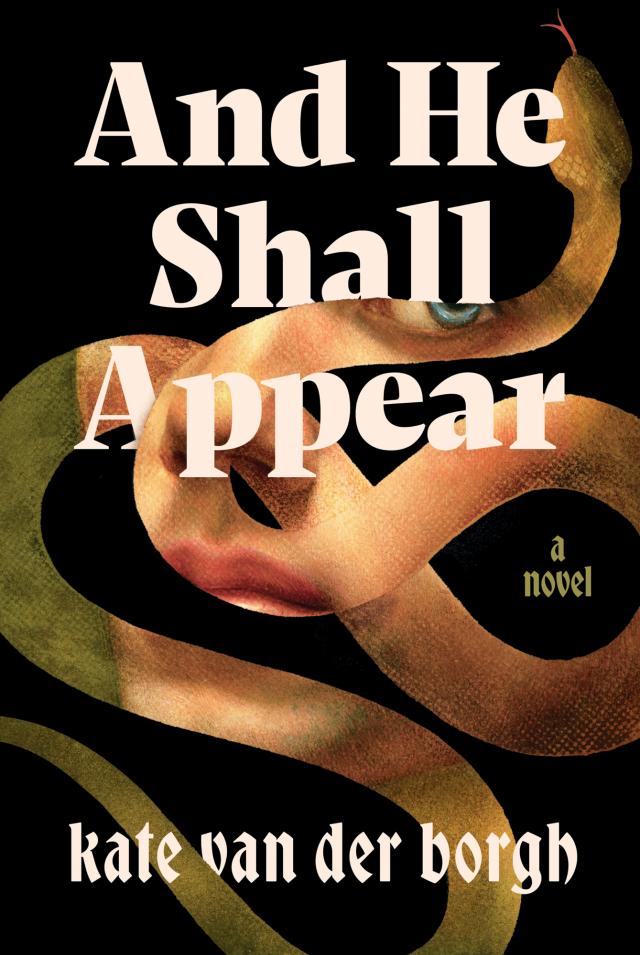
Cover images: Bridgeman Images: © Antonio Ciccone. All Rights Reserved 2023 (man); © Purix Verlag Volker Christen (snake)
Interior design by Rich Hazelton
For Leo: a believer
All good music, whatever its date, is ageless—as alive and significant today as it was when it was written.
—Peter Warlock, British composer
For myself I could but pity him … he was not one of those fortunate who has the gift to possess his love and not be possessed by it.
—Robert Nichols, friend of Peter Warlock
Contents
Cover
Title Page
Copyright
Dedication
One
i
ii
iii
iv
Two
i
ii
iii
iv
v
vi
vii
Three
Acknowledgments
And He Shall Appear Discussion Guide
Nobody is afraid of the past. What we’re afraid of is the past coming loose. We’re afraid that it might free itself from where we left it and, like a lengthening shadow on an empty street, slip silently after us until we feel it brushing at our heel.
I can’t prove what happened between him and me all those years ago, behind those exalting college walls. Nor can I prove what’s happening now. But plenty of truths defy physical evidence. Yes, we can make claims, but could you prove to someone that they were the best friend you ever had? Could you verify your regret at how terribly you let them down? What about your fear, your implacable, immeasurable fear that they will never forgive you for it—never forgive, and never forget?
Before I met him, I’d only had one experience I couldn’t explain. Something that happened when I was a child. It surprised me, because it wasn’t like the stories we told as we sat cross-legged behind the dilapidated science block, hidden from the dinner ladies who circled the asphalt like blue-rinsed sharks. In our Ghost Club tales—about the spirit that crept between the row of sari shops and the big Tesco, about the creature that stalked the wasteland where, long ago, the cotton mills stood—the fear was clear and sharp, like sherbet on the tongue. But what happened to me was hazy, as if it existed at the very edge of understanding, of reality. I remember it like this:
I was sitting up in bed, wrapped in my ThunderCats duvet, peering at the shapes made unfamiliar by the dark. In the corner, my music stand leaned like the mast of a sinking ship, next to my battered clarinet case and a neglected football. On my chest of drawers my action figurines stood, all—I knew without being able to discern their faces—with their gazes turned toward me. The silence felt a long way from morning. Something had woken me, I realized. Not a sound. A feeling, maybe.
There was someone in the house.
I had never been a brave boy, and there’s no denying that I felt deeply frightened then. But I also felt a low, irresistible pull. While I was terrified to discover whatever was moving in the night, I was somehow more afraid of not seeing it. Which is why I rustled softly out of bed and stepped soundlessly out of my room.
When my eyes finally adjusted to the darkness, I looked toward the bedroom at the end of the landing. Through the door, open just a crack, was my mum’s sleeping body, reflected in the mirrored wardrobe, made sickly by the light of her clock radio. There was no spectral figure floating beside her, no maniac raising a flashing blade. No movement but for the rise and fall of her chest with each unconscious breath.
I moved on to the bathroom. The streaks of moonlight on the tiles, the faint smell of bleach—all this made the space feel strangely antiseptic. My tongue became sticky at the thought that I might discover a figure stretched out in the bath, its clawed hands ready to curl around the candy-striped shower curtain. But when I edged forward and peered into the tub, there was only the dripping showerhead dangling like a hanged man, gazing sightlessly into the blackness of the plughole. Bare toes plucking at the cold vinyl, I reversed out of the room and back onto the landing.
Clutching the banister, I descended the stairs (stretching myself over the final step, which, for reasons I couldn’t articulate, I never liked to touch) and made my way into the living room, where the battered recliner hunched in the corner and the rug reached tasseled fingers across the floor. Fearful of what I might see, or perhaps of what might see me, I left the lights off as I padded across the carpet, peeking behind the sofa and beneath the coffee table as I went. The house, unremarkable during the day, was peculiar in the gloom. It crouched and whispered behind my back. When I looked toward the curtains, drawn tightly across the bay window, I had the vertiginous sensation that what was behind them was not normal, and that if I opened them and looked out into the night I might see something other than the usual pebble-dashed terraces, the ordinary, overgrown gardens. Approaching the window sidelong, I took the edge of one curtain between my fingertips. Peeled it delicately from the glass. From the darkness beyond emerged a face, so close I could see the shadows under its eyes, and I would have cried out had my breath not seized in my chest—but the face was only my own, reflected ghastly, and beyond it the street, empty and still.
Nerves thrumming, I carried on, past the dining table piled high with laundry ready for ironing, past the sagging spider plant and its crisping fronds. Finally, into the kitchen, lit only by the faltering street lamp outside. On my left was the sink, where metallic drips landed on sauce-crusted pans, overseen by the stained kettle and crumb-dusted toaster. Opposite these was the cooker, flanked by cupboards of plates and bowls, chipped mugs and old jugs, and empty jam jars. As ever, there was the smell of damp cloths and cooled cooking fat. But beneath this, something else—something organic, like freshly turned soil. There, straight ahead of me, the door leading into the little pantry, with its panel of frosted glass.
And someone behind it.
I froze. Stared. The silhouette was blurred but for small, dark rounds where its fingertips pressed on the glass. Its head swayed from side to side, a serpentine movement that made me shudder. I wondered whether it—whatever it was—could see me in the darkness. Whether it could hear me, or smell me.
The important thing was to avoid alerting it to my presence, to stay perfectly still while I worked out what to do. How did it get there? The door behind which it stood was the only way into the pantry, the only way out. Perhaps, I thought with a shiver, the thing had always been inside and we’d simply never known.
As I stood, it rapped hard at the door.
I skittered backward, terror thrilling through my body, my legs charged with the impulse to run. I wanted to call my mum. But still I felt that grim, reckless need—urgent now—to stay, to see it for myself. Taking a moment to slow my breath, I forced my feet toward the door, my body hunched as if braced for impact. Inhaled, exhaled.
I clasped the door handle, turned. Pulle
Waiting behind the door was my father. But he wasn’t the right age, not the age he was when I last saw him, the age at which he died. He was a boy like me, maybe ten or eleven. Instead of being florid and riddled with spider veins, his cheeks were now fair and dappled with freckles, while his strawberry blonde hair was styled neatly in a short-back-and-sides. He looked like a character from an Enid Blyton book, like he did in the black and white photos I’d once found in a disintegrating carrier bag. Alongside my terror, there came a confusion of feelings: anger for everything that had happened, relief that the person I’d thought was gone was, in fact, not. Here was a chance to speak to him again. But it seemed strange to call another child Dad, and I found myself fumbling over how to say hello. I felt babyish then, standing mute in my too-short pajamas, and I thought perhaps I might cry. He didn’t notice. He looked past me, into the darkness that hung deeper in the house.
Then, somehow, my mum’s hands were on my shoulders, her voice soaring over my head. “Can I help you?” she asked him, her tone blandly tolerant, as if she were speaking to a very old person or a salesman.
They stared at one another. Then my dad opened his mouth, so wide that it looked as if he might dislocate his jaw, as if he were letting my mum inspect his teeth. Then he reached out, would have touched me had Mum not drawn me sharply backward. I realized that she didn’t recognize the person in front of us.
I wriggled, straining to see her face, but she only held me tighter. I called out: Don’t you see who it is? Look at the eyes.
But with a swipe, Mum slammed the door and dragged me out of the kitchen. My feet skidding on the linoleum, I started to scream. There was the shadow, still shifting, restless, behind the door, with nothing to do but keep waiting to be let in.
When I told them, the members of Ghost Club were unimpressed. “So it was a dream?” one said.
“Well,” I said. “Sort of, but—”
“So it’s not true, then. Not a proper ghost story.”
I wondered how to explain that this dream world had contained a jagged tear of reality. “But it really was my dad. Coming back.”
“How’d you know?”
“I know.”
“But how?”
“I just do!”
“What did he want, then?”
I shrugged. I hadn’t understood my dad even when he was alive.
“So your dad,” whispered one slow learner, the know-ledge arriving in her head like a long-delayed train, “is dead?”
That afternoon I noticed children whispering and pointing. Some gave me extra room as they passed, as if I were carrying a population of head lice or a virulent strain of flu. Later, I found I’d been nicknamed—in that on-the-nose way of primary schoolers—Spooky, and I resolved not to talk to the others about my dad again.
Some time later, puzzling over my dream, I asked my mum: If a person was born with no legs, would their ghost have no legs too? Rummaging in the fridge, she said she supposed so. But what if, I went on, someone was born with legs but lost them in an accident? If they came back as a ghost would they have legs or not? I remember staring down at my boiled egg, at my toast soldiers queuing for a dip, trying not to look at the pantry door. My mum handed me a glass of orange squash and told me I was being a very morbid boy.
But I couldn’t stop thinking about it. Why wouldn’t an old man revisit his loved ones as his younger, stronger self? Why did we assume he’d spend eternity with arthritis in his fingers and a bend in his back? And if I died (because at that age I was still convinced that death would happen to everyone but me), would I get to choose my own eternal form? Or would it be chosen by God, by the Devil, or by something else?
I thought of the silly little boy I’d been only a few years ago: the one too scared to cross the road by himself, who couldn’t sleep without his ladybird night-light. I couldn’t stand to be like that forever. Even worse, what if my mum spent eternity as a child too? How, in the afterlife, would she make my favorite sandwiches, crisp-and-ketchup, with the crusts cut off? She wouldn’t be allowed to use a knife.
I also worried that the dream might come back. It hadn’t been scary as such—not a proper nightmare, scrabbling at the walls of a well or shambling down a twilit hospital corridor. But it had sunk beneath my skin, left a memory like a bruise. On the edge of sleep I sometimes jolted myself awake, thinking I’d heard that knock again. Perhaps he’d be a teenager this time, or a baby wailing in a Moses basket. Perhaps he’d be a pensioner with eyes dull as an old fish, his mouth puckered, older than he ever became in real life. And, whoever he was, perhaps my mum would still slam the door shut.
I’d almost forgotten about the dream when it returned, in my final year of university. But, this time, when I stood in that spectral kitchen gripping the door handle, I knew that the person behind the door wasn’t my dad. It was someone else, someone more recently lost to me. Thankfully, in the moments before the door shushed open, I forced myself awake.
As I lay sweating in the aftermath of the dream, I wondered: Which version of him had been waiting for me behind the rippled glass? Would he have appeared as my best friend? Or my worst enemy?
While I’d never known the meaning of the original dream, I understood this new one all too well. It was a warning that he wasn’t gone for good. Maybe one day, terribly awake, I’d catch an uncertain glimpse of him shifting through a crowd at a train station, or I’d pass him at a pedestrian crossing in the driving rain. Perhaps I’d find him waiting in the stairwell outside the flat. Who would he be, then? Would he return to me as the tortured soul or the scene-stealing showman, the conqueror or the conquered?
I didn’t know. But I was sure of two things. He would definitely come back. And when he did, he wouldn’t bother to knock.
ONE
i
The letter landed heavily on the doormat, its creamy envelope conspicuous in a sea of estate agent leaflets. I opened it while waiting for my toast to pop up, and the name on the elegant letterhead gave me a feeling like a cold hand on the back of the neck. Frances Cavendish was announcing the Cavendish Scholarship: a new bursary for disadvantaged students, to help them pursue their musical studies at Cambridge. The moment Frances had decided to set up the scholarship, she’d wanted to involve me. Not just, I imagine, as director of Voices from Before (which she acknowledged as Manchester’s finest ensemble for early twentieth-century vocal works, a phrase that mirrored our website exactly), but as a friend of the Cavendish family.
Frances very much hoped I’d join the judging panel at the auditions later in the year to select the recipients of the inaugural award. After the judging, there’d be a celebratory dinner in college, for the organizers, the judges, and their guests, which would of course be an emotional but rewarding experience. Frances ended the letter saying something about “fond memories.” Not what I’d call them.
My instinct was of course to reply with a firm “thanks, but no.” Life had settled, the years steady as a metronome, and I’d relished it: the parents, assuring me of their children’s genius, the children themselves rolling from one grade to the next at a resolutely average pace. Outside teaching, I clung to the predictable calendar of concerts through which my ensemble performed for undiscerning local crowds. That the vast majority of my university connections were broken was no accident.
And yet. This was a tantalizing professional opportunity, the kind of thing usually reserved for my more successful peers. I often came across former classmates conducting at the Proms or talking on Radio 3, and it had started to feel like I’d only imagined sitting behind them in the lecture hall. Like it was another person who had walked beside them down those hallowed corridors. I smelled burning and swore as I retrieved my blackened breakfast from the toaster. No. Of course I couldn’t go back.
The letter lay on the kitchen counter for a couple of weeks, and my eyes danced over it each time I heaped coffee into the pot. As I drove to rehearsals, Frances’s words rolled around my head like a screw come loose, and when I stood at my music stand, baton in hand, the crotchets and quavers in my score seemed occasionally to collapse into her elegant type. Now and again I set the wrong tempo, forgot to cue a soloist, and the singers shifted gradually from amusement to exasperation. Once, when I turned up late for a pre-concert rehearsal I blamed it on a death in the family, which I almost convinced myself was true. All the while I had a sensation like a toothache, low and dragging.


