

The Cat and the Corpse in the Old Barn, page 1


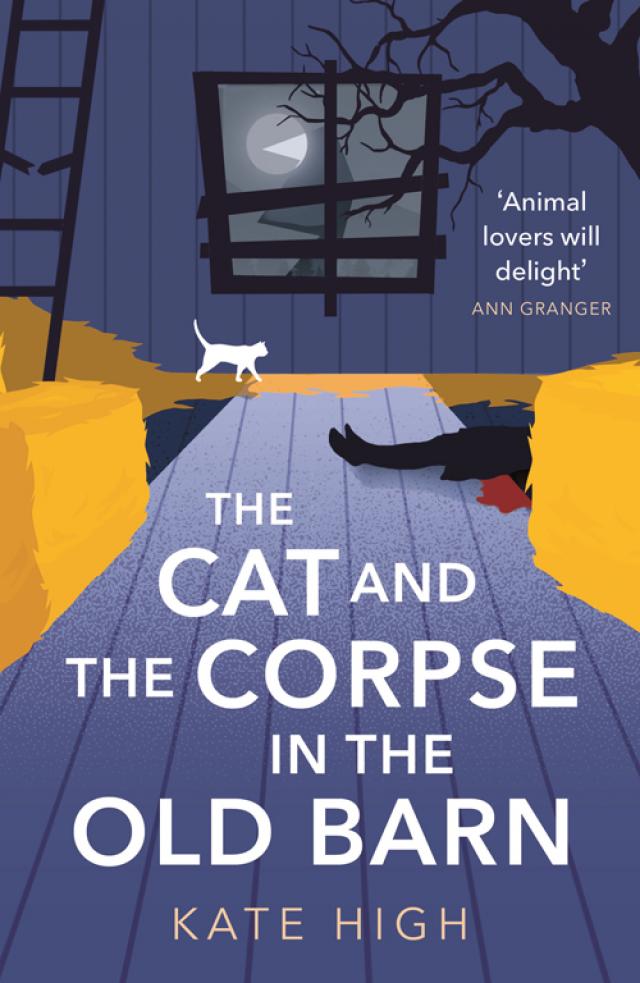
Copyright
Published by Constable
ISBN: 978-1-47213-172-0
All characters and events in this publication, other than those clearly in the public domain, are fictitious and any resemblance to real persons, living or dead, is purely coincidental.
Copyright © Kate High, 2020
The moral right of the author has been asserted.
All rights reserved. No part of this publication may be reproduced, stored in a retrieval system, or transmitted, in any form or by any means, without the prior permission in writing of the publisher.
The publisher is not responsible for websites (or their content) that are not owned by the publisher.
Constable
Little, Brown Book Group
Carmelite House
50 Victoria Embankment
London EC4Y 0DZ
www.littlebrown.co.uk
www.hachette.co.uk
Contents
Copyright
Dedication
Chapter 1
Chapter 2
Chapter 3
Chapter 4
Chapter 5
Chapter 6
Chapter 7
Chapter 8
Chapter 9
Chapter 10
Chapter 11
Chapter 12
Chapter 13
Chapter 14
Chapter 15
Chapter 16
Chapter 17
Chapter 18
Chapter 19
Chapter 20
Chapter 21
Chapter 22
Chapter 23
Chapter 24
Chapter 25
Chapter 26
Chapter 27
Chapter 28
Chapter 29
Chapter 30
Chapter 31
Chapter 32
Chapter 33
Chapter 34
Chapter 35
Acknowledgements
For Ted
Chapter 1
The first dog burst out like fizzy lemonade from a shaken bottle before the door to the cottage was fully open. It was followed closely by a second much larger dog, and then, at a more sedate pace, by Clarice.
The garden was still white at 6.30 a.m., after a night temperature of minus four. The frosty ground cracked underfoot as Clarice walked the two-acre boundary.
The first dog, Jazz, was brown and white, a long-haired bitch unidentifiable as belonging to a single breed. Her legs were short, her ears big, and her tail, going around in circles of excitement, appeared to be far too long for her body. Behind her, Blue, a thickset black Labrador cross, with a splash of white on her chest, tried to keep up, determined not to drop the red rubber bone clamped between her teeth.
Trailing behind them, Clarice, slim and over six feet tall, strode forward purposefully. Her long glove-covered fingers were pushed deep into her jacket pockets, her auburn hair tucked up inside a tan-brown woollen hat that matched in colour her calf-length fur-lined boots. The muffler around her neck and face did not hide the exhale of her breath, showing as a moving cloud of white.
The property, enlarged over the years by various incumbents, dated back to 1855. Much of the garden was now given over to a wildlife meadow, trees and hedging, with a vegetable patch and herb garden nestling close to the cottage. Beyond lay the outbuildings: Clarice’s workshop, which looked like a small bungalow; a barn converted to a garage; another old semi-derelict barn; and a long, low building surrounded by an outside enclosure, a temporary home to feral cats.
A year ago, she had walked the boundaries of the garden with Rick. They’d been seeing each other for three weeks when he came to visit for a weekend and, getting married along the way, stayed for thirteen years. He was her confidante, husband and lover. Conversations started as soon as one walked into a room occupied by the other, the picking-up of an endless, unbroken thread, neither wanting to put space between them. And then a year ago, it had changed. That she, who was known for her awareness and intuition, did not immediately recognise what was happening, and the speed at which it happened, astonished her. They became as an evolving species, one living organism that, having become toxic and in order to survive, had split in two. They had been estranged for six months.
The dogs ran back and forth exuberantly. After doing three circuits of the boundary, Clarice went into her workshop to turn up the heating, before going back out, leaving the dogs inside, to walk to the enclosure.
She stopped, reaching a point halfway, to look at the willow. It stood as a lone presence, stripped by the god of winter, throwing upwards beseechingly its frost-white naked arms. Its beauty deepened her sense of sorrow. Her face contorted for a fraction of a second. She pulled the heavy rainproof jacket tighter to her body, as if, by keeping the warmth in, the sadness might be driven out.
Reaching the enclosure, she unlocked and removed the Yale lock to go through the first gate, a wooden frame with mesh infill, then, less than five feet away, the second. The two-door double-lock system created a barrier so that none of the feral cats within could escape. The low brick building was about thirty feet from the second gate, the enclosure resembling a small wired-in garden. As she opened the door, she was greeted by a hiss.
‘Good morning, Lucy.’
The ginger tortoiseshell cat strolled slowly past her to go outside. The relationship between woman and cat was one of compromise: Clarice fed Lucy and her litter, and Lucy in return had stopped growling and allowed her kittens to be handled. Clarice waited for Lucy to do a U-turn and go back inside, aware that the cat’s protective instincts would not yet allow anyone to remain alone with her brood.
Standing in the centre of the room, she looked around. The bare brick walls accommodated cupboards and cabinets, a sink with a drainer, a kettle next to a jar of instant coffee, and a small fridge. On the tiled floor stood wooden hiding boxes, each with a circular hole cut out on one side for the kittens to enter and feel safe. A radio, an important part of the kittens’ learning process, familiarising them with different noises, was fixed to a wall so it could not be knocked over. She pressed the switch and it came to life with the pips that preceded Radio 4’s 7 a.m. news.
As she sat down on a plastic chair near the table, she was immediately pounced upon. The four kittens were five weeks old, and, having been socialised by handling and play, all but one were confident, doing well in their progress towards adoption.
‘Hello, Lula, you are the pushiest girl,’ she said to the small creature, while running her fingers down its back. Noise from the nearest cat box alerted her to activity as one ginger body rushed out pursued by another – Larry and Lenny, indistinguishable from each other. Although she was aware that new owners would rename them, it was her habit to christen members of each family group by working through the letters of the alphabet. This particular family comprised mother Lucy and her kittens Lula, Larry, Lenny and Liza – also known as Miss Shy Boots.
Clarice spent half an hour talking to and playing with the three youngsters before going to look for the missing kitten. Finding her hiding behind a box, she scooped her up, to return to sit holding and stroking her until her silence was replaced by a purr. Throughout, she had been stalked by Lucy, who, sitting nearby, watched intently. Lucy had been captured by use of a cat trap, and left with Jonathan Royal at the town’s veterinary practice. Clarice liked Jonathan; he had a good sense of humour and enjoyed a gossip, generally putting a witty spin on rumours or tales as he passed them on. A squat man, small but broad, his most notable feature was his abundance of snow-white hair. He had a self-conscious habit of talking to Clarice from behind his hand, as if fearful of being overheard. ‘I know your reputation as a sleuth,’ he would say after telling her what he considered to be a juicy piece of gossip. ‘Get to the bottom of that!’
When he had asked Clarice to take Lucy, he’d described the cat as ‘a tad feisty’. She knew him well enough to interpret his words. Feisty meant she was antisocial and grumpy. The pre-attachment of ‘tad’, while folding his arms and raising his eyebrows for dramatic effect, meant that she scared the shit out of him: she was a full-on feral. Over the weeks, Clarice had made progress with her, but though no longer the hissy, spitting creature taken from Jonathan’s surgery, she would never make a pet. After being neutered, she would begin a new life as a farm and barn cat.
Clarice sat down on the floor in the centre of a circle of kittens. While she absent-mindedly knocked table tennis balls for them to chase, she looked at the boxes, remembering the weekend that Rick had made them. It was the weekend she had realised the relationship was in trouble. There had been an atmosphere of animosity, and rather than staying to help him, she’d withdrawn to her workshop. Later in the evening, they’d argued, the underlying problems of their relationship like a festering wound, raw and visible. They’d picked over the minutiae of their lives: Clarice criticising his unpredictability due to work, the time he spent with his friends and playing sport; Rick expressing annoyance at the prioritisation of her work as a ceramicist and caring for the rescue animals above spending quality time with him – he was, he said, ‘at the very bottom of the food chain’. She’d said things that were exaggerated and mean, and he had reciprocated in kind.
The relationship had limped on for several more months, but they were both guarded and critical of one another. They talked less, both being overly polite in order to avoid conflict, the physical side of the relationship d
iminishing over the weeks, until it ceased altogether. The marriage had died slowly of a thousand tiny pinpricks of complaint and neglect. Rick now rented a small modern house in Castlewick. Having taken it on a six-month lease, she imagined that he must be at the point of renewing it or finding another property. Some kind of decision must be on the horizon.
She considered now with guilt the sudden awareness after his departure of how much he had supported her in caring for the fostered animals. She’d sought more help from volunteers over the last six months, allowing her to relinquish and delegate many of her roles. Why had she ever imagined that she could do it all herself? And, she chastised herself, Rick had been a police officer from the beginning of their relationship; she’d known the hours his work entailed, and she knew about the number of officers whose relationships had failed due to the unsocial hours and heavy workload. So what had changed?
A table tennis ball being knocked around the floor alerted her to the fact that Liza had joined her siblings’ hooligan gang and was running amok about the room.
Returning to her workshop, Clarice let the dogs out and they accompanied her back to the cottage. Her old friends Sandra and Bob would take on the role of kitten-handling in the afternoon. Until then, she was alone.
It was late morning when she received a call from Rex, an acquaintance who lived near the town.
‘Hi, Rex,’ she said, her voice lifting. ‘Are you OK?’
‘I’m fine,’ he said. ‘Some news for you – good, I think.’
Clarice stayed silent, waiting for him to continue.
‘Your cat, the three-legged ginger …’
‘Yes.’ She said the word slowly, suddenly filled with hope.
‘I spotted him late last night; drove past him on my way home.’
‘It’s a shame you didn’t call earlier. He might be gone now.’
‘Sorry, Clarice, meant to; the morning just slipped away.’
She guessed immediately that he had been out drinking until late the previous evening. She imagined he would have taken the back roads home, in the hope of not being stopped and breathalysed. Now, having just woken, he was phoning with the expectation that the information might be rewarded with a pint. Rex never gave anything away for free.
‘Are you sure it was him?’
‘Yeah, full moon, ginger cat, three legs. How long has he been on walkabout?’
‘Three weeks. He belongs to Vita at Winterby Hall.’
‘Lady Vita! You do move in posh circles. He was one of yours, though, wasn’t he?’
‘Yes, she adopted him years ago. Where did you see him?’
‘It was outside the Hanging Barn; you know where that is?’
‘I do. I’ll go there now – and thanks, Rex, I owe you a pint.’
‘Great – sound like good news for both of us.’ He laughed.
Walter had been given a home by Lord Roland Fayrepoynt and his wife. Clarice and Lady Vita shared a common interest in ceramics, and Vita had a number of Clarice’s pieces within her vast collection.
Clarice put the phone down and wrote a note for Sandra and Bob.
In case I’m not back when you arrive, Rex Cook spotted Walter near the Hanging Barn – YIPPEEEE! I’m going over to get him while he’s still there. Cherry cake in the cake box, see you later. Clarice xx
Chapter 2
Having climbed the rickety ladder, Clarice pressed down hard with her hands to test the strength of the beam that stretched between the two platforms. It felt firm, but would be impossible to walk across, either standing or in a crouched position. What remained of the roof was only three feet higher than the beam. Swinging her leg over to straddle it, she began to heave herself along before looking down: a fifteen-foot drop.
The ruined building on the edge of the Lincolnshire Wolds known locally as the Hanging Barn had last been used for that purpose in August 1752, when William Thomas was hanged for stealing a horse. Before that, it had hosted only two other hangings within the same decade: one man convicted of sheep-stealing and another of burglary.
There was an overpowering smell. It was not just the stink of ordinary decay. She had noticed it when she first came in, but up here, it was worse. It made her think of a damaged animal. One that had come to this quiet place to die, and was decomposing somewhere below in the hay.
The barn had three remaining walls. Where the fourth should have been there was an empty space; that and half of the roof had long gone. The place was filthy and decaying. Rotting wooden pallets, once possibly in a neat stack, had imploded downwards in a corner, resembling, thought Clarice, a sculpture, an unsung homage to the inevitability of the passage of time.
Icy rain flew in through the gap in the roof and the space where the wall had once been. Sufficient to make the open area saturated, it did nothing to eradicate the stench. Branches from an overgrown willow trailed downwards, making a clicking noise as they moved with the wind to hit against the structure.
On the climb to reach the beam, a jagged piece of metal protruding from the ladder had torn Clarice’s jeans. A throb of pain alerted her that it had cut into her thigh. Resting for a moment, she stared at the cat, which gazed back, unblinking.
‘Walter, do you really want me to get splinters in my arse?’ Although she was annoyed, the voice she used was soothing.
The scrawny ginger tom regarded her, body posture unchanged, attitude defiant. He had come to Clarice ten years earlier as a stray, damaged after being hit by a car. Where his left back leg had been amputated was now a small stump. He moved well on the remaining three legs, but at sixteen years old and toothless at the front of his mouth, his disappearance three weeks earlier had caused concern about his ability to survive. His unblinking stare, however, suggested that he considered himself to be neither lost nor in need of rescue.
Clarice edged forward along the beam, hand over hand, getting nearer to the cat. Suddenly she heard a groaning sound beneath her. As she squeezed the cheeks of her buttocks, an image came into her mind of two large soft oranges trying to hold a solid piece of wood, and failing. For a moment she was poised in mid-air, before she and the beam went crashing downwards.
*
Later, at the hospital, each doctor asked the same question. Had she been knocked unconscious? If so, for how long? She gave each the same answer: she didn’t know. One moment she had been up there talking to the cat; the next thing she remembered was being flat on her back in the hay below.
The stink on the ground had been vile, overpowering. Even half conscious, she’d found herself gagging with each breath. Someone was prodding her in the chest, and there was a rumble of distant thunder. She lay, eyes closed, trying to remember where she was. Moving her fingers in the hay, she worked out that it was not her bed.
She opened her eyes to find Walter sitting on her chest. A silver thread travelled downwards from the cat’s mouth, and she realised that while he was gleefully purring and paddling, he was also drooling through toothless gums.
Looking past the cat, she followed the direction in which a raised hand was pointing. The hand was grey, with long red fingernails, two of which were broken – snapped but still attached.
Could it be a discarded tailor’s dummy?
Her head throbbed with pain, as did her back and left ankle. She made an effort to focus on her surroundings.
The hand, although a strange grey colour, was realistic.
It had taken several minutes for her to understand. The smell was coming from beneath her. The hand was attached to an arm, which was attached to a body. She was lying on top of a rotting corpse.
Chapter 3
Clarice lay on a trolley in a curtained cubicle. Her ankle, which had been strapped, rested upon a support pillow. She awaited her relocation to a ward, when a space could be found. She felt like an unattractive parcel waiting to be moved on.
Feet scurrying, the babble of voices, telephones, the wheels of trolleys, the crying of a small child all assaulted her senses. Most injurious to her peace of mind was the smell of the hospital, a combination of disinfectant, urine, sweat, handwash and fear, which, for her, always had an association with death.
At the barn, after the fall, when the fog in her brain had cleared sufficiently, she had used her mobile phone. Unable to reach Sandra and Bob, she’d called Georgie Lowe, friend and neighbour. Her second call was to the police. Georgie had gone to Clarice’s home and grabbed a cat basket, plus a pair of jogging pants, a T-shirt and a sweater for her to change into. She had been insistent that she wanted to go with Clarice to the hospital, but Clarice, knowing that her friend had to get back to collect her children from school, was adamant. As she was assisted into the ambulance, she assured Georgie she would be all right on her own. Georgie left reluctantly with Walter, promising to feed him if Sandra and Bob had not yet arrived.


