One Week in Venice with the CEO, page 1


Franco rowed them under the Bridge of Sighs, then through a narrow maze of canals.
As the light began to fade, Roberto switched to playing a mixture of ballads and short classical pieces. Gianni found himself relaxing, enjoying the views and the music and the changing colors in the sky.
When they went round a narrow corner, there was a slight jolt and somehow Gianni ended up with his arm around Serafina, steadying her on the seat.
Their eyes met, and color stole into her face. He could feel his own cheeks heating, too.
He wanted her. Really, really wanted her. Part of him remembered how it had felt to dance with her in St. Mark’s Square and wanted to draw her closer, but part of him panicked, remembering how much he’d hurt after Elena had dumped him.
He withdrew his arm. “Safer than being on a roof, right?” he said drily.
But this wasn’t a physical danger, one he knew how to minimize. It was an emotional danger, and he didn’t know where to start guarding himself against that.
Dear Reader,
I fell in love with Venice on a water taxi, seeing the city rising from the sea. I loved the crumbling palazzos, the turquoise waters of the canal, the bright pop of scarlet geraniums on ancient windowsills and the beautiful stonework of the bridges. So I really couldn’t resist setting a book there.
Add an impoverished contessa who doesn’t believe in love and needs to restore her ancestral home, a builder who’d love to work on it but doesn’t trust himself not to fall for the wrong woman and a family legend that turns out to have some unexpected truths... I hope you enjoy Serafina and Gianni’s story, and have fun dancing under the moonlight in St. Mark’s Square with them—just as I had fun dancing there with my husband and our then-small children!
With love,
Kate Hardy
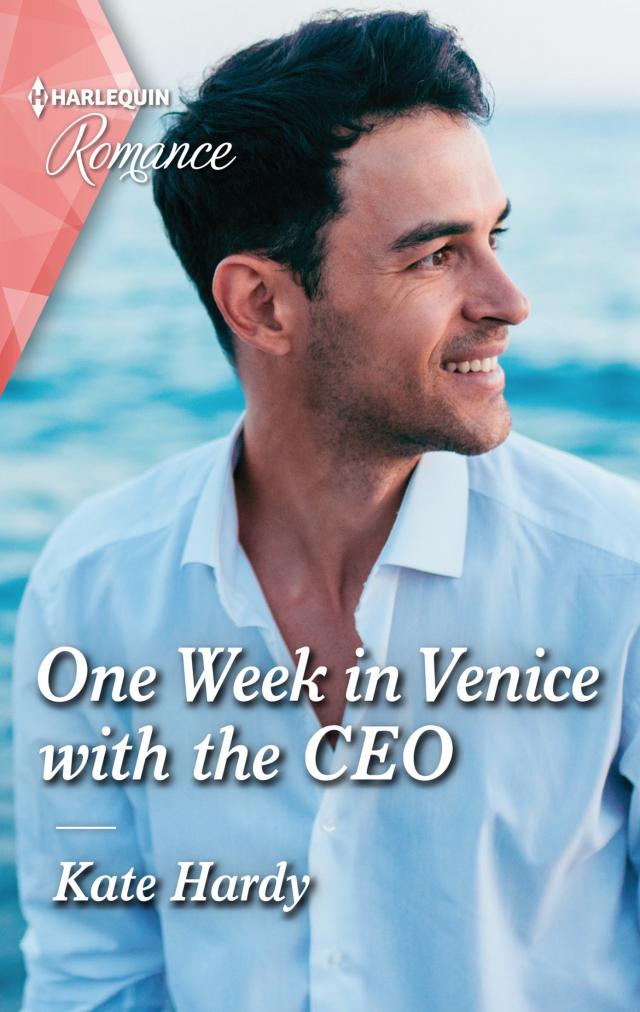
One Week in Venice with the CEO
Kate Hardy
Kate Hardy has been a bookworm since she was a toddler. When she isn’t writing Kate enjoys reading, theater, live music, ballet and the gym. She lives with her husband, student children and their spaniel in Norwich, England. You can contact her via her website: katehardy.com.
Books by Kate Hardy
Harlequin Romance
A Crown by Christmas
Soldier Prince’s Secret Baby Gift
Summer at Villa Rosa
The Runaway Bride and the Billionaire
Christmas Bride for the Boss
Reunited at the Altar
A Diamond in the Snow
Finding Mr. Right in Florence
One Night to Remember
A Will, a Wish, a Wedding
Surprise Heir for the Princess
Snowbound with the Millionaire
For Gerard—one day we’ll go back to Venice...
Praise for
Kate Hardy
“Ms. Hardy has written a very sweet novel about forgiveness and breaking the molds we place ourselves in...a good heartstring novel that will have you embracing happiness in your heart.”
—Harlequin Junkie on Christmas Bride for the Boss
Contents
Chapter One
Chapter Two
Chapter Three
Chapter Four
Chapter Five
Chapter Six
Chapter Seven
Chapter Eight
Chapter Nine
Epilogue
Excerpt from Baby Surprise for the Millionaire by Ruby Basu
CHAPTER ONE
‘IF I COULD have a superpower,’ Serafina said, ‘I’d go back in time and visit every single Conte Ardizzone and persuade them to actually fix the problem instead of shutting off a room whenever there was a problem. And also,’ she added wryly, ‘stop them selling off the family silver when funds got low and then spending the proceeds on partying instead of sorting out the palazzo.’
Alessia winced. ‘It’s that bad?’
‘It’s that bad,’ Serafina confirmed.
‘Perhaps I should be giving you gin instead of coffee,’ Alessia said.
Serafina shook her head. ‘There aren’t any real answers in the bottom of a gin glass, especially at ten o’clock in the morning. But coffee and a sugar rush would be wonderful.’
‘Now that I can do. Sit down.’ Alessia waved to the kitchen table, then busied herself with the expensive bean-to-cup machine Serafina usually teased her best friend about but was seriously grateful for right now.
Since her father’s death, six months ago, Serafina had had to sort out the funeral and the endless admin, and then there had been the shock of finding out that the family trust fund was empty. And she was still having trouble getting her head round the reason why it was empty.
This morning’s meeting at the bank had made it just that little bit worse.
While the coffee was brewing, Alessia took the lid off the jar containing bussolai, the ring-shaped lemon cookies that were a local speciality. ‘Not another word until you’ve eaten three.’
The first cookie helped a bit. As did the second. By the third, Serafina could feel the sugar firing her up. ‘You definitely have the magic touch, Lessi,’ she said with a smile. ‘Thank you.’
‘Nonna’s recipe never fails,’ Alessia said. ‘I’m assuming the bank isn’t going to help?’
‘No income equals no loan. And they’ve made it clear that even a solid business plan with projected income isn’t good enough,’ Serafina said. ‘Bottom line: I still owe a chunk of the inheritance tax, and the only real asset I have right now is the palazzo itself. Which I can’t sell, because it’s entailed.’ And now she was officially Contessa Serafina Ardizzone, the entailment meant that the palazzo was her problem. ‘I can’t rent it out or use it for any kind of business, because right now I’m pretty sure it’d fail every single health and safety directive going; but I can’t afford to fix the problems, either.’ She shook her head in mingled sadness and exasperation. ‘If I’d had any idea about the state of the palazzo and our family finances when I was eighteen, I would’ve read law or economics instead of History of Art and picked a career that could support the palazzo. Or even become apprenticed to a builder who specialised in restoration, so I could all spend my spare time repairing the damage. Ten years of working on the place might’ve made enough of a difference.’ She grimaced. ‘But instead I thought the family money meant I didn’t have to worry and I could study what I loved. Which makes me as bad as all the great-whatever-grandparents partying.’
In her case the partying had been with movie stars in Hollywood rather than with rich nobles in Venice; but it had ended with a broken heart. Hers.
And now the rest of her life had fractured, too.
Strictly speaking, she could walk away and let whoever inherited the palazzo from her deal with the problems, uncaring that the mouldering and neglect would get worse with every year. But that wasn’t who Serafina was. She didn’t dump her problems on other people, and she wasn’t a quitter.
Plus she loved her house.
Which meant she was the one who needed to fix things.
‘You’re being unfair on yourself. You make it sound as if you’ve idled away the last decade, and that’s not true. You’ve worked at the Museum of Women’s Art as a volunteer ever since you did your Master’s, and you’ve spent two years on the board. You have transferable skills,’ Alessia said. ‘You can look at something, see the business opportunity, persuade others to make changes, and write a grant application that actually gets mon—’ She stopped mid-sentence. ‘Can you apply for a grant to restore the palazzo?’
‘Sadly not. You need something special to make a case for getting a restoration grant,’ Serafina said. ‘There are dozens of crumbling fifteenth-century palazzos in Venice, and Ca’ d’Ardizzone doesn’t have amazing architectural features, frescos or anything else to make it stand out from the others.’
‘What about the Canaletto in your drawing room? If you put it up for auction, surely it would go for enough to pay for the repairs?’
‘It would,’ Serafina agreed, ‘if it wasn’t a copy.’
Alessia’s eyes widened in shock. ‘It’s a copy?’
Serafina nodded. ‘Apparently my great-great-great-grandfather sold the original. The same goes for the family jewellery: the originals were sold off over the years, and what we have now are paste copies that are practically worthless. I could try putting the porcelain up for auction, but what it would raise would barely make a dent in the debts.’ She frowned. ‘Maybe my dad was right. Maybe there really is a curse on the family. If my great-however-many-times-aunt Marianna had been allowed to marry the man she loved, three centuries ago, she wouldn’t have tried to elope, fallen down the stairs and broken her neck—and he wouldn’t have cursed the family.’
Alessia shivered. ‘That’s so sad. But of course there isn’t a curse. Curses aren’t real.’
Intellectually, Serafina knew that was true; but deep down she wondered if there was something in the story. Apparently Marianna’s lover had declared, ‘No Conte Ardizzone will have a happy marriage.’ And, from what Serafina could see, that was precisely what had happened over the centuries. In her own lifetime, her grandparents had lived in different wings of the palazzo and refused to see each other. Her mother had turned into a bundle of nerves who only ever saw
And then there was her own near miss: she was relieved she’d discovered Tom in bed with another woman before she’d been foolish enough to marry him. Particularly as she’d learned later that it hadn’t even been the first time he’d cheated on her. It seemed her movie star fiancé had wanted the cachet of marrying a Venetian countess; he’d been a good enough actor for Serafina to believe that he’d loved her for herself, when he’d only wanted her for her social position.
She’d fallen for his charm. Let him sweep her off her feet. Thought she’d be the first one in her family for decades to get her happy-ever-after with the man she loved...
Though she’d never make that mistake again. Not now she knew Tom hadn’t really loved her.
She shook herself. ‘I know you’re right. There’s been a long line of people who lived in the glory of the past and either didn’t notice the present changing round them or refused to see it.’ She took another gulp of coffee. ‘But I wish my dad had said something to me years ago instead of struggling on his own. I wish I’d known we were broke. I wish I’d explored all the shut-off rooms properly and realised that “economising on the heating bills” was a euphemism for ignoring the real problems.’
‘Maybe your dad didn’t want to burden you,’ Alessia suggested.
‘But I’m his only child, Lessi. If he couldn’t lean on me, who else could he have leaned on?’ Not her mother, obviously. Francesca Ardizzone would’ve gone straight into catastrophe mode. But why hadn’t he trusted her? That stung. Badly. ‘If I’d known how bad things were, if I’d had any idea he was gambling with serious money and not just for centimes and a laugh with his friends, I could’ve—well, at least have tried to stop him. And then he wouldn’t have had that last enormous loss and that heart attack.’ And then he’d still be alive...
‘Serafina, your dad’s heart attack wasn’t your fault,’ Alessia said gently. ‘It wasn’t anyone’s fault. Even if your dad hadn’t lost that money, he might still have had a heart attack. You know how it is: stubborn middle-aged men who like their pastries a little too much, don’t do any exercise and won’t listen to any advice. My dad’s the same. And every single one of my uncles. It’s the way that generation is.’
Serafina knew it was true, but it didn’t stop her feeling guilty. Or alone. Or mixed up: angry that her dad had been reckless and left her to clean up his mess, and hurt that he’d kept it all from her. He’d moved investments from the trust fund, hoping to beat the market, and got it wrong: and then he’d borrowed money from the fund to win back his losses. Except he’d lost again. And again. And again. The trust fund was empty, so Serafina and her mum had been living off her savings for the last six months. And the money was running out.
She squared her shoulders. There was no time for moping. She needed to act. ‘I need to make some money to fix the palazzo—or at least to fix enough of it to let me start making money from it, and the profits from that can go to fixing the next bit.’ She raked a hand over her hair. ‘The problems go back decades. They can’t be fixed overnight, but I don’t have to do everything at once. The first stage is to sort out some rooms to offer bed and breakfast, even if it’s only a single suite to begin with. But what makes Ca’ d’Ardizzone stand out from all the other ancient palazzos offering tourist accommodation? What’s my USP?’
‘You, of course,’ Alessia said with a smile. ‘How many other palazzos can offer colazione con la contessa?’
‘Love the alliteration.’ Serafina smiled back. ‘And breakfast with a countess is definitely going to attract one particular segment of the market. But most guests are going to want more than that.’
‘Painting lessons? You could run a retreat for painters, or for people who want to learn to paint. And where better to paint than overlooking the Grand Canal?’
‘The view from my balcony’s perfect,’ Serafina agreed, ‘but I’ve never taught anyone to paint.’
‘But you could. Your watercolours are beautiful.’
‘I paint for fun. For me,’ Serafina said. ‘Looking at it practically, I can’t earn enough from art to pay the bills. And I need to keep something in my life that’s just for me. Something to keep me sane.’ Not that she’d ever admit it, even to her best friend, but something to fill up the empty spaces.
‘OK. You’ve spent years working in an art museum and you know Venice like the back of your hand,’ Alessia said. ‘Maybe instead of art weekends, you can offer history of art weekends. Take your guests on a tour, and teach them about Venice and art.’
‘That could work,’ Serafina agreed. ‘But first I need to get enough of the building up to standard, so people can actually stay at the palazzo. At the very least they’ll want an en-suite bathroom, and renovations like that will cost money I don’t have. The fact I need to take in paying guests at all makes it very clear I don’t have any money. Nobody will agree to do the work on credit.’ She sighed and took another biscuit. ‘I almost wish I’d married Tom after all.’
‘What?’ Alessia looked shocked. ‘But he cheated on you, Serafina. You would’ve been miserable with him.’
With a man who loved her title rather than her. ‘I know. But Celebrity Life offered us a small fortune to run an exclusive on our wedding photos. I could’ve used money that to finance the ren—’ Serafina stopped and snapped her fingers. ‘That’s it. You’re right. I’m the USP.’ She stood up and paced round Alessia’s tiny kitchen. ‘I know Tom was the movie star, but a Venetian countess would draw in the magazine’s readers, too. The whole romance of Venice and an ancient palazzo—which, if we window-dress it and shoot in soft light, will look chic instead of shabby—and a society bride. If I marry someone who wants a society bride and we do an exclusive deal with the magazine over the wedding photos, I can use that money to restore the palazzo.’
Alessia shook her head. ‘That’s crazy, Serafina. It means marrying someone you don’t love.’
No Conte Ardizzone will have a happy marriage.
Serafina shook herself. It was a myth, she reminded herself. Even if there was an awful lot of evidence in the unhappy marriages of her forebears to suggest it might be true. ‘It won’t be a permanent marriage. It’ll be a marriage of convenience to suit us both, with a quiet divorce a year later. We both get what we want, nobody’s hurt, and everybody’s happy.’ They didn’t even have to live together: just make enough of a nuptial show to get the money for the photographs.
‘Money—even if you’re going to use that money to restore the palazzo rather than finance a lifestyle of partying—is completely the wrong reason to get married,’ Alessia said. ‘How about setting up a crowdfunding thing where people “buy a brick” or something and get a certificate for it saying that they’ve helped in the restoration of a Venetian palazzo? Bigger donors get something extra—once you’ve sorted out the accommodation, they can come and stay for a weekend of luxury.’
‘That sort of thing works for public buildings,’ Serafina said, ‘but not for private homes. If I sell one brick at a time, it could take years to raise the money. In the meantime, the palazzo will decay that little bit more every day, and the renovation costs will grow—and probably at a faster rate than the donations come in.’
‘Or maybe you could find a building company that would agree to staged payments in arrears, plus a discount, in return for publicity,’ Alessia said. ‘I did that feature for the Sunday supplement of La Cronaca last summer—the guy in Rome who took over his dad’s construction company a couple of years back. He was looking at moving away from new builds and increasing their restoration work.’ She looked thoughtful. ‘Gianni Leto. I liked him. He was a bit intense, but he struck me as the reliable sort. Maybe you could talk to him. Working on a project like your palazzo would be good publicity for him. That puts you in a good bargaining position, because we can place features on the palazzo and its restoration. We can definitely get something in the lifestyle and travel magazines. If we’re clever, we might be able to get a documentary out of it, too.’