

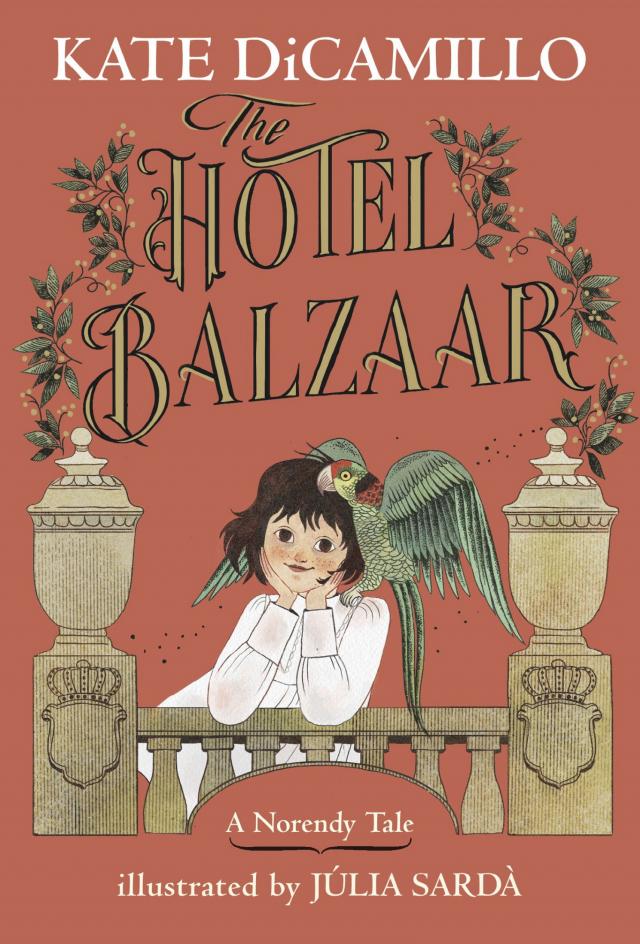
The Hotel Balzaar, page 1


CONTENTS
Chapter One
Chapter Two
Chapter Three
Chapter Four
Chapter Five
Chapter Six
Chapter Seven
Chapter Eight
Chapter Nine
Chapter Ten
Chapter Eleven
Chapter Twelve
Chapter Thirteen
Chapter Fourteen
Chapter Fifteen
Chapter Sixteen
Chapter Seventeen
Chapter Eighteen
Chapter Nineteen
Chapter Twenty
Chapter Twenty-One
Coda
IN MARCH OF THAT YEAR, Marta and her mother arrived at the Hotel Balzaar. They were given an attic room that contained a bed, a sink, and a battered chest of drawers.
The small room had a round window that faced east, and the sun, when it rose each morning, shone into the room with a beguiling brilliance—lighting up the bed frame, the porcelain of the sink, and the faded flowers on the wallpaper.
Every morning, Marta’s mother got up before the sun. She washed her face and put on her uniform, and then she bent over Marta and kissed her forehead and said to her again the words she had spoken on their first morning there: “All day long you must be quiet, quiet. You may leave the room, but wherever you go, you must be as quiet as a small mouse. You must bother no one. You must not be a nuisance, ever. You understand? You can do this?”
“Yes, Mama,” said Marta. “I can do this.”
After her mother left, Marta got up and washed at the sink. She brushed her teeth and dressed. She took the back stairs, wooden, worn, and dark (“Not the elevator,” her mother had said. “Never the elevator. The elevator is not for us.”), all the way down to the first floor, to the lobby of the Hotel Balzaar, which was a grand, high-ceilinged room outfitted with potted palms and ashtray stands, velvet chairs and overstuffed couches strewn with cushions of green and gold. The cushions were worn threadbare in places, but they were carefully arranged so that the bald spots did not show.
In the morning, the lobby was hushed and gray and dim. But by late afternoon, the room was filled to overflowing with light, almost as if someone were standing high above the Hotel Balzaar pouring molten gold from a pitcher and murmuring, There must be more light, more light. More, yes. And yet more.
At one end of the lobby was a fireplace. Above it hung a huge painting of a brown field and dark clouds; if you looked closely, you could see a single lighted wing emerging from one of the clouds.
Marta had decided that this wing, with its incandescent feathers, belonged to an angel.
But why was there only one wing? And was the angel arriving? Or was the angel departing?
Marta could never make up her mind.
At the other end of the lobby, there was a large grandfather clock, the face of which featured a cat chasing a mouse through the hours and minutes of the day.
Every morning, Marta would first go and look at the angel wing, and then she would walk to the other end of the lobby and consider the clock.
Always, as she stared at the painting and the clock, Marta stood with her hands behind her back.
“Touch nothing,” her mother had said, “for nothing is yours to touch. Do not sit on the furniture. The chairs are not ours to sit upon. Speak if you are spoken to; speak only if you have no choice. Otherwise, do not speak. Quiet, quiet like a little mouse.”
So Marta stood—quiet, quiet, hands behind her back—and considered the fate of the clock mouse, to be forever chased by the clock cat. It was good, she supposed, that the mouse would never be caught. But still, he must run and run; the mouse must run without ceasing until the end of time, and that was disturbing to consider.
Sometimes, it was so quiet in the lobby of the Hotel Balzaar that Marta could hear the mechanical whir the cat and the mouse made as they moved around the face of the clock, chasing each other for all eternity.
At the entrance to the lobby was the bellman’s stand. This post was perpetually occupied by a man named Norman Francis Binwithier.
Norman was five hundred, or perhaps six hundred, years old. His teeth were yellow. Huge tufts of hair sprang from his ears. His bellman’s suit was shiny at the knees and the elbows, and he wore his little bellman’s cap at a jaunty angle so that it obscured his left eye.
Norman could sleep standing up with his back very straight and a smile on his face.
“A skill, my dear,” Norman had said to Marta the first time he woke and found her studying him, “a skill of incalculable worth.”
Marta backed up. She felt her face flush.
“Norman Francis Binwithier, at your service,” said Norman. He clicked his heels together and took the cap from his head and bowed deeply to her.
“I’m not supposed to talk to anyone,” Marta said.
“Of course,” said Norman. He put the little hat back on his head and it immediately slid down and covered his left eye.
“We have not spoken,” said Norman, “you and I. In this business, discretion is everything. Discretion is all. Speaking of discretion, may I say that I have noticed you discreetly studying the painting and also the clock?” He smiled.
Marta smiled back.
“I’m Marta,” she said.
Immediately, she regretted saying her name. She heard her mother’s voice: Speak only if you have no choice.
“Marta,” said Norman. “Marta, the lady who studies art and time. Marta, whom I have never met, spoken to, or seen.” He winked at her. “Discretion, you see?”
Norman slept most of the day, always with the small smile on his face.
If he was awake, he would look at Marta and wink a slow wink. Sometimes, he produced a coin from one of his hairy ears and presented it to her with a solemn bow.
Marta said to him, “You smile when you sleep. Are you dreaming?”
“Of course,” said Norman. “Otherwise what is the point to go away so?”
“What do you dream of?” asked Marta.
“What a question from someone who is not supposed to speak!”
Marta’s face grew warm. She looked down at the scuffed toes of her shoes.
“Shh, shh, so,” said Norman. “I will tell you. I dream of the meadow behind my grandfather’s house. I dream of the blue flowers there, and of the tall grass and the bees buzzing. What do you dream of, lady?”
“I don’t dream,” said Marta.
This was not true.
She did dream.
She dreamed of her father returning.
It was a dream in which she opened a window or a door, and a dazzling square of light suddenly entered the room, and then behind the light was her father, wearing a black suit, walking toward her, smiling.
He walked with his arms stretched out on either side of him—balancing, balancing—and everywhere there was light.
She did not tell Norman about this dream.
She did not tell her mother, either—her mother, who slept beside her in the small bed in the attic room of the Hotel Balzaar.
Her mother who wept, sometimes, in the night.
What did Marta’s mother dream?
Marta did not know.
She was afraid to ask.
MARTA SPENT HER DAYS descending and ascending and descending the back stairs of the Hotel Balzaar.
She studied the angel wing.
She studied the clock—the cat and the mouse.
She counted the steps of the back stairs—thirty-eight, thirty-nine, seventy-eight, seventy-nine, one hundred and twenty-seven, one hundred and twenty-eight . . . There was no end to the numbers, the counting of the stairs, the watching, the waiting.
Her mother, meantime, cleaned rooms. At the noon hour, Marta was allowed to go to the hotel kitchen, and there she was presented with a hunk of bread, a wedge of cheese, and a cup of milky tea. Sometimes there was a thick smear of apricot preserves on the bread, sometimes not.
Marta stood with her mother in the kitchen, and the two of them ate this meal quietly, gratefully, as the kitchen workers moved around them.
“So,” said her mother. “You are being good.”
“Yes,” said Marta.
“We will see if I can find something to share with you,” said her mother. “Something. Who knows what.”
Marta’s mother often brought her things that people had left behind in their rooms. Once, there was a pair of elegant embroidered slippers that were too big for Marta’s feet.
“Perhaps someday you will grow enormous feet,” said her mother when she presented the slippers to Marta. She smiled sadly. “Who knows? It is possible. Your father has very large feet. You remember?”
“I remember,” said Marta. “Thank you, Mama.”
She put the slippers beside the bed, and they sat there in all their embroidered glory, waiting—either for Marta’s feet to become enormous or for her father to return.
Which was more likely?
Another time, Marta’s mother brought her an empty bottle of perfume.
The bottle itself was unassuming, but the label pasted on it was beautiful and elaborate. It featured a smiling mermaid with a green tail and yellow hair. Words in another language twined around the mermaid, above her glowing head, and below her fish tail. The words promised something—Marta was sure—but she did not know what.
She had pulled the stopper from the bottle only once, and a smell of flowers and grass and light had wafted up out of the glass like a memory, a dream.
Marta put the perfume on top of the chest of drawers so that she could see the mermaid’s face when she woke in the morning.
Also on the dresser was her mother’s brush, and beside that was an envelope that was stained and worn smooth from handling.
Marta’s mother’s name was written on the envelope—Elena Buchelli.
And below her name was Marta’s name—Marta Buchelli.
The exact words Marta’s father had written on the envelope were: And Marta Buchelli, too, of course.
How Marta loved those two words: of course.
Of course.
NORMAN WAS ASLEEP at the bell station.
The day was cloudy and gray.
Marta had been up and down the stairs seven times. She had considered the wing of the angel and the unanswerable questions it provoked: Arriving? Departing?
She had studied the ever-running, never-resting clock mouse and the sharp teeth and claws of the clock cat.
Meanwhile, in the attic room, the mermaid sat atop the dresser and smiled into the emptiness, smiled at the faded flowers on the wall, smiled at the gray light and the embroidered slippers on the floor beside the bed.
And Marta—ascending the stairs, descending the stairs—was quiet, quiet, as quiet as a mouse.
Right before the clock struck noon, there was a commotion in the lobby. A gust of cold air entered, and with it came an old woman dressed all in red—red shoes and a red hat and a red dress. She was leaning on a cane, and on her shoulder there perched a massive green-feathered parrot.
The woman walked over to where Norman was sleeping and tapped the bell once, twice, three times.
Norman opened his eyes. He lifted the hat from his head and bowed deeply.
“My luggage,” said the woman.
“Of course,” said Norman. He clicked his heels and bowed again. “Immediately, madam. At once, madam. Consider it done, madam.”
“So considered,” said the woman.
She then went to the front desk, where the clerk, Alfonse LaMontraine, waited—a smile pasted on his face, his eyebrows lifted in polite expectation. Alfonse’s tie was perfectly knotted. His hair was parted exactly.
Alfonse, Norman had once said to Marta, was a man who was “perhaps too fond of the straight edge.”
“What does that mean?” Marta had asked.
“It means,” said Norman, “that life will never allow itself to be straightened, and it will drive you mad, a little, if you keep trying to straighten it. Too many rules with that man, always. He will become unwell after a time. You watch and see. Life always wins. Life and its crooked lines will always win.”
Alfonse and Marta had an unspoken agreement. He pretended that she did not exist, and Marta pretended this also.
“Madam,” said Alfonse to the woman.
“Countess, if you please.”
“Countess,” intoned Alfonse. He inclined his head.
Marta moved so that she was standing behind one of the potted palms, hidden, watching.
“All the luggage must come in,” said the countess. “And I will have your best room, of course.”
“Of course,” said Alfonse. He inclined his head again. “May I inquire how long you will be staying with us?”
“You may not. Inquire.”
The parrot, still perched on the shoulder of the countess, turned his head and looked right at Marta.
He opened his beak as if he were about to speak. Marta held her breath. What words would such an unlikely creature say?
The parrot closed his beak without making a sound.
On the way to the elevator, the countess stopped in front of the palm and rattled its fronds with the tip of her cane.
“I see you, my dear,” she said to Marta. “You are not hidden to me, not one bit.”
Up close, the old woman was small. Her face was very lined, and her eyes were dark, dark. The parrot on her shoulder shifted from foot to foot.
“Be still, Blitzkoff,” said the countess.
The parrot (Blitzkoff!) again opened and closed his beak, but no sound emerged. He looked at Marta, unblinking, from his strange yellow eyes.
“I am very fond of children,” said the countess. “Very fond, indeed. You must come and visit us.”
The old woman leaned in closer. Marta caught a whiff of cinnamon and some other scent—something sweet that she could not name. “I will tell you a secret about Blitzkoff,” said the countess. “He was once a man. Yes, he was once a man who was a very great general.”
Blitzkoff puffed out his green feathered chest.
“Truly?” said Marta.
The countess smiled. “Room 314,” she said. “Come as soon as you can. I have a story to tell you. It is a story that you will find quite interesting, I’m sure.”
Marta’s heart skipped a beat.
“Room 314,” said the countess again. “You will not be sorry.”
“NOTHING HERE IS OURS, and we ourselves are nothing but little mice,” Marta’s mother often said to her, “so we must be as invisible as we can. Remember that before you say or do anything.”
“Yes, Mama,” said Marta.
“Say you understand,” said her mother.
“I understand,” Marta said.
And she did understand.
That is, she understood very well that a mouse should not go and knock on the door of the finest room at the Hotel Balzaar.
Marta understood, and she went anyway. She climbed the back stairs to the third floor and walked down the long hallway and stood in front of room 314. Her knees were trembling.
Just as she raised her hand to knock, the door slowly opened to reveal Blitzkoff standing on the rose-patterned carpet, looking up at her from his yellow eyes.
“Let her enter, Blitzkoff!” came the countess’s voice. “Let the child enter.”
The bird squawked and flapped his wings and rose up in the air.
“Come in, my dear,” called the countess.
Marta stepped inside. All the windows were open, and a great cold wind blew the curtains back and forth. In a far corner of the room, the parrot perched atop an enormous pile of luggage. The countess was in bed with the covers pulled up to her chin. She looked even smaller and more wrinkled than she had in the lobby. Her hat was still on her head.
“Tell me your name,” said the countess.
“I’m Marta.”
“Ah,” said the countess. “Marta. Yes. Very well, Marta.”
Blitzkoff flew from the pile of luggage to the windowsill. He looked down at the street below and let out a high-pitched screech.
“Does he speak?” said Marta.
“At the present moment, he is keening,” said the countess, “which means that he is feeling regret. Generals have very, very many things to regret. As you may well imagine.”
The parrot flapped his wings and made the terrible noise again. He kept his back to them.
“In any case, Marta, my dear, I find that I am suddenly very weary. The journey was long, much longer than I anticipated. I will sleep for a time, and then you will return and we will begin our work.”
“What work?” said Marta.
“Do not ask ridiculous questions, my little ray of light,” said the countess. “Tomorrow, we will begin. That is all you need to know. You must close the door when you leave.” She waved a languid hand in the direction of the door, and then she pulled the covers up over her head and disappeared entirely.
Marta backed out of room 314. She closed the door behind her very gently.
From inside the room came the sound of Blitzkoff keening.
My little ray of light.
That is what the countess had called her.
My little ray of light.
Dear Marta, child of my heart, my little ray of light.
So began the last letter from Marta’s father.
We are encamped in and we are footsore and weary. The nights are clear and cold. We can see the stars, although they will not organize themselves into any recognizable patterns. Oh, willful, stubborn stars!
The rats here are large, and they move through the shadows with a terrible purpose. Sometimes, I see atop their backs small soldiers armed with bows and arrows. These small soldiers are engaged in a war, too. A different war.
Perhaps I am only imagining all this.


