Roses Are Dead, Violets Are Blue, page 1


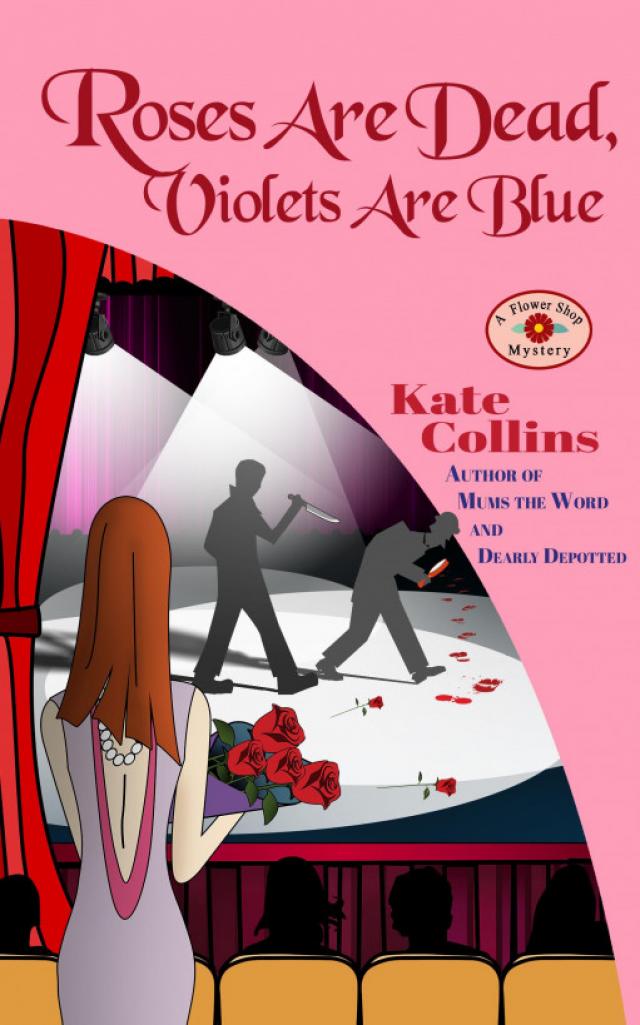
Roses are Dead,
Violets are Blue
A Flower Shop Mystery
Kate Collins
Follow Kate Collins Online
katecollinsbooks.com
Book cover design by Arash Jahani
ROSES ARE DEAD, VIOLETS ARE BLUE
A Flower Shop Mystery
SMASHWORDS EDITION
Copyright © 2024 Linda Tsoutsouris
This is a work of fiction. Names, characters, places, and incidents are either the product of the author’s imagination or are used fictitiously, and any resemblance to actual persons, living or dead, business establishments, events, or locales is entirely coincidental.
Contents
Title Page
Copyright
Poem
Prologue
Chapter One
Chapter Two
Chapter Three
Chapter Four
Chapter Five
Chapter Six
Chapter Seven
Chapter Eight
Chapter Nine
Chapter Ten
Chapter Eleven
Chapter Twelve
Chapter Thirteen
Chapter Fourteen
Chapter Fifteen
Chapter Sixteen
Chapter Seventeen
Chapter Eighteen
Chapter Nineteen
Chapter Twenty
Chapter Twenty-One
Chapter Twenty-Two
Chapter Twenty-Three
Chapter Twenty-Four
Chapter Twenty-Five
Chapter Twenty-Six
Epilogue
Acknowledgements
Flower Shop Mysteries
Preview – A Vase in the Window
About the Author
Roses are dead,
Violets are blue,
Life simply isn’t,
the same without you.
If only I’d listened
Then all would be fine.
I would be yours,
And you would be mine.
Alas, now my heart is
Unwell and unruly.
Love,
Forever,
And ever,
Yours Truly
PROLOGUE
♥︎♥︎♥︎
February 2nd
Saturday Evening
Grace Bingham, my assistant at Bloomers Flower Shop, walked out of the shadows covered in blood. I gasped at the sight of her. I’d known the slender, sixty-something widow for almost four years, and I’d never expected this. I couldn’t believe my eyes - or my ears for that matter. She had no remnant of her British accent, and her once proper posture had been replaced with a crooked, hunched spine. Her eyes were layered in thick mascara that ran down her cheeks as though she’d been crying for hours. And as she stepped further into the light, I could see that she was holding a knife.
I knew Grace had been keeping a secret, but I never could’ve imagined this. For a few months, I’d suspected something was wrong with her. She’d been slipping out of work early during the week and asking for weekends off. She’d also been fixated on her smart phone more frequently during work, always checking for messages and responding immediately. Then there were the suspicious new guests who would come into the tearoom and chat quietly with her. I knew she had to have been hiding something.
Lottie, my mentor, and former owner of Bloomers hadn’t believed me. As usual, she’d blamed my curiosity on my ardent need to solve mysteries, an insatiable urge to fix problems, even when there were none. But now, as I looked over at Lottie, with her short, brassy curls and hot pink sweater, who sat with her jaw hung low, her eyes intensely focused on Grace – the woman of whom she’d assured me had no more secrets than anyone else – now I knew she was a true believer.
Grace’s manner was so unlike the woman I’d come to know that I shivered. All I could do was watch as she came up behind the detective and raised the six-inch blade above his head. I held my breath, frozen in place.
“Look out, Detective!” An attractive older woman in a striking, form-fitting, red evening gown approached the detective with her arms out shouting, “Behind you!”
Marco was seated to my left. He yawned conspicuously. I nudged his arm and whispered, “Stop it.”
The handsome young detective spun around just in time, deflecting the blow from the knife. A Police officer rushed out and grabbed Grace’s arms, pulling them behind her and snapping cuffs on her wrists.
Marco yawned again, and before I could stop myself, the urge struck me, too. I covered my mouth and tried to stifle the yawn as my eyes filled with water. “Marco,” I whispered again, “you’ve got to stop doing that.”
“Sorry,” he replied quietly. “It’s a long play.”
♥︎♥︎♥︎
The tall, handsome actor playing the detective’s role stood in the center of the wide stage, dressed in a three-piece brown tweed suit and shiny brown shoes, puffing on a pipe. “If only I’d taken your advice, I might’ve been able to prevent these senseless tragedies. Thanks to your bravery, Mrs. Wells, we will now be able to charge this gruesome fiend with five counts of murder.”
The actress who played Mrs. Wells, a petite, attractive, blond, fifty-something, gave a gracious nod of her head. “I told you from the start, Detective, you were looking in the wrong place. And may that be a lesson for you all. Never underestimate a woman’s intuition.”
The lights went dark. The curtain closed swiftly. And the audience roared with applause.
Amidst the clapping, the curtains were drawn open and the whole cast returned to the stage to take their bows. Marco and I rose; Marco whistled. My assistant, Lottie, jumped to her feet, clapping hard. Grace shielded her eyes from the lights and found us in the audience. She smiled wider than I’d seen in a long time. It was the opening night of the murder mystery, Death in the Night, at the Rose Playhouse in my hometown of New Chapel, Indiana, and we’d come out to support our colleague.
I considered the Rose Playhouse to be an elegant theater, although it was somewhat timeworn. Its gold patterned walls were faded, the heavy red curtains a bit frayed on the edges, the red upholstered seats shiny with wear. Still, it was a magical place to me. I’d been to several plays there when I was a child, and still remembered the first one I’d seen, Annie, for my tenth birthday.
I’d known about the Rose Playhouse fundraising project in which Grace had been involved for several months. I’d also known that she’d put a tremendous amount of effort into getting the community’s support, but what I hadn’t known, what Grace had so cleverly kept from us, was that she’d landed a major role in the very first production of the theater’s reopening. It wasn’t until she’d surprised us with center row seats that I’d found out.
I clapped harder as Grace stepped forward to take her bow. What a transformation she’d made for the role! And more than that, what a wonderful performance she’d given on stage. She had effortless, natural talent, and I was beyond proud of her.
As the clapping died down, the actors moved off into the wings and the director, Richard Rose, walked to the center of the stage and began to speak. “Thank you for coming tonight. I hope you enjoyed the production. I’d like to thank my brother Collin for his patience and financial expertise in helping produce the show. I’d also like to thank the cast for their excellent performances.” As the audience clapped in response, he turned toward the actors in the wings and said, “Good job, everyone.”
He turned back to the audience. “As many of you know, our beloved playhouse has been in grave disrepair for many years. But thanks to your kindness and the generosity of many more in our wonderful community, the old girl has a new lease on life.”
The audience clapped and cheered.
The director continued. “The Rose Playhouse has a long and venerable history here in New Chapel, beginning its life at the end of the Great Depression, where it cheered its beleaguered citizens with uplifting productions. Over the years, my family has hosted many, many plays, musicals and even some operas. I’m happy and proud to continue with that tradition. Again, thank you and –”
Before the director could finish, a long, heavy light fixture crashed down onto the stage in front of him. The glass shattered as the can lights attached to the fixture bounced off the stage and broke apart. Richard Rose staggered backward, lost his balance, and landed on his rear as the audience gasped in horror. One of the actors, the detective, hurried over to make sure he was okay.
There were murmurs in the crowd around us, a low rumble of tense conversation as most of the audience stood to see what had happened. The young man playing the detective helped Richard to his feet. The audience continued their surprised chatter, and some stood and began to file out of the rows of seats as though the theater was on fire.
“It’s the curse,” a woman whispered to her husband in the row behind me.
As another couple passed by, I heard the man say, “The curse has come back.”
I turned around in my seat in time to hear the woman respond, “I’m sure it’s never left.”
“What’s this about a curse?” I asked the couple, but neither seemed to hear me.
Beside me, Lottie said under her breath, “Nonsense.”
“People, please,” Richard Rose said in a shaky voice. Holding his hand to his heart, Rose took a deep breath to collect himself, then stepped around the long light fix
As the rest of the audience filed out, I looked at Lottie and she looked at me. “I know what you’re thinking,” she said.
“I can’t help it, Lottie.”
“Sweetie, take off your detective hat. It’s probably just what it appears to be – an accident.”
“I agree,” Marco chimed in.
I glanced at him. “Oh, were you awake for that part?”
He raised his shoulders in a shrug. “It was a long play. I said I’m sorry.”
As we left our seats, I glanced back to see that more of the actors had returned to the stage and were staring up into the overhead curtains, pointing at something above them. What were they seeing? Something suspicious? Could there be foul play at work?
“Are you coming?” Marco asked me.
“Just a second.”
“I’ll go get the bouquet of roses from my car and meet you by will call,” Lottie told us.
My mind was still on the accident as we waited in the lobby. “That light bar must’ve weighed hundreds of pounds with all those lights on it,” I said to Marco.
“The director is lucky to be alive,” he replied.
“What if the lights had fallen during the play? A lot of the actors could’ve been injured.”
“It’s a freak accident,” he said.
“It was no accident,” came a frail voice from behind me.
I turned to see an elderly woman holding the arm of her husband. “What do you mean?” I asked.
She held her finger to her lips and whispered, “It’s the Rose Playhouse curse.”
“What is that?” I asked her.
Before the woman could answer, her husband ushered her along, saying, “I apologize for my wife. It’s nothing, really. Just an old rumor.”
“The Rose Playhouse curse?” I asked Marco. “Have you ever heard of it?”
He shrugged. “Maybe Grace would know more.”
“Speaking of Grace . . .” I looked around the lobby. None of the cast had come to meet and greet with the audience.
Lottie walked in the front door with a large, beautiful bouquet of roses and baby’s breath. “Where is the cast?”
“Nobody’s come out yet,” I answered, “and it looks like most of the audience is leaving anyway.”
“Well, I can’t stay much longer,” Lottie informed. “I told Herman I’d be home by ten-thirty. He worries if I stay out too late.”
“Lottie,” I asked, “have you heard of the Rose Playhouse curse?”
“Oh, brother,” Marco sighed. “Here we go.”
I ignored him and said to Lottie, “I just had the most ominous warning from a woman who said there was a curse.”
“The only curse on this place,” Lottie said with a roll of her eyes, “is that no one ever cared enough to keep it operational. Here she is now.”
I turned to see Grace walking toward us still wearing her thick stage makeup and wig. She looked harried. “Are you okay?” I asked.
“It’s just a madhouse back there. Thank goodness no one was injured.”
Lottie held out the bouquet. “These are for you, Gracie.”
“How incredibly thoughtful,” she said and gave all three of us hugs. “Thank you.”
“Grace,” I asked, “what’s this I’m hearing about a playhouse curse?”
“It’s absolutely nothing to worry about, love. Accidents happen is all.”
“Just like I said,” Lottie added.
“Now, I don’t mean to rush off,” Grace told us, “But we’re gathering for a cast picture in ten and I must hurry to remove this horrid stage makeup. Thank you again for coming out tonight.”
As we said our goodbyes, I had to stifle another yawn.
Marco smiled and rubbed my back. “See. I told you it was a long play.”
CHAPTER ONE
♥︎♥︎♥︎
Monday, February 4th
I loved Mondays. They were like opening a much-anticipated book, turning to the first page, eager for the story to unfold; or watching a sunrise, those first shiny rays peeking over the horizon, bringing a glorious golden shimmer to start the day. I took a sip of my morning coffee, smiling to myself as my handsome hubby Marco came into the kitchen from the basement, a sheen of perspiration on his forehead from his workout.
I could be biased when I say that Marco Salvare was the most attractive man in town, with his thick, dark brown hair that waved down over one eyebrow, olive-colored skin, dark eyes framed by darker eyebrows, and a stance that - to those who didn’t know him - made him look dangerous. Why he ever fell in love with a short, busty, redhead with a ferocious Irish temper, I’d never understood. He’d been an Army Ranger before attending Indiana University on the GI bill. He’d then joined the New Chapel police force, only to abruptly quit a year later. After completing his military service, Marco had grown tired of taking orders.
“How was your workout?” I asked.
“Intense.” He wiped his face with a baby blue towel hanging around his neck. “Ready for work?”
“All set. I’ll walk down to the bar at noon so we can have lunch together.”
“The bar” was Down the Hatch Bar and Grill, a local tavern that my husband had bought at the same time that I’d become the brand-new owner of Bloomers Flower Shop, both on Franklin Street, both on the town square. We’d met on the street in front of my shop when my car had been involved in a hit-and-run accident. Marco had come down to see what had happened; we’d learned that the driver was a possible suspect in a homicide; and our curiosity had led us to investigate the case, which, to our amazement, had resulted in the driver being charged with murder. We’d been a team ever since.
I gave Marco a kiss, patted my little dog Seedy and ruffled the fur of my big Russian Blue cat Smoke, put my purse strap over my shoulder, grabbed my car keys, and stepped out the door into the garage, where my banana baby awaited. That baby was a vintage 1960 Corvette convertible that had been found in a barn, stored there for decades. The ‘Vette was in bad shape when Lottie’s nephew, an auto mechanic, discovered it. I’d bought it for a song, had the cracked leather seats refurbished and the car painted in my favorite color, yellow, and now it was beautiful.
Although it was a sunny day, it was February, so I couldn’t put the black ragtop down. But I did crank up the music and sing along to a Billy Joel song as I drove from our little house on the west side of town to the town square. I parked in the public parking lot a block away from Franklin and shuffled through the snow over to Bloomers. I paused in front of the three-story redbrick building to gaze up at the sign hanging above the yellow frame door: Bloomers Flower Shop, Abby Knight, Prop.
I’d yet to have the sign repainted to include my married name. It was Abby Knight Salvare now.
Bloomers Flower Shop occupied the first floor of the building, with the display room up front, a coffee-and-tea parlor off to one side, my workroom in the middle, and a small bathroom and kitchen across the back. A heavy fireproof door opened onto the alley and a steep staircase near the back door led to the basement. We kept larger supplies and huge flowerpots down there, along with pieces of my mom’s art that we were too embarrassed to display in the shop. I tried not to go to the basement very often. It was a scary place.
I opened the door and stepped inside, triggering the bell above. No matter how many times I entered, the thrill of owning Bloomers never faded. Well, technically, it belonged to the bank until the mortgage was paid off – like that was ever going to happen. Nevertheless, seeing my name on the sign above the door still filled me with pride. Little ol’ me, the law school flunk-out, had my very own business.
I took a moment to gaze around the interior, inhaling the sweetly perfumed air. The flower shop had an old-world charm, with original wood floors, a high tin ceiling, and brick walls that dated back to the early 1900s. I’d worked hard to keep the same feel with the décor, using a heavy round oak table with claw feet in the center of the room to display silk arrangements, an open antique armoire against one side wall, a wicker settee in the back corner shaded by a leafy Ficus tree, and an oak sideboard on the opposite wall.