

The Worst Thing You Ever Did, page 1


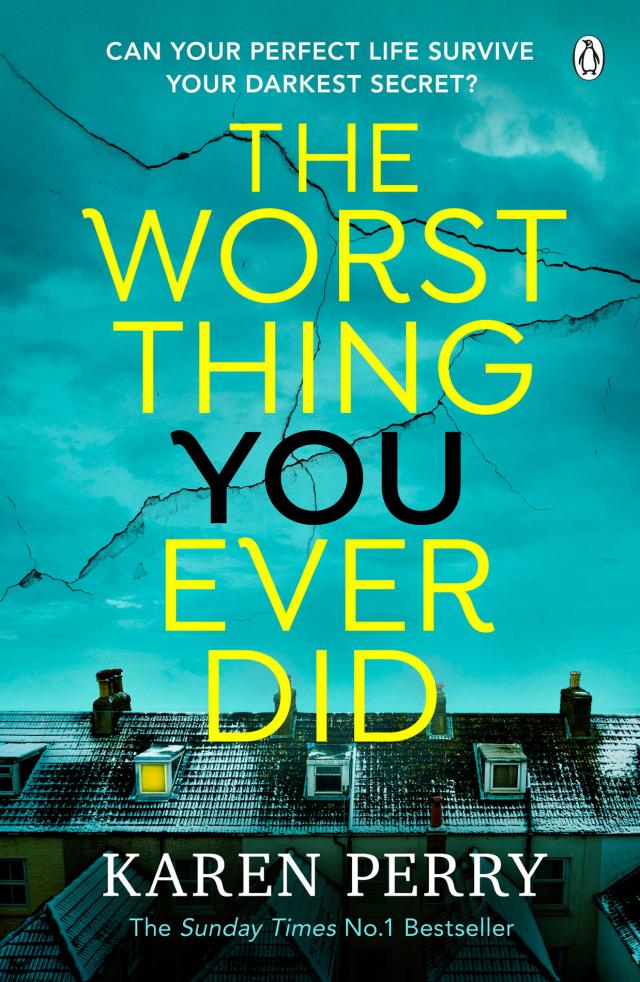
About the Author
Karen Perry is the Sunday Times bestselling author of Your Closest Friend, Can You Keep a Secret?, Girl Unknown, Only We Know, Come a Little Closer, Stranger and The Boy That Never Was, which was selected for the Simon Mayo Radio 2 Book Club. She lives in Dublin with her family.
Karen Perry
* * *
THE WORST THING YOU EVER DID
Contents
Prologue
PART ONE 1: Faye
2: Faye
3: Michael
4: Faye
5: Faye
6: Faye
7: Michael
8: Faye
9: Faye
10: Faye
PART TWO 11: Faye
12: Michael
13: Faye
14: Faye
15: Faye
16: Faye
17: Faye
18: Michael
19: Faye
PART THREE 20: Verona
21: Michael
22: Verona
23: Faye
24: Verona
25: Michael
26: Faye
27: Michael
28: Faye
Acknowledgements
In spring 2010, the Icelandic volcano Eyjafjallajökull erupted. The cloud of ash from the eruption caused air travel chaos as flights across northern Europe were grounded. Thousands of travellers were left stranded as they waited for the ash cloud to disperse.
They’re asleep when he enters the room. The soft rise and fall of breath, all that exhaled air – the staleness of it gathers between the bare floor and the stippled ceiling. His own breath is held fast in his chest. Important to make himself invisible, to maintain absolute silence as he moves through the darkness. But his heart is thumping so loudly it must surely give him away. At any moment they might wake and find him moving stealthily across the room towards the bassinet. He tries to swallow, but his mouth is dry, his whole body parched, wrung out. He needs to calm his ragged breathing, but time is running out.
A small swaddled shape lies in the basket, delicate wisps of hair on the sleeping head. A tiny fist has escaped from the confines of the blanket and is pressed against the infant’s mouth.
If you love me, you’ll do this, Faye had said.
Words like the sharp edge of a blade held to his throat. Words that continue to haunt him.
Rain patters evenly on the windowpanes like white noise. Something stirs on the ground beside him, the brush of an arm or a leg as a body rolls over, groaning in sleep. But the infant does not wake. Not even when he reaches down and takes the child, holds her close against his chest.
He backs out of the room the way he came, the soft bundle warm against his beating heart. The silence holds as he eases the door shut, then he turns the key in the lock.
Part One
1
Faye
It starts on the evening of Ed’s book launch.
We’re at home, both of us busy in our separate ways, bathing and grooming and readying ourselves for the night ahead. The house itself seems to have taken on a new energy, a fizz of excitement bubbling up through the domestic ease.
I’m standing in front of the hall mirror, putting in earrings – long gold dangly ones that were a gift from Ed on our first wedding anniversary – when he clatters down the stairs and pauses behind me, his hands on my hips, landing a kiss on the back of my neck.
‘You look gorgeous,’ he tells me, then continues down the hall into the kitchen, where copies of his book sit on the island in a neat stack. Scattered around them are cards of congratulations that had arrived in the post this morning; chilling in the fridge is a bottle of champagne sent by his publisher. Earlier in the day, I had heard the low drone of his voice coming from the attic bedroom he uses as a study, his warm melodious reading voice tentatively rehearsing the passage from the book he has chosen for tonight.
‘We should eat something before we go,’ I tell him, as I come into the kitchen and look around.
‘I’m not sure I’ll be able to,’ he remarks, straightening up and putting his hands on his belly, and smiling haplessly. ‘Nerves.’
He looks handsome, my husband, in his charcoal-grey suit, a crisp white shirt open at the collar to reveal a triangle of lightly tanned skin. He is that rare being: a red-head with sallow skin. It’s the brown eyes, I suppose. My own hair is brownish in colour, tending to auburn, and my skin is pale and prone to freckling, hopelessly Irish. Back when I was a student, I wore my hair long – I can still remember the heavy swing of it, a chestnut shine from its natural hue. But after college – after everything that happened to me in Barcelona – I cut it short, and it’s been short ever since. These days I wear it in a neat bob with blonde highlights. Catching a glimpse of myself in the reflective glass door of the oven, I see a carefully put-together look: neat eyebrows, subtle make-up, a linen dress with a square-cut neckline. Anyone who knew me back in those distant university days would scarcely recognize me now.
‘You have to eat something,’ I insist. ‘All that wine on an empty stomach. We’ll have cheese on toast, and then we’ll go.’
He acquiesces, and I start pulling out ingredients from the fridge and the breadbin while he opens the grill.
‘Christ, it’s gotten in here too,’ he exclaims. ‘Look at this!’
He holds up the grill tray so I can see the fine layer of white dust coating it.
Six weeks have passed since we moved into our new home, and still, when I wake in the mornings, the roof of my mouth is coated with a thin powder, my tongue parched. The plaster dust gets everywhere – on furniture, in cupboards; it clouds the windowpanes. In the bath this evening, I’d felt the grit of it between my skin and the enamel.
Ed says: ‘It’s like living in an ash cloud, don’t you think?’
They’re just words – a throwaway remark – but they come at me sideways, unexpectedly. Immediately the feeling surfaces: a tightening, as if I am bracing myself against a sudden blow. I try to keep my features calm and inexpressive, but he catches it nonetheless.
‘What is it? What’s wrong?’ he asks, the grill pan still in his hand but his focus entirely on me now, the warmth of his brown eyes misting with curiosity and concern.
I could tell him. It is the opening I have needed. Almost as if by uttering the words ‘ash cloud’ he’s given me licence to tell him everything – about Barcelona, about Michael, about the thing we did …
But the clenching inside me has reached my throat, cutting off the opening and sealing those words deep inside. Instead, I force a smile and step briskly forward, taking the grill pan from his hand, saying, ‘Nothing. I’m just famished, that’s all!’ and busy myself rinsing the dust from the pan into the sink, while he turns his attention to slicing the cheese.
It worries me, though – how quickly it had awakened. An old pain that I thought was buried. A nerve touched to life that easily. I watch the ash sluicing down the drain and remind myself to be more careful.
It’s a beautiful late-spring evening, the laburnum trees planted at the edge of our estate drop with bursts of golden-yellow flowers as I guide the car past them out on to the road. Ed is too nervous to drive. I’m feeling a little nervous myself. So much rests on how this event goes, and I can’t help but feel responsible. He flips through his book, thumbing open to the pages marked with neon-pink Post-its, as well as reading through some words he has jotted down on a flashcard, silently rehearsing his lines while I navigate the traffic.
‘Relax,’ I tell him. ‘You’re going to be amazing.’
He exhales and grins. ‘If you say so.’
‘Grab a glass of wine when you get there to calm the nerves, and then enjoy the evening. This is your night, love. Soak up every bit of it.’
He reaches across and squeezes my knee. ‘Thanks.’
‘For what?’
‘I dunno. For knowing what to say. How to calm me.’ Adding, as an afterthought: ‘Unlike my dad.’
‘Oh? Did something happen?’
‘He sent me a text earlier when you were in the bath.’ Picking up his phone, he reads from the screen: Faber est quisque fortunae suae.
‘Translation?’
‘Each man is the maker of his own fortune.’
I feel the prickliness emanating from him, and think, not for the first time, that he needs to be less sensitive about these things. His father, in particular, gets under his skin. ‘I think he means well, Ed.’
‘You don’t think it’s some kind of a dig? You know, like he’s telling me to go and paddle my own canoe, instead of hijacking his?’
‘You’ve been talking about writing this book ever since I’ve known you. If anything, the reason it’s taken you so long to do it is your father and his career.’
It’s a sore point, this. The shadow of his father’s success looms large over this new writing enterprise, and Ed has confided in me on occasion about his fear of being judged in comparison with his father’s considerable body of work.
‘I asked him if he would introduce me this evening,’ he tells me, adding that it was his publisher’s suggestion.
‘And?’
‘The old man turned me down. Said that he didn’t want to draw the attention away from me on what should be my night.’ These last words he utters in his father’s characteristic stiff and gruff delivery.
‘He was probably trying to be considerate.’
‘You think?’ he asks sceptically.
‘Of course. He is sensitive to the fact that comparisons will be made between the two of you. If he’s trying to distance himself, it’s only so that you can stand on your own rather than in his shadow.’
‘I suppose so,’ he admits quietly.
I look across and see the tightness of his jaw, the pinch of anxiety in the furrow of his brow, and I feel a corresponding squeeze of uncertainty within myself and wonder, not for the first time, whether we’ve made a mistake. And, if we have, then it’s all my fault.
Neither one of us had ever intended returning to Ireland – not to live, anyway. Even our trips home at Christmas were always brief – a bare forty-eight hours before jumping back on a plane and taking off for some far-flung destination, our ‘real’ holiday. Ireland was a duty, a burden that we had both long ago shrugged off. Our lives were in London, Ed working in the theatre, me with my role at the UK branch of Enterprise Ireland. We had our flat in Fulham, a good circle of friends with whom we shared a busy social life, weekends away, foreign holidays. We were happy. And then, one afternoon, at a lunch organized by the British-Irish Council, I found myself sitting next to Jess Power, a businesswoman from home that I had dealt with frequently over the years. Jess was in town raising finance for her latest venture – a small tech company focusing on data analytics for the consumer market. I’d set up meetings for her with some investors, and we’d ended up spending much of the week together. She was forthright, sparky with ideas, a straight-talker – the kind of person who might be intimidating, but I enjoyed her company.
‘I’ve been thinking,’ she told me as our entrées were cleared away, ‘I need someone to help me to scale up the business. Someone efficient, practical, an organizer who can act on her own initiative. Someone just like you, in fact.’
‘Are you offering me a job?’ I asked, joking, surprised, then, when she replied: ‘Yes.’
My first instinct was to refuse, uttering platitudes about being flattered by her offer, but she waved them away with impatience.
‘I’m not talking about some office manager Girl Friday role,’ she insisted, ‘but a senior role. It might not be permanent and pensionable like the job you have here – but you’d be an independent consultant on a generous daily rate, as well as being a member of our board. And we could work something into the package about share options, the chance for you to have some equity in the company. Just think about it, Faye – an opportunity to be involved in something new and innovative and exciting. Instead of sitting on the sidelines, you’d have a chance to actually get your hands dirty, to be involved from within, building a company from the ground up!’
Her enthusiasm was infectious, and, despite my misgivings, I found myself getting drawn in to the exclusion of all other conversation around me. Jess and I spent the rest of the lunch discussing her plans and how I could be involved, what my role would entail. An ember of excitement fanned by her passion was kindled into a small fire. I came away from that lunch with a new spring in my step, temporarily carried along on a wave of ambition. It was only when I got home that evening and raised the matter with Ed that my excitement made contact with reality.
‘Leave London?’ he said, his forehead creased into a frown. ‘You’d actually consider that?’
‘Maybe. For the right job.’
‘And you think this is it?’
‘I think it’s worth giving it some thought.’
‘Well. By all means think about it.’ He turned away from me then, glanced down at his phone. ‘There’s a Kurosawa movie showing at the Picture House shortly,’ he remarked. ‘Do you want to go?’
We went to the cinema that evening, both of us quietly simmering in the darkness, and on the walk home the row erupted. He didn’t want to leave London, he argued, and it was selfish of me to assume he would up sticks and go back to Ireland just so I could indulge some entrepreneurial fantasy. I accused him of hypocrisy, all his talk of being an enlightened modern man who believed in equal rights for women just meaningless bullshit. When it came down to it, he deemed my career to be second to his, even though I easily out-earned him. It was an ugly argument, shaking free the resentments we had each quietly harboured and unleashing words from within us that should never have been spoken. Ed slept on the sofa that night, and I made no attempt to dissuade him. It was not an auspicious start.
We made up the next morning, both of us weary and contrite and needful of regaining our usual balance. I rang Jess on the way to work, thanked her for the offer but explained that I was not yet ready to give up my life in London and return to Ireland.
‘When you’re ready, come and talk to me,’ she said, and I promised that I would, while thinking that it was never going to happen.
We went back to the way things were, but something was different. While I had been aware for some time that I had been coasting at work, now I felt actively bored. I began putting out feelers for potential job offers, but nothing really captured my imagination. My unhappiness at work seeped into our home. Our flat felt too small and cramped. I was aware of being unsettled and tense. Weekends away were an escape, but, as soon as darkness fell on Sunday evening, the sense of restlessness drifted in once more. I told myself that these feelings would pass. That things would change. But still it kept needling away at me, so that when the first lockdown was announced weeks later, and Ed’s work in the theatre dried up overnight, the possibility of returning home to Ireland felt like a kind of solution. Ed began working on the novel he’d always talked about writing, and, quietly, I’d contacted Jess to see whether the job prospect was still a live one. This time, when I raised the idea with Ed, he did not seem so averse, and as the weeks passed slowly I worked away at him, persuading him that it made sense. We had both felt the worrying distance between us and our elderly parents back home over the long months when we couldn’t travel, the constant spectre of the virus and their vulnerability to it hanging over us. Eventually, he acquiesced. We sold our flat and made the move back to Dublin, purchasing a new-build in Blackrock, a suburb of South Dublin, straight off the plans. Ed finished his book and found a publisher, while I threw myself into my new job, exhilarated by the challenges and the rewards. For all my doubts and anxieties, it has turned out better than I had hoped.
And now there is to be a new change to our lives, more vast and profound than all that has gone before. Earlier in the week, the two us had sat huddled side by side at the edge of our bed, staring as two pink lines appeared on the wand in my hand. Another pregnancy test yesterday had yielded the same result, and it seems miraculous to both of us: that we should receive this blessing on top of everything else we are fortunate enough to possess.
Sitting up a bit in his seat, Ed brightens with a new idea. ‘Hey, do you think we should tell them this evening?’ he asks. ‘Mum and Dad? About the baby.’
‘You’re kidding, right?’ My voice rises with incredulity, and he laughs.
‘I know what you’re going to say: that it’s early days –’
‘It’s far too soon!’
‘But I’m dying to tell someone! And just think how happy they’d be!’
‘No –’
‘I could announce it from the lectern, when I get up to make my speech.’
‘Don’t you dare!’ I cry, and he laughs.
‘Don’t worry. I wouldn’t go that far.’
‘Let’s just try and get through the first trimester,’ I plead. ‘I know you’re not superstitious, but I really don’t want to risk telling people and then something going wrong.’
‘Fair enough,’ he concedes, giving a mock sigh of disappointment, and I can’t help thinking how boyish and handsome he looks.
‘Besides,’ I add, flicking my indicator as I pull the car into a space, ‘don’t you think it’s sort of special, that this is just between you and me? Our own little secret?’
My husband, with his open face, his warm brown eyes and clear gaze, takes his eyes off the road for just an instant and looks at me. ‘I’ve never much liked secrets,’ he declares.
The launch is being held on the upper floor of a bookshop; its large windows give on to a sideview of Trinity College, the cricket pitches glowing green in the evening sunlight. Sounds of the bell and soft acceleration of a tram are carried up from the street below. Almost immediately, Ed is handed a glass of wine and ushered away to sign books, while members of staff create a little fuss around him. Soon guests start arriving and the room quickly fills. I edge my way around, greeting friends of Ed as well as some of his parents’ set who have come along to celebrate. Some of my work colleagues have turned up, and I detach myself from the group I am in and go to join them. Jess, my boss, puts an arm around my shoulders and gives me a warm squeeze.


