Monster vs. Boy, page 1


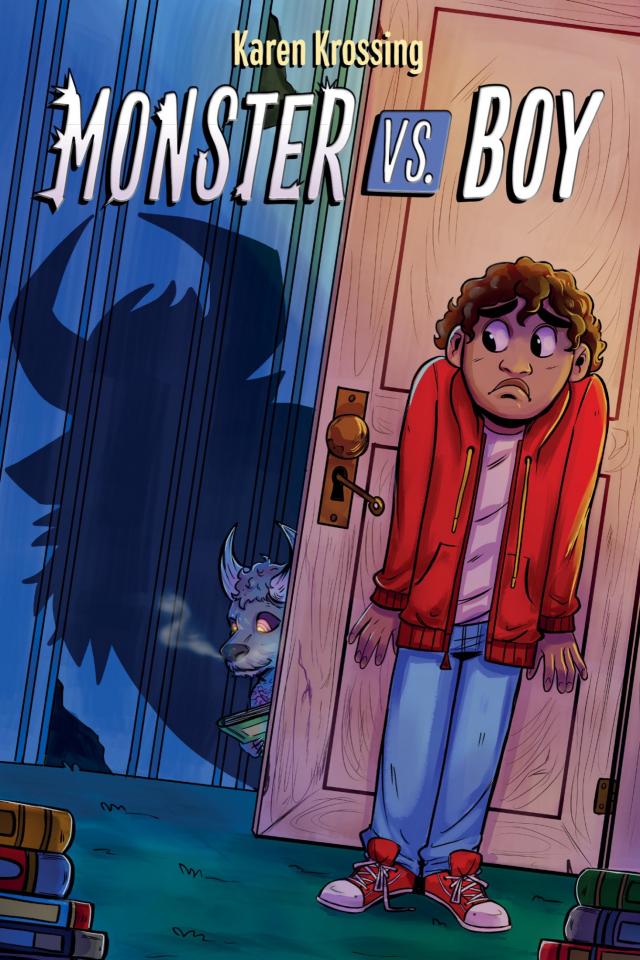
Text copyright © 2023 by Karen Krossing
Cover illustrations copyright © 2023 by Markia Jenai
All rights reserved, including the right of reproduction in whole or in part in any form. Charlesbridge and colophon are registered trademarks of Charlesbridge Publishing, Inc.
At the time of publication, all URLs printed in this book were accurate and active. Charlesbridge, the author, and the illustrator are not responsible for the content or accessibility of any website.
Published by Charlesbridge
9 Galen Street, Watertown, MA 02472
(617) 926-0329 • www.charlesbridge.com
Library of Congress Cataloging-in-Publication Data
Names: Krossing, Karen, 1965– author.
Title: Monster vs. boy / Karen Krossing.
Other titles: Monster versus boy
Description: Watertown, MA: Charlesbridge, 2023. | Audience: Ages 10–12. | Audience: Grades 4–6. | Summary: As eleven-year-old Dawz and Mim, the terrifying but kind-hearted monster who lives in his closet, become more aware of each other, they must uncover the true nature of their mysterious connection.
Identifiers: LCCN 2022012914 (print) | LCCN 2022012915 (ebook) | ISBN 9781623543563 (hardcover) | ISBN 9781632893284 (ebook)
Subjects: LCSH: Monsters—Juvenile fiction. | Magic—Juvenile fiction. | Interpersonal relations—Juvenile fiction. | Books and reading—Juvenile fiction. | Fear—Juvenile fiction. | CYAC: Monsters—Fiction. | Magic—Fiction. | Interpersonal relations—Fiction. | Books and reading—Fiction. | Fear—Fiction. | Fantasy. | LCGFT: Monster fiction. | Fantasy fiction.
Classification: LCC PZ7.K9355 Mo 2023 (print) | LCC PZ7.K9355 (ebook) | DDC 813.6 [Fic]—dc23/eng/20220426
LC record available at https://lccn.loc.gov/2022012914
LC ebook record available at https://lccn.loc.gov/2022012915
Ebook ISBN 9781632893284
Illustration done digitally using Clip Studio Paint
Production supervision by Mira Kennedy
Epub design adapted from print design by Cathleen Schaad
a_prh_6.0_144228932_c1_r0
For you,
and your
monster too.
Contents
Cover
Title Page
Copyright
Dedication
Chapter 1
Chapter 2
Chapter 3
Chapter 4
Chapter 5
Chapter 6
Chapter 7
Chapter 8
Chapter 9
Chapter 10
Chapter 11
Chapter 12
Chapter 13
Chapter 14
Chapter 15
Chapter 16
Chapter 17
Chapter 18
Chapter 19
Chapter 20
Chapter 21
Chapter 22
Chapter 23
Chapter 24
Chapter 25
Chapter 26
Chapter 27
Chapter 28
Chapter 29
Chapter 30
Chapter 31
Chapter 32
Chapter 33
Chapter 34
Chapter 35
Chapter 36
Chapter 37
Chapter 38
Acknowledgments
Chapter 1
In the way-up north, the town of Morsh squatted on a rocky mound surrounded by a forest. It was north of the bustle of the big city. West of cottage country with its crowded lakes and roaring motorboats. And southeast of a mucky marsh that liked to lead hikers in circles before releasing them tired and confused. Morsh was a town where black bears didn’t live in pens, and most people believed that dangerous and magical creatures had once haunted the place. As if the land used to breed monsters but had forgotten how.
The shops in Morsh sold hiking gear and maps of long-ago monster sightings to delighted tourists. At Four Corners—the crossroads at the center of town—a statue of a giant bearlike beast towered on its hind legs, mouth open in a silent roar and claws raised. Tourists posed for photos with it. Townsfolk decorated it during holidays.
In this town lived a boy who kept his distance from the Bear Beast statue, which looked like it might break free and chase him down Main Street. The boy’s mom had named him Dawson, but when his little sister, Jayla, learned to talk, she shortened it to Dawz.
Jayla and Dawz. Dawz and Jayla.
Dawz didn’t like to think about Mom or the small apartment in the big city where they’d once lived. He didn’t like to think about how weird Mom had become before she left—mumbling to herself about yellow feathers and a scorpion tail, and forgetting to make dinner night after night. Now Dawz and Jayla lived with Pop in a ramshackle house on the outskirts of town, where Pop’s kitchen was always busy and bubbling.
Pop was really their uncle, although he’d adopted them on a warm summer day years ago. That day, they’d toasted with fizzy apple drinks and shared a peach cobbler Dawz helped to make. Pop had let him slice the peaches, mix the batter for the topping, and sprinkle the sugary-cinnamon mix over it all. Jayla had poured the drinks with only one spill.
The three of them were a mismatched crew—Pop skinny as a celery stalk with long ash-brown hair and pale skin, Jayla shaped like a pumpkin with pecan-brown pom-pom ponytails and bronze skin, and Dawz in the middle with wavy brown bangs that fell in his eyes and sourdough skin. Dawz wished they looked more like one another, but they were a family in all the ways that mattered.
No one in their ramshackle house knew that a monster—who was smaller than a bear cub—lived in Dawz’s bedroom closet on the third floor. But Dawz suspected. A niggling prickle at the edge of his left eye told him so.
Chapter 2
The monster lived in the boy’s closet. She called herself Mim. No one had ever spoken her name. Not the boy. Not the grownup who tucked blankets over the boy each night. Mim was a name for herself. Her own delightful secret.
Still, she wouldn’t mind sharing her secret with someone else.
* * *
—
The boy’s closet was nestled against the roof of the house. Or was it Mim’s closet? She couldn’t remember. She’d been there such a long time. And time had a way of scrambling her memories with her daydreams.
Mim couldn’t remember before the closet, or if she’d ever been outside it. She couldn’t remember how she got there, or when it happened. She just knew that the closet was her safe place in a world that felt too big to explore.
This closet—she decided it must be hers—had odd nooks that poked into the eaves before they spilled into the wide space by the door. Mim knew all the nooks. The narrow one. The high-up one.
She also knew what was in every box, bag, and barrel. Yes, there was a barrel. A blue plastic one filled with a tent without poles, a dragon costume, and holey sweaters—the scratchy kind. Mim had crawled into every container. She’d shaped a nest out of ribbons and wrap. She’d built a tower of books that teetered and fell. Then she’d built it again and again. She liked how the crashing noise rumbled through the floorboards. How it made the boy call out in his sleep. How it made him grip his blanket under his chin and watch the crack in the closet door with his eyes wide as moons.
Yes. Mim growled her best monster growl, releasing a puff of smoke and ash from her nostrils. I like my boy this way.
* * *
—
Mim watched the boy through that same crack and sometimes the keyhole in her door. They lined up with his bed, and only his bed.
He was no trouble when he was sleeping. Then, he breathed peaceful sounds—shoosh-swip, shoosh-swip. She liked the rhythm of it.
But when he got as wild as the wind against the roof—waving a glowing stick, yelling “Take that, you villain,” and chasing a larger boy over and around the bed—then Mim hid in her nest of ribbons and wrap with her hands around her knees and her hooves tucked under her.
No. Mim flattened her stub tail against her. I do not like my boy that way.
Mim watched the boy cough and sneeze in his bed. She watched him cry once, but she didn’t know why he was upset. She watched until he moved out of her view. Where did he go?
He disappeared on most days. While he was gone, she sprawled across a box of wooden blocks until they left marks on her scales.
* * *
—
But most evenings, he came into her view. The grown-up came too, and the small girl—long enough to share a book. Mim knew the word grown-up meant “big person.” She’d learned words like that because of books.
Mim had discovered that books could be used for more than building towers and crashing. She’d watched the boy, grown-up, and girl burrow under blankets with a book. The boy usually rested his head on the grown-up’s shoulder, and the girl did too, their faces aglow in a circle of lamplight. Mim didn’t want to burrow with them, and she didn’t like the too-bright light, but their circle also filled up with words. The grown-up held the book as he spoke them, and Mim suspected they came out of the book.
Those words slithered and leaped within that small circle. They made the boy’s limbs grow still. They set his eyes ablaze. They brought a smile to his face like a
Mim could only guess at how those books fired him up and tamed him all at once. But they did.
Books were powerful. Wonders dwelled inside them. Wonders that Mim was missing, alone in her dusty closet.
Luckily, the grown-up’s words spilled beyond the circle of light too. They flipped and flapped across the room. They danced and wriggled through the crack and the keyhole in her closet door. They visited Mim in the most tail-flapping ways.
They built stories that lived inside her and kept her company. They formed creatures that felt realer than real, like friends come to play. She adored the gigantic wolf-humans of most fearsome terribleness. She cheered for the lake serpents with barbed fins. One of her favorites were the jumbies who watched children from the forest. They made Mim’s purple scales shiver and her gray fur rustle. Jumbies spied from the shadows, like Mim did.
Books were magical.
Although the endings of stories haunted Mim. The story-children defeated the wolf-humans. They hunted the lake serpents. They chased the jumbies. Over and over, Mim had to plug her ears when the stories ended.
If only a book could end in a better way.
Yet what haunted Mim more than story endings was a question. How did a book beam words into the grown-up’s mouth? If only Mim could control the words from a book. Then she’d be powerful enough to tame the boy. Magical enough to create story friends. Friends that could never be defeated.
But when Mim opened one of her books, nothing happened.
Maybe she couldn’t make a book work by herself. After all, the grown-up had the boy and the girl to help.
Maybe she needed someone else to help her unlock the magic.
She found a rather large spider in the high-up nook where the wind whistled in. First, she nestled next to the spider, as the boy did with his grown-up. One of her horns poked near the spider’s web, which was a kind of nest, so Mim was careful not to knock it loose. Next, she opened the book. It was full of squiggly black marks arranged in rows, like ants marching in lines through her closet. The marks were as thin as the spider’s legs, and they bent into strange shapes. Some shapes stood straight and tall. Others circled and curved. Many shapes repeated. None of them moved or spoke to her. Neither did the spider.
She turned the pages just like the grown-up had. She opened her mouth, anticipating a spill of words over her lips. Would they tickle? She hoped they wouldn’t hurt.
Nothing.
Mim shook the book at the spider. “Why aren’t you making it work?”
More nothing.
A moth fluttered into view…and into the spider’s web. Could the moth help? Mim held the book so they could all see. She opened her mouth wider than wide. Please come, she begged the words.
The spider hurried to the moth and began to wrap it in its silk.
How upsetting for the moth. How lucky for the spider.
Mim turned away. Maybe the spider wasn’t the right someone. Same for the moth.
Maybe she needed a particular someone to make the book work. Maybe that someone was the boy.
Mim had seen the boy open books and turn pages when he was by himself, but words didn’t come out of his mouth then. He had made a book work when the girl nestled with him. Then he’d spoken words that made the girl laugh and Mim prickle because she didn’t want to hear the boy speak a book at her. She wanted books to beam words into her mouth.
But the boy was not a helpful someone. He would never show Mim how to make a book work. Mim knew that like she knew her own name.
She would have to force him.
But how?
* * *
—
Mim pressed herself into the high-up nook. She breathed in the mysterious scents that traveled on the breeze. One day, fresh and damp. Another day, sooty and sour. Scents that promised delights but troubles too. And she pondered how to make the boy unlock the magic of a book.
Could she capture him when he entered the closet, even though the boy rarely came near anymore?
Could she rush out at him while he slept, even though she’d have to open her closet door and step out into the world?
A world that smelled shivery delicious.
A world that might be too wide to see at once.
A world that felt too vast for a small closet monster who had named herself Mim.
Chapter 3
Outside the closet, in his attic room, the boy named Dawz bounced high on his mini-trampoline but not high enough to hit the ceiling.
He gazed out his three windows that faced different directions, so he could see anything coming at him from street, forest, or marsh.
He traced the monstrous constellations on his blanket—like the hydra that Hercules defeated—and read about them in books.
And he locked his bedroom door to keep Jayla out after he’d pranked her—maybe by leaving whipped cream in her slippers.
Dawz’s room fit him just right. Except for his closet.
It was almost as big as his whole room. It had a crawl space into the eaves and odd crevices like the cavities in the old, yellow teeth his dentist had once shown him to convince him to floss more. It was crammed with a jumble of junk no one used.
“It smells worse than wet dog,” Dawz told his friend Atlas. “Worse than campfire smoke.”
At night, when Dawz woke from a bad dream, he often heard strange sounds coming from his closet. Footsteps. Shuffle, shuffle sounds. Then—crash!
Dawz kept his clothes in his dresser drawers.
* * *
—
He knew that most eleven-year-olds weren’t afraid of a closet. Atlas wasn’t, but he had shoulders that were wide enough to scare off most things. That was why Dawz had nicknamed him Atlas—after the Greek Titan who held up the sky on his shoulders. Also, Atlas was part Greek, which made the nickname even better. Dawz sometimes wished he and Atlas were brothers. Dawz’s own family was townsfolk from way back.
Luiza, a retired town councilor who told the best stories, said foolish settlers from across the sea were the first to inhabit this place—a place where no Indigenous people wanted to set foot. Perhaps because of the strange growls and yips that echoed through the forest and marsh. Perhaps monsters really had roamed back then. If Luiza’s story was true, the settlers got lost in the marsh, camped on the first dry ground they could find, and never left. They called the town Morsh—a mashup of monstrous marsh—and the name stuck. The town of Morsh by the Monstrous Marsh. Good for tourists who loved scary tales. Not good for a boy who worried they might be true.
On the day Atlas opened Dawz’s closet just to explore the jumble of junk, he pulled out a sponge and a pair of broken flippers.
“Let’s play flipper badminton.” Atlas lobbed the sponge above his head, then smacked it toward Dawz with a flipper.
“Wait!” Dawz tried to close the closet door first, but the sponge came at him fast. Then he had trouble hitting it back because he worried the whole time the closet door was open, as if something might escape.
It was a silly worry. Only little kids were afraid of closets. Except for his sister, who wasn’t afraid of much, even though she was three years younger.
Dawz wished he could be as fearless as Jayla.
* * *
—
After the flipper badminton game, Dawz kept his closet door locked all the time. The lock was old-fashioned with a keyhole he could see through and a tarnished brass key that wobbled in the lock. Since it didn’t seem secure, he also began to set traps outside the closet door each night, except when Atlas slept over. Sometimes, he’d sprinkle Froot Loops on the floor around the closet door so if anything tried to escape, he’d wake to crunching footsteps. Other times, he’d stack some books so they’d tumble over if the door opened. But he always tidied up his traps in the morning before Pop or Jayla saw them. He didn’t want them to know he was worried about weird stuff like closet monsters. It reminded him of Mom and her strange talk about yellow feathers and a scorpion tail, and Dawz wanted to be normal, like Pop.
As he got older, Dawz spent more time in Pop’s kitchen. Pop was a freelance chef, and he had two ovens, spoons in all sizes, and silver pots Dawz could see his face in. One of Dawz’s best kitchen memories was when Pop taught him and Atlas about the magic of baker’s yeast.