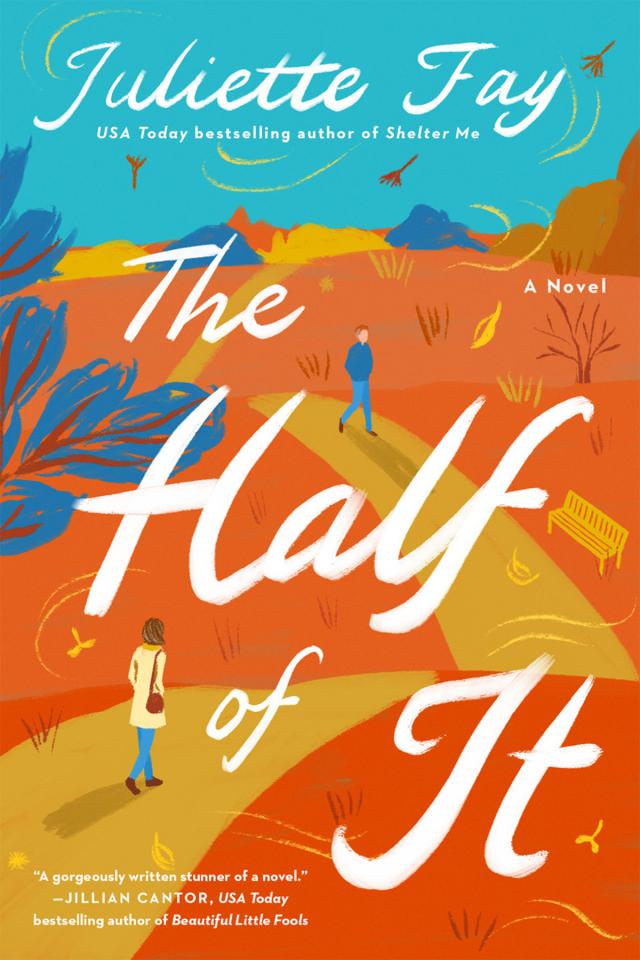
The Half of It, page 1


Dedication
For Linda Dacey, my beloved stepmother
Epigraph
A Continual Autumn
Inside each of us, there’s a continual autumn. Our leaves
fall and are blown out
over the water. A crow sits in the blackened limbs and talks
about what’s gone. Then
your generosity returns: spring, moisture, intelligence,
the scent of hyacinth and rose
. . . . . . . . . . . . . . . . . . . . . . . . .
Very little grows on jagged
rock. Be ground. Be crumbled so wildflowers will come up
where you are.
—Jalāl al-Dīn Muḥammad Rūmī, thirteenth-century Persian poet, Islamic scholar, and Sufi mystic
Contents
Cover
Title Page
Dedication
Epigraph
Chapter 1
Chapter 2
Chapter 3
Chapter 4
Chapter 5
Chapter 6
Chapter 7
Chapter 8
Chapter 9
Chapter 10
Chapter 11
Chapter 12
Chapter 13
Chapter 14
Chapter 15
Chapter 16
Chapter 17
Chapter 18
Chapter 19
Chapter 20
Chapter 21
Chapter 22
Chapter 23
Chapter 24
Chapter 25
Chapter 26
Chapter 27
Chapter 28
Chapter 29
Chapter 30
Chapter 31
Chapter 32
Chapter 33
Chapter 34
Chapter 35
Chapter 36
Chapter 37
Chapter 38
Chapter 39
Chapter 40
Chapter 41
Chapter 42
Chapter 43
Chapter 44
Chapter 45
Chapter 46
Chapter 47
Chapter 48
Acknowledgments
About the Author
Praise for Juliette Fay’s Catch Us When We Fall
Also by Juliette Fay
Copyright
About the Publisher
Chapter 1
2021
Helen sits on her favorite bench in the woods by the river, boot heels dug into the stony New England earth, body hitched forward slightly to accommodate the baby backpack. Limp, fleece-swaddled legs dangle by her hips.
Fall is in full profusion here in Belham, Massachusetts. Yellow leaves glint like gold off the surface of the water as they glide by; afternoon sun casts bright but diminishing rays that bounce against the ripples.
Helen doesn’t see the beauty. Her blank stare conjures only the wrong turns; regret is a thing with teeth. There’s movement out of the corner of her eye, and for the briefest moment she’s sure it’s an animal that will chew her to bits.
But it isn’t.
A small child—maybe two and a half or three years old—running. His little-boy legs paddle at the dirt path with the delightful inefficiency of limbs that have only recently learned to accomplish this feat of anatomical engineering. Chubby fists clench as his body concentrates on propelling him forward. Grinning to himself.
The sight of her catches him unawares and he stops smiling, eyes suddenly round in fear. His gaze is locked on hers when his foot hits a root in the path, and he spills forward onto his belly, his neck not yet strong enough to keep his lovely little face from smacking into the dirt.
Helen is up and running to him as he lets out a wail of pain, the sleeping one-year-old on her back jostling against her so that she almost falls right on top of the little boy.
“Hey,” she coos, squatting down next to him, “hey there.” She doesn’t want to touch him—children are so well-versed in stranger danger these days, and she doesn’t want to fuel his panic. But he can’t seem to lift himself out of the dirt, and still crying hard, he only manages to roll over onto his back like a baby turtle.
“Can I help you up?” she asks.
“Yessssss!” he wails and reaches up to her. She slides her hands into his little armpits and lifts him, intending only to right him onto his feet, but he clamps his arms behind her neck and wraps his legs around her waist like a baby monkey, nearly destabilizing her. She gets a better grip on him and stands up.
“Where’s your grown-up?” Helen gently wipes at the dirt on his cheeks with the sleeve of her sweatshirt.
“I runned away!” he says, and this precipitates a whole new round of sobs.
“You ran away? From who?”
“My grandpa!”
Helen immediately pictures an evil old man hitting the boy—or worse—but she warns herself against jumping to conclusions. “Why did you run away from him?” she asks mildly so as not to further inflame the situation.
“I played a triiiiick!” He wails with remorse. “Grandpaaaaa!”
“Okay, okay,” Helen croons, trying not to laugh. Her daughter, Barbara, was emotional and dramatic like this as a child, and Helen had often marveled at the girl’s ability to allow feelings (any feelings, good, bad, or indifferent—the girl could make indifference dramatic) to erupt like flames from an unpredictable volcano.
Jim was always so perplexed by Barb’s emotional outbursts, as if she were an alien species with whom, try as he might, he couldn’t quite communicate. Helen had told him countless times, “She’s young. She just feels what she feels.” And he would chuckle and say, “Apparently.” But to this day, Barb still felt what she felt. It was a wonder.
Helen pats the little boy’s back and says, “Don’t worry, we’ll find Grandpa.”
She’s just turning to head up the path when she hears a man’s voice in the distance booming, “Logan! Logan, where are you? Logan!” The panic in that voice makes Helen’s heart hurt. She’s occasionally lost track of a child and knows there is nothing more terrifying.
“He’s here!” she calls back. “Logan’s here! He’s okay!”
“I’m okay!” the little boy echoes in his high, sweet voice. “I’m okay, Grandpa!”
Helen feels the man’s thumping footsteps coming toward her before she catches sight of him rounding a turn in the path. His face is ashen with worry—either that or he has alarmingly bad circulation. His shoulders hunch forward as he jogs toward them in a strange, ungainly lope. As he gets closer, Helen sees the reason for his galumphing gait: he, too, has a baby on his back, a little pink-capped head bobbing up and down, in and out of view from the oversize pack.
“Hi, Grandpa!” Logan sings out, suddenly happy and excited, as if this is a pleasant surprise rather than a mildly traumatic event that he himself set in motion. He leaps to his grandfather’s arms before the man is quite close enough to get a good hand on him, and the guy stumbles forward, gripping the kid and pressing him into his chest a little too tightly.
His face somehow sets off a ping of memory, a long-buried familiarity, but before Helen can study it further, tears form in the man’s eyes, and his face contorts into a barely controlled sob. Helen is a bit taken aback. Jim never cried. She’s only seen men cry at funerals. Except for Barb’s father-in-law, who cried at their wedding.
“Jesus, Logan,” he chokes out. “You scared the shit out of me.”
“Dat’s a bad word,” says Logan from inside the man’s nearly smothering embrace.
“Sorry.” The man shifts the child into one arm and puts a hand up to pinch the tears out of his eyes. “Don’t tell Mommy, okay?”
“Dat’s okay. Jesus is good.”
A laugh bursts out of the man then, and he catches Helen’s eye, and they both start to laugh. Helen puts a hand up to her mouth. She wants to keep this feeling.
With his face relaxed and smiling, the memory comes clear. Cal Crosby.
Cal fucking Crosby.
With no sign of recognition, eyes still twinkling with humor, he pulls the child back to look at him. The little boy puts his hand up to his grandfather’s cheek, finger pressing on an errant tear. “Is it raining?”
“A little,” he says, though the sky is a cloudless crayon blue, “but it’ll pass.”
Helen continues to stare. How does he not recognize her? But he’s focused on Logan, and she can almost feel the ebbing panic of his pounding heart pulsing through the crisp air against her own body. Fear can blind you. She knows that.
There’s a squawk from the pink cap behind him, and he kisses the boy and attempts to lower him to the ground. But Logan isn’t having it.
“Hold me!” he begs.
“McKenzie needs her bottle, buddy.”
“My legs hurt,” he whines.
It’s Helen’s escape hatch. Let him deal with the bruised toddler and hungry baby. No one wants other adults bearing witness to the inept handling of unhappy children. Because it’s always inept. Child wrangling is rarely elegant, and by the looks of him Logan is summoning the demons of a five-alarm tantrum.
Barb and Danny had loved to throw fits in public. A two-year-old Danny once howled like he’d been hit with a hammer because Helen wouldn’t let him hold the steak knives in her shopping cart at Target. On a trip to Ben & Jerry’s, Barb had hurled her ice cream to the ground, convinced that someone had licked it (And who would that have been—the bespectacled scooper? Helen? Aliens?) and wailed for another. Sam was the gentle bookish child. He never complained on his own behalf. But he could become utterly distraught if he thought a passerby was holding a dog too tightly on its leash, and no amount of explaining about puppy training could console him.
Helen has a brief vindictive wish for Logan to throw a good fist-and-foot-flailing thrasher. Something to make Cal fucking Crosby really cry . . .
But honestly, does she even care anymore? It was all so long ago. Oceans of water have passed under countless bridges. She’s brought three humans into the world. Buried a husband in the enforced emptiness of a pandemic. Moved to a little town where she knows no one except her daughter and son-in-law, who are utterly engrossed in the endless blessing of this baby, and the endless exhaustion of new parenthood. At fifty-eight, Helen Spencer somehow finds herself relegated to solitude at the edge of other people’s lives.
Maybe she’s due for a good fist-and-foot-flailing thrasher herself.
Oh, grow up, she tells herself. It’s for the best that he doesn’t recognize her. Who wants to revisit that mess? Better to move on. Put one foot in front of the other. She has always been a good little marcher.
But before she heads down the path, Helen takes one last look at the boy’s smudged, angelic face and feels a duty to say, “He hit the dirt pretty hard. Tripped over that root there.”
“I tripped,” confirms Logan, nodding solemnly. His lower lip begins to quiver at the memory of his rather impressive fall.
The baby is crying in earnest now, sobs coming in little jags between gulps of air. The man, oversize presence though he is, is physically trapped between two small children and their oversize needs. He looks around as if hoping to MacGyver a solution out of twigs and moss. He’s an Eagle Scout, Helen remembers, but fire building won’t help him now.
She actually feels bad for him. In forty years, she’s had not one moment of pity for Cal fucking Crosby, so it’s kind of interesting. Also, how does the bastard not recognize her? Honestly, this is the most interesting thing that’s happened to her in months.
“Hey, Logan,” she says, “how about if I hold you while your grandpa feeds the baby. We can sit on this bench over here.”
The boy leans out to her, and she collects him into her arms again, but when she walks toward the bench he whimpers, “I don’t want to sit!”
“It’s my favorite bench,” she says. “You’ll love it.” And without waiting for further approval, she lowers herself. She’s done a few rounds of puppy training herself and found it far more helpful than any parenting book. She snuggles him onto her lap and gives him a teasing little poke. “See, isn’t this fun?”
Logan is confused by this. What’s so fun about sitting on a bench, after all? Only moments ago, she was sitting on this very bench having zero fun. Negative fun. But now she’s enjoying herself. It’s like reading a plot-twisty book and wondering when the truth will reveal itself. Her enthusiasm quells his peevishness, and the little boy says only, “Shh, your baby is sleeping.”
Cal slides one shoulder out of the backpack, pulls out the stabilizing arm, and gently sets it on the ground. He roots around in the attached pouch for a moment as the baby shrieks in despair. He pulls out a bottle, hauls the little banshee out of the carrier, quickly cradles her in one arm while he rubs the nipple over her bottom lip trying to get her to settle down enough to realize that he’s giving her the very thing she’s demanding at such a high decibel.
Logan puts his hands over his ears. “Too loud.” This is despite the fact that his own cries were scaring woodland creatures in all directions only a few minutes before. Now he’s the noise police.
Cal bounces on his knees a little. “Okay, Kenz, come on now, it’s right here,” he murmurs, still dabbing the nipple at her wide-open mouth. Finally, she latches on and slurps hungrily. Her little fingers wrap around the bottle, and she holds it herself. Cal puts a finger against the bottom, adjusting it to the proper angle.
A pro, thinks Helen, and remembers how easily he picked things up, the bastard. But then she wonders how he lost Logan. Maybe he’s slipping. She slides over on the bench. “Want to sit?”
He gives her a quick smile as he sinks down and shifts the baby into a more comfortable hold on his lap. She notices the sheen of anxiety-induced sweat on his upper lip. He wipes it self-consciously against the shoulder of his chamois shirt and reaches up to tug off his wool cap. His short-cropped hair is a little more auburn now. It was bright red back then, and he’d kept it long even for 1981. All that flowing beauty. It had felt like silk against her fingers.
His eyes are bookended by matching deltas of creases at the corners, but they’re still that soft blue she remembers a little too well. There’s a scar on his upper lip that wasn’t there forty years ago. He hasn’t shaved today, and his whiskers are sprinkled with white.
So that’s how you turned out, she thinks.
“I’m hungry, too!” Logan suddenly announces, and Cal leans down toward the backpack again, hand emerging with a fairly smushed sandwich. He peels off the sticky plastic wrap and hands over a half.
“It’s all ick,” whines Logan.
“Sorry, kiddo, that’s what we got.”
Helen says, “I’ll eat it.”
Logan jams the sandwich into his mouth.
“Another satisfied customer,” says Helen. It’s a phrase her father often used, and the words unexpectedly make her chest tighten, even after all these years. To dispel the sadness, she focuses back on Cal Crosby and his potential incompetence. “How’d you lose him?”
Cal shakes his head. “The little . . .”—shit, Helen can almost hear him say, but he pivots to—“snip. I was changing the baby, and I was just getting her into the pack, and I look around and he’s gone.” He shakes his head again. “His mother would’ve killed me six different ways. I just got back in her good graces, and if anything happens to him . . .”
Good graces, Helen thinks. That’s a slip he didn’t mean to make.
“My youngest would take off every chance he got,” she says. “I had to hang on to him so often, I was afraid his wrists would have permanent indentations.”
“Youngest?” His perplexed gaze shifts to the baby still asleep in the backpack.
Helen doesn’t know what to say for a moment. Jesus, he really doesn’t know who she is. “She’s not . . . She’s my granddaughter.”
Cal’s eyebrows shoot up. “Oh. I just assumed—”
“You can’t possibly have thought I was her mother.” True, Helen is still coloring her hair, unlike several of her friends who “embraced” their gray under cover of Covid. Hers is perhaps a little more glossy chestnut than her natural mousy brown was back in high school. And she is fairly fit for her age, though the time required for her daily three-milers has gradually increased like the size of her ass. Still, she is clearly not of childbearing age.
“Well, I figured maybe late in life . . .”
Helen lets out a snort. “Not this late.”
He frowns at her. “You could be midforties. It’s not that farfetched.”
“Look at me.”
He’s on the defensive now. “Seriously, you have great skin and—”
“Cal, look at me.”
Chapter 2
1976
Helen Iannucci was not a good sitter. Girls were supposed to be better at keeping still and paying attention than boys, and she was probably better than most of the boys in her class, but this required a concerted effort on her part. It was okay to jitter and tap if you were a boy. It just made a girl look nutty.
She liked being outside. She had been a Girl Scout, with high hopes that there would be hiking and campouts. But her den mother, Mrs. Galudet, did not like bugs. The troop stayed indoors and did a lot of so-called Indian crafts. Helen wasn’t so sure that Indians made sit-upons, which the girls wove out of construction paper because Mrs. Galudet couldn’t find the kind of frondy stuff that would have been slightly more authentic-looking. And Girl Scout cookie sales put Helen over the edge. Countless hours sitting outside the post office and accosting people to place their orders. She quit in fourth grade.
“Those cookies,” her mother scoffed in her piquant Italian accent. “Taste like the box they come in.”