

The Pigeon Pie Mystery, page 1


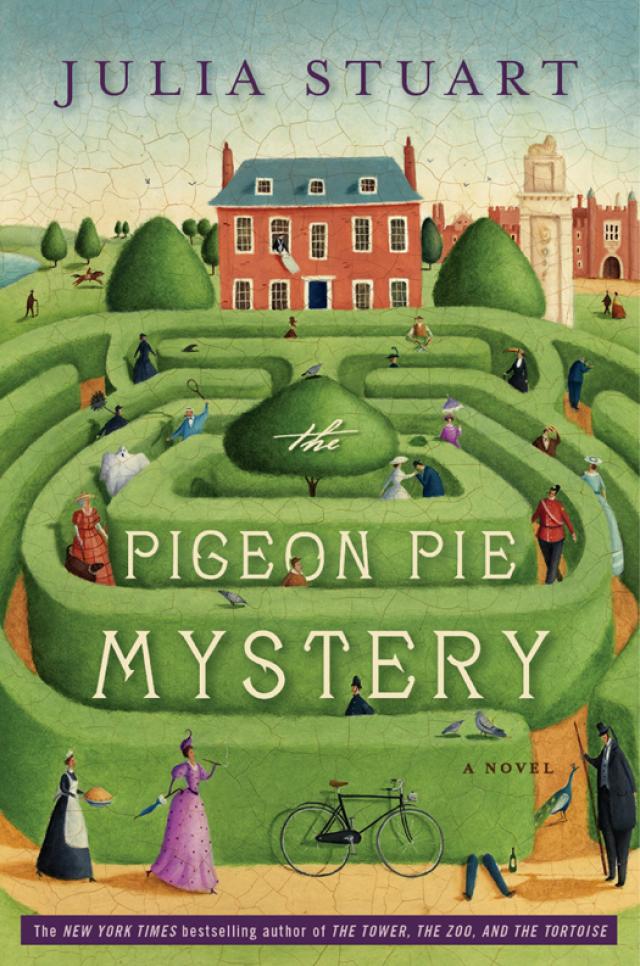
Copyright © 2012 Julia Stuart Limited
All rights reserved. The use of any part of this publication, reproduced, transmitted in any form or by any means electronic, mechanical, photocopying, recording or otherwise, or stored in a retrieval system without the prior written consent of the publisher—or in the case of photocopying or other reprographic copying, license from the Canadian Copyright Licensing Agency—is an infringement of the copyright law.
The Bond Street Books colophon is a registered trademark of Random House of Canada Limited
Library and Archives Canada Cataloguing in Publication
Stuart, Julia
The pigeon pie mystery / Julia Stuart.
eISBN: 978-0-385-67661-8
I. Title.
PR6119.T826P54 2012 823’.92 C2011-908599-2
This book is a work of fiction. Names, characters, places and incidents are products of the author’s imagination or are used fictitiously. Any resemblance to actual events or locales or persons, living or dead, is entirely coincidental.
Jacket design by John Fontana
Jacket illustration © Alison Jay www.organisart.co.uk
Map illustration by Laura Hartman Maestro
Published in Canada by Bond Street Books, a division of Random House of Canada Limited
Visit Random House of Canada Limited’s website: www.randomhouse.ca
v3.1
For my mother, with love
We look at other nations and we pity them because
They’re not a little patch on dear old England.
Their trades, their arts, their everything are full of faults and flaws,
So different to clever Model England.
—“MODEL ENGLAND,” HARRY DACRE AND EDGAR WARD, 1892
Contents
Cover
Title Page
Copyright
Dedication
Epigraph
Cast of Characters
Map
CHAPTER I
An Elephant, a Funeral, and More Bad News
CHAPTER II
Albert Is Sold to a Travelling Zoo
CHAPTER III
The Ominous Arrival of the Undertaker
CHAPTER IV
The Ruinous Consequences of Shirt-sleeve Pudding
CHAPTER V
An Unfortunate Incident with the Blancmange
CHAPTER VI
A Body in the Palace
CHAPTER VII
Things Aren’t Looking Good for the Maid
CHAPTER VIII
The Pleasure and Peril of a New Pair of Gentleman’s Stockings
CHAPTER IX
A Prophetic Mole
CHAPTER X
The Impolite Shooting of Lady Montfort Bebb
CHAPTER XI
Cornelius B. Pilgrim’s Secret
CHAPTER XII
Pooki’s Dying Wish and Trixie Predicts Rain
CHAPTER XIII
The Hazards of a Stuffed Codpiece
CHAPTER XIV
A Surfeit of Anchovy Relish
CHAPTER XV
Worse Than Harris in the Maze
CHAPTER XVI
The Princess’s Dr. Watson
Author’s Note
Acknowledgements
Other Books by This Author
About the Author
Cast of Characters
H.H. the Maharaja of Prindur: former ruler of the Indian state of Prindur, with a weakness for shirt-sleeve pudding
H.H. Princess Alexandrina: his daughter, nicknamed Mink, and the best woman shot in England
Pooki: the Princess’s large-footed Indian maid and defender against moths
Dr. Henderson: amorous general practitioner and bicycling enthusiast
The Honourable Dowager Lady Montfort Bebb: once held hostage in Afghanistan, and a horror at playing the pianoforte
The Lady Beatrice Fisher: devotee of exuberant millinery and doves, whose apartments are haunted by Jane Seymour
The Countess of Bessington: parsimonious widow in perpetual mourning, with an addiction to ferns
Major-General George Bagshot: former military man with a roving eye, and a Tudor expert who is writing his fourth history of Hampton Court Palace
Mrs. Bagshot: his wife and patron of a school for the blind who takes cures in Egypt
Cornelius B. Pilgrim: the Bagshots’ American houseguest, with a woeful grasp of English etiquette
William Sheepshanks: Keeper of the Maze and victim of the success of Three Men in a Boat, a novel by Jerome K. Jerome with a scene in the palace’s leafy labyrinth
Thomas Trout: Keeper of the Great Vine, who strives to protect his mighty charge from being felled by rats
Mrs. Boots: bronchial palace housekeeper and Keeper of the Chapel Royal
Mrs. Nettleship: Dr. Henderson’s incompetent housekeeper, who’s even worse at matchmaking
Alice Cockle: the Bagshots’ former parlour maid, since demoted to a maid-of-all-work for the Countess
Inspector Guppy: police inspector with an inglorious past
Silas Sparrowgrass: homeopath from East Molesey, and Dr. Henderson’s archrival
Charles Twelvetrees: solicitor and coroner for West Middlesex, who’s had a gutful of the mysteriously dead
Pike and Gibbs: the butcher’s and grocer’s delivery boys
The Lord Chamberlain: the Earl of Kellerton, responsible for the allocation of apartments at Hampton Court Palace, and a laudanum addict
The Reverend Benjamin Grayling: palace chaplain, with an appreciation for the communion wine, who’s at war with the organist
Mr. Blood: the myopic undertaker who carries a measuring rule tucked under his arm
The watercress seller: hawks outside the palace gate and sleeps in a coffin
Mr. Wildgoose: Dr. Henderson’s tailor and taxidermy fancier
The organ grinder: street musician paid by the public to keep quiet
Wilfred Noseworthy: palace turncock and hauler of the push, a sedan chair mounted on wheels used by the palace ladies
Alfred Bucket: bicycling instructor and fancy riding opponent
Horace Pollywog: one-legged dancing master, who trod on a sea hedgehog
Barnabas Popejoy: a butterman of over-generous girth known for his bad jokes
The drunk woman who sells pig’s trotters outside the King’s Arms
Albert: the Maharaja’s monkey, who suits red velvet trousers
Victoria: a hedgehog named after the British sovereign, with a penchant for beetles and Madeira wine
Lord Sluggard: the palace mouser, who wouldn’t recognise a rat if he saw one
Gertrude: Silas Sparrowgrass’s adored rabbit and reluctant prop for his magic tricks
Trixie: Thomas Trout’s leech and formidable weather forecaster
CHAPTER I
An Elephant, a Funeral, and More Bad News
MONDAY, MARCH 22, 1897
S the hail bounced on the carriage roof, Mink suddenly wondered whether she ought to buy mourning knickers. She thought of asking her maid, who had wept for the dead Maharaja almost as much as she had. But the sight of Pooki’s stockingless feet emerging from the bottom of her sari changed her mind. She turned back to the window to distract herself from the loathsome task ahead of her. Wiping away the condensation, she watched the shoppers on Regent Street, the gritty downpour toppling the ostrich feathers on their elegant hats.
The horses began to slow and came to a halt outside Jay’s, the mourning emporium. The Princess had walked past it during countless shopping trips, but never once imagined needing to go in. As she waited for the carriage door to open, she fiddled with the buttons on her gloves, avoiding the window display. But George, the second footman, whose woeful height and lamentable calves would normally have excluded him from such a position, took so long she wondered whether he had forgotten her. Finally the door opened. Lifting up her skirts, she climbed out, determined not to be sold a pair of mutes, for the funeral attendants hired by the bereaved for their doleful expressions had a reputation for unabashed drunkenness.
A doorbell never tinkled so mournfully as the one at Jay’s. A lump was sure to form in even a hangman’s throat at the sound of its pitiful wail. The Princess and the maid stood silently in the entrance, shrouded in black drapery, a vase of white lilies engulfing them in the politest scent of death. As they waited to be served, a huddle of pale-faced female assistants dressed in the hue of sorrow stared at them. Those at the back stood on their toes and gazed with envy at Mink, whose arresting looks were the result of an Indian father and an English mother. Her long dark hair was pinned and padded to form a high cushion round her head, and her straw hat was trimmed with daffodils and chiffon, which, they noticed, perfectly matched her green cape jacket. Those at the front stared at her emerald earrings, some of the few family jewels the British hadn’t stolen. Added to the colourful spectacle was an older, dark-skinned Indian lady’s-maid in native dress, a black plait hanging down her back. She was so skinny she seemed to have been eroded by years of persistent wind.
The hush was broken by a sniff, and the Princess handed Pooki a silk handkerchief, which she took with grateful, bony fingers. Suddenly, as if descended from the overcrowded heavens above, a man appeared. Dressed in the dullest of black, for only tears were allowed to shine at Jay’s, he appeared to be executing the humblest of bows. But too long passed before he straightened himself up, and it was soon apparent that he was in a permanent state of humility. His cinnamon hair, the only hint of
“Ratakins is the name, ma’am,” he said, clutching his limp hands in front of him. “How may I be of assistance?”
The Princess looked at him uneasily, and replied that she needed some mourning wear as soon as possible.
“First of all, ma’am,” he said, “may I offer you the deepest of sympathies? Some of the lesser mourning establishments may tell you of their regrets, but I assure you that here at Jay’s condolences are at their most profound. If I may enquire, at what hour did our loved-one depart?”
The Princess thought back to the previous day, when the butler broke the news. “Some time yesterday afternoon,” she replied, her stomach like lead.
Mr. Ratakins scrabbled for his watch chain, and, with a flutter of bloodless fingers, stopped the time accordingly. Slowly he raised his red-rimmed eyes to her once more.
“A tragedy,” he said.
The assistants continued to stare.
As silently as he’d arrived, Mr. Ratakins headed down a mahogany-panelled corridor, which the Princess took as an indication to follow. Passing through a doorway, he took up his position behind a counter. A one-eyed ginger cat lay on top of it, a stray the shopkeeper fed out of solidarity for its colour. He swiftly removed it and asked: “If I may enquire, which of our loved-ones has left us?”
Mink swallowed. “My father.”
“A tragedy,” he repeated, his eyes downcast.
The Princess sat down on the chair next to the counter, clutching her green handbag. “I’m not sure how long the period of mourning is for a parent these days,” she said. “None of the women’s magazines seem to be in agreement.”
“For a parent, we at Jay’s recommend a year, six months in crape, three in black, and three in half-mourning.” He continued with the speed of a mantra: “For grandparents it’s six months, two in silk with moderate crape, two in black without crape, and two in half-mourning. For brothers and sisters it’s also six months, but we advise three in crape, two in black and one in half-mourning. For an uncle or an aunt, two months, no crape, black to be worn the whole time. For a great-uncle or aunt it’s six weeks, three in black and three in half-mourning. For a first cousin it’s four weeks. Black. Three weeks for a second cousin, if you liked ’em.”
“I see,” replied the Princess, blinking.
“Heliotrope and other mauves are, of course, still very favourable colours for half-mourning, and grey has never gone out of fashion. It is, after all, a most fetching colour for the bereaved. Complements the pallor.”
“Tell me,” said Mink. “Is a widow still expected to wear mourning for two and a half years, while all a widower does is put on an armband for three months, and remarries whenever he pleases?”
“Something like that, ma’am.”
Mr. Ratakins then rubbed his fingers until they shone. There were skirts and mantles in the latest fashions ready for immediate wear, he said, and bodices made to measure in a few hours. He hauled down a roll of black cloth from behind him, and pulled out the end for inspection.
“This is what I’d recommend for you, ma’am. Bombazine. And we use Courtauld’s Crape. It will withstand any amount of rain,” he said. He glanced at Pooki and lowered his voice. “Bombazet is best for the servants. It’s inferior and therefore cheaper. I wouldn’t want to waste your money.”
With none of the usual pleasure she derived from sitting at a shop counter, Mink chose from the selection of shoes, gloves, mantles, bonnets, toques, hairpins, fans, aigrettes, boas, parasols, bags, purses, mittens, umbrellas, and antimacassars—all the colour of crows.
A young female assistant, her hair scraped back into an unyielding bun, took the place of Mr. Ratakins in order to broach the delicate matter of underwear. Instantly she recognised the Princess from the newspapers, which for years had been captivated by the oriental glamour of the young woman born and raised in England. The female columnists extolled her outfits, quoted her calls for suffrage, and longed for an invitation to her all-women shooting parties, when the laughter startled the grouse more than the beaters.
Opening several drawers, the dry-mouthed assistant draped on the counter a selection of white chemises, drawers, and underpetticoats, all trimmed with black ribbon.
“They’re from Paris, Your Highness,” she said, glancing at the Princess’s earrings.
Mink looked at them. “I’m not of the opinion that everything from Paris is automatically desirable,” she replied. “And anyway, no one will know what I’ve got on underneath.”
“You will, Your Highness,” said the girl, fingering the lingerie with bitten nails.
“So will I, Your Highness,” piped up Pooki from the sofa behind her.
The Princess let out a short, sharp sigh that sent the cat fleeing from underneath her chair, and quickly made her selection.
Mr. Ratakins returned, spread his pale hands on the counter, and leant forward. “And the funeral itself, ma’am,” he said, his eyes gleaming. “Jay’s can take care of that. We have the best mutes in the whole of London, if you don’t mind my boasting. They won’t say a word. We keep them down in the basement. There’s not much to talk about down there. Except for the spiders.”
The Princess shook her head. “My father arranged his funeral years ago, and I’m told he left very precise instructions,” she stated. “I can assure you, the last thing he’d want is mutes.”
“How will people know that a death has occurred, ma’am, without the presence of mutes at the front door?”
“I’m sure half of London is already well aware of my father’s death, gossip being what it is.”
The shopkeeper’s slender fingers silently traced the counter. “They’re coming back into fashion, ma’am,” he said from underneath his lashes.
“I dare say.”
He looked up. “Ours will squeeze out a tear for an extra twopence.”
“They won’t be necessary, thank you.”
“What about a penny tin of black paint for the horses that pull the hearse?” he asked, producing one from underneath the counter with the flourish of a conjurer. “They come up lovely, ma’am.”
“No, thank you.”
The tin disappeared.
“May I recommend some black ostrich feathers for their heads?” he asked, slowly pulling one through his fingers. “All the way from Egypt.”
“No one has plumed hearses these days expect for costermongers and chimney sweeps.”
The shopkeeper foraged under his counter, then stood up triumphant. “We do an unparalleled line in false horses’ tails,” he announced, holding one up in the air and giving it a hopeful shake.
“Mr. Ratakins!”
The man’s eyes fell to the floor, and he lost several inches in height. Suddenly he looked up. “There’s one thing I almost forgot, ma’am. A young lady such as yourself, thoughts naturally turn to marriage. We have the daintiest of wedding dresses in bridal black, should the happy occasion fall sometime soon. It’s a most fetching shade, ma’am. Just the right tint of hope and despair.”
The Princess suddenly thought of the ivory wedding gown with orange blossom at the neck and waist that she had already chosen. She had seen it in a magazine and hidden the picture in her stocking drawer, ready for her dressmaker, should the proposal finally come. But there had been no word from Mark Cavendish since news spread of the scandalous way in which her father had died.
The silence continued as the Princess stared at the floor.
“Her Highness would like to leave now,” said Pooki, standing up from the sofa, clutching the cat.
“Well, that seems to be everything,” muttered Mr. Ratakins, his eyes flicking from the servant to her mistress as he realised that he was in the presence of royalty. “Your Highness, if I may inform you for next time, we do make personal visits at no extra cost. On receipt of a telegram one of our lady fitters will be with you in no time at all.”
Mink’s thoughts turned to her mother, who had died of childbed fever just days after giving birth to the sister she’d begged her for, who had also failed to survive. She then imagined her father cold and alone, lying on his back in a mortuary.


