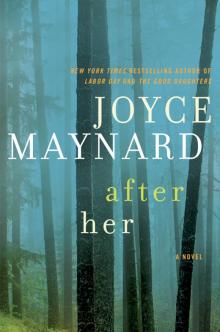
After Her, page 26


“There is one beautiful woman,” he said, facing forward, as if he was the one who had to keep his eyes on the road.
I had never backed out of a parking space before, or even driven in reverse, and my father looked so exhausted now I knew I couldn’t ask him to help. I started the engine, shifted the gear, and turned the steering wheel too sharply . . . smashed into a Dumpster with enough force that later, when I checked, I saw a significant dent. Once this would have caused my father regret, but now he seemed not to notice.
“We won’t be back to this place again,” he said, as I pulled out onto the highway. “You want to leave things on a good note.”
HE WENT IN FOR THE surgery that January. He was supposed to stay in the hospital only a week, but after the operation, they moved him to a different floor, and a few days later, he asked his friend Sal to bring him a portable stereo and a stack of his records. That was when we understood he wasn’t going home anytime soon.
When Patty and I came to see him, he showed us how the hospital bed worked—the buttons you could push so you could sit up or lie down at more of an angle. Easier to get to the bathroom that way, though later that wasn’t possible either.
“You girls,” he said. “I did one thing right, anyway.”
THAT LAST WEEKEND, WE SLEPT in chairs by his bed.
Mr. Armitage took us to the hospital, and later our mother came with food for us and she sat with our father, though only briefly. She had never been one for the big drama moments.
Patty and I stayed by our father’s bed all the rest of that weekend, and when Monday came there was no thought of school, or any awareness even of what day it was anymore. Our father was beyond speech now, his mouth gasping, palms open in the gesture that, for a police officer, signaled that he was carrying no weapon. At one point the pain appeared so terrible that I thought, if he had his gun now he might just end it here.
We didn’t leave till Thursday, and then only because he’d died.
I remember how it felt, stepping out the entrance to the hospital after they’d taken his body to the funeral home. You’d expect it to be raining in Northern California in February, but that day the sun was out, and it seemed to me so bright I had to shield my eyes. I’d been in his dark room for six straight days at that point. My pupils probably needed to adjust, though there was more to it. The world, with our father no longer in it, protecting us, seemed to be an unrecognizable and unbearably lonely place.
PART THREE
Never gonna stop. Give it up.
Chapter Thirty-three
They would have held a service for my father at St. Mary’s in the city, with an honor guard from the Marin County and San Francisco police forces, and a flag draped over the coffin for my sister and me to bring home afterward. But at our father’s request, there was no service. He had asked that his body be cremated.
He left me his gun—the Chief Special—and the Alfa Romeo. Other than those, my father didn’t own much: a wardrobe of great shoes, a medal for valor in the line of duty, the leather jacket, his gold watch, and every album Frank Sinatra, Tony Bennett, and Dean Martin ever recorded—and one Dusty Springfield album that brought back memories of a long-ago afternoon, Kool-Aid from bendy straws, and that closed bedroom door. One item I had looked for among his possessions and failed to find: his father’s haircutting scissors. Strangely enough, those would have mattered more to me than the medal.
There had been a savings account in which he had told us he’d been putting aside money every month for the long-imagined Italy trip. At the time of his death, this account held just under eight hundred dollars—not quite enough for two round-trip tickets to Italy, so Patty and I could scatter his ashes in his family’s hometown of Lucca. This was the place he’d always said he would take us. There, and Venice.
We didn’t make the trip that year, or for some time after that. We waited until a few weeks after my high school graduation, when Patty was sixteen, to make the trip—and by then we’d saved up enough extra that we were able to see Florence and Rome too. In Venice we met a couple of beautiful Italian boys—one of whom turned out to be a fair basketball player, who didn’t mind it at all that my sister was several inches taller than he was. Neither Patty’s height nor the fact that she totally destroyed him on the basketball court got in the way of their kissing, which Patty described to me as excellent. She had her braces by then—paid for with paper route money, and later a busgirl job, augmented by a gift from Mr. Armitage. The braces proved not to be an obstacle for Vincenzo and Patty.
When we got home, I went to beauty school. I hadn’t ever thought about college, but it occurred to me, after a couple of years of cutting hair and listening to all the stories told by women sitting in my chair, that I wanted to study psychology, with an emphasis on forensics and the criminal mind.
I started out in community college, but after two years, transferred to Berkeley. My sister had gotten into Berkeley too, on a basketball scholarship. This meant that we could commute from our mother’s house in the blue Alfa our father had left to me, until we got our own apartment in my senior year.
That was when Patty was able to fulfill her lifelong dream of getting a dog. Not surprisingly, to me, her ongoing debate—cute puppy versus lovable old rescue dog in need of home—ended in the adoption, from the Marin Humane Society, of a half-Lab/half-golden mix named Betty, who was missing one leg, but still managed to run alongside my sister when she jogged. Betty managed to live five years with Patty—longer than anyone would have guessed for a dog whose age was estimated at twelve when Patty brought her home.
I did become a writer, as I’d always planned—though the international spy part, and the race car driving aspiration, fell by the wayside. I am almost embarrassed to admit—given how many fine writers struggle for decades before seeing a book published—that I sold my first novel, a darkly comic thriller titled Come the Blood, when I was twenty-nine.
The book did reasonably well, and its sequel, Blood Again, fared even better. Since then, I have published a novel nearly every year, always in the spring. As for the rest of my story: this will be harder to tell.
After our father’s death, and the sentencing of J. Russell Adler, I tried for a while to put the Sunset Strangler case out of my mind. The idea that J. Russell Adler—the man now serving his sentence in San Quentin for the murders on the mountain—was not the killer (despite his own insistence that he was) would have been difficult enough to live with. But the knowledge that the real killer remained at large ate away at me, as it had done to my father.
And of course there was this: I knew well from my studies (as I would have, from my father) that once a person has manifested the behavior of a serial killer, he is highly unlikely to discontinue his behavior. Intervals may occur in which a serial killer goes on hiatus. He may make a geographical shift. He may even alter aspects of his M.O., though certain trademarks of his method of committing crimes are likely to endure, even when whole decades may have elapsed between one murder and another.
But as I told Alison during that brief period when she had posed as my friend: once a person acquires the taste for blood, it’s virtually assured that he’ll go after more.
A serial killer does not stop killing until he is arrested or dies.
MY VISIONS, AS MY SISTER and I had always called them, became less frequent, and then they disappeared completely. It wasn’t a change I was aware of at the time, but one day somewhere around age eighteen or nineteen, I realized that a few years had passed since the last time I’d experienced one of those moments in which I knew something would happen before it did, or knew it had happened before anybody told me, or—as was most disturbingly true during the year of the Sunset Strangler—an instance in which I’d find myself inside the head of a person other than me: know what he was thinking, see the world through his eyes.
It was a relief, in many ways, that my gift, or curse, had abandoned me. But in another way, I recognized that the landscape I now inhabited seemed less filled with color and richness. Where once there were layers to what surrounded me (things as they appeared to be, and the once-endless fantasies cooked up in my imagination), now there was only real life; I conjured up stories and wrote them down, but they no longer filled my brain as they once did, and I no longer confused what I dreamed up for what was actually taking place.
I still thought daily, hourly, about the Sunset Strangler, however, as I had from the moment he first slunk onto our mountain with his piano wire and his electrical tape, and his deadly quest for shoelaces. Once and once only since the summer of 1979 did I succeed in putting the Sunset Strangler—and my need to redeem my father’s story—out of my mind. My sabbatical lasted about eleven months. It was a brief time—the only one I ever experienced—in which I allowed myself to fall crazily and ecstatically in love, to the point where everything else seemed to fall away (my father’s death, the Sunset Strangler, even my sister), and all I knew was that I wanted to be with this man, and my thoughts were only of the two of us.
I had never wanted to get married, but when I got together with Chris, that idea seemed suddenly possible, even inevitable. I wrote a hopelessly romantic love story—an unfinished novel that would surely make me cringe if I looked at it now. Chris and I talked about moving to Oregon. Having a baby. We bought a VW bus and decided to drive around the country for a while, cooking over an open fire and sleeping under the stars whenever possible.
We were at a campground in South Dakota when we heard the news over someone’s radio that a woman had been found murdered in the Black Hills, not far away. Whoever it was who’d committed the crime appeared to have been on foot at the time and had managed to depart the scene without leaving a trace of evidence.
Knowing my history, Chris suggested that we take off right away for someplace else. Montana, maybe, or Utah. Plenty of beautiful places to go.
But I wanted to stay in South Dakota. Not just for a few nights, but until they caught the killer. I wanted to know everything about the crime. Participate in the investigation, if possible. Believing as I did that the perpetrator of the Black Hills murder must be the man my sister and I had confronted on Mount Tamalpais years before, I wanted to be present for the triumphant moment, years in coming, when they slapped the cuffs on him.
This was the beginning. We actually rented an apartment in Brookings. Chris was that crazy about me that he went along with my obsession, and he seemed to accept all the days I spent at the library, the long letters I wrote to law enforcement agencies around the state, filling them in on details of the Sunset Strangler case I felt might assist them in locating their killer. (Who was eventually apprehended, in Canada. And turned out never to have set foot in the state of California. This was the first moment I got it, that instead of there being one man out there murdering women in remote backwoods locations, the country was crawling with them.)
In those days, the Internet had barely gotten going, and the concept of any kind of national database, beyond what the FBI maintained, remained primitive by today’s standards. Say a woman had been murdered with a .44-caliber pistol in the state of Georgia by a man who had posed as a vacuum cleaner salesman to gain entry into her apartment. It was unlikely that the investigating officers on that crime would have known whether some other woman around her age and physical type had survived an attack, eight months earlier, by someone using a gun of the identical caliber, who had gained entry by telling her he had a great set of knives for sale at a fantastic price. Particularly if this other woman lived in another state—Ohio, say, or Rhode Island.
Unless you were an FBI agent, the only way you might know that these two events had both taken place, and recognized the similarities between the two, would be if you subscribed to a few hundred newspapers and made it your business to keep track of every murder you possibly could, in every state, and then recorded the details of every one of these murders or attempted murders. You would need to fill your brain with a great many terrible stories. You might even find yourself doing the very thing my father had done all those years before: tacking pictures of murder victims on your wall, so you could study their faces twenty-four hours a day. Their faces and the details of exactly how it was they had spent their final moments on earth.
I did that.
I covered one whole wall of the apartment Chris and I shared with a map showing the fifty states. (Alaska and Hawaii seemed unlikely destinations for a serial killer, but I wasn’t writing off any spot as a possible location for the Sunset Strangler to have touched down.)
I spent my days in libraries, scrolling through microfiche, scribbling down data. Then sticking pushpins in the map, in every place I heard about in which a crime had occurred that sounded like something the Sunset Strangler could have pulled off.
My conversation and my thoughts were consumed with details of rapes and murders, and the men who’d committed them. When I didn’t talk about murders, I thought about them. I no longer talked about Oregon, or a baby.
Within a year, Chris and I parted. There was no room in my life anymore for another man, knowing there were two already whose stories occupied virtually my every waking hour. One was the Sunset Strangler. The other was my father.
I moved around a lot after that. Same way I believed the killer must. Two months in Illinois. Six months in Minnesota. A year (that was a long stretch) in Nevada, during a period in which four young women turned up dead at ski resorts over the course of two successive seasons. When they eventually arrested the man responsible for that one, it was clear he wasn’t the one I was looking for. As hard as it had been to make out the particulars of the man who’d lurched toward us, that afternoon my sister and I had confronted the Sunset Strangler on the mountain, I knew he was a person of below-average height. The man found guilty of the Ski Mask killings was six foot five.
For the first few years I tracked killers (hauling around my map and my pushpins to every stop), I got waitressing jobs, and sometimes I’d rent a chair at a beauty salon. Having no relationship with a man, and little need or ability to sleep, I wrote at night. My stories were fiction but filled with the details I picked up from my research. I had no use for love.
I quit cutting hair the day I sold my first novel. After my second one was optioned as a movie, I bought an old farm in New Hampshire, about as far as a person could get from where Patty and I grew up, in the shadow of a mountain called Monadnock. After that, I returned to Marin County only once or twice a year—never for more than a few days—to see my mother. She was doing better by this time. She’d discovered antidepressants and gotten a job at her favorite place, the library.
When she was young, my sister had held out the dream of one day playing professional basketball. The year of the trailside killings had also been the first year of the WBL, which had meant that even as the most terrible thing was happening up on the mountain where we lived, for Patty that year had also represented hope and possibility that her great dream might actually come true.
Two years later, after the women’s professional basketball league folded, she shifted her focus. Strangely enough—considering I was the one who always talked about traveling around the globe—it was Patty who joined the Peace Corps. I used to tell her it would be easier to do without food than do without my sister. But we wrote each other long letters every week—though sometimes hers took months to reach me.
She had written to me from Africa about what the game of basketball meant to the young, poor girls she was teaching there. Because of her damaged voice—she never was able to speak above a whisper—classroom teaching was impossible for Patty. She tutored her kids, one-on-one, and it almost seemed they listened better, she wrote to me, because they had to strain so hard to hear her.
She started to run basketball clinics—first in Senegal, and then other countries too. She was always on a bus going to some village or other with her basketball shoes around her neck, and a bag of balls above her seat. Her one regret about the work she’d chosen was that she couldn’t bring a dog with her.
She was in Somalia, running one of her clinics at a school for junior-high-school-aged girls, when a UN bombing there that killed a hundred civilians set off a mob riot. The journalist who reached me sometime that night with the news explained to me that the riots had been touched off right where the school was, at the time her girls—the Warriors, she called them—would have been putting on their uniforms.
Who would ever think of a basketball court as a dangerous place? But knowing that for those girls, that day, it would be, my sister had left her rented room in a safe part of Mogadishu to make sure they were out of danger. On a bus first, and then, when the streets got too mobbed and no vehicles could get through, on foot. Still carrying her basketball. Running like the wind.
She had almost reached the school where the girls were—nine players, just about the ages we were that day we met the killer on the mountain, when Patty had let out her string of loud and powerful words that saved my life.
She couldn’t raise her voice to call her players’ names, so she ran into the crowd to get them out, and when one of the men grabbed her, she could not cry for help.
The stone, thrown by one of the faceless mob, hit her square in the head. It is my only source of comfort knowing that my sister died instantly.
THERE NEEDS TO BE A blank page in my story here. Or a thousand of them—more than that—for all the days she hasn’t been there that I’ve spent missing her.
At first I wanted to disappear—cut off my hair and burn it, run out onto the mountain or to the bluffs at Tennessee Valley, or somewhere in Point Reyes—and jump off the edge of the world. I went through the motions of getting through the days, though sometimes just lifting the covers off the bed and setting my feet on the floor beside it felt like too much of an effort. There was no place to go, no place to look that did not summon a picture of Patty. Oddly enough, the one thing that seemed bearable was writing my stories and losing myself in the lives of people other than myself and my sister.