

The Colony Ship Eschaton: The entire ten book series, page 1


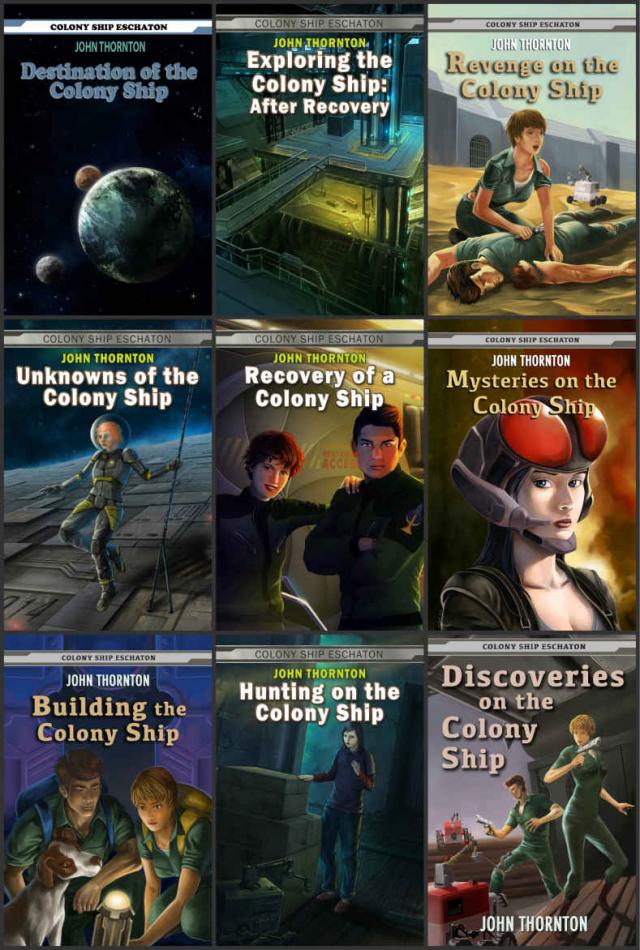
Colony Ship Eschaton
(all ten books of the series)
By
John Thornton
Recovery
of a Colony Ship
Book 1 Colony Ship Eschaton
By John Thornton
Copyright © 2013 John Thornton
All rights reserved.
ISBN-13: 978-1482720440
Newest cover art by Jon Hrubesch
Other original art by Brianna Parker
This book is dedicated to my amazingly understanding wife. Even though she is not a science fiction fan, she still listens to my crazy stories. Thank you!
This is a work of fiction.
Please check out all ten books in the completed Colony Ship Eschaton series. Also there are eight books in the completed Colony Ship Vanguard series, and four in the newest series, the Colony Ship Conestoga.
If you like this book, consider buying a copy and donating it to your local library! Support libraries!
1 Back from the dust
The dirt crumbling into the dust-filled wind was the color of Michael’s attitude. It was tan, dry and lifeless. He stomped his shoes again and columns of dust swirled away into the barren landscape. He took one more dry-eyed look at the tan nothingness, for, even under the heavy goggles, his eyes felt dried out. There was only so much tan a person’s eyes could tolerate. Michael had seen more tan than he cared to remember. The light was diluted and dirty as well. The barren, tan, ground was only slightly darker than the tan air which made up the sky. At night, the light was just sucked away into a sick brown color of unending sameness. Even the fusion truck, which he had just parked in the exterior garage, was tan. Nothing escaped being tainted by tan. Tan was the lifeless dead color that surround him.
He turned back toward the entryway, only giving the briefest glimpse upward toward the dome, which arched away into the tan sky. Wind whipped dry particles of dust and grit past him, swirling around the dome. Reaching to the sidewall, he popped open the control box, punched in his command codes and started the process to enter into the dome.
The entryway dilated. He stomped a few more times for all the good it would do, then he entered the small outer lock. A gush of air pushed past him. The pressurized decontamination system had started. He would follow it step by step. Doing so would allow him to continue his entry into the dome. The airlocks were not designed to equalize pressure, they were built to produce pressure gradients which kept things out of the dome. The outer entry closed together with a snap. The next door dilated open and he stepped forward. The illumination came on, and a storage bin slid open.
Taking the data stick out from his belt, he inserted the narrow information storage and processing device it into the slot where its information would be transferred to the appropriate people. “I know you gathered what I saw, but it was not good.” Michael stated as the data stick flashed a bit. Not as powerful or as interactive as an artificial intelligence, data sticks were used in many aspects of dome life. Those transferred facts would then be incorporated into his personal report. The physical data stick would not go any further than this slot in decontamination. It would never be used again.
Michael dropped his hat, pulled the goggles off, and stripped off his hooded coveralls, socks, underwear and shoes. The coveralls were soft and pliable, even though they contained radiation absorbing materials which had been standard issue for as long as he could remember. Old timers spoke of enclosed suits and isolated air supplies, but that was before the RAM fabric was developed. Taking up the goggles and the hat he looked at them and shook his head. They were coated in tan. He knew he would never see them again, they were radioactive and toxic, but regretted the waste of technology. He placed all his belonging into the storage bin. Pushing the lighted button over the bin, it snapped shut. The bin led to an incinerator where all his gear would be eliminated.
The next entryway dilated, and he again felt the rush of air come past his now naked body. The air always flowed from the interior toward the exterior. The next chamber was smaller than the last, and he stepped in and stood on the expanded metal of the floor. As soon as he stepped into that chamber, the floor recognized his presence and signaled the door to close. ‘Here it comes,’ he thought. He felt the rinse begin. He knew it was not water, that was far too precious for decontamination procedures, but he still felt wet as the mist enveloped him.
He then felt the warmth of the broad-spectrum lighting come on. At first it was pleasant enough, but like all things, that did not last very long. Soon the heat was uncomfortable; not long after that, it became painful. The pain intensified steadily. Michael stoically remained expressionless. The lights extinguished themselves just before the point of blistering skin, exploding eye balls, or scalded bones. He knew he would have diarrhea later as a result of the internal cleansing that just took place, probably blood in his urine as well. Just another typical mission. Only this time he was alone in passing through decontamination.
A new bin opened, and his neatly folded dome clothing was inside. He pulled on a shirt, underwear and pants, placed his feet into his shoes and stood still. Only then did the last dilation happen. Again he was hit with gushing air as he stepped out of the entry portal and into the dome itself. The dilation sealed itself behind him. Marked only by the “Decontamination: Restricted Access” sign, the entry portal was hardly noticeable.
Michael Jacobs was back inside Dome 17. He was home again. Just one of the 1483 people who lived in this pimple of life on the cadaver of a planet, once known as Earth.
2 Home sweet dome
Michael made his way through the sterile hallways of Dome 17 toward his own apartment. On the way he encountered an associate.
“Hello Michael. How was the journey to Dome 11?” A slender woman asked as she bounced up to him. Her short hair was reddish, and her face covered in freckles. A playful smile was on her lips. Jamie was in the same occupation as Michael. They were called adventurers by the Committee, and their numbers were down to only twenty. There were currently six adventurers out on missions to other domes. The adventurers were the only people who ever left the dome.
“Hi Jamie. Outside was beautiful. Clear blue sky, robins singing, and many dandelions chasing sweet little bunnies.”
“At least get your sarcasm accurate. You are aware that dandelions were not carnivorous, but some type of flowering plant, right?” Jamie smiled again at Michael.
“Well, Dome 11 was as dead as the others were. I did copy their records on my data stick, but it looks like they have been dead for at least a few years. The outside wall was breached, and there were indications of explosions inside the dome. Looked like a civil war again,” Michael reported in a detached manner.
They walked quietly for a while, Jamie’s muscular, lithe body smoothly in stride with Michael’s larger frame.
“So there are no other operating domes that we know about? What about the rumors of underground bunkers and whatnot?” Jamie finally asked. She wanted to know about how Michael’s going alone on the mission had been, but she hesitated to ask.
“Rumors like that are about as real as life outside the dome. In Dome 11, even the biologicals in their sealed units were dead. Some of those tech units looked nearly as good as ours, but who knows what killed them? I did not see any evidence of radiation absorption material technology.” Michael continued as they walked.
“So when their dome was breached, they basically cooked inside?”
Michael’s lips grew taunt. “Well maybe? Some might have been dead before the breach, it was unclear. I could not find out what started their whole demise. Mass suicide? The forensics on the breech were inconclusive. Who knows? The bodies were all well into being so dried out it was hard to tell. Dust inside that place was almost as bad as outside. Tan everywhere.”
“So it was not as ghastly as Done 3?” Jamie sighed out. She had been on the three person team to investigate Dome 3, and the memories, obviously, still haunted her. Only two adventurers came back from that mission.
“Nothing is as bad as Dome 3, and I only saw the videos,” he replied. No one spoke publicly too much about that Dome 3 incident, not Jamie, nor the other survivor of that mission, even though it was what every survey team dreaded when they went to a different dome. Michael knew Jamie had been forced to see Doctor Larson for ‘counseling’ to discuss the Dome 3 incident, but he knew Doctor Larson was as worthless as the dried out dead bodies he had seen in Dome 11.
They entered their apartment. As soon as the door slid shut, Jamie took Michael in a loving embrace, “I am so glad you are back!” Michael returned the hug eagerly. His mind was grateful he had her in his arms again.
3 who called this meeting
The next morning Jamie and Michael awoke and prepared for the day. The Committee had called a meeting, and all the adventurers were required to attend. Jamie climbed out of bed and bounced toward the toilet which sat in the corner of the room. A bed, a few cubby shelves on the wall, and the toilet. That was the apartment.
Michael sat and contemplated what he had seen on his solo mission. He was expected to make his report on Dome 11, and he had nothing positive to say. It had been dead for a long while. All the other domes which any of the adventurers had ever been visited were dead. Looking around his sterile room, he wondered if he, too, was already virtually dead. But then he saw Jamie and knew some life still existed. Only Jamie could look good while using a toilet. He heard the air compress as she flushed the waste on its way to reclamation. Jamie finished and smiled at Michael.
Jamie's personal artificial intelligence system, Sequoia, interrupted with an urgent proclamation: "Jamie, there is a message from the Committee, which they advise all adventurers to review. Shall I display that message?"
"Yes, thank you," Jamie replied.
Moments later Michael's personal artificial intelligence system, Burke, stated, "I have the same message as Sequoia for Michael."
Michael answered, "Yes, display that. We will watch it together. Thank you."
A three dimensional display with images and videos began to play in the middle of their apartment. From whatever angle in the room, the display looked the same. It was quite detailed.
"Dome 17 Committee Only Memorandum on Colony Ship Recovery.
In light of the success of faster-than-light communications over the last 5 years, and the newest breakthrough which has allowed development of the Piloted Faster-Than-Light (PFTL) scout ships, information is now being shared about the Old World colony ship program. Research and Development still has not been able to get past the weight and mass restrictions, so PFTL missions will only be able to accommodate two human pilots.
As you are aware, information released to our dome’s general public - regarding the colony ship program - has been minimal. The surprising lack of interest in the colony ship program by the general public has been expected.
Generally speaking, the view is that the Old World’s colony ship program was a total failure. This memorandum is to inform you about the newest finding of our reassessment of the colony ship program. The public is unaware of these issues, and will remain so for the foreseeable future. The PFTL missions have the real potential to directly assess what remains of the colony ships. What the general public needs to know will be reassessed after the PFTL missions are completed. Robotic FTL probes are ready to be dispatched to those colony ships deemed best available to re-contact. PFLT scouts could be ready in the near future.
According to the Old World records, a total of seven colony ships were manufactured. Two major factors led the leaders of the Old World to think the colony ship program possible: modern permalloy and gravity manipulation. Major manufacturing was from a spun material called modern permalloy. Not to be confused with the nickel and iron alloys made about one hundred and seventy years previously, modern permalloy is still the hardest substance known to humanity. Breakthroughs of technology in the Old World showed that, because of the strength and other qualities of modern permalloy, the colony ship projects were possible. Combined with gravity manipulation technology the ships were assembled in orbit over a thirteen year period. These ships were then inhabited with various ecological zones’ flora and fauna, rescued from preserves on Earth and established in homeostasis in suitable habitats.
Each colony ship had eight separate and unique habitats populated by a thousand generational humans. These people lived in the habitats with the full knowledge that they would spend their entire lives there, Estimates of transit time from Earth to a targeted destination world were from three to eight generations. Ship operations were overseen by one thousand humans of the ship’s active crew, and various artificial intelligences. The crew positions were in dynastic successions to the subsequent generations. An additional 144,000 humans were kept in suspended animation capsules in storage bays, to be awakened upon arrival at target world.
Ships listed by launch date:
Vanguard CS 1:
Latest assessment: 23% into voyage, when an incident occurred. Last known message received stated a mutiny had occurred and the captain of ship had been assassinated by unknown crew members. Reporting officer was J. Baldwin, Pilot 3rd class. No further reports. Ship considered lost. Trajectory plotted and potential of robotic FTL contact, 48%.
Marathon CS 2:
Latest assessment:19% into voyage when incident occurred. No human contact, but distress signal sent from secondary Artificial Intelligence, Lenore, reports that ship has been attacked by hostile aliens. This date is the first contact with any alien race. AI also reported that counter-attack had begun, but message was garbled and when decrypted also contained contamination from other Artificial Intelligences. Ship considered lost. Trajectory plotting attempted repeatedly using all three methods of colony ship tracking. Marginal success on plotting of course, Estimated robotic FTL contact at less than 5%.
Warren CS 3:
Latest assessment: 31% into mission when incident occurred. Unnamed crew member reported some “disaster” onboard the ship. The ship’s main Artificial Intelligence, Monitor, was put into Command Mode with the only instruction to “protect human life.” One report received from the AI Monitor which stated “biological organisms killing each other. Request immediate instructions.” Trajectory plotted and estimated robotic contact at 87%.
Conestoga CS 4:
Latest assessment: Unknown time of incident. Report received from unlabeled AI as having made planet fall. This would be at least a century prior to when ship was scheduled to arrive. No human messages from Conestoga. Trajectory plotted and robotic FTL contact estimated at greater than 90%. Star charts show its location is not a known solar system, nor does there appear to be a solar system at that location. Report from the AI is suspect, but tracking shows ship has not moved from the reported location.
Eschaton CS 5:
Latest assessment: No reports of any kind from the ship. FTL communications have not received any reply. Trajectory plotted and robotic FTL contact estimated at 95%. The nature of the crew and their religious extremism may explain their failure to report. Ship and crew considered as probably hostile.
Trailblazer CS 6:
Latest assessment:14% into voyage, massive systems failures reported by Captain Josey Alberts. Cause of malfunctions thought to be encounter with micro singularity. Captain Alberts also reported loss of 62% of sleepers but stated “repairs underway.” 29% of way into voyage, automated distress signal activated. No further contact. Trajectory plotted and robotic FTL contact estimated at 71%.
Zubalamo CS 7:
Latest assessment: Still on course as scheduled. No human responses to FTL transmissions. AI Kwame reports “situation normal, all systems operational” to every request. Uncertain if AI is functioning, and uncertain if human crew awake. Trajectory plotted and robotic contact estimated at 90%.
Conclusions:
Each of the seven colony ships in the project have fallen short of design and mission parameters. Loss of at least three ships is probable. Loss of human life estimated at over 70% of all sleepers. Loss of environmental systems also a high probability. Program review concludes colony ship program a decided failure."
"That is very interesting," Jamie stated with a yawn.
"But what difference does it all make?" Michael asked.
Michael threw off the covers and dressed. He used some foam disinfectant on his face and hands. Jamie returned rubbing her hands in the disinfectant, and she also dressed. They departed the apartment and headed to the cafetorium.
The cafetorium was one of the largest rooms under the dome. Most of the dome was constructed from opaque permalloy, but from the cafetorium one could actually see through transparent permalloy to view the outside. Outside the dome, the dull tan dust blew and blew. Nothing ever changed in that tan swirling dead nothingness of outside. The nontransparent walls around the cafetorium were the same color as most everything else.


